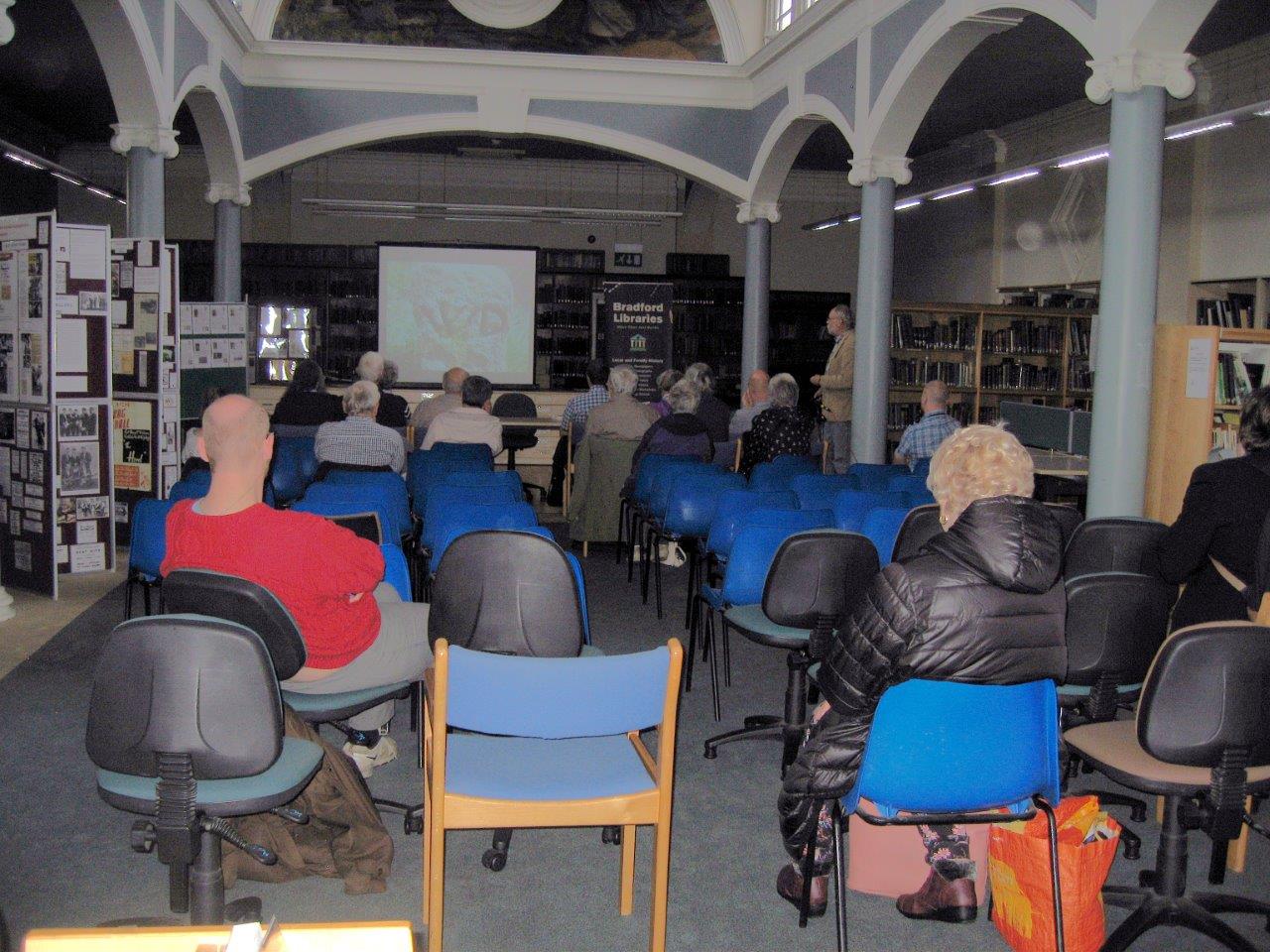
Bradford’s Forgotten author: A Blog Post on Bradford’s Willie Riley. A recent talk at Bradford Local Studies by David M. Copeland

Thanks to the tireless efforts of David, a University of Bradford graduate and Riley enthusiast, there has been a recent revival of interest in the life of Willie Riley. Copeland’s work has included:

A Master of Philosophy thesis on Riley’s life and works: From Bradford Moor to Silver Dale.

  • The establishment of a dedicated Willie Riley website.
  • An introduction to the re-issued edition of Windyridge, which is now back in print.

Bradford Local Studies holds most of his fiction catalogue which can be perused in the Library.

The University of Bradford Library Special Collections holds an extensive archive of his work, including manuscripts, correspondence, and photographs, which are available for researchers and fans alike.

Willie Riley’s story reminds us that literary fame can be fleeting, but the power of a good story well told endures. His work offers a charming window into a bygone era of Yorkshire life, and its high time he was rediscovered.

Born in Bradford in 1866, Willie Riley was a fascinating figure who went from a successful businessman in the textile and optical lantern slide industries to a best-selling author of over 30 novels. Though a household name in his time, particularly across Yorkshire, his work is now largely forgotten, making a revival of interest in this unique regional voice even more important, especially as it coincides with a renewed interest in the Yorkshire Dialect, with ‘Let’s Talk Tyke’ workshops and the appointment as President of The Yorkshire Dialect Society, Yorkshire-born British Library linguist and dialectologist Jonnie Robinson.

From Boardroom to Bookstore


Riley’s journey to becoming an author was unconventional. He started working for his father Joseph, in his ‘stuff business’, straight after leaving school in 1882.
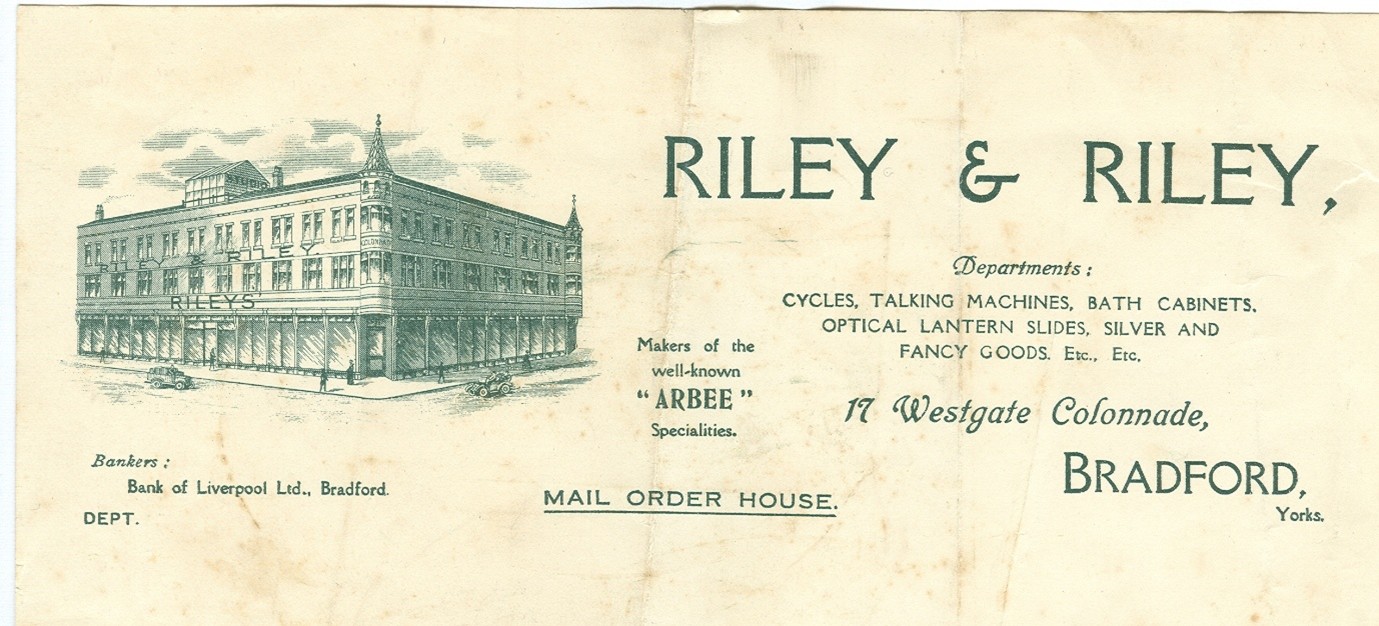
Credit: University of Bradford, The W. Riley Archive., Special Collections. RIL10/2.	Headed notepaper for Riley & Riley. 17 Westgate Colonnade, Bradford.
Credit: University of Bradford, The W. Riley Archive., Special Collections. RIL10/2. Headed notepaper for Riley & Riley. 17 Westgate Colonnade, Bradford.

In 1884, Joseph created The Optical Lantern Business and Willie transferred to this part of the family business, which was a firm that sold and hired magic lantern equipment internationally. In 1889, Willie was made a partner in the company. The business thrived until World War I, when it collapsed.

(The National Science and Media Museum in Bradford has a collection of the Riley Magic Lantern Slides.)

However, even though he worked in the family businesses, his writing career had already begun as a personal project. In early 1911, to amuse his wife and two bereaved friends, the Bolton sisters, he began writing a story in weekly chapters. This heartwarming tale, full of the detail of Yorkshire life and set in a fictionalised version of the village of Hawksworth near Baildon, was eventually published as Windyridge in 1912.

Windyridge was an instant sensation, selling around half a million copies and remaining in print until his death in 1961. Its success even led to houses across the country being named after the fictional location.

Riley became a full-time writer after his business closed, producing a steady stream of novels, short stories, newspaper articles, and travel works, most of which were set in his beloved Yorkshire Dales. His work is characterised by:

  • A deep love for Yorkshire: His stories used real places under disguised names, capturing the landscape and local character.
  • Methodist faith: A dedicated local preacher for 75 years, his strong religious beliefs underlie all his writings.
  • Heartwarming storytelling: His books offered a comforting escape, full of gentle humour and moral reflection.

Despite his immense fame during his lifetime (he died in 1961 at the age of 95), Riley’s popularity waned significantly after his death, and he became almost completely forgotten.
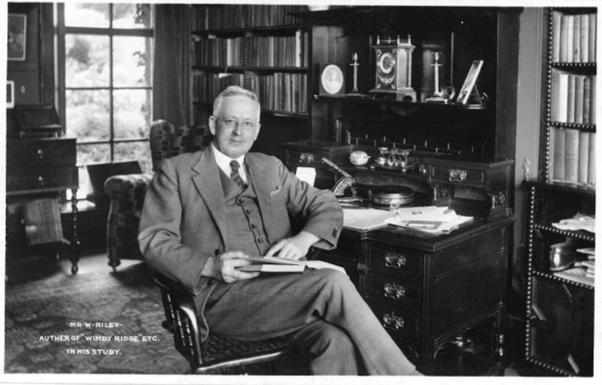
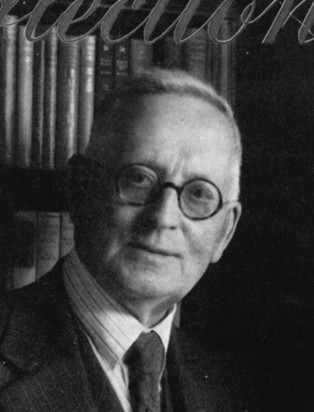
Willie Riley, in his study. Published by J.E. Lacy, Post Office, Silverdale.
Part of the Bradford Local Studies Library Postcard Collection.
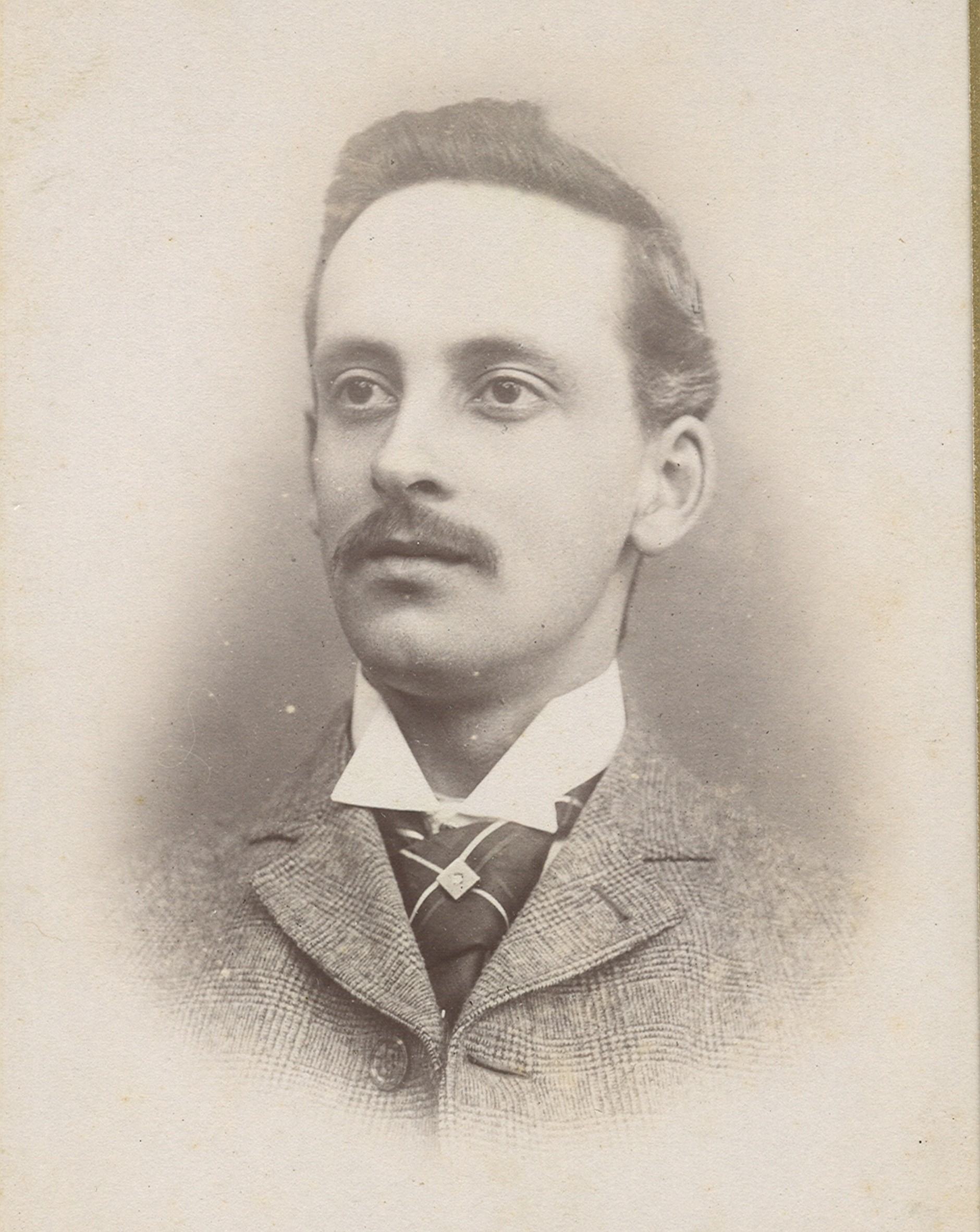
Willie Riley, in his study. Published by J.E. Lacy, Post Office, Silverdale.
Part of the Bradford Local Studies Library Postcard Collection.

Riley also contributed his Message of the Moors to the historical 1931 Bradford Pageant.
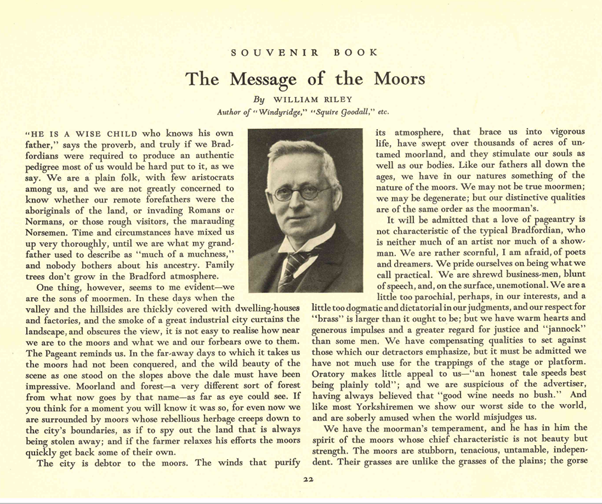
Bradford Pageant Souvenir Book 1931. Image courtesy of the owner.
Copies also available to read onsite at Bradford Local Studies.

Thank you to

Bradford Local Studies Library.

David Copeland – https://www.willieriley.org.uk/

Julie Parry- Bradford University Special Collections

Written by Vicki Warner, Bradford Local Studies and Archives

Readers can access his collection of stories at Bradford Local Studies,to read in the library.      

Please contact us on 01274-433688 or local.studies@bradford.gov.uk to book an appointment.
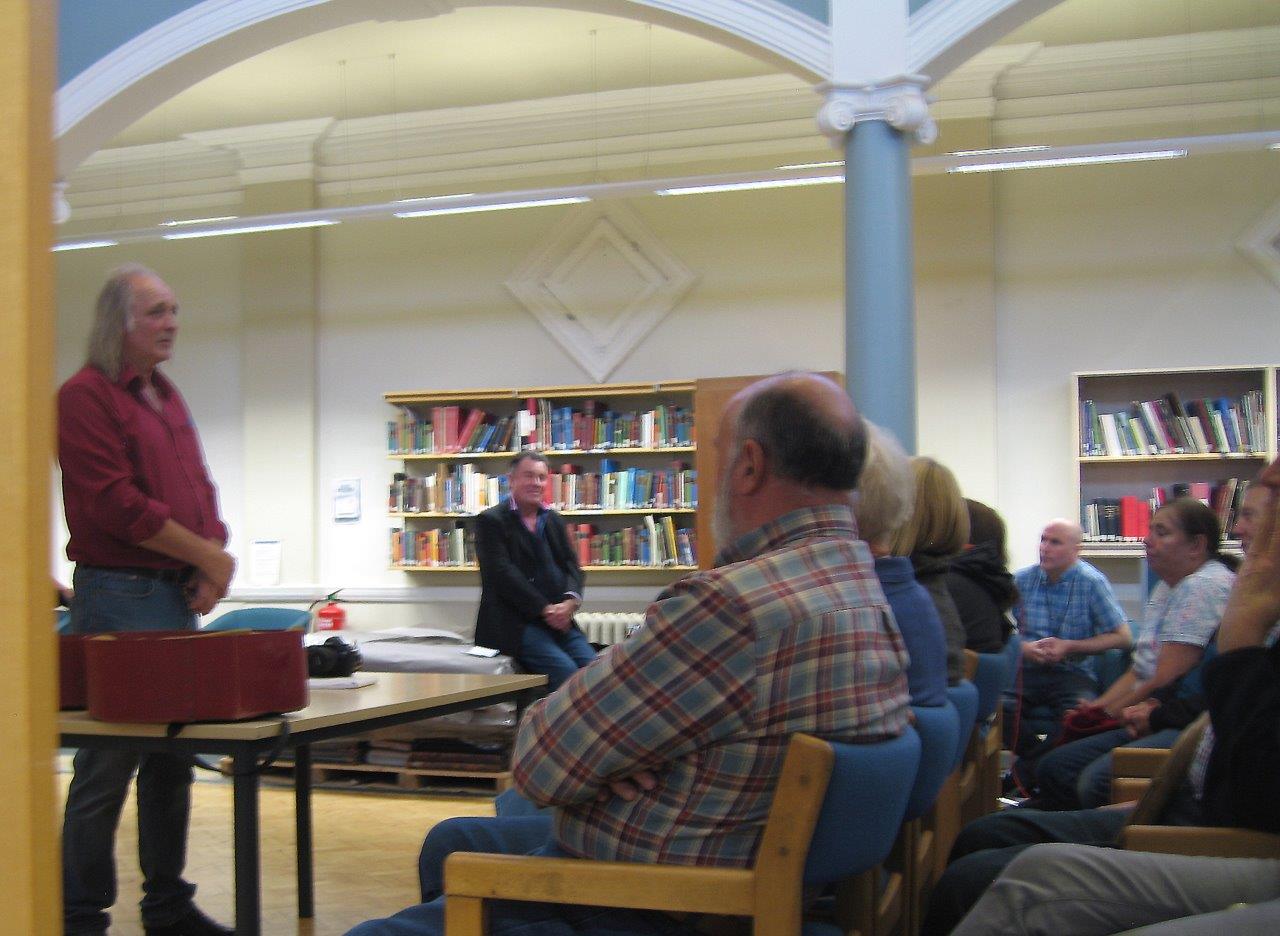
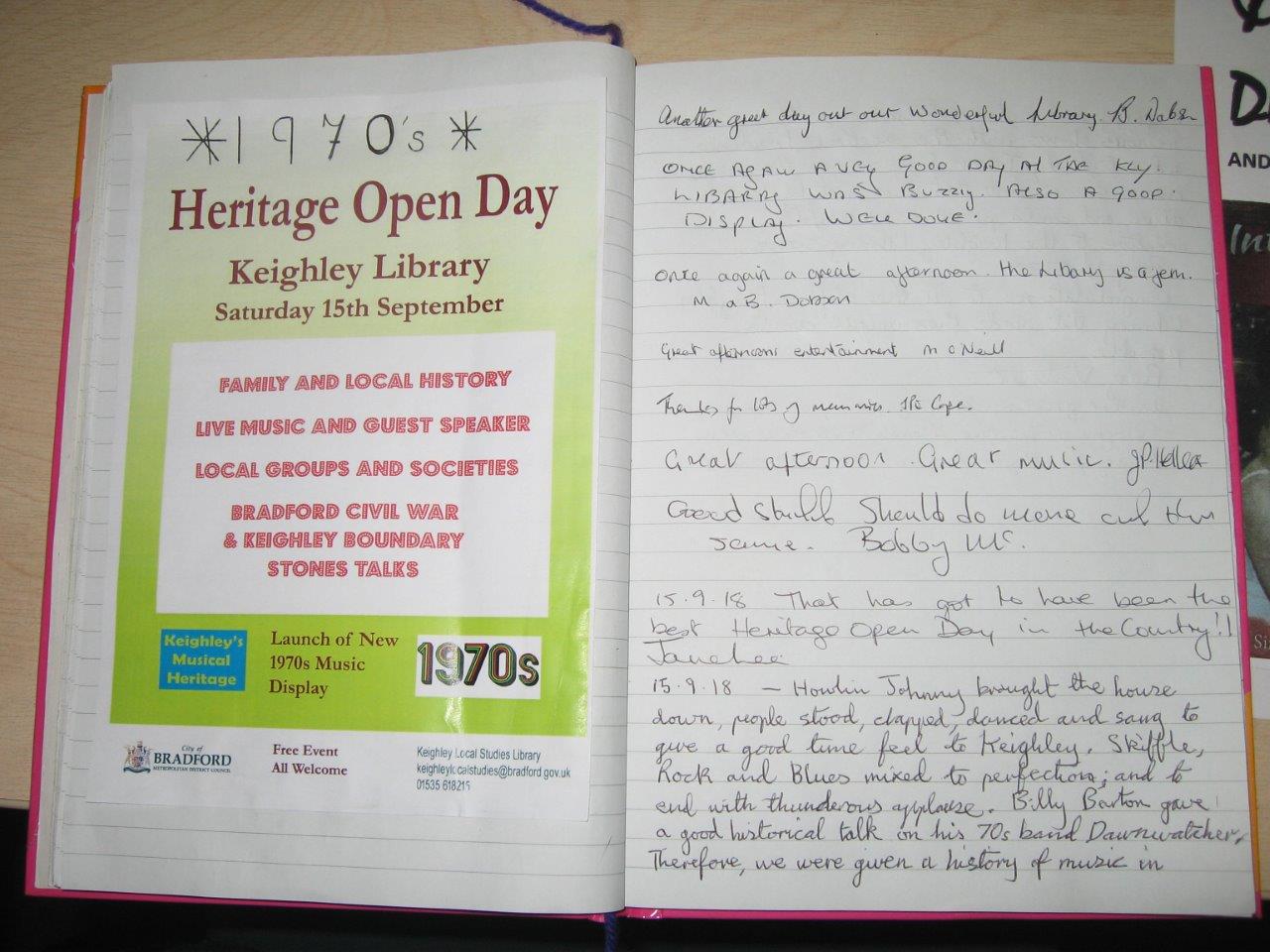
Keighley Library Heritage Open Day 2018

Keighley Library celebrated Heritage Day on Saturday 15th September 2018 with a feast of history and culture celebrating local heritage, community and history. The day was a roaring success with something for everyone in the mix.

Billy Barton from legendary Keighley band Dawnwatcher took us back to the 1970’s and the new 1970’s Musical Heritage exhibition was launched.

Billy Barton talk 4

Billy Barton

Malcolm Hanson told the story of  the Civil War  and local people’s heroic stand. It is a most uplifting story!

Malcolm's talk 3

Malcolm Hanson

Historian Robin Longbottom gave a fascinating and  informative talk about the boundary stones based on his new publication.

BS1a

Robin Longbottom

History Societies exhibiting included Keighley and District Family History Society, Keighley and District Local History Society, Men of Worth project and Keighley Model Railway Club all with a wealth of information about the local heritage.

The highlight of the day for many was live music from Keighley band ‘Howlin’ Johnny and the Devil’s Rejects’ who had the audience on their feet and the building rocking to the rafters.

A comment from the Visitors book:

Comments book

‘Howlin’ Johnny brought the house down, people stood, clapped and sang to give a good time feel to Keighley. Skiffle, Rock and Blues mixed to perfection; and to end with thunderous applause.’

The 1970’s exhibition will be up in the library until the end of October.

There are still  opportunities to hear Malcolm Hanson’s Civil War talk in libraries on the following dates:

Saturday September 22nd, 2.00pm, Denholme Library
Saturday September 29th, 2.00pm, Eccleshill Library
Saturday October 6th, 2.00pm, Bingley Library
Saturday October 13th, 2.00pm, Shipley Library
Saturday October 20th, 2.00pm, Bradford Local Studies Library
Saturday 27th October, 2.00pm, Ilkley Library
Saturday 3rd November, 2.00pm Wyke Library

October 1642. ‘When the battle began, the Royalist Commanders laughed at Bradford’s rabble army, but help for Bradford was at hand.’ Join Local historian Malcolm Hanson as he  brings to life this story of great heroism. These are free events. No booking required.

Small Town, Saturday Afternoon

This slideshow requires JavaScript.

On Saturday 14th July, Trevor Simpson by-passed the defenders: Wimbledon, the World Cup and a hot, blue sky day in Yorkshire to strike gold for Keighley Library in a talk about – you’ve guessed it – local music heritage. He was as hot as Billy Fury and music events’ mogul, Janet Mawson, was as relieved as Gareth Southgate when an audience of upward of 70 people turned out.  In fact the Library was very lucky to get Trevor because, as a former referee, if his talk had been scheduled for the afternoon of the previous week, when the dream was very much alive and England was taking on Sweden, he would probably have shown us the red card.

Trevor Simpson has two passions in life: football and music, or is that music and football? As a referee, he officiated for the football league at the highest level for every club except West Ham United. He even put Gaza in his place during a Tottenham versus Manchester United match at White Hart Lane. He was also a linesman at a World Cup qualifier but enough said on that score.  Musically, Trevor started out as a mobile disc jockey and moved on to hospital radio in December, 1981 and is still a DJ after some 37 years. He reckons it is well worth breaking a leg to get in to hospital to listen to his show. One of his more amusing requests was for Johnny Cash’s Ring of Fire from a chap who was recovering from a haemorrhoid operation. However, it was in the days after the war when music began to change again and youth culture began to grow, along with Saturday night culture, that Trevor, with a real feel for social history and a recognition that those days marked unique and exciting change, began to collate and collect memorabilia and information about the local music scene that he so loved.  He used this information and first-hand experience to write and illustrate two original, bestselling books. Both called Small Town Saturday Night, the first volume is a musical journey through the 1960s, chronicling the development of the popular music culture in the next town from Keighley, Halifax. The second volume continues with the story of the dance halls, groups, the Champion Jack Dupree and the two local music festivals, looking at the period 1954-1970.

These two books formed the basis of the talk and although the focus was on Halifax, it translated well to a love affair with the music scene in virtually any 1960s Northern town.  In fact, some in the audience had been to the same venues and gigs as Trevor,  including Keighley’s musical heritage volunteer, Malcolm Hanson, who remembered trips to Halifax, especially to the Princess Ballroom, with his friends, often walking there and staggering back in the early hours to Denholme. We heard about the acts such as Dusty Springfield, Cliff Richard, Marty Wilde, Rod Stewart, Shirley Bassey and the time the Jackson Five were given a sound ticking off for being tardy about their second set after a brotherly bust-up before the show. Stories of colourful entrepreneurs were of equal interest from the young, ambitious dance instructor, Pearl Paling of the Princess Ballroom; the three huge wrestlers, Shirley Crabtree (alias, “Big Daddy”) and his brothers, to the budding entrepreneur who refused to book, “the Be-attles” with “someone called Cilla Black” because in true Yorkshire fashion, they were, “How much?!!..”. Trevor also illustrated these stories and anecdotes with a film he made of all the venues he spoke of. We also heard a cassette of some of the stars that had kindly recorded “hello” to the patients for his hospital radio show, including that someone called Cilla Black. All this really made the history come to life and the whole experience was an enjoyable and memorable one to match such a major sporting day. Let’s hope for a return visit please.

The next Keighley Musical Heritage event will be held on Heritage Day, 15th September and will be a celebration of the 1970s hosted by volunteer, Malcolm Hanson, who is still gathering memorabilia from bands and fans. Malcolm can be contacted for this at the following:

Email: Malcolm.b.hanson@gmail.com or call Malcolm on 01756 798730

Sadly, the two great books by Trevor Simpson packed full of information, photographs and memorabilia are now out of print but we do hold reference copies in Keighley’s Local Studies Library.

Small Town Saturday Night by Trevor Simpson (Milltown Memories Publications, Hebden Bridge, 2007), ISBN 978-0-9548960-2-7

Small Town Saturday Night (Volume Two) by Trevor Simpson (Milltown Memories Publications, Hebden Bridge, 2008), ISBN 978-0-9548960-3-4

Keighley’s Musical Heritage at its finest!

A sunshine summer day in the city could not be better celebrated than with upbeat rock ‘n’ roll bands,  superb singers, and a locally famous comedic host – Keighley Library had it all. The atmosphere was buzzing with a capacity crowd of over 200 pop fans, over 800 visitors to the library on the day (Saturday 9th June) and £213 raised for the charity St Martin’s House by the brave staff manning the very busy refreshment area.

The afternoon kicked off with an introduction to the 1950s like no other by local historian and former Reference Librarian of Keighley Library, Mr Ian Dewhirst MBE. He spoke of how rock ‘n’ roll music seemed to have passed him by in a flurry of 2 years of National Service and helping in his dad’s shop. He said, “The only song I liked was Peggy Sue by Buddy Holly, but he died and that was that!” After hearing the Doveston Brothers, however, Ian acknowledged that he must have absorbed more of this burgeoning pop culture because he did indeed recognise many of the songs. Ian’s continued funny and informative account of the fifties and sixties did not lack spice as he spoke of having to help in a newsagent’s with a top shelf collection. He mentioned no names but said that he was surprised at the identity of some of the local customers.  Not surprisingly, all this racey activity led to a request for information about sex from Ian, the teenager, when he and his dad were riding tandem through the countryside. His dad didn’t fall off the bike but apparently went very quiet and after a couple more miles said simply, “Both the man and the woman have to agree, Son,” which brought the house down.

The Doveston Brothers was just one of two of Keighley’s finest bands of this era. They had formerly played twice at the London Palladium and though they had not played for 45 years, their winning professionalism shone through with a brilliant set of 60s covers. Brian Eldee’s voice is still superb and the audience was treated to Everly Brothers’ favourites as well as more rock ‘n’ roll songs. As a special treat for Janet Mawson, who organised this event, Brian sang John Denver’s, Leaving on a Jet Plane. Later, it was hard to get her feet back on the ground to chat to people about her revamped exhibition on the 1960s but she had to manage it.  With even more unique photographs, music reports and personal anecdotes from local band members, Janet was in great demand all day to answer questions and introduce people.

The Doveston Brothers were beyond popular and set the bar super high for the next band, fast becoming seasoned Keighley library stars – The Presidents, but as we know from last year’s event, they could not possibly disappoint. Their playing was fab with the expected nifty guitar work and Bruce’s acclaimed harmonica.  Linda Russell’s voice soared into pop and ballad perfection to match Brian Eldee’s earlier performance. Both the bands added interest and humour between songs with conversation and funny anecdotes to further enrich the value of this fantastic first class, free entertainment.

Local children were not missed out in this poptastic extravaganza and Saturday Rhymetime became Jamba Samba with little ones, ears fully protected, enjoying Samba drumming with an expert in the art. “Happy” does not describe the expression on some of the children’s faces as they got to make an exceptional musical noise in one of the quieter places in the centre of Keighley. Complements about the event are still coming in.

It’s an underestimation to say that everyone had a great time on Saturday 9th June, many people have filled in the Visitors’ books to the effect that it was another event that brought back many happy memories and was a wonderful musical and social occasion for the local community, especially for many in the audience whose youthful years were represented in the music and the exhibition.  I am sure Ian Dewhirst would agree, that this is local social history at its finest because it is momentarily giving real life to the books, photographs and archives in our keeping. As we have already found out, this in turn enhances their usage and local interest in the subject. It’s certainly something that Keighley Local Studies is very proud to deliver on.

Now, that’s not all folks because the  locally acclaimed and revamped 60’s exhibition will run until September when a brand new display will be launched, assembled by hard working volunteer, Malcolm Hanson with Music of the 70s. A local historian, writer and former local band member of this decade himself, he has inside knowledge of the local music scene but is still collecting memorabilia from bands and fans.  Malcolm can be contacted for this at the following:

Email: Malcolm.b.hanson@gmail.com or call Malcolm on 01756 798730

This exhibition will be accompanied with more live music, this time from the 1970s to celebrate Heritage Day on Saturday 15th September 2018.

The next Keighley Musical Heritage event in Keighley Local Studies Library is: “Small Town Saturday Night”, A talk by Trevor Simpson on Saturday 14th July 2.00 pm. Trevor Simpson is the author of two books telling the story of a love affair with the local music scene in a northern town.  It is a story of rock ‘n’ roll at its peak in the 1950s and 1960s told with humour and shared memories. The talk will be accompanied with photographs and memorabilia from those decades. Don’t miss it!

Gina Birdsall, Keighley Local Studies

This slideshow requires JavaScript.