Neglected Bradford Industries: Iron-smelting

Bradford is famous for spinning and weaving but textile production was only one of a group of important industries which ‘Worstedopolis’ supported. Since several  are now almost forgotten by contemporary citizens I should like to draw attention to those which seem unreasonably neglected, in a series of short articles.

The production of copperas (iron sulphate) and glass in the Bradford area have been completely forgotten. Brick-making has escaped serious study until quite recently. It is the extent, rather than the existence, of quarrying, coal-mining and iron-smelting that has tended to pass out of memory. I shall try to provide a brief introduction to these industries and to some smaller concerns: pottery, fireclay production, lime burning and vitriol manufacture. My survey cannot be exhaustive since I know very little about soap boiling, clay pipe production, nail making or leather tanning. I hope any reader with knowledge of these activities will feel free to contribute. Although my main interest is in the history of technology I am not unaware that the successes I shall describe came at considerable human cost. In the period selected the rural poor were driven by a need for work into factories and crowded, unsanitary, housing. Some employers, like Titus Salt, were humane men but others were exploitative. Foundries, mines and vitriol works were dangerous places where often little thought was given to worker safety. Those who paid the price of progress seldom reaped its benefits.

Bradford had many advantages as an industrial centre. Building stone was relatively easy to acquire, and since the late eighteenth century there had been a vigorous brick industry. Cheap local coal was available, and could be coked to supply blast furnaces which made pig iron from locally dug ironstone. There had long been water-powered corn and textile mills but it was the introduction of steam engine power that really transformed any process that was capable of mechanisation. Cloth production was a principle beneficiary of this technology which in turn promoted the development of textile engineering in Bradford and Keighley. The town was originally a communications backwater. It was hard to move raw materials, or manufactured products, cheaply and speedily. Horse transport had been used for centuries and a network of pack-horse routes had developed throughout West Yorkshire. The construction of turnpike roads in the years 1734-1825 produced a substantial improvement in the situation. With the opening of sections of the Leeds to Liverpool canal in the 1770s, with its spur into Bradford, transport of bulk goods, especially coal and limestone, became far cheaper. Railway links were established by the 1850s.
Iron1

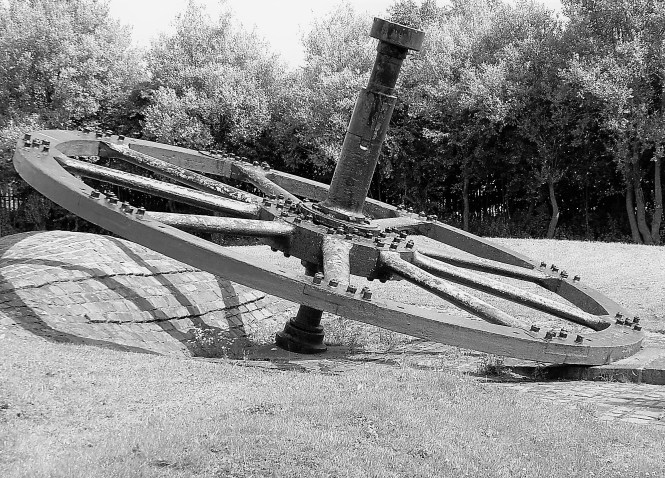
A 30.5 ton Rolling Mill flywheel presented by Alan Elsworth and preserved for display near the site of Low Moor Ironworks.

A century ago no community would be without its blacksmith but Bradford could boast a complete package of iron based technologies: ironstone mining, iron-smelting, and foundries. Historical sources, and deposits of slag, suggest that a medieval, bloomery furnace based, iron-smelting had occurred at Eldwick, Harden, Baildon, and Eccleshill, with charcoal being the fuel employed. Until their dissolution around 1539 northern Cistercian abbeys were heavily involved in iron-making but there is some documentary evidence of late Tudor smelting at Esholt and Hirst Wood, Shipley.  The origin of modern industry was the discovery in 1709, by Quaker ironmaster Abraham Darby of Coalbrookdale, that iron could be successfully smelted using coked coal. This advance took about 50 years to be widely accepted. Darby’s grandson was the creator of the famous iron bridge.
Iron2

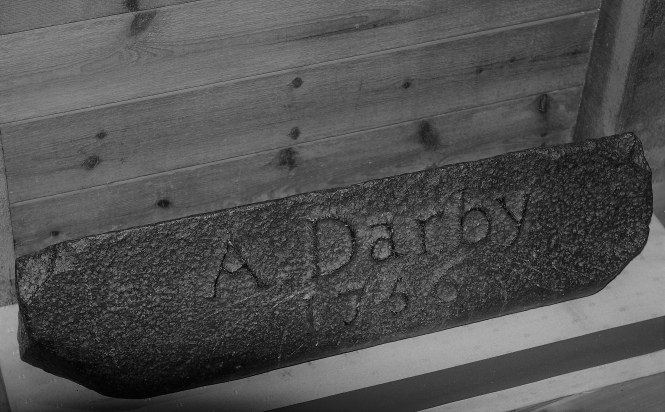
An iron pig produced by Abraham Darby in 1756, on display at Coalbrookdale Museum.

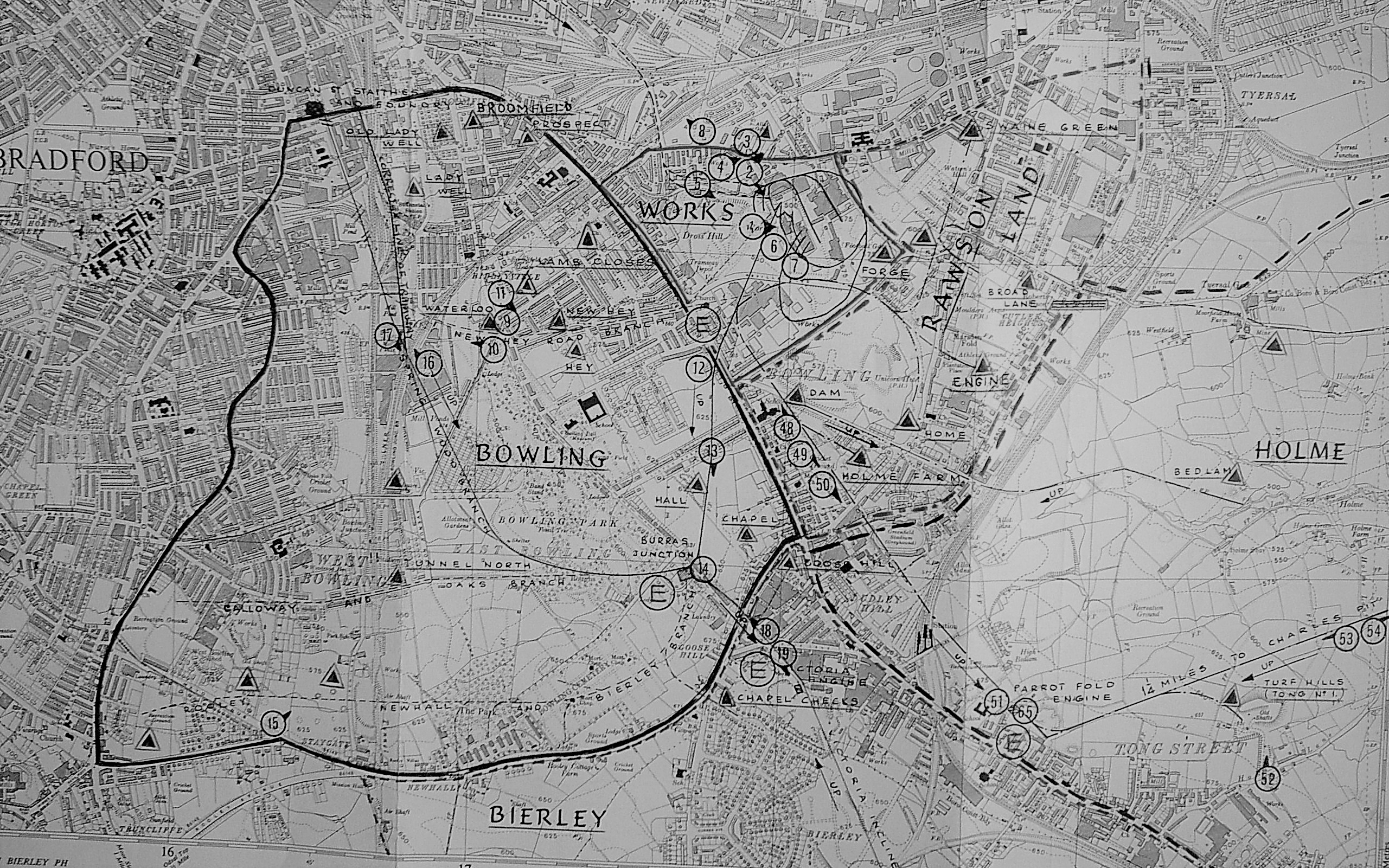
Bradford did not have the capacity to produce vast quantities of charcoal for blast furnace fuel but Darby’s discovery resulted in south Bradford’s Black Bed coal seam being mined for its rich roof deposits of ironstone. It was discovered that the deeper Better Bed coal seam was low in sulphur and phosphorus and so produced coke highly suitable for iron-smelting. The  industry was capital intensive but blast furnaces were set up at Birkenshaw (1782), Bowling (1788), Low Moor (1791) and Bierley (1810). Their products were cast iron and the ‘best wrought iron’, produced by Cort’s ‘puddling’ process. Cannon and shot were manufactured during the Napoleonic Wars. At a later date the companies did not adopt the Bessemer process to convert cast iron into steel for which Sheffield became celebrated. The furnaces are long gone but the ‘dross’ waste and some of the iron products remains. I vividly remember encountering some Low Moor cannon at Alnwick Castle. As local deposits were exhausted mineral carrying tramways transported vast amounts of coal and ironstone for miles towards the furnaces. In the 1960s a scholar called Derek Pickles studied the mineral ways supplying Bowling Iron Works. His detailed and fascinating work is curated by Bradford Industrial Museum but I know virtually nothing about him. Can anybody help me?
Iron3

A plan from Derek Pickles’s study showing mineral ways around Bowling Iron Works (top centre). The triangles mark collieries.


If you want to undertake further background reading the Local Studies Library has copies of three useful texts:

  • RCN Thornes, West Yorkshire: A Noble Scene of Industry, WYCC (1981)
  • Gary Firth, Bradford in the Industrial Revolution, Ryburn Publishing (1990)
  • C Richardson, A Geography of Bradford, University of Bradford (1976)

Derek Barker, Local Studies Library Volunteer

Book Reviews – The Low Moor Explosion

The Low Moor Explosion, August 21st 1916. A Mystery Explained? By Ronald Blackwell. Augmented Reprint. Published by the Low Moor Local History Group, 2016. 144 pages. A4 format. Illustrated.

Yellow Poppies. The Dead and those who received honours as a result of the 1916 Low Moor Munitions Explosion. By Barbara Reardon and Mary Twentyman. Low Moor Local History Group, 2016. 110 pages. A4 format. Illustrated.

On August 21st 1916, a series of explosions took place at the Low Moor Munitions Works which resulted in the deaths of forty people, six of whom were corporation firemen. It was wartime, and picric acid was produced at the works. The acid was reduced to a powder and bagged ready for transportation to shell-filling works elsewhere. The cause of the initial fire appeared to be either that a drum containing the powdered acid was not adequately insulated on its exterior surface and inappropriate handling of the drum by a worker caused picrate deposits to combine with the metal leading to combustion; or, that the drums, which were being transferred to a packing shed, were not covered on top as safety requirements stated and a spark or descending hot clinker from an adjoining part of the works could have come in contact with the open drum and caused ignition. The fire thus started in the drum entered the building where the stored picric then caught fire, leading to explosions all over the site. Hot flying debris landed on adjacent corporation gas holders, leading to their wholesale destruction and that of adjoining buildings. The accident investigators commented that the works were holding far more picric acid than its licence permitted. The company, though, was under pressure to produce as much as possible for the war effort.

In 1987, Ronald Blackwell wrote a detailed and comprehensive account of the accident, but his book has long been out-of-print and hard to obtain. Since its publication more details have been uncovered with much research carried out on the people who were killed or who were involved. As a consequence the Low Moor Local History Group decided to commemorate the centenary of the explosion by re-printing the book and to add these further details. The book has now been reprinted in its entirety with the addition of Blackwell’s article in the Bradford Antiquary of 1987, which gave a simplified account of the disaster and a revised list of the dead. Also added is are two new names, other new information, and the transcription of the citation recommending a bravery award that had been submitted later. Ronald Blackwell supported this augmented re-publication.

Since the 1980s new sources have become available, most notably census data and the ability to search some newspapers digitally, so it was decided to research details of the people who were killed in the explosion and those who received national awards for their bravery. Their stories are told in a separate publication, Yellow Poppies. The title relates to the fact that the people working in the area were often referred to as ‘canaries’ due to the fact that their skin often acquired a yellow tinge from the sulphur content of the acid, and also, of course, the poppy being a symbol for the war – the reason why explosives were being manufactured at Low Moor in the first place. Typically, each of the forty victims has a double-page spread giving details of their part in the disaster, their background, and information about their surviving families, with photographs. Similar treatment is given to a number of the firemen, managers and telephonists who were involved in the disaster but survived.  Finally there is information about the national and local awards for bravery that were awarded. The book is profusely illustrated.

Both authors are experienced in family history research and this marvellous publication demonstrates how much information can be discovered using modern research methods, despite the difficulties caused by wartime news restrictions. More importantly, it brings back life these brave and innocent people, of which Low Moor can be proud.

Bob Duckett


The publications can be borrowed from the library service or purchased from the publishers c/o 13 St Abbs Fold, Odsal, Bradford, BD6 1EL. Email: info@lmlhg.org.uk.


TREASURE OF THE WEEK. No. 2 – A RAMBLE ON RUMBOLD’S MOOR

In the basement of Bradford’s Local Studies Library are collections of nineteenth century pamphlets (and some of earlier date). Ranging from sermons and programmes of royal visits, to reports, articles, obituaries and regulations, they are a treasure-trove of local history. What follows is an account of one of these treasures. To consult any of these items please ask the staff. Card catalogues of these collections are located in the Local Studies Library.

JND 245/4 + 5 (Please quote this number if requesting these booklets)

C.F. and W.F. A Ramble on Rumbald’s Moor among the dwellings, cairns & circles of the Ancient Britons in the spring of 1868. Part II Counterhill & Castleberg.
20 pages. (Wakefield: W.T.Lamb, Printer and Publisher.)

C.F. and W.F. A Ramble on Rumbald’s Moor among the rocks, idols & altars of the Ancient Druids in the spring of 1869. Part III. 26 pages. (Wakefield: H.Kelly, Printer and Publisher.)

What delightful titles have these two pamphlets! Sadly the first of these three ‘parts’ is missing, though since only one hundred copies were printed this is no surprise. This, their age, and the fragile nature of the paper they were printed on, must make any remaining copies pretty scarce.

Our first pamphlet opens: “Who, after rambling among British dwellings, cairns and circles on that part of Rumbold’s Moor which extends from Burley Wood Head to Ilkley, could hear reports of Roman Camps on Counterhill and Castleberg, and not wish to visit them?” As indicated by the titles, these slim volumes give an account of early relics of past peoples, though an account of Addingham fills much of the first volume. A newspaper cutting inserted into the second volume here makes the point that the authors “drew attention to the sculptured rocks … recently discovered on Ilkley Moor.”

And who were C.F. and W.F.? A newspaper cutting inserted into the second volume here gives the authors as Charles Forest and William Grainge.

tres-2-ramble-on-rumbalds-charles-forest

Charles Forest

Some of the early historians, or ‘antiquarians’ as they were often called, have a bad reputation for making unsubstantiated assertions and promoting theories in the face of contradicting evidence, but not C.F. and W.F., according to the newspaper account, an obituary of Forest. It makes the point that he was careful in his research, and the text of these pamphlets bears this out, for the authors were often critical of other antiquarians.

There are a number of line drawings. These pamphlets are an early account of these remarkable relics on the moors. Though do take care if using them, else these scarce ‘relics’ will crumble to dust, unlike the relics they describe!

Stackmole