Lord Asa Briggs of Lewes , born and schooled in Keighley: 07 May 1921 – 15 March 2016

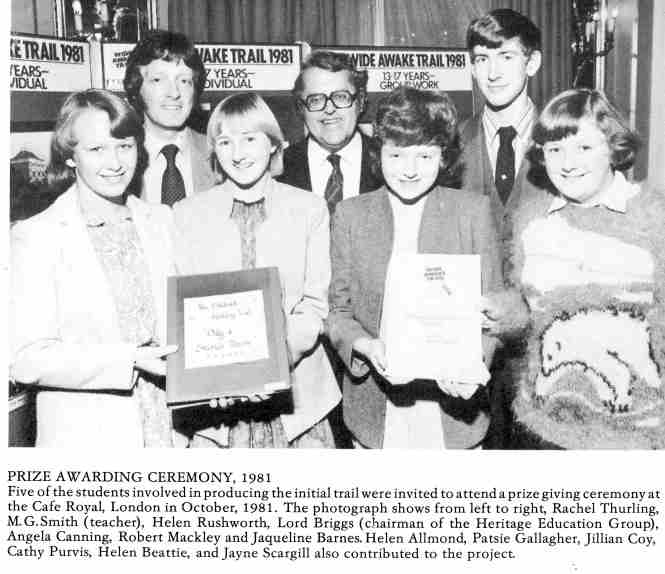
Lord Briggs Prize Award Ceremony 19811mb

Image taken from the book ‘Oakbank History Trail’ © Maurice G. Smith

Keighley Boys’ Grammar School produced not one, but two, great historians in the early part of the twentieth century. Both were to have an impact on the study and philosophy of history and were to become amongst the most prominent historians of their day, their names were Asa Briggs and Herbert Butterfield (1900-1979). This blog concentrates on Lord Asa Briggs who sadly died last year and in whose honour the Historical Association have kindly donated a collection of books to Keighley Library, where the young Asa Briggs loved to study.

Keighley Library view c19291mb.jpg

Asa Briggs, historian and public servant, was born in Keighley 7th May 1921. He was the son of William Walter Briggs, a skilled engineer and a good pianist. His mother, Jane, was the daughter of a greengrocer, who, prior to the depression, had been part of a small farming family in Yorkshire.

Asa initially attended Eastwood council school, followed by the school, said to have had the most influence on his development and future studies, the Keighley Boys’ Grammar School, adjacent to the old Mechanics’ Institute in North Street and opposite this library.  He used this Carnegie public library, regularly. This is where he first learned to browse. Here too, amongst the newspapers in the reading room, and the large collection of books from the Philip Snowden collection that specialised in social economic and political interests,  Briggs says that he studied the politics that he would later introduce to his own version of social history, (Special Relationships, Frontline Books , 2012, p.9).

Keighley Library Reading Room

Boys studying in reading room 1mb

Briggs enjoyed his school days at Keighley, especially his English and drama lessons with Kenneth Preston, of whom he speaks as the ablest of teachers. He seems to have made the most of his time there, becoming a school prefect and a member of a variety of societies including the Literary and Debating Society, the Stamp Society and the “Thirty- Three” Society. Despite a general love of history, Briggs in fact wanted to become a writer and, during this time at school, wrote poetry and various society reports for The Keighlian, the school magazine. However, another revered mentor at the school, the headmaster Neville Hind, did not favour the further study of English and encouraged students to pursue other subjects and to also try for his old Cambridge College, Sidney Sussex. Briggs was to adhere to this advice, so following in the footsteps of Herbert Butterfield from Oxenhope. By this time Herbert Butterfield was also lecturing at Cambridge. In 1944, Butterfield was elected Professor of Modern History, later Regius Professor and Vice Chancellor of Cambridge University from 1959-1961. He was knighted in 1968. On arrival at Cambridge, Brigg attended his lectures which influenced the young historian, (Special Relationships, Frontline Books, 2012 p.5).

In 1937, with war imminent, Briggs was accepted as a scholar by Sidney Sussex College, Cambridge at the very young age of 16. In Special Relationships, the tutor, James Passant, is quoted as saying, “You’re only a baby, Briggs – but since we are sure there is going to be a war, we would like you to complete your degree before you are called up for military service,”( p.68).

Briggs went on to achieve first class honours in History Tripos Parts 1 and 2. He also graduated from the London School of Economics before his call-up to the Army. He was posted to Bletchley Park as a cryptographer under Frank Adcock. He worked mainly on signals traffic from the Mediterranean using Alan Turing’s proto-computers (Bombes). These allowed them to read enemy signals. He also helped to dupe the Germans into thinking D-Day would not be carried out in Normandy. A full account of his life at Bletchley is given in the acclaimed book Secret Days Code-breaking in Bletchley Park (Frontline Books, 2011), available for loan in Bradford Libraries.

He left Bletchley for Oxford in 1944 where he became Fellow of Worcester College and his academic career began in earnest. His main areas of interest were the social and cultural history of the 19th and 20th centuries and the history of broadcasting in Britain. The following list is taken from the University of Sussex site: http://www.sussex.ac.uk

  • 1944-1955 Fellow of Worcester College, Oxford
  • 1950-1955 University Reader in Recent Social and Economic History, Oxford
  • 1953-1955 Faculty Fellow of Nuffield College, Oxford
  • 1953-1954 Member of the Institute for Advanced Studies, Princeton, New Jersey, United States
  • 1954-1967 Deputy President, President of the Workers’ Education Association
  • 1955-1961 Professor of Modern History, co-Head of the History Dept., Leeds University
  • 1961-1967 Professor of History, Dean of the School of Social Studies, Pro-Vice- Chancellor, University of Sussex
  • 1967-1976 Vice-Chancellor, University of Sussex
  • 1976-1991 Provost of Worcester College, Oxford
  • 1978-1994 Chancellor of the Open University
  • 1988 A founder, first chair of the Commonwealth of Learning

Asa Briggs was also active in a very large number of societies:

  • President of  Haworth’s  own  Brontë Society and also of the following:
  • Social History Society
  • William Morris Society
  • Victorian Society
  • Ephemera Society
  • British Association for Local History
  • Association of Research Associations

He also served on a variety of committees:

  • member of the University Grants Committee
  • governor of the British Film Institute,
  • a trustee of the Glyndebourne Arts Trust, the International Broadcasting Institute, the Heritage Education Group  and the Civic Trust
  • chairman of the Standing Conference for the Study of Local History, the European Institute of Education, the governors and trustees of the Brighton Pavilion, and the Advisory Board for Redundant Churches.

Briggs also undertook several public appointments: most notably chairing a committee on the future of nursing, which in 1972 recommended improvements in nurses’ pay and conditions and an overhaul of nurses’ training that were later accepted by the Conservative government.

To quote Tam Dalyell in the Independent, Wednesday, 16th  March 2016,

“…his output in the written word, and in broadcasts and lectures, was awesome. It is doubtful whether Briggs ever spent a truly idle moment in his life.”

In fact, following his 90th birthday, he completed 3 books including Loose Ends and Extras in 2014.

Asa Briggs always kept in touch with Keighley and regarded himself as a “Lawkholme Laner”, (Keighley News 1930s Special, 16 February 1996). He was brought up in Emily Street, just off Lawkholme Lane.

Emily St Keighley1mb

In 1962,  he became the first vice-president of the newly formed Friends of Cliffe Castle. He attended Old Keighlian reunions, and followed the developments of his old school. Keighley Boys’ Grammar School had been renamed Keighley School in 1964, when it became a County school, and it became known as Oakbank Grammar School in 1967. In 1982, Asa Briggs wrote the Foreward of the prize- winning, The Oakbank History Trail, published to commemorate the official opening of the new Oakbank school buildings. He had already attended the prize-giving ceremony in 1981 in London, as Chairman of the Heritage Education Group hosting the ceremony.

In 2015, Keighley Library was contacted regarding Lord Briggs’ time at Keighley Boys’ Grammar school and regarding the first poem that he ever had published, which was in the school magazine, the Keighlian’s December issue 1936, part of our own archive collection. The Complete Poems of Asa  Briggs, was subsequently published in 2016 and it was a real privilege for Keighley Library staff to play even a minor role in this last published work of one of Keighley’s greatest sons.

Lord Briggs died at Lewes 15th March 2016, leaving his wife, also an historian, whom he married in 1955, (then Susan Banwell), four children and 14 grandchildren, to whom this last book is dedicated.

Gina Birdsall, November 2017
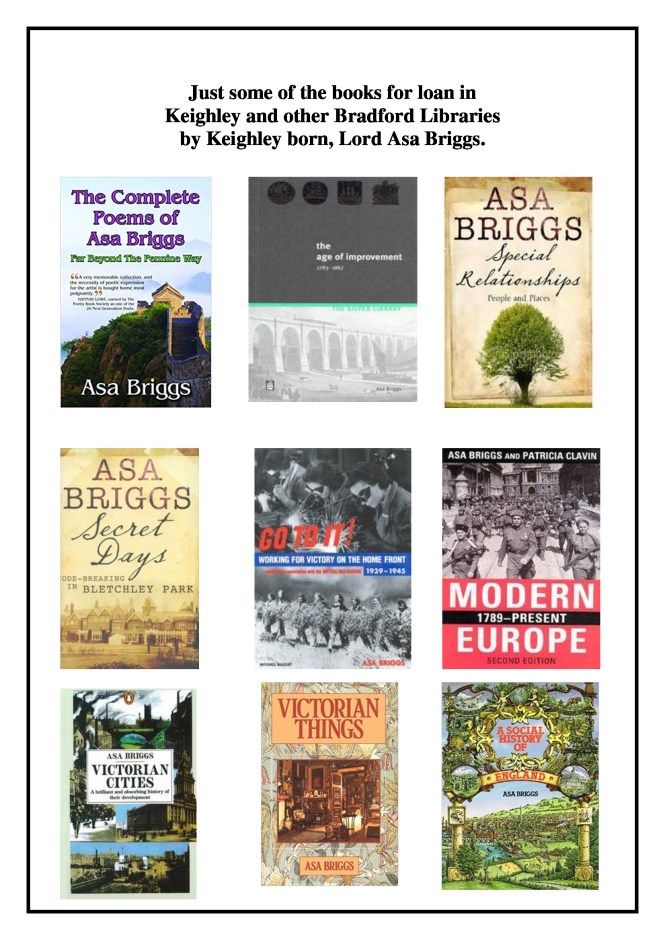
Asa-Briggs_-books-for-loan

Books about Professor Asa Briggs donated to Keighley Local Studies Library

A presentation of books about the late Professor Briggs has been made to Keighley Local Studies Library by the Historical Association.

The books were presented by Professor Tony Badger, President of the Historical Association, to Maggie Pedley, Head of Libraries, Museums and Galleries on Wednesday 29 November.

Also present at the event were Dr Trevor James, Editor of ‘The Historian’ journal and historian, Philip Johnston.

Asa Briggs was one of Keighley’s foremost citizens. He became a well-known and remarkable historian who inspired others through his research, teaching and writing.

At Keighley Library, the young Asa developed his skills to become such an influential social historian.

In his book ‘Special Relationships’ he traces his love of history back to his days in Keighley. He said of Keighley Library ‘It was there that I first studied the politics that I was to introduce into my own version of social history.’

​It is fitting that these books will be added to the archives and made available for the benefit of future researchers and historians.

There is a display of books and local information about Asa Briggs in the Local Studies library on the first floor that will remain up over the next 3 weeks.


Map of the Week: Bolton Woods

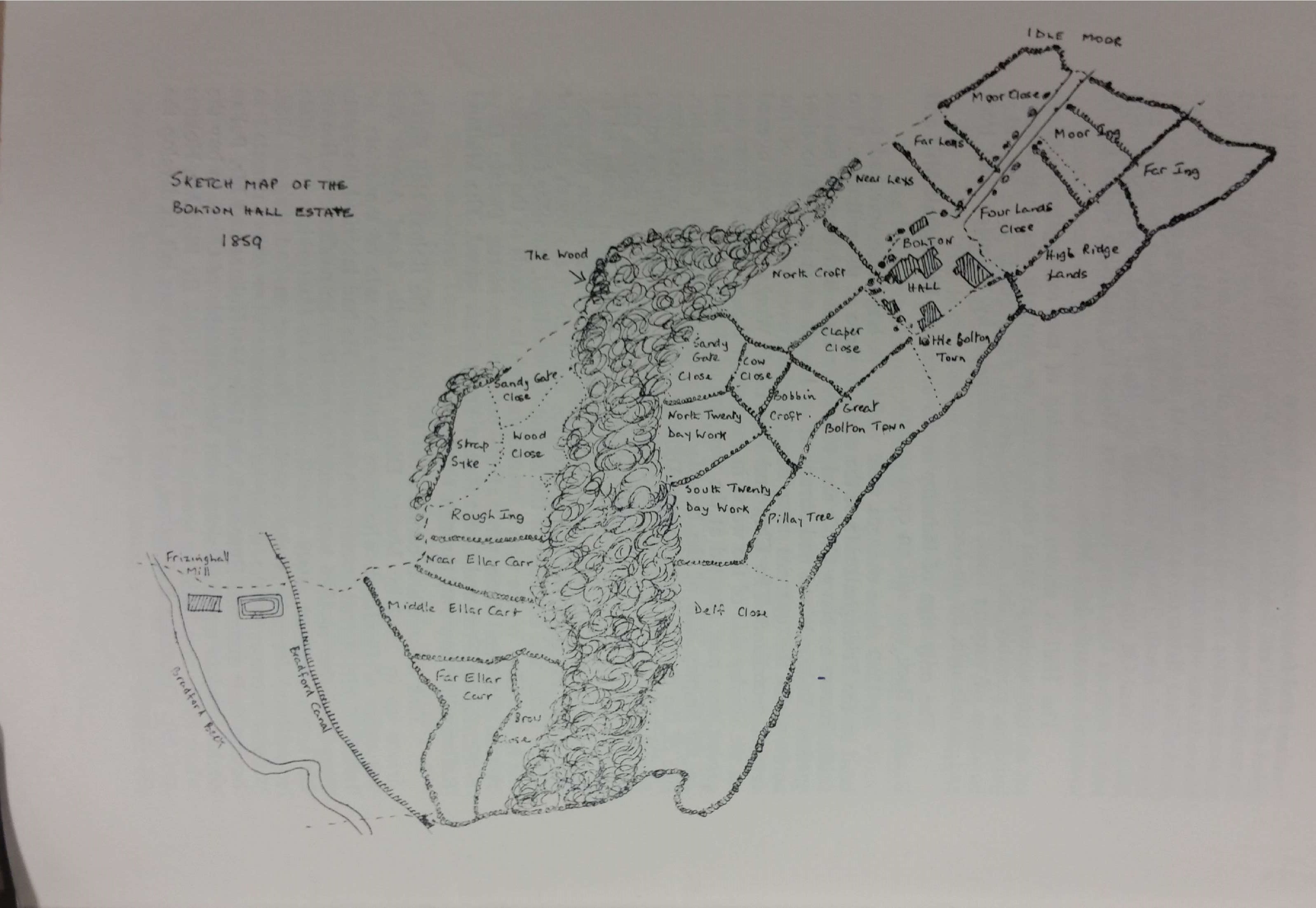
These two sections from a Bradford Local Studies Library map are part of a sale plan of the Bolton Hall Estate dating from 1882. Among other things it advertises the availability of building land and stone quarries. The right side of image 1 joins the left of image 2. The map as a whole marks a transitional stage between rural and industrialised phases in the district. Some woodland remains but quarries are in action, roads are being laid out, and houses have been built. Frizinghall mill is drawn although this and its reservoir no longer exist. The Bradford canal spur has also gone now, although the canal bridges remain. The railway line already existed in 1882 and it would appear that the extension of Canal Road to Shipley is being suggested.

Map of the Week 020 AMap of the Week 020 B

I have to admit that I am not sure of the precise boundaries of Bolton Woods. It is to your right as you travel up Canal Road from Bradford to Shipley although the very high ground is occupied by the much more ancient townships of Bolton, Idle, and Wrose. The designation ‘Bolton Woods’  appears on the 1851 OS map but is probably naming the woodland only. I think we can be certain that Bolton Woods was neither an old community, nor a planned one: it ‘just growed’. William Cudworth treats the area as part of Bolton township and two more recent authors have developed his account:

        A History of Bolton in Bradford-Dale: RC Allan (ed), 1927, p.107.

        The Story of Bolton Woods and St Laurence’s Church : Mary Lister, 1980.

Both these books are available in the Local Studies Library although the second is kept in the stacks and will have to be fetched by a member of staff. Mary Lister (1922-85) was a noted local historian who was ex-President of the Bradford Historical & Antiquarian Society, and taught at Hanson School. As a further source of information I am indebted to Tony Woods for the unpublished findings of his study into the district’s coal mining.

There is general agreement then that the history of Bolton Woods is quite recent. Before 200 years ago the district was simply noted for fields and a magnificent woodland. There were no roads, only trails through the trees. Peat could be cut there for fuel and the was some question of whether the inhabitants of Bolton had the right of turbary on land lying about Bolton Old Hall. In 1624 Bolton Manor became the property of Thomas Walker. The Old Manor House was soon demolished and Bolton Old Hall erected a short distance away. The Stanhopes of Eccleshill bought the Bolton Hall Estate from Thomas Walker in 1648. Bolton Woods was one of the many districts of Bradford where coal extraction may well have had medieval roots. In 1699 Cudworth describes various freeholders entering into an agreement to extract coal. Coal features again in a 1746 lease: near Hollins Close John Whitaker leased land for £6-10s with a condition of the lease being an undertaking to remove the coal-pit hill when it was dispensed with. By 1750 land around Bolton Grange Field was apparently much broken up by attempting to get coals through trenches or ‘Day-holes’.

An Enclosure Act operated at Bolton Woods in 1819, and in 1825 Bolton Road was constructed.  By 1840 Walter Scott-Stanhope had inherited the estate and then sold it to his cousin Richard Watson of Springwood, Manchester. Watson’s Scottish bailiff equipped the farm and, according to Cudworth, by his efforts made it one of the best in the district. At first he grew wheat but later suggested that building stone might be more profitably extracted. The first modern quarry in Bolton Woods was opened by John Holmes and Thomas Dawson in 1853. In the later nineteenth century more organised extraction of the Hard & Soft Bed coal seams was undertaken in Bolton Woods. Shafts and ‘old shafts’ are present on early OS maps but no named collieries are indicated. In the late 1850s there seem to have been two companies: Handforth & Co, and Messrs Brogden & Co. Their enterprise was  known as Bolton Wood Colliery which had been leased by Richard Watson. It was under Navy Croft, Far Ellar Carr, Mid Ellar Carr, Nr Ellar Carr, Rough Ing, and part of the Woods.

You can identify these fields on the lovely sketch map Mary Lister drew for her publication. It shows the same area as the sale plan but is 25 years earlier and has a slight different orientation. Essentially it shows the land on which the village was later developed. The field name ‘Delf Close’ suggests that stone extraction pre-dated the nineteenth century; delph being a local name for quarry.

Map of the Week 020 C

Messrs Brogden was perhaps a partnership of miners extracting coal but their enterprise was dissolved by mutual consent (Bradford Observer, 18 June 1859). The majority of the men involved could not write but the literate James Brogden had been underground steward at Bunker Hill Colliery on Barkerend Road. A well-known Bradford brick-maker, Edward Gittins, is also involved at Bolton Brick Works in 1861 although I don’t know in what capacity. E. Handforth & Co. are listed as fire-brick and sanitary tube makers two years later in a single trade directory (1863). Elsewhere Handforth is listed as a ‘colliery owner and fire-brick manufacturer’. It is probable that the company bought up Bolton Wood Colliery and added a Firebrick works. In 1865 E. Handforth & Co were advertising in the Leeds Mercury for a firebrick moulder at Frizinghall, near Shipley. They seem to have sold up in 1867. The only product I can attest is a firebrick marked [..FORTH & CO BOLTON WOOD]. The extraction of coal was not always easy. Mr Woodhead of Eccleshill Potteries operated a mine in a field facing Home Farm in Hodgson Fold. It was worked by a horse-gin but failed due to flooding. In her book Lister mentions that a Bolton ‘Clay and Firebrick Works’, existed on the Shipley side of the Woods in a piece of land known as ‘Rough Ing’. When it closed it was replaced by Bolton Woods Shed (Woolcombers) which you can see on the first plan.

The ground now covered by village part of Bolton Woods was a part of the Bolton Old Hall estate purchased from Alfred Barton by three men called Holmes, Pullen & Constable as a building speculation for £11,000. John Pullen subsequently sold off Bolton Woods in small lots. Wilkinson Shann built first row of houses in Shann St. During this period the quarries were progressively developed and attracted workers to the area. The light yellow stone was purchased by Leeds for paving slabs and was used for buildings such as Manchester Town Hall and the Bradford Eye & Ear Hospital. In 1870 the construction of the defecation works at Frizinghall created additional employment opportunities and at the same time JT Riddiough opened a saw mill. In 1871  a highly influential man, Harry Stockdale, came to Bolton Woods from Long Preston. He was a builder and brick-maker and with George Lang he constructed Bolton Hall Road. In 1874 he was elected a councillor and was influential in the building of Bolton Woods first school. In a Yorkshire Directory for 1875 one entry for Shipley reads:  ‘Harry Stockdale, Bolton Woods Brick & Tile Works’. In the same year Mr H Stockdale was prosecuted for smoke nuisance from his brick kiln. Did he buy the premises of Handforth & Co? Strangely on 17 August 1878, the Leeds Mercury recorded that he appeared in court summoned by Bradford Corporation for the sum of £63.10s: this being the unpaid cost of sanitary works at his properties at Livingstone Road. Apparently he flew into a temper in the court, but was reprimanded and ordered to pay. Something unpleasant had clearly happened to a celebrated Bolton Woods resident. He died early in 1881. In the years before 1914 brick-making took place near the present children’s playground. There were also two rather rarer forms of industrial activity: a factory making glass marbles for Codd bottles and the Guana Fertilizer Works. The last coal-mining in Bolton Woods was in 1923 when Slater Bros worked a large day-hole in the hillside to north-west of Hodgson Fold. Apparently they had access to a 3 feet thick seam of poor quality coal but their colliery was soon abandoned. In 1956 Bolton Woods farm was finally sold for housing.

Derek Barker, Local Studies Library Volunteer

TREASURE OF THE WEEK. No. 2 – A RAMBLE ON RUMBOLD’S MOOR

In the basement of Bradford’s Local Studies Library are collections of nineteenth century pamphlets (and some of earlier date). Ranging from sermons and programmes of royal visits, to reports, articles, obituaries and regulations, they are a treasure-trove of local history. What follows is an account of one of these treasures. To consult any of these items please ask the staff. Card catalogues of these collections are located in the Local Studies Library.

JND 245/4 + 5 (Please quote this number if requesting these booklets)

C.F. and W.F. A Ramble on Rumbald’s Moor among the dwellings, cairns & circles of the Ancient Britons in the spring of 1868. Part II Counterhill & Castleberg.
20 pages. (Wakefield: W.T.Lamb, Printer and Publisher.)

C.F. and W.F. A Ramble on Rumbald’s Moor among the rocks, idols & altars of the Ancient Druids in the spring of 1869. Part III. 26 pages. (Wakefield: H.Kelly, Printer and Publisher.)

What delightful titles have these two pamphlets! Sadly the first of these three ‘parts’ is missing, though since only one hundred copies were printed this is no surprise. This, their age, and the fragile nature of the paper they were printed on, must make any remaining copies pretty scarce.

Our first pamphlet opens: “Who, after rambling among British dwellings, cairns and circles on that part of Rumbold’s Moor which extends from Burley Wood Head to Ilkley, could hear reports of Roman Camps on Counterhill and Castleberg, and not wish to visit them?” As indicated by the titles, these slim volumes give an account of early relics of past peoples, though an account of Addingham fills much of the first volume. A newspaper cutting inserted into the second volume here makes the point that the authors “drew attention to the sculptured rocks … recently discovered on Ilkley Moor.”

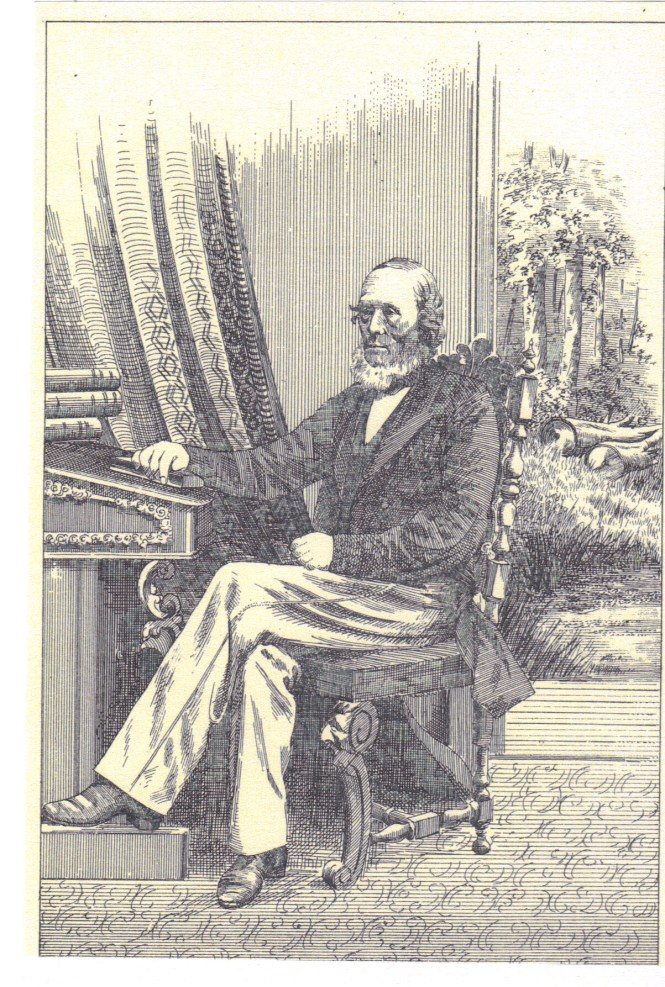
And who were C.F. and W.F.? A newspaper cutting inserted into the second volume here gives the authors as Charles Forest and William Grainge.

tres-2-ramble-on-rumbalds-charles-forest

Charles Forest

Some of the early historians, or ‘antiquarians’ as they were often called, have a bad reputation for making unsubstantiated assertions and promoting theories in the face of contradicting evidence, but not C.F. and W.F., according to the newspaper account, an obituary of Forest. It makes the point that he was careful in his research, and the text of these pamphlets bears this out, for the authors were often critical of other antiquarians.

There are a number of line drawings. These pamphlets are an early account of these remarkable relics on the moors. Though do take care if using them, else these scarce ‘relics’ will crumble to dust, unlike the relics they describe!

Stackmole

Heritage Open Day, Keighley Local Studies Library

On 10th September as part of the Heritage Open Days Festival, Keighley Local Studies Library will be host to a variety of local societies and groups and will be exhibiting some of the treasures from their archives and collections.

This is a great opportunity not only to see some of the hidden gems of the Keighley archives, but also to meet local groups, see displays and exhibitions on the history of the local area, and to get help with your family tree and research.

It is also an chance to bring along your own stories, memorabilia and pictures to help celebrate the rich and diverse history and heritage of the Keighley District.

Amongst the groups exhibiting will be Keighley and District Local and Family History Societies, The Airedale Writers Circle, Silsden Local History Society, Oxenhope historians and local authors.  

The event will feature the exhibition from Men of Worth about the men of Keighley and District in the Battle of the Somme and Keighley’s Military Hospital along with a showing of the film ‘The Battle of The Somme’.

This is a free ‘drop in’ event and will run from 10.30am until 4.00pm. All are welcome.

KeiHeritage