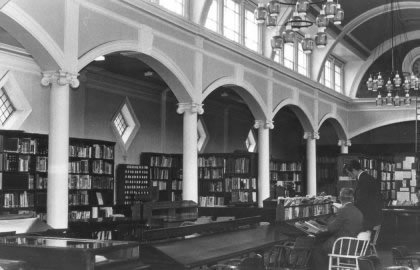
The Brontë Collection in Keighley Local Studies Library

In this, the 200th anniversary year of Charlotte Brontë’s birth (21 April 1816), Keighley Local Studies Library must celebrate its own excellent collection of Brontë literature, critical works, articles and news cuttings. It is now second only to that of the Parsonage Library itself in importance, especially since Bradford Local Studies Library has recently deposited much of its own collection with Keighley.  Staff  are presently working to catalogue, index and promote the collection to a wider audience of readers and researchers both at home and abroad and an information booklet will be published later this year about the book collection.

The history of the collection dates back to the nineteenth century and includes the archives and some book stock (Milligan collection) from the Keighley Mechanics’ Institute, of which Patrick Brontë was an active member, and where the family attended lectures and gained some art tuition (see leaflets). The library has also been privileged to receive a bequest from the library of the late Joanna Hutton, first female curator of the Brontë Parsonage Museum, and this is an important addition.

Anyone who is also interested in Haworth and Keighley at the time of the Brontës can also consult maps, photographs, plans, tithe records, trade directories, mill reports,  Parish and Non-Conformist records and local family archive collections. The library holds a wealth of published works on the history and development of the local area, many of them recently researched. Haworth and Keighley are fortunate in having some excellent local historians who have contributed greatly to the scholarly canon of local history publications, including Ann Dinsdale (Curator, Brontë Parsonage), Steve Wood (specialist Haworth historian), the late Michael Baumber, local teacher and historian and Ian Dewhirst MBE (former Reference Librarian and renowned Keighley historian).

So, as you settle down for the new Brontë costume drama now being filmed in Haworth and prepare to look at yet another screen in your life, please think of the wonderful original material that is waiting for you in Keighley Local Studies Library and the exciting discoveries that can be made through reading a well researched and illustrated book on a fascinating local subject.

Resources on Haworth

Keighley’s Bronte connection

Hindenburg Over Keighley

Hindenburg
On Friday evening, May 22nd, 1936 the German Zeppelin Hindenburg en route from the USA to Frankfurt altered her course to fly across Yorkshire reaching Keighley about 8 o’ clock.


It was the biggest airship ever built and included a dance floor amongst its lavish passenger accommodation.
As it flew over High Street, a parcel fell from the Zeppelin and was picked up by two boy scouts, Alfred Butler and Jack Gerard. The parcel contained a bunch of carnations, a small silver and jet crucifix, some postage stamps, a picture of a flying boat and a request written upon Hindenburg notepaper to deposit the flowers and cross upon the grave of ‘my dear brother Franz Schulte, Prisoner of War in Keighley near Leeds.’ The letter was signed by ‘John B Schulte, the first flying priest.

The flying priest’s brother had been a prisoner of war at Morton Banks War Hospital and upon his death had been buried in Morton Cemetery. The Movietone News came and filmed the boys laying the flowers and cross upon Franz Schulte’s grave and 300 scouts were granted free seats at Keighley Picture house to view the newsreel.

You can see the short film here
You Tube – Hindenburg

There is also a relevant newspaper article with the full story here:
Hindenburg Article

New school archive for Keighley Local Studies

Keighley Library recently received a donation amounting to over 36 boxes of photos, records and plans from the former Greenhead High School.

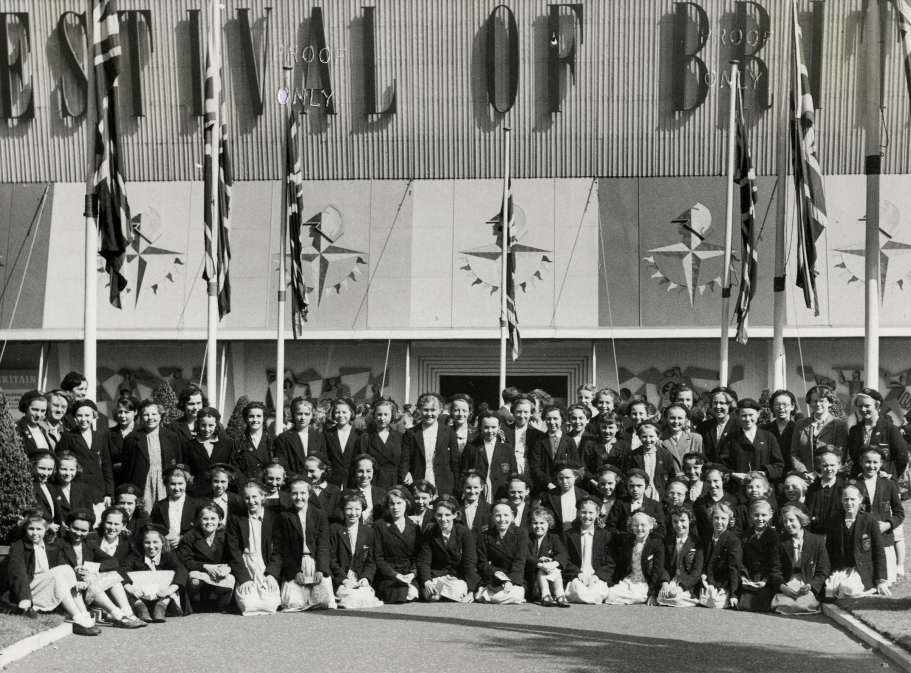
The origins of the school date back to the earliest Free Grammar School established for boys in 1713, as a result of an endowment of a house and garden with land by local man John Drake. It had 50 free scholars for English reading, Latin and Greek. However, Greenhead’s origins lay in the division of the Grammar foundation into Girls’ and Boys’ when Greenhead follows the Girls’ school branch of development. The Girls’ Grammar School, only established in 1872, stayed in the old Drake & Tonson School building in Strawberry Street but moved to Utley, Greenhead Road in 1934, hence Greenhead Grammar. The school became co-educational and a comprehensive in 1966 when the first boys arrived.

This collection is a wonderful record of the development of education through the decades, from school work displays, trips and drama productions to fashion in uniforms and hairstyles shown in the many photographs of staff and students. Today Greenhead is the University Academy, Keighley, a large multi-cultural school with many facilities unimaginable in 1872.

If anyone would like to view the collection, please quote catalogue BK 613 and give 24 hours’ notice.

This photograph shows the Festival of Britain school trip in 1951.

Greenhead Pupils

Ian Dewhirst in Keighley Library Then and Now!

Ian Dewhirst was the Reference Librarian in Keighley Library from 1967 until his retirement in 1991.  Here are images of him doing a talk in 2015 and working in the library at the start of his career in Keighley.

Ian Dewhirst 2015

Keighley Public Library has the distinction of being the first in England substantially paid for by the Scots-born American industrialist Andrew Carnegie. The Borough council was to provide the site and adopt the Free Libraries Act. An architectural competition was held and the design of McKewan and Swann of Manchester was chosen. The design of the building was described as ‘Edwardian Free Style with Art and Craft influence which presages future 20th century developments in architecture more than it reflects 19th century eclecticism.’ (Sarr 1980)

Ian Dewhirst 1967