National Poetry Day the Dewhirst Way!

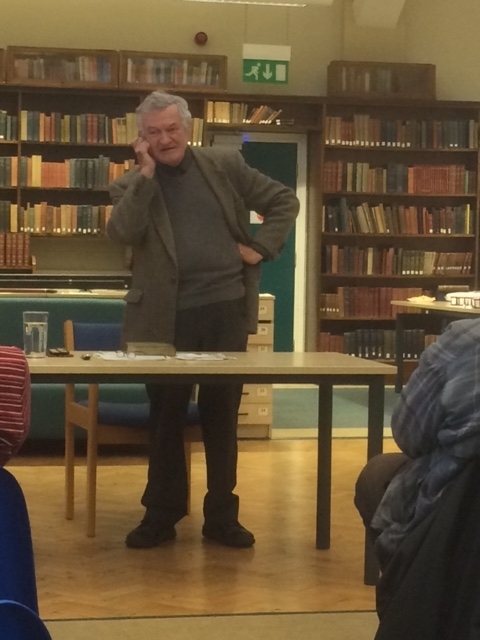
A talk by Ian Dewhirst is always something to look forward to and, given Ian’s keen interest and admiration for Keighley’s Gordon Bottomley, writer, poet, playwright, art collector, I was particularly eager to hear this one. I was not disappointed.
id2

Ian outlined Gordon Bottomley’s early life in Keighley and how local theatre trips with his gran, access to good libraries and his time at Keighley Boys’ Grammar School had all, Bottomley acknowledged, ultimately influenced his playwriting and poetry. Ian also noted the origins of Keighley Library’s unique archive collection of his original correspondence, deposited by Mrs Philip Lamb, a relative from Harrogate. You might have thought that a talk about a man so troubled by poor health would reflect some slow progress but Bottomley did travel at times and he certainly mingled in intellectually energetic company. Ian apprised us of his literary and artistic connections including Edward Thomas, renowned poet, John Masefield, Poet Laureate and Paul Nash, the famous artist. He also spoke of his influence in the Georgian Poetry Movement during the early 20th century, which included Rupert Brook and Siegfried Sassoon and significantly marks the major change in poetry from the romantic to the harsher realism of modern poetry, following the impact of WW1.

This talk could also have become one of simple name dropping of the artists and literati of the time but Ian Dewhirst MBE was never going to be so dull. The talk was well rounded, peppered with amusing anecdotes and brought to life the cultural times in which Gordon Bottomley lived, as well as Bottomley’s intelligent, witty and lively personality which so successfully managed to overshadow very serious ill health.

id

Nevertheless, a talk from Ian would not be complete without a relevant but hilarious personal story at the expense of Ian himself. This came in his very funny account of his attempts to get a clearer view of the much admired The Sheiling. From 1914, this was Bottomley’s home with his wife, Emily, in Silverdale, near Carnforth. Quite a few of the great and good visited the Bottomleys here and so there are some fine descriptions of a beautiful house and woodland surroundings, a “magic wood” even. Inspired by these descriptions, Ian had, on a few rambles, attempted to get a better view of the house over the limestone rise and one wet, windy day, romantically determined to get that view at last. Manfully he scaled the rocks, only to find himself suddenly wet nose to pane with the kitchen window. As he put it, soggy and bedraggled, he knew the washing powder of the latest occupants but still had no better idea of the building.

Everyone enjoyed the talk, from the local lady who wrote poetry herself to a member of Keighley’s Film Club who commented that it was inspiring to hear “the expert” speak on an entirely new topic, never tackled before in depth, and he looked forward, as I do, to repeats in the future. Radio Leeds, who had interviewed Ian before the talk, made plans for not one but two features on this national day of celebration.

Indeed, it was a great pleasure post talk, to once again marvel at this comparatively small town of Keighley which has made such a contribution to the nurturing of national and international cultural and artistic influences, not only Gordon Bottomley but the Brontës, Alexander Smith, pioneer of the pictorial movement in photography, and the late Lord Asa Briggs, renowned historian, to mention a few, and all this whilst standing in one of the earliest of the famous Carnegie public libraries. GRAND!

Gina Birdsall

The History of Whitakers Chocolatiers

whit2

The next in the series of talks in Keighley Local Studies library organised by the Keighley & District Family History Society will be on Monday 7th November.

The talk by John Whitaker will  feature the history of Whitakers Chocolatiers (there will be samples!)

The meeting opens at 7pm before the speaker begins at 7.30pm and will finish at 9pm. Please use the side entrance to the library on Albert Street.

All are welcome. There is a fee of £2.50 for non-members.

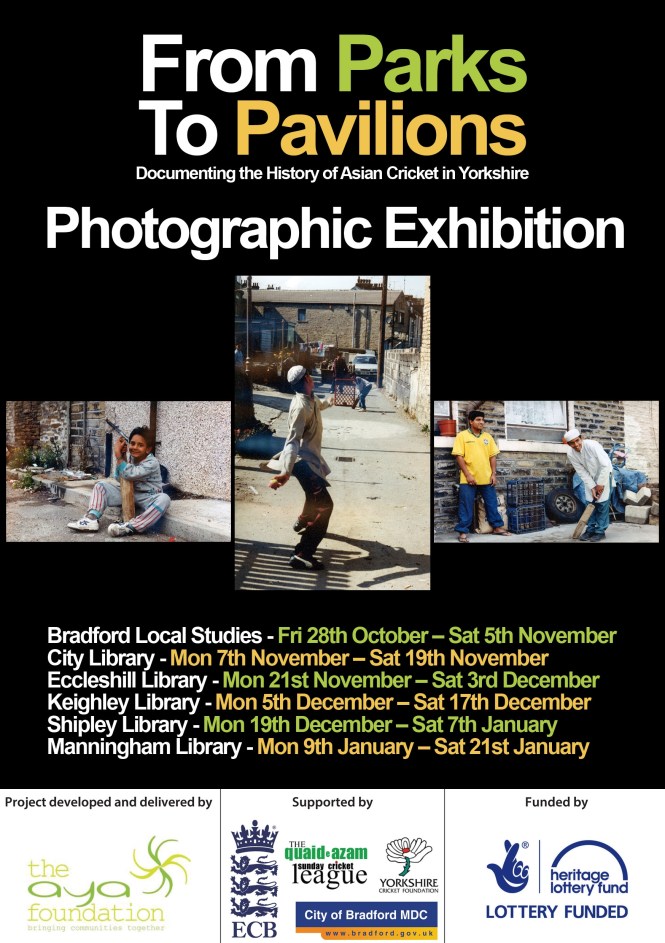
From Parks to Pavilions

A photography exhibition illustrating the grass roots beginnings of Asian cricket in Yorkshire will be touring Bradford libraries over the coming weeks.

p2p

The exhibition contains photographs, taken by cricket enthusiast Mohanlal Mistry, of back-street cricket being played in West Yorkshire in the early 1990s. The exhibition has been displayed at Headlingley Cricket Ground for the one day international between England and Pakistan and at the Oval for the 2016 Asian Cricket Awards. This will be the first time that the exhibition is open to the public and free to visit.

It is part of the From Parks to Pavilions project which is documenting the history of Asian cricket in Yorkshire. The project was developed by the AYA Foundation, a community organisation specialising in promoting minority heritage, arts and culture, with support of Bradford Local Studies Libraries, the Yorkshire Cricket Foundation, the England and Wales Cricket Boards (ECB), and funded by the Heritage Lottery Fund.

This slideshow requires JavaScript.

Mobeen Butt, the curator of the exhibition and Project Lead of the From Parks to Pavilions project said: “The photographs perfectly capture how young Asians played cricket in the 1970s, ‘80s and ‘90s. They didn’t play on cricket grounds, in practice nets or even in parks – they played wherever they could, and that meant playing in alleyways, carparks and wastelands. They played with milk crates, traffic cones and crisp boxes for wickets and would carve out a bat from pieces of broken floor board or fence”.

The project aims to collect material and record interviews from members of one of the oldest Asian led cricket leagues in Britain, the Bradford based Quaid-e-Azam Sunday Cricket League.

As part of the project, the young people visited Bradford Local Studies library to find out about the oral history collection, the newspaper files and cricket memorabilia.

Maria Hussain, one of the young people working on the From Parks to Pavilions project said: “This exhibition is only a small part of our project. We’ve been to visit archives and museums. We’ve been to Lords, and we’ve been taught how to conduct oral history interviews and been on photography workshops. We will be producing a radio and video documentary and putting everything on YouTube for everyone to see!”

Councillor Sarah Ferriby, Bradford Council’s Executive Member for Environment, Sport and Culture, said: “It’s important to record the rich history of our South Asian communities participating in one of our great national sports. Cricket is still close to the hearts of local people and is a significant factor in community cohesion. We’re pleased to see the Heritage Lottery Fund get behind this as we have an enormous passion for sport across the Yorkshire region and it is a great unifier.”

To keep updated with the project visit: www.fromparkstopavilions.org.uk, follow @Parks2Pavilions on Twitter or join the ‘From Parks to Pavilions’ Facebook group.

All are welcome to take a look as it tours libraries in the coming weeks.

The exhibition will be in:

Bradford Local Studies Library from Fri 28th October – Sat 5th November
City Library from Mon 7th November – Sat 19th November
Eccleshill Library from Mon 21st November – Sat 3rd December
Keighley Library from Mon 5th December – Sat 17th December
Shipley Library from Mon 19th December – Sat 7th January
Manningham Library from Mon 9th January – Sat 21st January


Keighley’s Neglected Poet: a talk by Ian Dewhirst MBE

To celebrate National Poetry Day on October 6th, well-known author and historian Ian Dewhirst MBE will be giving a talk ‘Gordon Bottomley, Keighley’s neglected poet and playwright’ in Keighley Local Studies library.

Born in Keighley in 1874, Gordon Bottomley was an important figure in the poetry movement before and during the First World War and one of the most influential literary figures to have been born in Keighley.

Over the years, Mr Dewhirst has made a special study of Gordon Bottomley, for whom he has a great deal of admiration, and we are fortunate that this renowned raconteur has agreed to share his knowledge in this unique talk to be held at Keighley Library.

The talk starts at 11.00am. Admission is free and all are welcome.

gordon-bottomley-keighley-poet


Gordon Bottomley (1874-1948)
Keighley’s poet, writer, playwright, art collector

Gordon Bottomley is one of the most important literary figures to have been born in Keighley.  Despite the limitations he faced in society due to illness, his cultural reach extended into the national arts scene including drama, poetry and fine art.  As well as honorary degrees, Bottomley was a Fellow and Benson medallist of the Royal Society of Literature and Vice-president of the British Drama League.  In 1994, a blue plaque, similar to those for famous London landmarks, was put up to mark the site of his birth in Keighley.

Born in 1874, the only child of Alfred Bottomley, a Keighley accountant and his wife Maria, a Scot, he was initially educated by his mother. He then attended the Keighley Trade and Grammar School, part of the Mechanics’ Institute building which later became Keighley Boys’ Grammar School. Gordon Bottomley credits the school as a major influence on his literary development and Keighley Library holds the records of the school which reveal to some extent the kind of education and facilities available.

At the age of 16, he became a junior clerk at the Craven Bank in Keighley. In 1891 he was transferred to the Bradford branch but ill health (haemorrhaging of the lungs) left him an invalid for long periods of time. When he was 18 years old, the family moved to Cartmel area on the Cumbria-Lancashire border. Bottomley stayed in the area for the rest of his life, moving to The Sheiling, in Silverdale near Carnforth in 1914 with his wife Emily. Here they entertained friends such as Paul Nash, the artist, and Edward Thomas, the poet, and his correspondence with both these influential men has since been published.

Gordon Bottomley began writing poetry in earnest in the 1890s and became a leading figure in the Georgian Poetry movement before, and during, WW1. He had seven collections of poetry published and his works appeared in anthologies of the time.
He was also a playwright, mainly of one-act verse plays and he also championed the experimental theatre of the 1930s. He loved art, and became a dedicated collector. Greatly influenced by William Morris and the Pre-Raphaelites, he acquired a nationally important collection which also included the work of influential contemporary artists such as Paul Nash, Stanley Spencer, William Nicholson and Bradford’s own Sir William Rothenstein.  In 1949, he left over 600 paintings, drawings and prints to the Tullie House Museum and Art Gallery in Carlisle. Details of his collection are available in archive BK60.

gordon-bottomley

Keighley Local Studies Library Resources

Gordon Bottomley’s works are out of print now but Keighley Library has an important collection of his publications, photographs and published and original correspondence housed in the Library’s Yorkshire Authors’ Collection and in the archive.

The library also holds news cuttings and biographical articles, including some written by local historian and former Keighley Reference Librarian, Ian Dewhirst MBE.

A leaflet has also been produced outlining Gordon Bottomley’s life, works and original archive resources stored in Keighley Local Studies Library.

Heritage Open Day, Keighley Local Studies Library

On 10th September as part of the Heritage Open Days Festival, Keighley Local Studies Library will be host to a variety of local societies and groups and will be exhibiting some of the treasures from their archives and collections.

This is a great opportunity not only to see some of the hidden gems of the Keighley archives, but also to meet local groups, see displays and exhibitions on the history of the local area, and to get help with your family tree and research.

It is also an chance to bring along your own stories, memorabilia and pictures to help celebrate the rich and diverse history and heritage of the Keighley District.

Amongst the groups exhibiting will be Keighley and District Local and Family History Societies, The Airedale Writers Circle, Silsden Local History Society, Oxenhope historians and local authors.  

The event will feature the exhibition from Men of Worth about the men of Keighley and District in the Battle of the Somme and Keighley’s Military Hospital along with a showing of the film ‘The Battle of The Somme’.

This is a free ‘drop in’ event and will run from 10.30am until 4.00pm. All are welcome.

KeiHeritage