Library archive session – 18th October 2025

The History Society recently held the third of its Local Studies Library Archive sessions at the library in Keighley. We’ve been organising these sessions because we know that between our 70+ members, we have some people working on individual projects who use these sessions as a spur to progress them further, and because we know that some members won’t be fully aware what a terrific resource the Local Studies Library is with its comprehensive collection of documents, maps, directories, photographs, plans and so on.

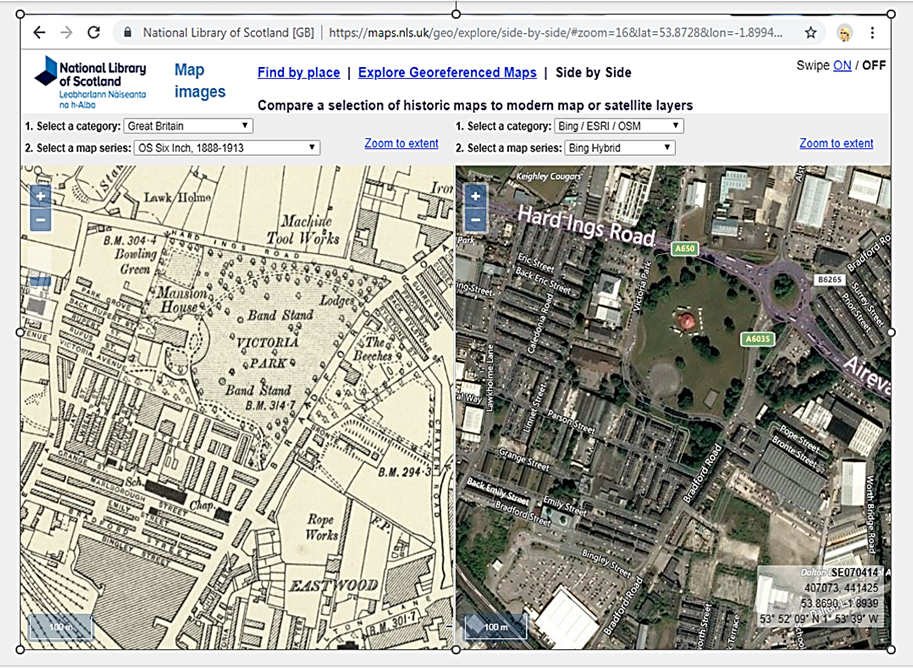
This time a couple of committee members thought it would be helpful to focus on how to research the history of particular properties (most usually the one people now live in). I personally had attended an open-session on this very topic at the library a couple of years ago, so I knew how beneficial it would be, plus I’d moved house in the meantime and had a new property I wanted to find out more about! Properties of interest to other members included a former vicarage, a converted barn, a farmhouse, a manor house, a nursery and numerous other properties dating from the seventeenth to early twentieth centuries.

The session started with Angela and Gina giving a presentation on the various collections and resources available within the library. These included the more obvious (you might think) local maps, and building plans, and expanded to census records and electoral records which would help you discover who was in your property before you. But then they talked about resources like court records from the 17th century, taxation records and rate books, and a whole host of other avenues to take your research down.

After the presentation, Angela, Gina and Janet were on hand to take our members through the various examples of records they had brought out, and that covered virtually every available surface in the upstairs library. They had also prepared a number of packs for individuals with details for some of the properties people were interested in. This included, for myself, a plan of a property linked with my own, that I am now keen to share with my neighbours who occupy said property.

Over twenty members of the History Society came along to the session (including one member who actually came to donate a plan of her previous home to the library). The morning was extremely well-received by our members. But I’ll let them say that in their own words…

“I found Saturday’s Archive session most helpful and enjoyable. The librarian ladies had gone to great lengths to help us further our study of the property we are researching which I greatly appreciate and wish to thank them again for the print outs of various documents and maps. Without their expertise and great knowledge of our Library’s resources I would have been overwhelmed.” – Eveline Rhodes

“I really enjoyed the session at the Library on Saturday. The preparation and presentation of archive materials was as always extensive. The members of the Team were knowledgeable and informative, offering links to people at various stages of their genealogical journey in addition to those seeking information about houses and buildings of interest, the two of course being closely intertwined. The Team are enthusiastic and readily accessed individual historical materials when requested. Keep up the good work.” – Eileen Whitley

“The Library Ladies, Angela, Gina and Janet, presented an impressively comprehensive array of information sources for us to consider.  They had also prepared an individual pack of ‘site-specific’ information plus maps, to identify the age of my particular dwelling.  This was immensely helpful and I am grateful for their time and focussed effort.” – Graham Mitchell

“I found the library session very useful and the staff gave a good presentation on what resources were available – and where to find them in the library. A few good tips too on which resource to use and when. I had not realised there were so many useful sources of information other than old OS maps and I can see myself calling in quite often now to try and dig out bits of history relating to a couple of projects I am working on; some listed buildings in Cross Roads and the history behind bridges in the Worth Valley and Keighley.” – Roger Grimes

“The library team are very knowledgeable and organised. Always helpful and will help with ideas on how to move forward. The archives themselves are well kept and organised and on Saturday they pulled together a lot of useful books and documents. Their handout is a very helpful and informative document. The session was really useful and it has inspired me to get back into my research on our house and local hamlet.” – Sally Morgan

“Following an interest in when my barn in Ingrow was built and its history, I attended the recent Property History Research lecture at the Local Studies library. I was amazed and excited by the range and depth of the physical records held in the library. This demonstrates to me how vital the Local Studies library is in curating and preserving the history of our town.” – John Rodger

We are all looking forward to future archive sessions in 2026.

Tim Neal

Keighley & District Local History Society

HISTORY SOCIETY @ KEIGHLEY LOCAL STUDIES LIBRARY

The History Society held another of their research sessions at Keighley Local Studies Library on the morning of Saturday 31st May 2025. Around twenty members attended, with Angela, Gina and Janet from the library staff opening up various photographic archives and maps of the area for people to peruse.

The session started with History Society committee member Tim Neal talking to attendees about 3D or stereoscopic photography. Many of those there could remember the phenomenon of View-Masters that were around from the 1950s to the 1980s. These handheld viewers used to be loaded with a cardboard circular disc holding seven different colour stereoscopic photos. When looking through the viewer these images appeared in 3D. Tim had brought along half-a-dozen View-Master viewers and a selection of geographical and event-based discs covering subjects as varied as Princess Margaret’s wedding in 1960 to a mid-century of Ottawa in Canada. Members were able to peruse these at their leisure.

Mel Whitaker, writing after the event: “Tim’s collection of ‘View Masters’ brought back many happy memories for all of us who had owned one – and really impressed those who had never seen one before!”

People were then introduced to a collection of card-backed slides from the library’s collection. These were stereoscope images of Keighley in the Victorian era. Local historian Eddie Kelly had already studied the cards and had been able to conclude that they must have been produced around 1895, judging by some of the businesses depicted and the development of some of the buildings in some of the pictures. Using either the vintage wooden viewer or modern plastic equivalents, attendees were able to see Victorian Keighley brought back to life in 3D.

Accompanying these stereoscopic images were selections of photographs, organised by area of town, from a variety of the library’s archive collections, showing the town from the 1900s to the 1960s. It was a period that saw enormous changes in the landscape of the town.

Andy Wade, writing after the event: “Had an excellent session in Keighley Library’s Local Studies room looking at stereoscopic photographs and some of the old photo archives and in particular, the chance to talk about what we were looking at, as there were some unique views of Keighley which I’ve never seen before.”

Finally, bringing us right up to date, the staff had set up the library’s virtual reality equipment, enabling members to view 3D recreations of a 1970s living room, and to explore potential habitats fifty years in the future.

Several members also brought their own items to add to collections,  and could also explore their own research lines of query with the staff and the amazing resources that the library has to offer. The session was summed up by society member Jean McClennon: “An excellent and interesting session, thanks very much to all involved.”

The History Society will be holding another similar session on Saturday 18th October, focusing in how to use the library’s resources to research the history of your own home.

Tim Neal
Keighley & District Local History Society
1st June 2025

The Asylum and Related Records

The first of a series of talks on family and local history topics was launched on Wednesday, 23rd October in Keighley Local Studies Library with Jude Rhodes as speaker. Jude is an Associate of the Association of Genealogists and Researchers in Archives (AGRA), specialising in Yorkshire history. She is “passionate about using local history with family history, this provides the exploration of who our ancestors were, why they lived in a particular place and how they were part of their community at a given time”.

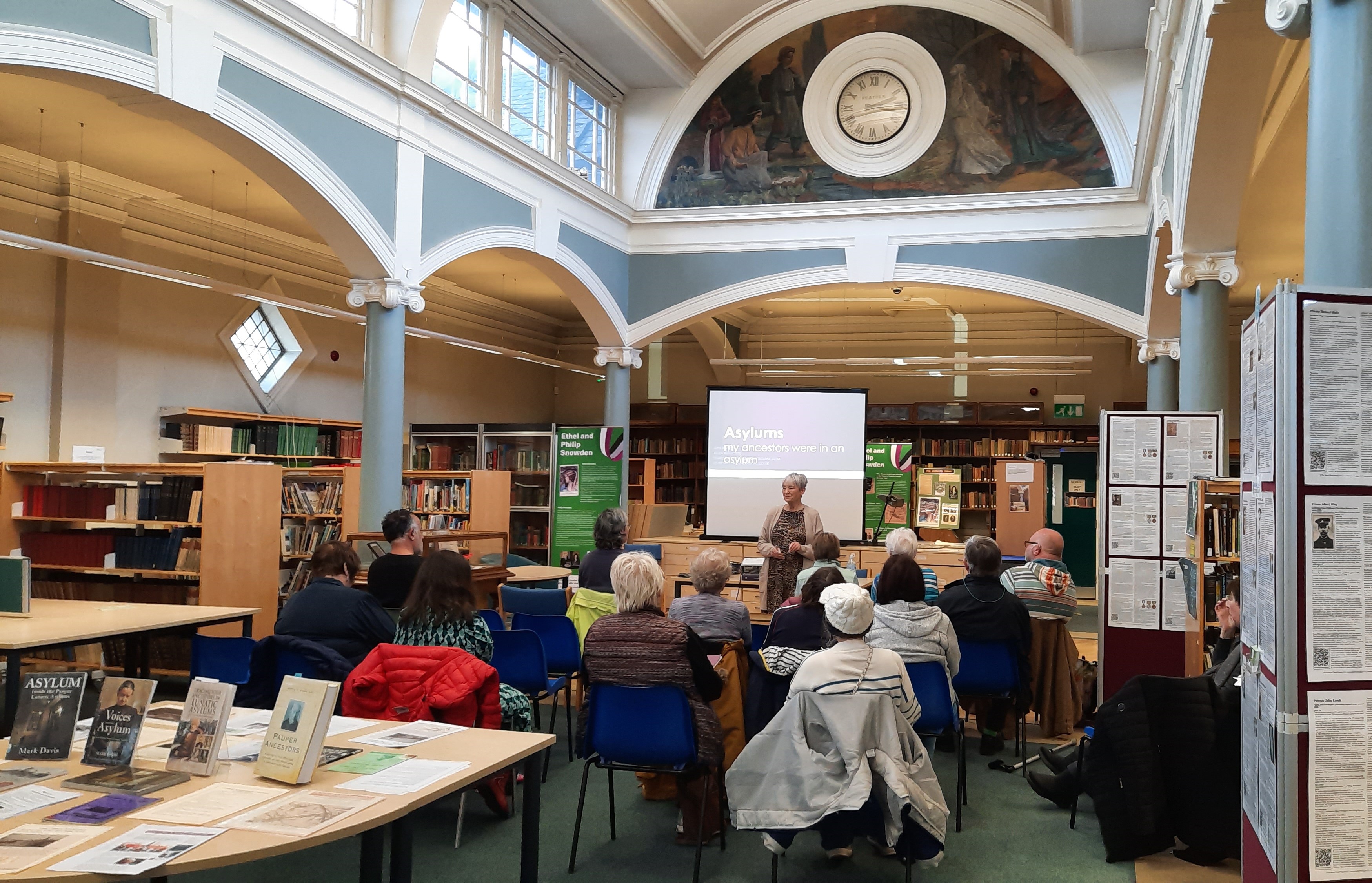
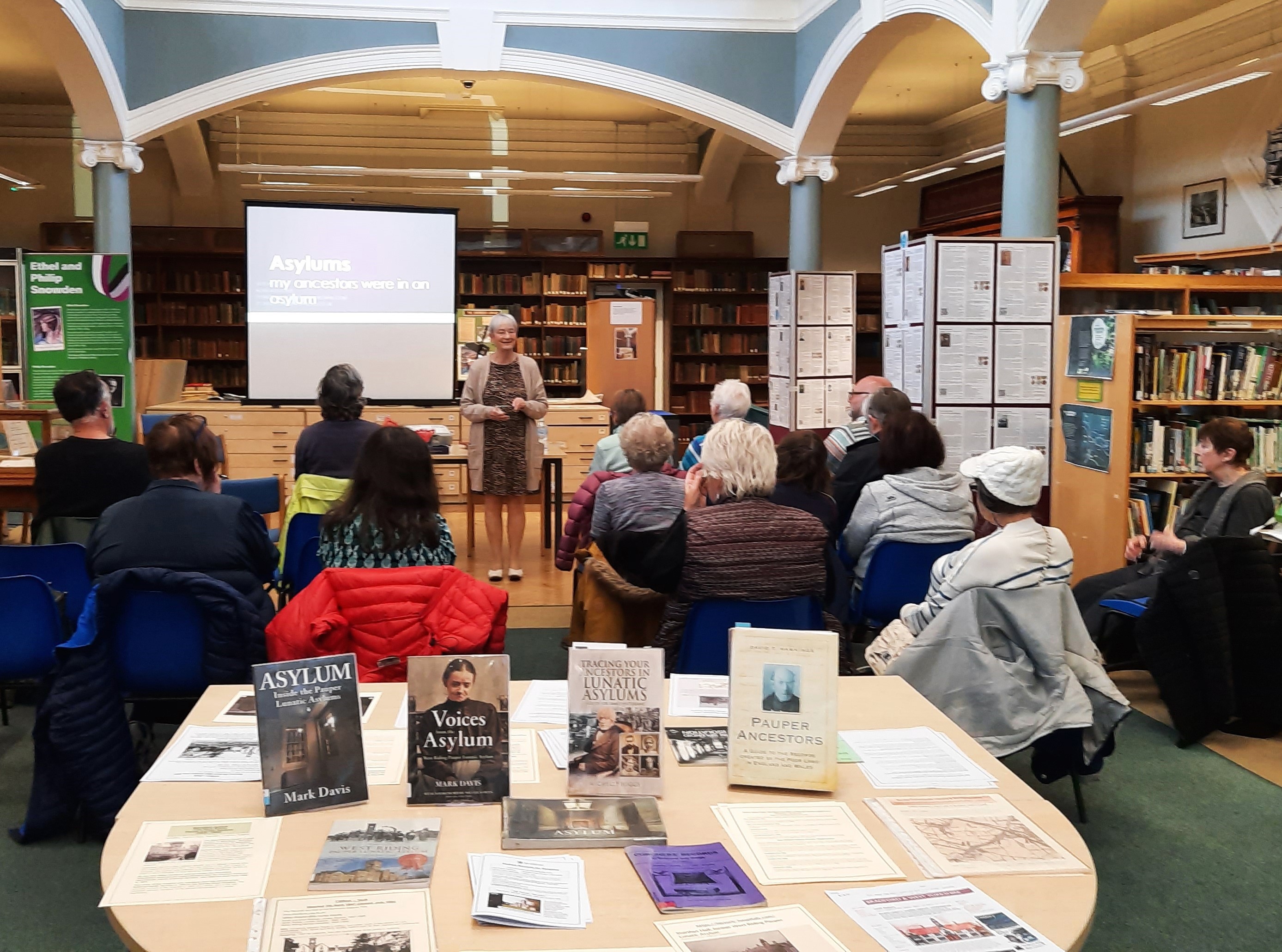
The topic this time was Asylums, looking at their history, categories of patients, care provided and life in an asylum, followed by location and access to records. From the start the audience was advised that some of the terminology was difficult to hear and would never be used today but that these terms were mentioned to accurately depict the historical times and attitudes.

Jude began before Henry VIII and noted how monasteries and nunneries had been a support outside London which was the only place that actually had a hospital, Bethlem, later known as Bedlam. There were private “madhouses” but generally and for those of limited means, care for mental health would be entirely dependent on family and friends and this was the case under the old poor law, when the only alternative was the workhouse or prison. The Lunacy Act of 1845 under the new poor law stated that asylums, “Union Asylums”, had to be built but it wasn’t until the 1930s that asylums started to be called mental health institutes.   

Historic categories were quite astonishing and could include: “refusal to pray”, “inability to feel pious”, “weeping”, “talking too much” (known as “excitement”) and even “hatred of spouse”. Syphilis was rife at this time, it ravaged the body but in time, the brain too and there were many innocents infected along the way.  According to statistics, industrial areas, ports, the military and some mining towns were especially prone to the spread of this infection also known as “Ladies Disease” for women infected. Jude readily acknowledged the dangers of misdiagnosis in the past, with single pregnant women committed, menopausal women and those with post- natal depression, similarly those people with epilepsy or with bipolar and with dementia in old age. The early years after WW1 saw many former soldiers admitted with the effects of shell shock. It was also agreed during the discussion with the audience after the talk that many people in less supportive historical periods may have suffered circumstantial stress that if continuous had led to total breakdown in mental health.

However, Jude also pointed out the advances made at such as Wakefield’s Stanley Royd (1818-1995), formerly known as the West Riding Pauper Lunatic Asylum, that was one of the world’s most famous and active research institutions and led to global scientific changes in the treatment of the mentally ill. Its collection is held at Wakefield District Archives and there is a digital archive at www.wakefieldasylum.co.uk and an online tour at https://museumofthemind.org.uk . Similarly, Clifton in York (1847-1994), under the Medical Superintendent, Dr John Ivison Russell, pioneered in the field of occupational therapy. These larger institutions such as Menston (High Royds) were run as self-contained communities with their own farms, churches, cricket grounds and in Menston’s case, its own railway line connected to the Midland Railway to carry supplies, mainly coal for the boilers. Menston (1888-2003) site was 300 acres and opened with a capacity of 800 beds. There is a digital archive at www.highroydshospital.com  and records are held at Wakefield District Archives.

Other local asylums include Scalebor Park, Burley in Wharfedale, a private asylum, and also with records at Wakefield Archives, with an illustrated history on the Burley Archive’s web site at https://burleycommunitylibrary.weekly.com and Storthes Hall, Kirkburton and you can find more about all the hospitals and see images at https://historic-hospitals.com .

Jude finally spoke about her own personal journey through the archives, having had a great grandfather who was an attendant at High Royds and a grandfather who was a also a patient. She now believes that her grandfather was admitted suffering from the effects of shell shock after the First World War that he never recovered from.  Nevertheless, he was allowed to practice the organ and became the main organist for all weddings and funerals in Wakefield. He was also taken to the AGM of the Organist Society in London.

We would like to thank Jude for a very informative talk, handled well on a what is still today but especially as you look into its history, a complex and sensitive subject area. Library staff produced handouts and information sheets and if you would like to see them, please call into Keighley Local Studies library on the first floor of Keighley Library and ask for the file at the counter. We also have a small collection of books that cover the history of asylums and how to trace records for loan and for reference.

Our next events are listed below this blog, they are free as part of the 120 Year Celebrations of the free Keighley Carnegie Public Library (1904-2024), all welcome.

storiesofourgenerations@gmail.com  

Wednesday 13th   November,  10.30am -12.30am     
‘Back-to-back Housing and The Brigg Family, Keighley Mill Owners’

Wednesday 11th December,  2.15pm – 4.00pm
Family History & Christmas Crafts

Saturday 25th January 2025, 10.30am – 12.30pm
One place study with the Mechanics’ Institute as an example.

Saturday, 22nd February 2025, 10.30-12.30pm
‘The Workhouse’

Friday, 7th March 2025,   2.30-4.30pm 
‘Nursing History’ (part of the International Women’s Week Celebrations)