Map of the week: A track into history

I’m not really a railway enthusiast so I must start with an apology to those readers who are, and say that I would welcome your guidance. I don’t find the early history of Bradford’s rail links an easy topic since the companies involved seem to change their names, and move the location of their stations, quite frequently. Naturally the creation of early railway lines generated maps and plans, many of which have survived. Even here I have a problem since tracks appear on maps which are notionally of an earlier date. Despite these difficulties I want to describe the early lines entering Bradford from the south because of  the interesting light they shed on the city’s industrial past.
Map of the Week 30 A

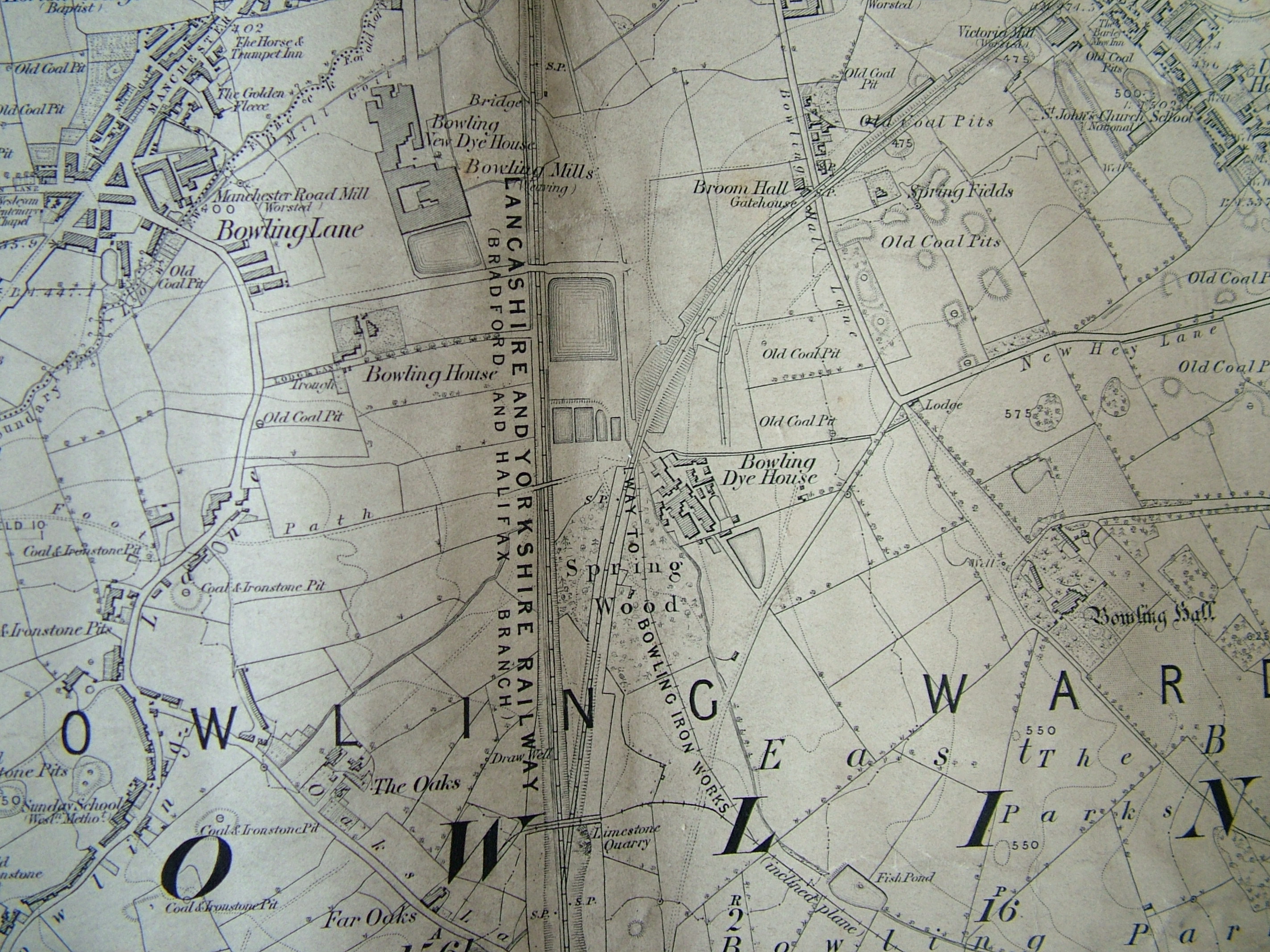
The first image is a detail from the 1852 Ordnance Survey map. It shows Bowling junction, although this is not named. Two, seemingly single, rail tracks, are mapped. The first is the Lancashire and Yorkshire Railway line which connected Halifax to Bradford, and its terminus Drake Street (later Exchange) Station which opened in 1850. The second line moving off to the right went from Bowling junction to Leeds, via Laisterdyke, and was opened a few years later in 1854. It was operated by the same company and, I presume, allowed trains to travel from Leeds to Halifax direct, by-passing Bradford completely. The track no longer exists but the line is visible on aerial photographs.

I am interested that at the junction a ‘limestone quarry’ is mapped. Limestone strata do not reach the surface in the city area but there was nonetheless an early lime-burning industry based on the extraction of boulders from glacial moraines in the Aire valley. Boulder pits were certainly established in Bingley by the early seventeenth century. It looks as if glacial erratic limestone boulders were found elsewhere, being exploited in the same way. In this case the digging of a railway cutting presumably exposed the valuable mineral. Plausibly these boulders were taken to the nearby Bowling Iron Company where crushed lime was used as a flux in iron smelting. Slightly further north is Spring Wood. The name has almost certainly nothing whatever to do with a water supply. ‘Spring’ was applied to a tree that had been cut off at ground level for coppicing. So Spring Wood was presumably an area of old coppice woodland. William Cudworth records that there was once also a Springwood Coal Pit, but the wood itself soon disappears from maps.
Map of the Week 30 B

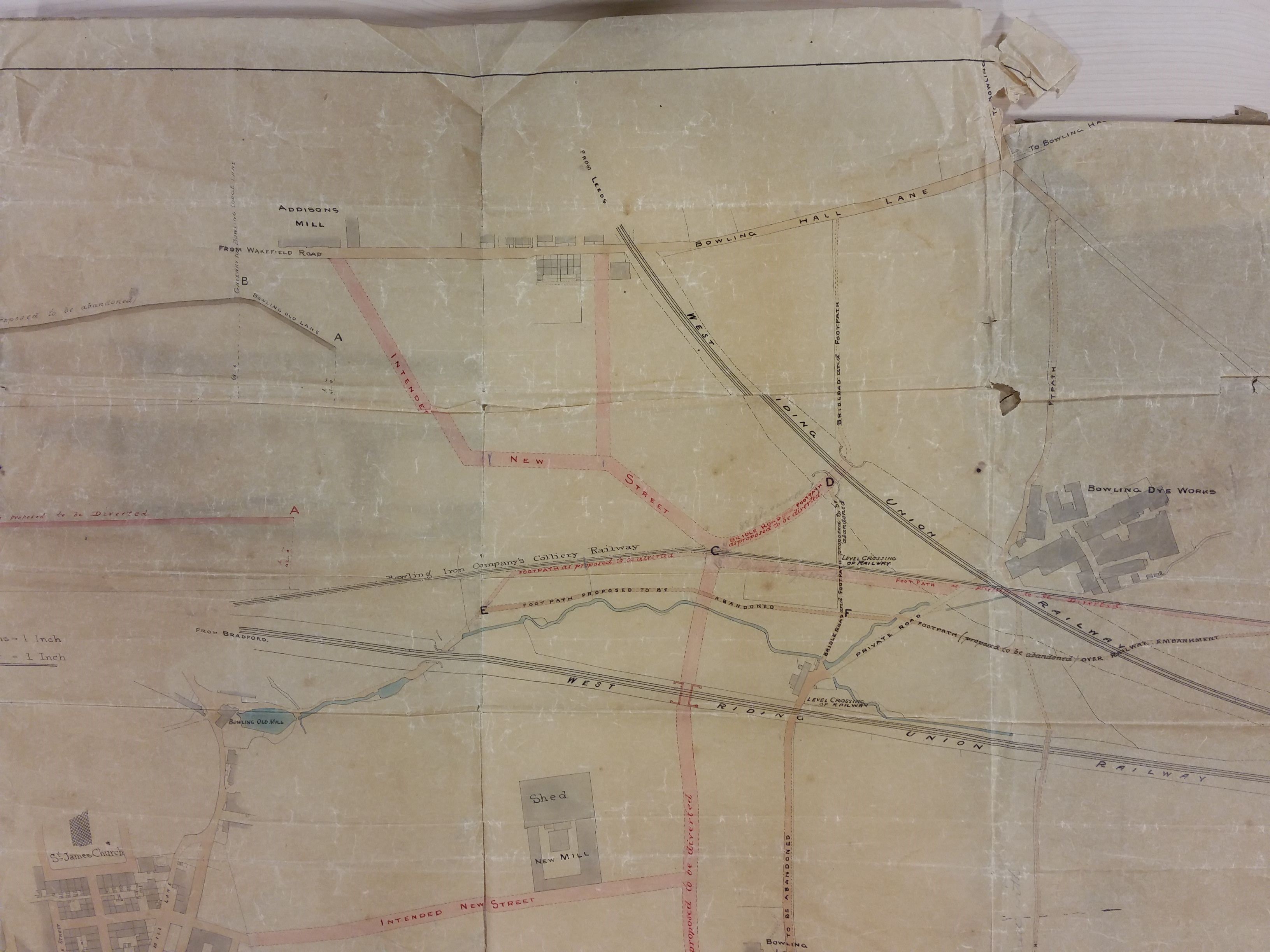
The next plan is from the Local Studies Library reserve collection. If you imagine it turned 90º  clockwise it is clearly the same view as before. You can easily identify the two railway tracks and also the Bowling Dye works. The name of the company involved here is West Riding Union Railway. As I understand it this title was only employed for a brief period around 1845-47. This and other evidence suggests that this map is a few years earlier than that of the OS map we have examined. This map shows the Bowling Iron Company colliery tramway very clearly. This took coal to the Bowling Depot on Queens Street where I assume it was available to local merchants. The Bowling Dye Works and the Bowling New Dye House were both parts of the Ripley family enterprises (Edward Ripley & Co). What are obviously missing are the large reservoir and dye pits which are such a prominent feature in the OS map. When were these created? The Bradford Observer reports a large sale of land in this area, including that piece accommodating the Dye Works, in 1850. The vendor isn’t stated but might well be the Bowling Iron Company. Probably the dye works boss, the famous Sir Wm. Henry Ripley, purchased land at this time to allow for the expansion of his business and the assurance of adequate soft water supplies, which included a reservoir. Cudworth records a 100 acre purchase by the Ripley company and also states that a contractor called Samuel Pearson constructed reservoirs for Bowling Dye Works and Bowling Iron Works at a date ‘early in the fifties’. We shall hear more of Samuel Pearson shortly. Marked on this map are marked a variety of planned new streets. Were these streets ever constructed? Presumably not. After 1863-64 Ripleyville, consisting of 200 houses with schools, was constructed by Sir Henry but the alignment of these streets on the 1887 borough map looks quite different.

Map of the Week 30 C

This third map shows an area slightly further north. There have been additional train track developments. The Great Northern Railway had opened its service to Leeds from Adolphus Street station in 1854 but the rival Midland Railway service, via Shipley, ended at a station more convenient to the town centre depriving GNR of customers. In consequence, around 1867, a track loop was constructed connecting the GNR line to the L&Y track at Mill Lane junction and allowing passengers from Leeds access to Exchange Station. Nearby St Dunstan’s passenger transfer station was also opened. The loop is clearly visible on the map north of Ripleyville. In describing the work involved in taking the GNR railway line from the Exchange Station towards Leeds, Horace Hird (Bradford in History, 1968) again mentions the activities of Samuel Pearson & Son who took over responsibility for the material excavated from the necessary cutting. The cutting spoil created a ‘great mound’ and for 15 years 60 men were employed making drain pipes, chimney pots and bricks from this material. Their Broomfield brick works is clearly indicated on the map above the loop. The line seen curving away to the left edge of the map, opposite the brick works, services a series of coal drops which are still visible, in a ruinous state, off Mill Lane today.

Samuel Pearson was a Cleckheaton brick-maker who founded a contracting dynasty. His contracting business started in Silver Street, off Tabbs Lane, Scholes, in 1856. By 1860-63 Messrs. S. Pearson & Son were established at the Broomfield Works, Mill Lane (near St Dunstan’s) for the manufacture of building bricks, sanitary tubes and terracotta goods. The works can be identified on the 1871 map of Bradford but closed shortly before the 1887 map was published, the ‘spoil bank’ being exhausted. The site is described as a ‘disused brick-works’ by the time of the 1895 OS map. Within a generation Pearson’s had became an international contractor and was particularly associated with Mexico during the dictatorship of Porfirio Diaz. Canals, railways and oil were among the company’s many interests. After being created a baronet Samuel Pearson’s grandson, Weetman Pearson, became the first Viscount Cowdray in 1917. The family seat became Cowdray House and park, near Midhurst in West Sussex.
map-of-the-week-30-d.jpg

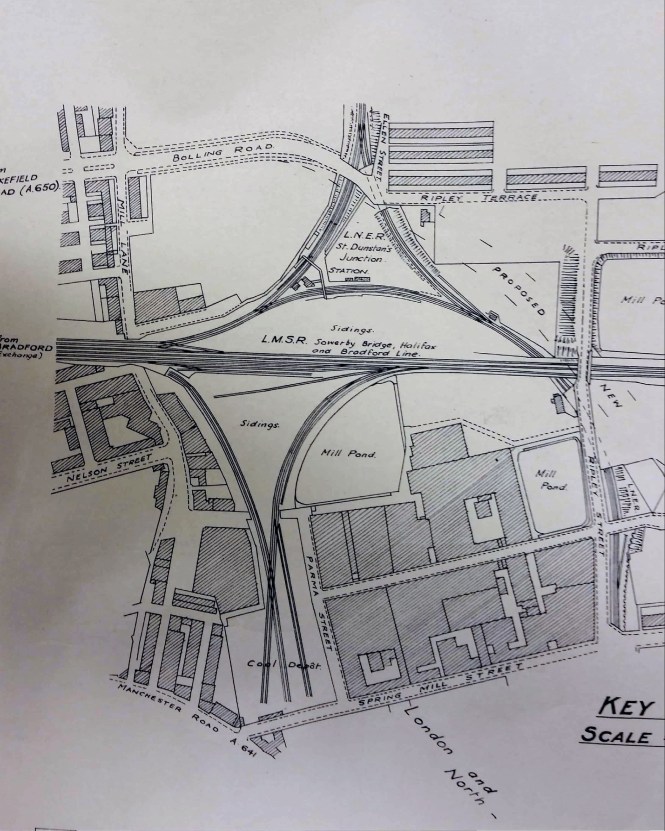
For the final plan I return to the LSL Reserve Collection. Essentially it shows the same area as the last. The plan is undated but the railway companies have their pre-nationalisation names, so it is earlier than 1948. Wakefield Road is referred to as the A650 and local historian Maggie Fleming suggests that this nomenclature makes the plan later than 1920. St Dunstan’s Station is still present, and in fact had another thirty years of life before closing in 1952. The site of Broomfield brick works is blank, and is today a car park. The purpose of this plan seems to have been to show the course of a new road joining Bolling Road to Upper Castle Street. This is another thoroughfare that was never constructed.


Derek Barker, Local Studies Library Volunteer


Greengates

SITUATED around three miles north of Bradford, Greengates  is unfairly known by many as no more than the busy Bradford to Harrogate and Leeds to Keighley crossroads.  Its boundaries, however, spread beyond this busy junction. The actual parish boundaries show that Greengates includes parts of the Thorpe Edge and Ravenscliffe estates and Apperley Bridge.

Map

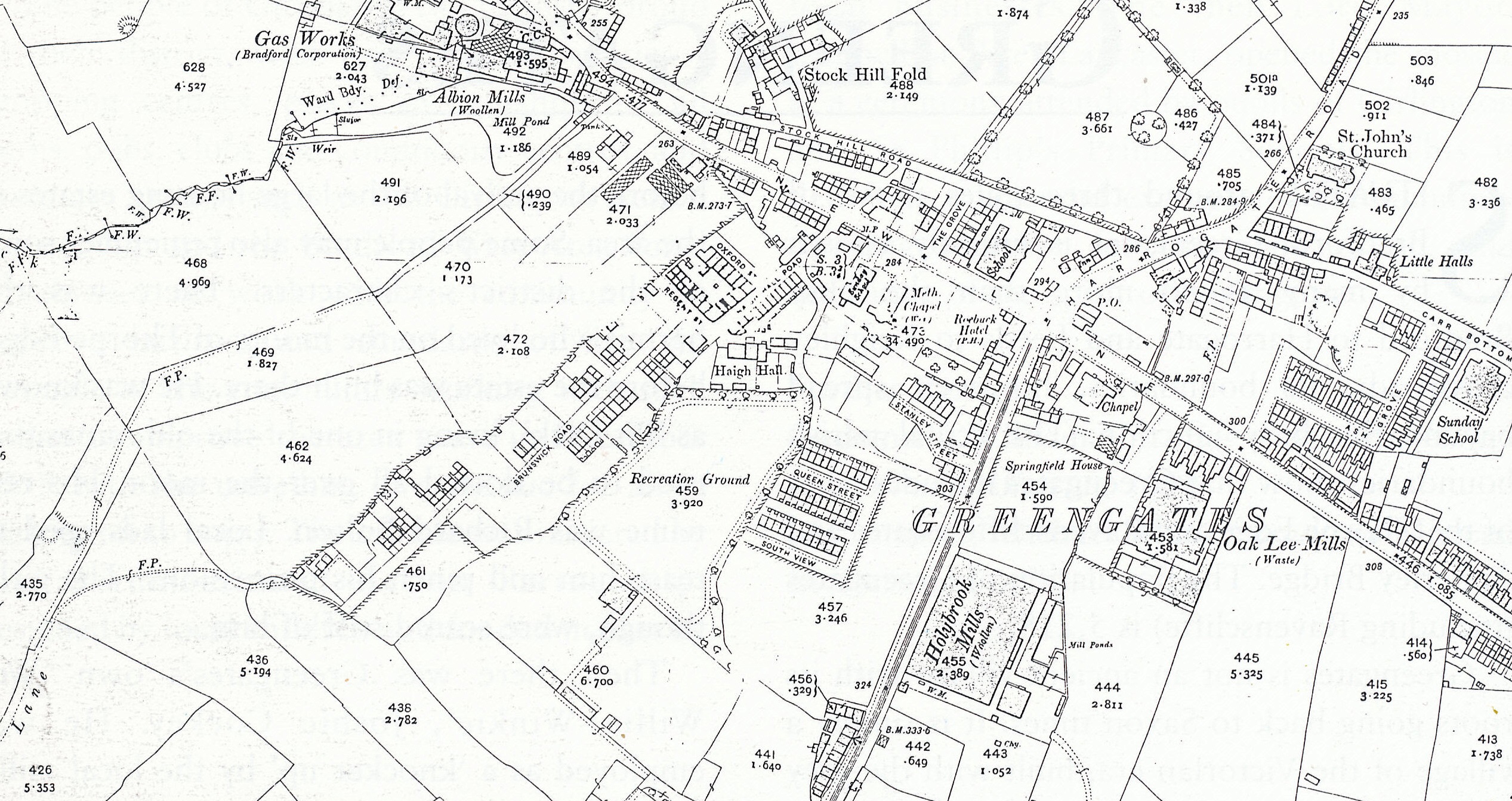
Map of Greengates, 1908


Greengates is not an ancient village with its roots going back to Saxon times. It is simply a village of the Victorian era, built with the grey Yorkshire stone of early Victorian prosperity.  In fact little of Greengates nowadays is more than 60 years old.

The village, like many others in Bradford, has now been swallowed up by the city.  However, some of the prettier and more interesting qualities of the place still exist.  Take, for example, the row of cottages in Stockhill Fold.  They were built for weavers and some date from as early as 1786.  They were renovated in 1979.  The builders and architects ensured that many of the original features were retained.   In fact, Methodist pioneer John Wesley is reputed to have stayed in one of the cottages. They are all now listed buildings.

Stockill Fold

Weavers Cottages in Stockhill Fold, 2002


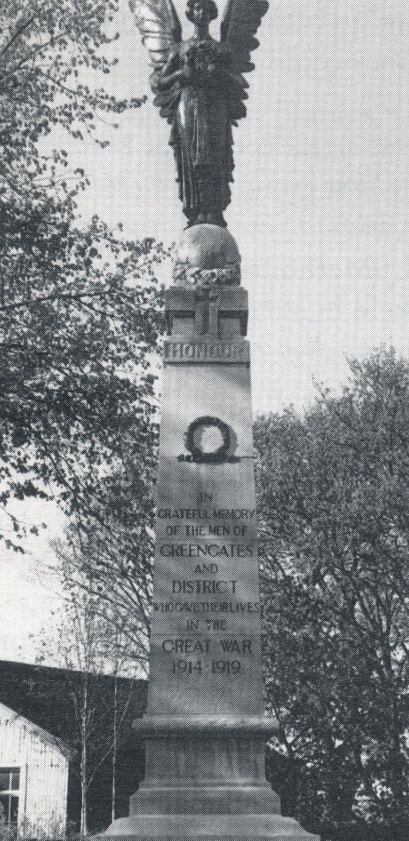
Another of the village’s most famous landmarks is its war memorial, situated at the busy crossroads. The imposing angel statue was erected in memory of the men of Greengates who died in World War One.

War Mem

War Memorial, 2002


Some older people may still remember with affection Greengates’ mills, or the acres and acres of green fields that surrounded the village before the arrival of the large housing estates in the area. Some people may also remember some of the district’s characters.  There was the hermit who lived on the moors of Thorpe Edge,  before the estate was built there.  He was known as ‘Pit Dick’, living in one of the old mines that used to be dotted all over the moor. His real name was Richard Bolton. Local lads used to tease him and pinch his possessions.  The girls, though, were scared stiff of him.

Then there was Greengates’s own ‘Wee Willie Winkie’, Joshie Cockey.  He was employed as a ‘knocker up’, by the local mill owners.  Some may remember the time when he knocked everyone up an hour early.  When he realised his mistake he had to to go back on his rounds letting folk know that they could have another hour in bed.

Greengates was a real centre for Methodism in Bradford. The first group met there in 1781, the year Wesley was supposed to have stayed in Stockhill Fold. Methodism prospered and meetings were held in a building in Haigh Hall Road. This building eventually became Greengates Library as well as a burling and mending workshop.

Today Greengates can certainly be a bottleneck.   The busy junction at its centre, known as New Line, is now under more pressure with the arrival of supermarkets and retail parks.  Next time you’re doing your weekly shop in Sainsbury’s, or travelling between Shipley and Leeds or  Bradford and Harrogate, spare a thought for what used to be a small, quiet village, with superb views over  the Aire Valley.

New Line

New Line, Greengates, in more peaceful times

Taken from The Illustrated History of Bradford’s Suburbs, 2002

1918-2018 Celebrating The Vote


HB1


Saturday 10th March, “Bradford Suffragettes: The Fight for the Vote”, a talk by Helen Broadhead, Bradford Local Studies Library, 2.00pm

This talk will feature some of the remarkable stories of Bradford’s pioneers of the vote including textile trades unionist Julia Varley who was twice imprisoned in 1907.

The talk will be accompanied by an exhibition of items from the Local Studies Library collections.

Free event. Please book at local.studies@bradford.gov.uk or telephone 01274 433688


HB2

Saturday 17th March, ‘Women of Bradford’, a guided walk by Helen Broadhead, starts at Manningham Library, 2.00pm

Join Helen Broadhead at Manningham Library on Saturday 17th March at 2.00pm for a heritage walk. Helen will explore women’s role in Bradford’s history as workers, vote seekers and activists. This circular walk will take around an hour and a half at a leisurely pace.

Free event, please book a place at local.studies@bradford.gov.uk or telephone 01274 433688

Book Review – Heraldic Shields in the Banqueting Hall of Bradford City Hall.

Heraldic Shields in the Banqueting Hall of Bradford City Hall. Researched and written by Janet Senior; window photography by Steve Reeder. City of Bradford Metropolitan District Council, 2016. 28 pages. £5.00. Available from City Hall Reception or from the author (janetsenior@googlemail.com)

Available from Bradford Libraries

Heraldic Shields

This slim booklet is a treasure; a full colour informative and beautifully produced treasure of local history. Heraldic shields may seem an esoteric subject for most of us, and the fact that so few people will ever get to see the ones featured here, high up in the exclusive City Hall Banqueting Hall, is a reason to ignore them. But the beautiful photography of Steve Reeder, and the informative prose of historian Janet Senior, make this an enjoyable browse.

This booklet, apart from a brief introduction, consists of 86 full-colour photographs of hand-painted glass windows in the form of heraldic shields, mostly the work of the stained glass relief artist Henry Gustave Hiller, which were painted at different periods in the early 20th century. Each shield represents the coat of arms of a prominent local personage or family, or in a few cases, a figure of early national importance. In the book, each image is accompanied by a brief note on the person or family concerned. Edmund Peckover, H W Ripley, Sir Henry Mitchell and Alderman W E B Priestley are examples of local persons of note; the Rawsons, the Peckovers and the Ferrands examples of prominent local families; while John of Gaunt, Phillippa of Hainault, and the Duke of Northumberland are examples of national figures. Janet explains that both John of Gaunt and Phillippa (wife of King Edward III) were both, for a while, owners of the Honor of Pontefract, of which Bradford was a part; while Bradford was part of the Percy ‘Fee’ in the 12th and 13th centuries (Percy being the family name of the Dukes of Northumberland). Less exotically, but maybe more usefully, we learn that Charles Harris, along with his uncle, Edmund Peckover, founded the Bradford Old Bank; that Roland Paley was an iron merchant who, with John Stranger, founded the Bowling Iron Works; and that the first Lord Cranbrook was the politician Gathorne Gathorne-Hardy, son of John Hardy, one of the owners of Low Moor Iron Works.

Janet found no trace of why or how these particular people or families were selected and ‘It is not clear if the heraldic shields actually belong to all the families represented.’ It seems, however, that the artist got the wrong shield for the Prince of Wales (that of the Stuart Prince of Wales rather than of the Prince and Princess of Wales who visited Bradford in 1904)!

This is an attractive booklet of great interest. All profits will go to the Lord Mayor’s Fund.

Bob Duckett

Map of the Week: Toads and Chapels

In the 170 years since Bradford became a borough, in 1847, its centre has changed almost beyond recognition. New buildings have been erected and old ones demolished. The Bradford Beck has progressively vanished underground into culverts.  New roads have been created (Sunbridge Road being a good example), while others have been repositioned, lengthened, or have disappeared entirely. Change has been a continuous process but it was accelerated in the 1960s when there was a wholesale city centre redevelopment associated with the name of SG Wardley, the City surveyor and engineer. I should like to recount something of this story by describing the events that befell a thoroughfare called Chapel Lane.

Map of the Week 028 A Final

Image 1

I thought I had made a good start with the this first plan, which is widely reproduced and purports to date from 1800. Here it is easy to see the acute angle made by the Turls (Tyrrel Street) and Chapel Lane/Toad Lane. Toad Lane is an odd name but it is not unique; there are, or were, Toad Lanes in Bingley, Newark and Rochdale. Possibly the name is a corruption of ‘t’owld’ lane: certainly in Bradford the lane is drawn, but not named, on a map as early as c1722. On the above plan building (3) is the Unitarian Chapel which was certainly in existence at this time. An existing town hall is numbered (35) on the map but there is a small puzzle here. The Act of Parliament that appointed commissioners for levying rates, and improving Bradford roads and lighting, was only passed in 1805 and no town hall was to be built for decades. I am very obliged to local historian Kieran Wilkinson who explained this apparent anomaly by telling me that the map of 1800 is not contemporary but was a creation of the late nineteenth century, and marked places both where important local buildings were in 1800, and would be in the future. Let us instead look at a detail from a map that is believed to be contemporary, that of 1802, which is available in the Local Studies Library.

Map of the Week 028 B Final

Image 2

I do not think that there is much doubt that the second plan was the origin of the first, but there are some difficulties here too. Firstly Toad Lane is not mentioned. Kieran tells me that the shortening of Toad Lane, to that unnamed portion that leaves Chapel Lane at a right angle to join Bowling Green, happened in August 1804. The town’s board of commissioners changed both it and the names of a number of other roads in the town (Bank Street, Bridge Street, Market Street and Well Street being introduced as names then). Secondly although there is a Chapel Lane there is no obvious chapel. In his Pen & Pencil Pictures of Old Bradford William Scruton gives a full account of this building, originally constructed in 1717. Much of its material came from Howley Hall, Batley and the land on which it stood was donated by the Sharp family of Horton Hall. The names was originally the Toad Lane Presbyterian Chapel. The old chapel lasted about 150 years and for much of this time was located ‘amid green fields’. The chapel was replaced by a larger more modern structure in 1869, and finally demolished a century later. The most notable figure to be connected with the institution was Rev. Joseph Dawson who is closely associated with the exploitation of the mineral wealth of Low Moor. One possible explanation of the difference between the two maps is that the 1800 marks the position of the 1869 rebuild whereas in 1802 the chapel formed part of the block drawn immediately south of the first section of Chapel Lane. Unfortunately this simple explanation cannot be correct. A chapel, but with no denomination provided, is mapped here c1722, which is in accordance with Scruton’s statement, and the following detail from a map of 1825, surveyed by L Atkinson, clearly illustrates the same building. Here the building numbered (8) is identified on the map rubric as the Unitarian Chapel.

Map of the Week 028 C Final

Image 3

I have already mention the Bradford commissioners. This early embryo town council are said to have originally met at the Bull’s Head Inn, Westgate. At the first meeting according to historian Horace Hird, Lord Mayor (1951-52), the commissioners drew up that list of Bradford roads. The same commissioners moved to the ‘Station House’ in Swaine Street after it was erected in 1838. They did not change landlord since the Bull’s Head and the Station House were both built on land leased from Rev. Godfrey Wright who regularly features in this articles.  The final building I want to mention is the Bowling Green Hotel, which completes what I shall call ‘the central triangle’. This hotel was located at the end of Bridge Street. Cudworth mentions that in the 1830s its owner was a Mrs Susannah Ward, widow of Joseph Ward. William Scruton pushes the Bowling Green’s existence still further back into the seventeenth century. He regarded it as ‘the best inn of the town’. It was used by the Royal Mail and the open space in front of the inn, which presumably was once a bowling green, came to be employed for political meetings. The road names remain unchanged until the mid-nineteenth century, which is represented by the next map from the Local Studies Library reserve collection.

Map of the Week 028 D Final

Image 4

It is perfectly clear that there has been extensive construction in the central triangle.  The Bradford Observer (1844) observed that the premises of DH Smith at the corner of Toad Lane were ‘striking and elegant’. Elsewhere a ‘Smith’s Tavern and Beer-house’ is noted which I assume was the same building. Other developments were evidently far from elegant. In 1847 the Poor Law Commissioners considered Chapel Lane a possible site for a ‘vagrants yard’, and in 1855 a ton and a half of ‘vile bones’ were removed from the premises of John Boyd. The Lund’s 1856 Directory of Bradford lists John Boyd as a ‘rag dealer’. The same source gives Rev. JH Ryland as the non-resident minister at the chapel. There is also an architects’ partnership (Stott & Illingworth) and a painter (John Edwards), but otherwise the Chapel Lane residents are all tradesmen: plumbers, hair dressers, bootmakers, saddlers, pawnbrokers and so forth. Was the ‘Old Foundry’ (Cliff’s Foundry) drawn on the second map still functioning in the town centre? According to Hird it was.

The new unnamed cut-through joining Chapel Lane and Tyrrel Street  is Bower Gate. Toad Lane makes an acute angle with Norfolk Street. Kieran Wilkinson tells me that Toad Lane was ‘stopped up’ in 1869 to assist with the subsequent Town Hall development. The Bradford Daily Telegraph of 10 September 1873 recalled that Toad Lane was a ‘narrow passage… immediately behind Garth’s warehouse’. According to the Bradford Observer of 17 March 1869, the width of Toad Lane was only three and a half yards. The next development, which I have already hinted at, represented a huge change. Bradford Borough Council decided that a purpose built Town Hall was required to support the rapidly growing urban area. A number of sites were considered but Chapel Lane or the Bowling Green were the front runners. Finally a competition was launched to design a hall to be built on the Chapel Lane site. The winning design was opened by the Mayor, Matthew Thompson, in 1873. The architects were the famous partnership of Lockwood & Mawson who had already designed the Wool Exchange (1867). The contractor was John Ives of Shipley. In his book Bradford in History Horace Hird described the whole process and provided illustrations of the runners-up. It seems that all the considered designs were for Gothic buildings including a tower. The stone for the winning design came from Cliff Wood quarries but at present I do not have sources for the glass, metal work and ornamental marbles, nor the million bricks incorporated into the structure. The Unitarian Chapel and Chapel Lane itself were left alone during this development, but Bradford became a city in 1897 and the increase in council business required an extension to the Town Hall, opened in 1909. This provided more committee rooms and a banqueting hall. The designer was Richard Norman Shaw. As you can see from the map below only a stub of Chapel Lane remained after the completion of this extension, and the chapel is now south of Town Hall Square. A further extension was constructed in 1914 but this does not seem to have affected the plan of the building which is essentially the same in the 1930 OS map with Chapel Lane now opening off Norfolk Street. The nearby Alhambra Theatre was to be built at the same time.

Map of the Week 028 E Final

Image 5

Understandably these events drastically reduced the number of occupants of Chapel Lane. Even before the extension was built the PO 1898 Directory indicates that, besides the city’s conditioning house, health office and water testing department, there were just five textile related premises, and a produce merchant. Chapel Lane and the Unitarian chapel survived until the reorganisations of the late 1960s when wholesale clearances took place. These must have been required to create the space that became Centenary Square, the Magistrates Court and Coroner’s Office building, the Norfolk Gardens and the Hall Ings extension. The court building, which was opened in 1972, retains ‘The Tyrls’ as its address. What remained of Chapel Lane ultimately gave way for Norfolk Gardens. However Kieran feels that it is arguable that some of Chapel Lane remains within the Town Hall as there is an outside area between the original Town Hall and the extension which was part of this lane.


Derek Barker, Local Studies Library Volunteer