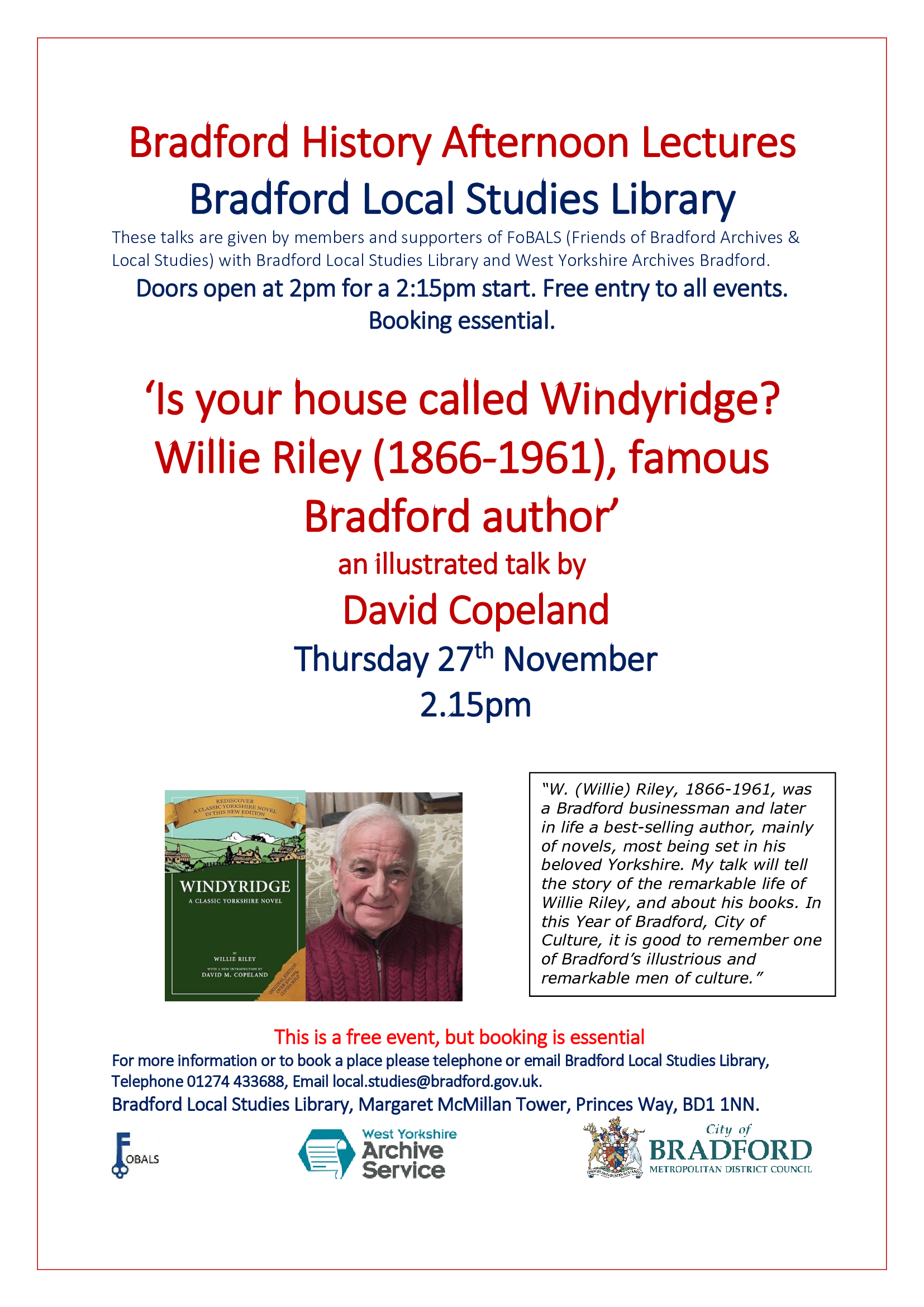
‘Is your house called Windyridge? Willie Riley (1866-1961), famous Bradford author’

Bradford History Afternoon Lectures
Bradford Local Studies Library

‘Is your house called Windyridge? Willie Riley (1866-1961), famous Bradford author’
an illustrated talk by David Copeland
Thursday 27th November, 2.15pm

“W. (Willie) Riley, 1866-1961, was a Bradford businessman and later in life a best-selling author, mainly of novels, most being set in his beloved Yorkshire. The talk will tell the story of the remarkable life of Willie Riley, and about his books. In this Year of Bradford, City of Culture, it is good to remember one of Bradford’s illustrious and remarkable men of culture.”

These talks are given by members and supporters of FoBALS (Friends of Bradford Archives & Local Studies) with Bradford Local Studies Library and West Yorkshire Archives Bradford.
Doors open at 2pm for a 2:15pm start.

Free entry to all events. Booking essential.

Lunchtime Lectures – ‘Book Treasures in Local Studies’

These talks are given by members of FoBALS (Friends of Bradford Archives & Local Studies) with Bradford Local Studies Library and West Yorkshire Archives Bradford.

‘Book Treasures in Local Studies’ – an illustrated talk by Bob Duckett
Thursday 25th April
Doors open at 1pm for a 1.15pm start. Free entry to all events. Booking essential.

The Bradford ‘Free’ Library was established in 1872 and from the start efforts were made to collect books and other items of local interest and the collections have developed over many years. Come along and hear Bob speak about some of the ‘Treasures’ from these collections. There will be the opportunity to view some of these items on display.

Bob Duckett is widely known as Bradford’s Reference Librarian before retirement. Since retirement Bob has been a volunteer in a number of libraries including Bradford Local Studies Library.

For more information or to book a place please telephone or email Bradford Local Studies Library, Telephone 01274 433688, Email local.studies@bradford.gov.uk.

Bradford Local Studies Library, Margaret McMillan Tower, Princes Way, BD1 1NN.

Lunchtime lectures poster

Treasure of the week no. 26: Hedgehogs, polecats and churchwardens.

This week we resume our popular ‘Treasure of the Week feature by our volunteer ‘Stackmole’. These treasures are from 19th Century Publications which give a varied insight into the Bradford of the 19th Century – history as it happened. We hope these articles will encourage people to study these items and to pursue this interest into other aspects of Bradford’s history.

Natural History Notes from the Bradford Churchwarden’s Accounts by Herbert E. Wroot. Offprint of pages 183-187 from The Naturalist, June 1895. Contains a transcript of the entries relating to payments for catching wild animals from 1668 to 1748.

JND 18/12 (Please quote this number if requesting this item)

Tres 26 image

The Churchwardens were very much the local officials in the seventeenth and eighteenth centuries and were responsible for the administration of the law. Interesting are the payments made for catching vermin and wild animals. The entries in The Accounts of the Bradford Churchwardens date from 1668 to the end of 1748. From these, journalist and naturalist, Herbert Wroot, transcribed the entries that relate to wild animals. They give evidence that in and near Bradford there were:

  • Hedgehogs (or ‘Urchins’)
  • Wild Cats
  • Foxes
  • Otters
  • Badgers (or ‘Greys’)
  • Polecats (or Foumarts)

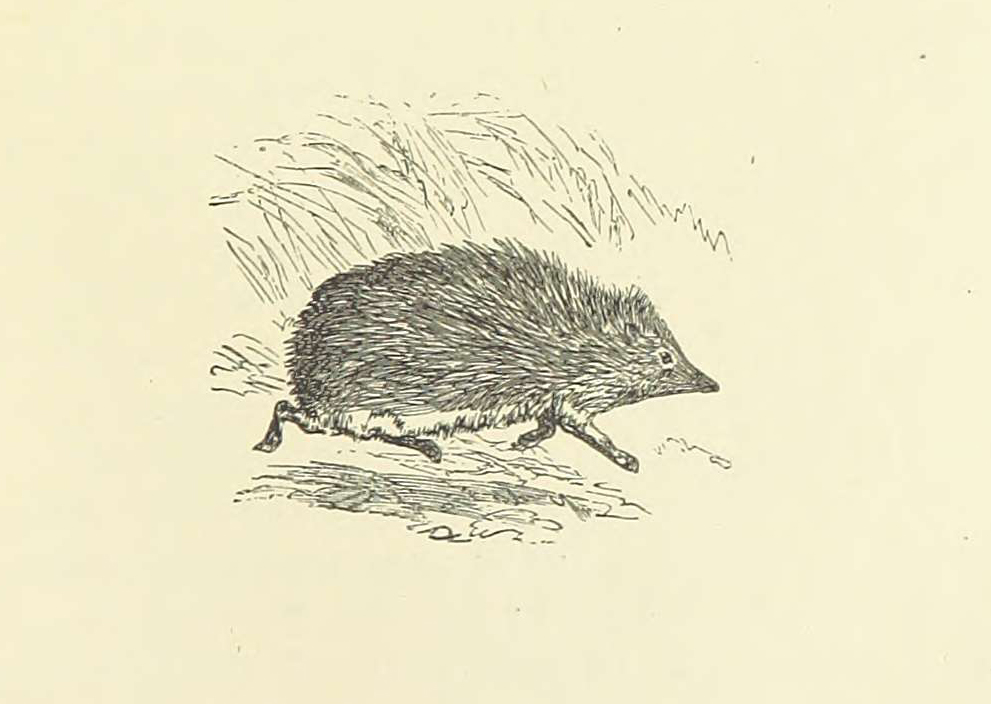
hedgehog from Eileen Aroon p 127

Image from ‘Eileen Aroon’ by Stables, Gordon, 1884 https://www.flickr.com/photos/britishlibrary Flickr Commons

Most common of these were hedgehogs, the deaths of 180 being recorded. Superstition against this harmless creature was strong – they were supposed to seek the milk from the udders of cows as they lay on the ground. The existence of the wild cat in the district is especially interesting; the animal being long ago extinct in England. Four specimens are referred to – two were caught in 1676, one in 1678, and the last in 1680. The badger or ‘gray’ seems to have been scarce or rarely seen. The sole specimen referred to was killed in 1676 at Shipley. Although polecats are several times noted, there were no martins, weasels or stoats. Otters were not uncommon, five having been killed, the last mentioned in 1731.

No payment was made for any of the birds whose destruction was prescribed by the Acts; birds such as hawks, kites, the buzzard, magpie, jay, rave or kingfisher. Likewise, there is no record of smaller vermin such as rats, mice or moles. The rewards paid, one shilling each for foxes and greys, and two pence each for hedgehogs, otters, wild cats and polecats, were in conformity with the scale prescribed by the Government.

The struggles of the illiterate churchwardens with spelling of the words ‘urchin’ and ‘hedgehog’ are amusing. Two examples are:

1670, April 23   Paid to Thomas Roe for Catshing two heg hoges ..… 4d.

1679-9   Aloud to the Churchwarden of Shipley for 6 uerchanes & for a wild cat ….. 2s. 02d.

Stackmole

Image from ‘Eileen Aroon’ by Stables, Gordon, 1884 https://www.flickr.com/photos/britishlibrary Flickr Commons

Neglected Bradford Industries: Copperas

Bradford is famous for spinning and weaving but textile production was only one of a group of important industries which ‘Worstedopolis’ supported. Since several  are now almost forgotten by contemporary citizens I should like to draw attention to those which seem unreasonably neglected, in a series of short articles.

  I would be delighted if any reader has ever heard of copperas, let alone that it had once been produced close to the city of Bradford.  Copperas is nothing whatever to do with the element copper, but is an old name for ‘green vitriol’ or iron II sulphate heptahydrate. Copperas was used in the manufacture of iron gall ink, leather tanning, and a very early process for the production of sulphuric acid. Copperas, like alum, was also important as a mordant in cloth dyeing processes. For centuries both these chemicals were papal monopolies. The monopoly was eventually broken and in the early post-medieval period the production of alum, on the North Yorkshire coast, and copperas, at several sites round the country, marked the origin of the domestic chemical industry. The industry flourished and the UK became the world’s biggest copperas producer.

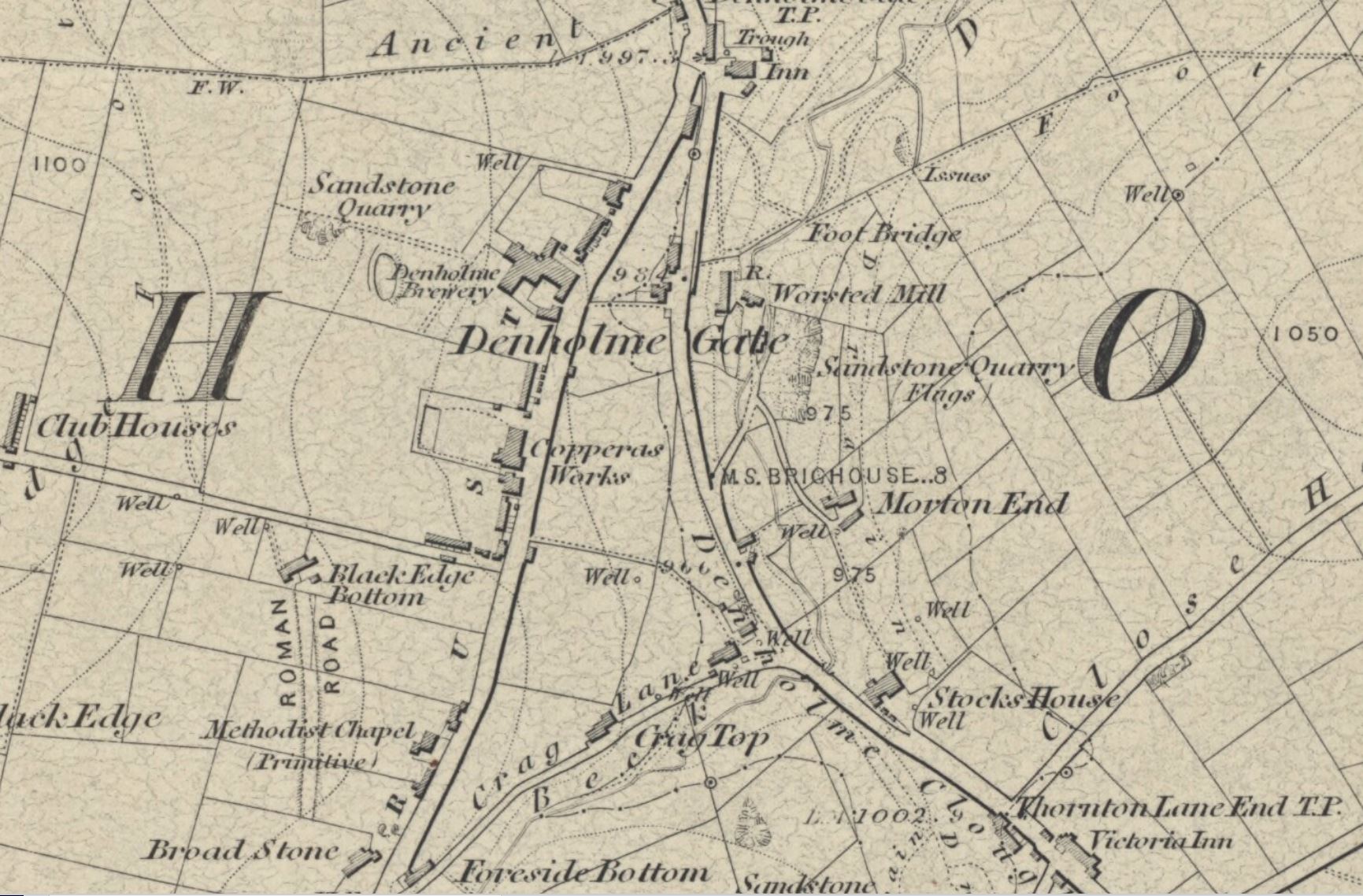
At various times production works existed in several places, this being indicated by name evidence: Copperas Hill in Liverpool, Copperas Road in Colchester, Copperas Point in Chichester Harbour, Copperas House Terrace in Todmorden, and Copperas Bay on the Stour estuary in Essex. The technique adopted  was similar at the various sites. Some years ago I was surprised to learn from historian Jean Brown, of the Thornton Antiquarian Society, that Denhome had been a centre of this industry. From trade directory evidence it is clear that, between 1822-1854, copperas was being made at not only there but at Hunslet, Birstall, Huddersfield, Elland, Southowram and Todmoden as well as in the cities of Manchester and Liverpool. Nineteenth century historian William Cudworth, writing about Denholme, recorded that an extensive coal seam was then being worked by Messrs. Townend of Cullingworth and that in parts of this Hard Bed coal ‘quantities of iron pyrites were to be found’. Cudworth stated that the process of converting iron pyrites, or pyrite, into sulphuric acid was carried on along the line of the coal seam’s outcrop. He omitted to say that two copperas works, Field Head and Denholme Gate, were associated with a family called Horsfall.


08 Plan Image

Essentially the Copperas process was the slow oxidation of iron (II) sulphide, obtained as the mineral pyrite, using atmospheric oxygen and rain water to form iron (II) sulphate heptahydrate, that is copperas. Essential to the process was, of course, access to a plentiful supply of pyrite. Pyrite nodules (‘brass lumps’) are found in the Coal Measures in Cumbria and West Yorkshire. At Denholme the producers obtained the nodules and placed them in ‘beds’ lined with clay. They were then left to weather for up to six years. Towards the end of this time they began to produce a large quantity of liquor, a dilute solution of hydrated ferrous sulphate and sulphuric acid, which was pumped into a lead boiler positioned over a furnace. Quantities of additional scrap iron were added to increase the final yield. As the liquor was reduced by evaporation more liquor was added. When it was  sufficiently concentrated the liquor was tapped off into a cooling tank. As the solution cooled the copperas crystallised in the tank. Crystals were collected, heated to melting point, and poured into moulds; finally the resulting cakes were packed into barrels for transport.

Why did the industry survive in Denholme? The most important property of copperas for nineteenth century textile manufacturers in Bradford must have been that it ‘saddened’ and ‘fixed’ wool dyes. Because it prevented the colour from washing out or fading, copperas became an essential part of the black dyeing process, especially for woollen cloth in conjunction with log-wood imported from South America. We known that cheap coal and pyrite nodules could be obtained with minimum transport costs and I imagine that once the plant had been set up there were little additional capital costs.

The cheap manufacture of vitriol, in Bradford and elsewhere, by the lead chamber process inevitably killed off the copperas industry. Once you can make sulphuric acid cheaply and in bulk you can make copperas more quickly by reacting the dilute sulphuric acid with scrap iron fragments and evaporating the result. The discovery, by Sir William Henry Perkin in 1856, of aniline dyes which did not require mordants were to make copperas largely redundant in dyeing in any case. Elsewhere copperas works were adapted to produce other industrial chemicals but this did not happen at Denholme in its rather rural location. Nevertheless at one time this community was a small but significant centre of Britain’s chemical industry. By 1888, at the very latest, all production had ceased.

If this topic interests you do read the following paper which includes Jean Brown’s meticulous family history studies:

D.J.Barker & Jean K Brown, Bradford’s Forgotten Industry: Copperas Manufacture in Denholme, Bradford Antiquary, (2015) 3rd series, 19, 25-38.

Derek Barker, Local Studies Library Volunteer.

Treasure of the week no. 23: Billygoats, frogs, & pickle-pot : ‘The Old Inquirer’ and the ‘March of Reason’.

The Old Inquirer [The Rev. Wm. Atkinson] A volume of tracts.

B 042 ATK (Please quote this number if requesting this item.)

In my trawl through the basement of Local Studies Library I came across a volume of tracts by ‘The Old Inquirer’. The use of pseudonyms was quite common in the eighteenth and nineteenth century, especially for authors writing on controversial topics or opposing the views of other writers. The Old Inquirer did both. His spat with ’Trim’, the Headmaster of Bradford Grammar School in the years from 1787 to 1791 was very public, bad tempered, and yet clever – both Trim and the Old Inquirer were well educated and highly literate. The prose (and sometimes verse) is fun to read even if we don’t fully understand what it was they were arguing about! The Old Inquirer was a prolific writer: the volume I came across had 16 separately paginated tracts containing some 70 individual letters, essays and other items. He even had his own printing press!

To provide extracts from these writings would be far too ‘heavy’ for these ‘Treasures’. Instead I have extracted some of the verse he used to illustrate his opinionsand  which can be enjoyed just for themselves. They are indicative of the rumbustious satire of The Old Inquirer.

‘The Old Inquirer was the Reverend William Atkinson, M. A. , ‘Lecturer’ or ‘Afternoon Man’ at the Parish Church in Bradford (now the Cathedral) from 1784 till his death aged 89 in 1846, a period of 62 years. The ‘Afternoon Man’ was so-called because he was only required to be in attendance on Sunday afternoons. According to newspaper cuttings in the Local Studies Library, Atkinson was a man of herculean build and of singular strength of mind as well as body. He used to walk from his home in Thorpe Arch on Saturdays and walk back to his home on Mondays, staying over in Bradford for his Sunday lectures. So what did he do for those 62 years? Well, among other things, he wrote letters, essays and poems.
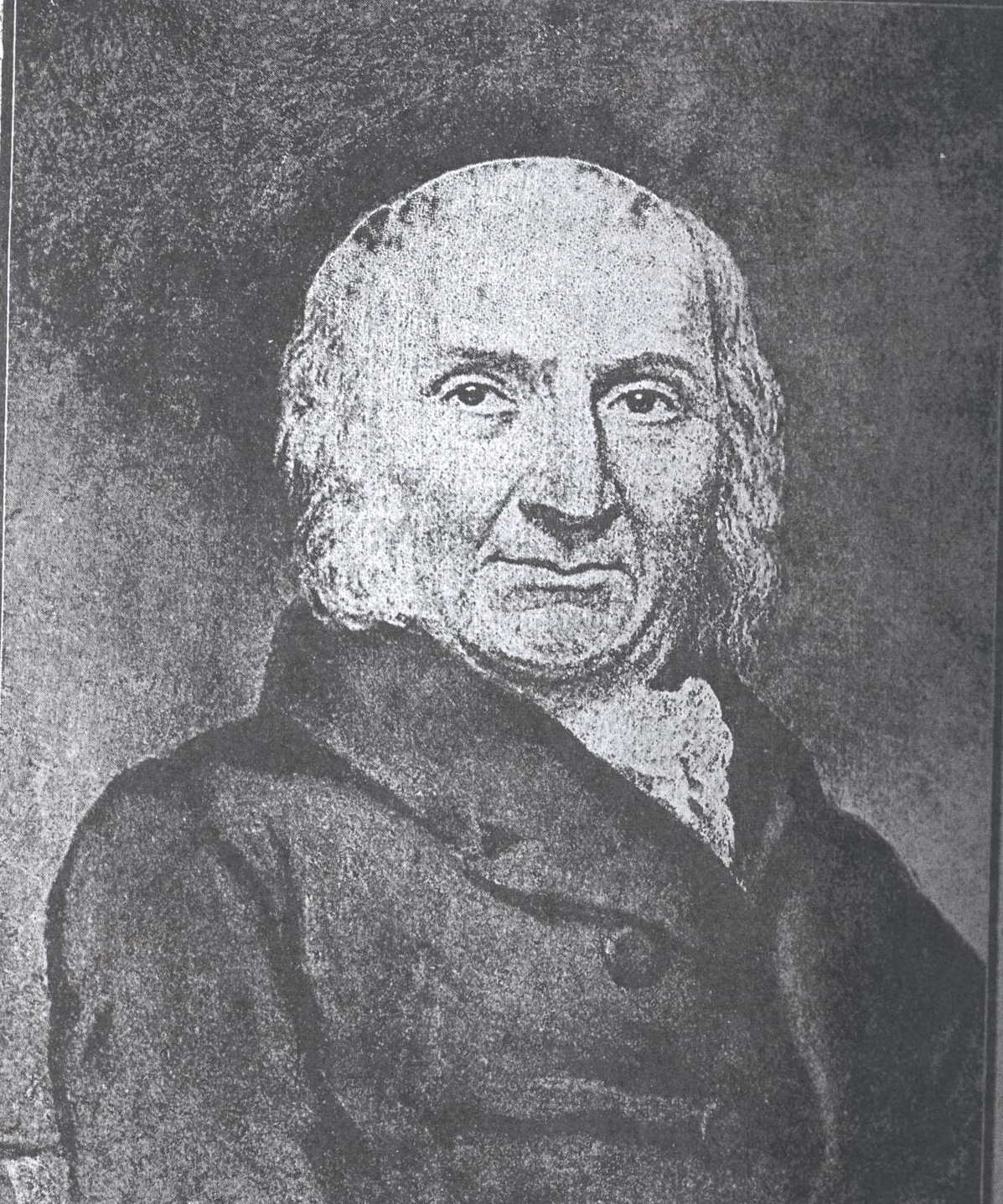
Rev William Atkinson MA

‘Rev William Atkinson’ from ‘Bradford Fifty Years ago, 1807’ by William Scruton
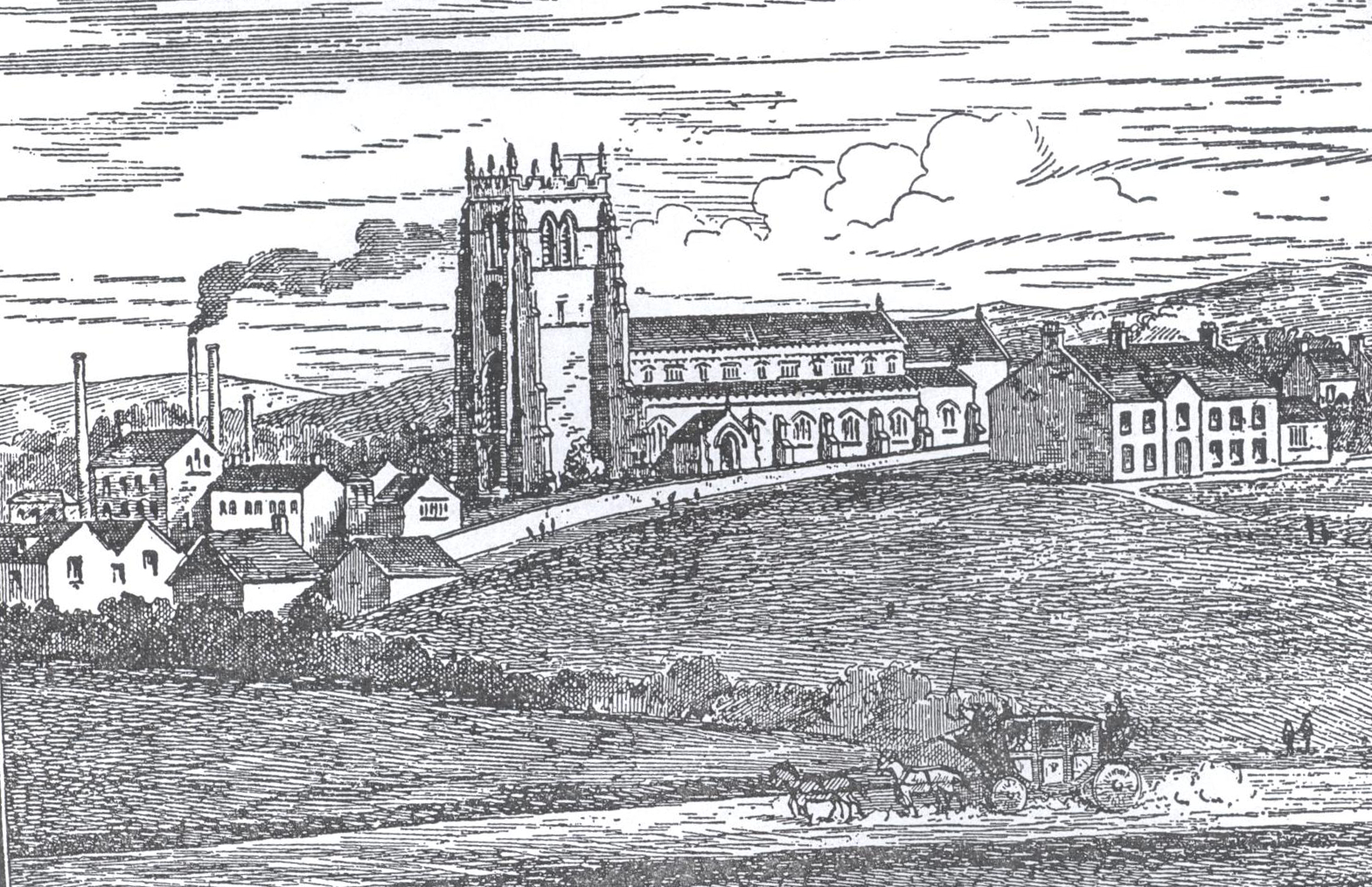
Parish Church and Vicarage 1810

‘Parish Church and Vicarage in the year 1810’ from ‘Pen and Pencil Pictures of Old Bradford’ by William Cudworth

The range of subjects he wrote on was wide: the exportation of wool;  tithes; political reform; dissenters from the Church of England; the Pope; press bias; agriculture; even banking. Anyone interested in understanding our history from 200 years ago would do well to read these tracts. Here, though, we just relish his gift for verse and satire, and be amused at the wit, boldness, and candour of the ‘Old Inquirer’. And maybe wish he was around today!

…  Fee fau fum,

I smell the stink of democratic plum;

And though I love Reform disclosed,

And would by no means clog them;

Yet meeting with bare r – ps exposed

I cannot help but flog them.

(A Letter to the Reforming Gentlemen. 1817, p. 1. Tract no. 5)

Their arms, their arms,

Are the Radical charms,

With which they’ll lay about them;

Order, order,

Says R. D. our Recorder,

They’d better be quiet without them.

(Free Remarks upon the Conduct of the Whigs and Radical Reformers in Yorkshire; with some Slight Allusions to the Court Party, 1819, p.1. Tract no. 7.)

How Johnny Bull

Is made the Gull,

Of Men who love his money,

The wasps who thrive,

Within his hive,

And live upon his honey. (p.12)

(Remarks on the Strictures in the Leeds Mercury upon the Rev. M. Jackson’s Coronation Sermon, &C. &c. &c., 1821. p. 12. Tract no. 7)

A Lily sprung in foreign land,

And grew to be a flower,

It was transplanted to this strand,

But flourish’d not an hour.

(As above, p. 16)

“Alas! No rest to mortal man is given,

Till they are safe arriv’d in heaven.”

(A Speech Intended to have been spoken at a Second Meeting of the Clergy upon the Popish Question, 1821, p 41. Tract no. 13)

The man in the moon,

Has ordered a spoon,

To give all there maniacs their pottage;

No, no, let them go

To the region below,

For the pickle-pot must be their cottage.

(As above p. 51)

I am the Prince’s Dog at Kew,

Whose Dog are you?

(A letter to the Reforming Gentlemen, 1817, p. 14. Tract No. 5)

Granting that he had much wit,

He was rather shy of using it.

(As above, p.13.)

Hallo, hallo, away they go,

Unheeding wet or dry,

And horse and rider snort and blow,

And stars on all sides fly!

Hold  Parsons, hold, on Peggy’s rig,

For stormy is the wind,

Or like John Gilpin’s hat and wig,

You’ll soon be left behind.

(A Letter to one suspected to have been written by a Stranger, assisted by the Jacobin priests of the West Riding, 1801, p. 43. Tract No. 1)

Your reasoning, with wondering stare,

Quoth Tom, is mighty high, Sir;

But pray forgive if I declare,

I doubt it is a lie, Sir:

We ne’er shall get, I really think,

Lord H….w..d’s land to us, Sir,

I’d rather have a pot of drink,

Than hang up like a truss, Sir:

If you think thus, my honest clown’

We’ll take another sight on’t –

Just turn the picture upside down,

And you will see the right on’t.

(Lucubrations in Prose and Verse written during the Awful Revolution in 1829, p. 12. Tract no. 16)

Jerry’s Song to his Tippling Wife.

Upon her cheek so fair,

The lily and the rose,

Of flowers a pretty pair,

Did all their sweets disclose.

But time has cropt that rose,

The lily too doth fade,

Such are the cruel foes;

In wedlock to a maid.

And has time cropt that rose?

Ah, no! it grows it grows,

Upon her well-fed nose,

You yet may see my pretty little rose.

(As above, p.13)

And what of the Frogs, Billygoats, and The March of Reason of the heading to this blog? See:

Tract number 14: A Rapid Sketch of Some of the Evils of Returning to Cash Payments, and the only remedies for them. To which are added The Leeds Mercury turned into a Frog, the Billygoats in Leading-Strings, and The March of Reason. 1823.

A full listing of Atkinson’s tracts can be found in the folder ‘Federer, Dickons and Empsall tracts in the Local Studies Library’. Listed under  B 042 ATK

Stackmole