Map of the Week: A ‘village in uproar’ and the war of Bower’s dog

033 A

Recently a map introduced me to another strange unknown fragment of local history. Legal actions seem to be the explanation of several depositions in the Local Studies Library reserve collection, but after the passage of many decades it can be very difficult to establish what such actions were about, or who won, or why anyone ever thought the issues were important enough to spend a small fortune on lawyers’ fees. I am in a slightly better position with the case of Ferrand v Milligan (1845) since I believe I can provide answers to the first two questions at least, and possibly the third.

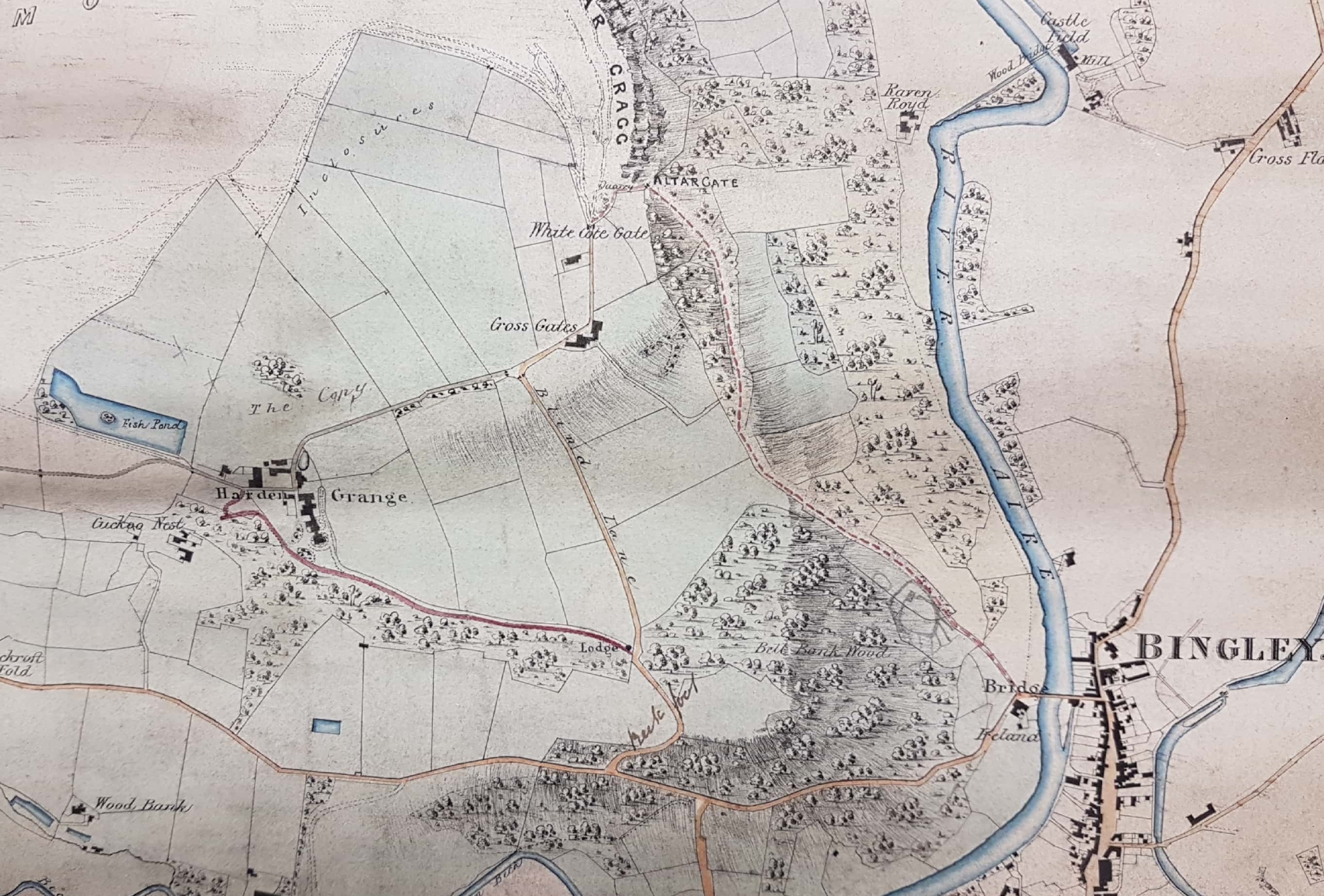
The whole map, of which this is a detail, is additionally marked ‘Plaintiff’s plan No 1’ and so it was evidently once used by Mr Ferrand or his legal team. No railway lines are marked which would suggest a date prior to 1847. In fact it closely resembles the Fox map of the area from 1830 which presumably was redrawn for the purposes of litigation. It is immediately obvious that St Ives is not in its present location. The valuable website of the Friends of St Ives confirms that this house swapped names with Harden Grange a decade or more later, in 1858. The importance of this fact is that the name ‘Harden Grange’ that was used in reports of this case, and which appears on the maps or in my account, was the building we think of today as St Ives. Aside from maps my other researches have been in the pages of contemporary local newspapers.

I am certain that the plaintiff in Ferrand v Milligan was William Busfeild Ferrand (1809-1889), landowner, magistrate, and at this time the Conservative MP for Knaresborough. He lived at Harden Grange and was a friend of Richard Oastler. William’s mother was called Sarah Ferrand. As often happened in the nineteenth century William adopted her surname in 1839 in order to receive a large estate from his maternal uncle. This bequest was ultimately transmitted through his mother when she herself died in 1854. The estate he obtained included both St Ives and Harden Grange, where he was living at the time of the action. The principle defendant is variously named as Mr Milligan or Robert Milligan: who was he? Evidently he must have had at least a modest competence to undertake the expense of litigation and the 1851 census suggests he was Robert Milligan, aged 32, of Harden Mill, worsted spinner. A man of this name had certainly been operating the water and steam powered worsted mill since 1842. There was also a Walter Milligan, aged 57 and born in Scotland, a worsted & alpaca manufacturer of 38 Myrtle Place, Bingley. I think that the two men were probably son and father. Walter Milligan & Son are listed as the proprietors of Harden Mill in many reports until 1861. I should add that Robert Milligan is quite certainly not the contemporary ‘travelling Scotchman’ and Liberal MP of that name who was also Bradford’s first Mayor. This important figure in Bradford’s history had his estate at Rawdon. If Robert Milligan of Harden Mill was indeed the man then he and William Ferrand had been acquainted in happier times. From 1842 there is a pleasant story concerning the properties of both men being visited by children from a Wesleyan Sunday School outing.

William Busfeild Ferrand does not always seem to have been popular with the editors of local newspapers. This should be taken into consideration when reading the initial account of events, published by The Bradford Observer and Halifax, Huddersfield, and Keighley Reporter under the title of ‘a village in uproar’, on 18 May 1843. It describes how a certain James Bower walked, with a terrier dog at his heels, along a road through Harden Grange Fold. There he was allegedly seized by Mr Ferrand and his servants while the terrier was ‘worried to death’ by their dogs. I’m relieved to say that, despite the title I’ve adopted, the poor terrier shed the only blood spilled in these events. Because of local indignation the whole episode was reported to Mr R Milligan, who was then Surveyor of the Highways, and he it was who insisted on the right of the public to use the road concerned.

After that things got rapidly out of hand. Robert Milligan proceeded to break down the gate that led on to the road, and to walk ostentatiously down it with a crowd looking on. Mr Ferrand, it was said, hired men to guard what he evidently considered to be his own property. If necessary his rights were to be protected ‘by force’. An emergency meeting of the ratepayers of Harden was summoned and held in Bingley churchyard. Mr Milligan’s conduct was cordially approved by the gathering. Mr Holden of Cullingworth (the future Sir Isaac Holden but then merely the manager of Townend’s Worsted Mill) proposed a motion empowering Milligan ‘to take such steps in law as may be found necessary for defending the right of the public to use the said road’. An attempt by Mr Middlebrook, a recent Highway Surveyor and friend of William Ferrand, to put any expenses involved squarely on the shoulders of Milligan, rather than the ratepayers, was defeated. The newspaper report was very partisan to the inhabitants of Harden who were praised for resisting ‘oppressive encroachments’.

The inevitable legal case was heard at York Spring Assizes in March 1844 before Judge Coltman; bizarrely William Ferrand JP MP had already been sworn in as a member of the Grand Jury for these assizes. It is clear from reports that the action was for trespass against Milligan, and others, in order to try whether the road which went through the grounds of Harden Grange was indeed a public highway or not. Mr Baines represented the defendants and examined no fewer than 31 witnesses! Mr Knowles for the plaintiff admitted that some local residents and their carts were accustomed to use the road, which ran through a considerable portion of the Harden Grange estate, but he disputed that they had a ‘right’ so to do. He explained that the road had been created in Major Ferrand’s time (c.1797) when he was a tenant, and also that William Ferrand was not actually the owner of Harden Grange but ‘entail expectant on his mother’s death’. He further stated his belief that Mr Milligan was animated in his actions by some private feeling, and finally he demanded in excess of 40 shillings damages. The unfortunate jury were then locked away from 7.00 pm until 4.00 am the following morning! With nice judgment they found that there was indeed ‘no carriage road or public foot road’ in existence, but rather than £2 or more the plaintiff (William Ferrand that is) was awarded only the derisory sum of one farthing in damages.

This was not quite the end of the matter. In another bizarre twist there was an associated criminal case, against Milligan and his servants, which saw him hauled up for ‘riot and assault’. The plaintiff and his barrister seem to have understood that Milligan honestly believed he had a right of way past Harden Grange. Mr Ferrand stated that he wished to live in ‘peace and goodwill with his neighbours’ and as a result offered no evidence against him: consequently the prosecution failed. Rather ominously Mr Milligan said that ‘nothing had occurred yet that had shown him that he was mistaken’ and so unsurprisingly, a year later, he tried to renew the action. The legal point at issue was under what circumstances the road had been repaired in Major Ferrand’s day and whether repair was at his own expense, or that of the parish. There was also some doubt over whether this evidence was really admissible: a rather a complicated point for a non-lawyer like me to follow. In any event a further action was not allowed by the court. That didn’t restrain the Bradford & Wakefield Observer who reported that ‘in this weather’ it was dangerous to cross the path of William Ferrand on the moors about Harden Grange.
033 B

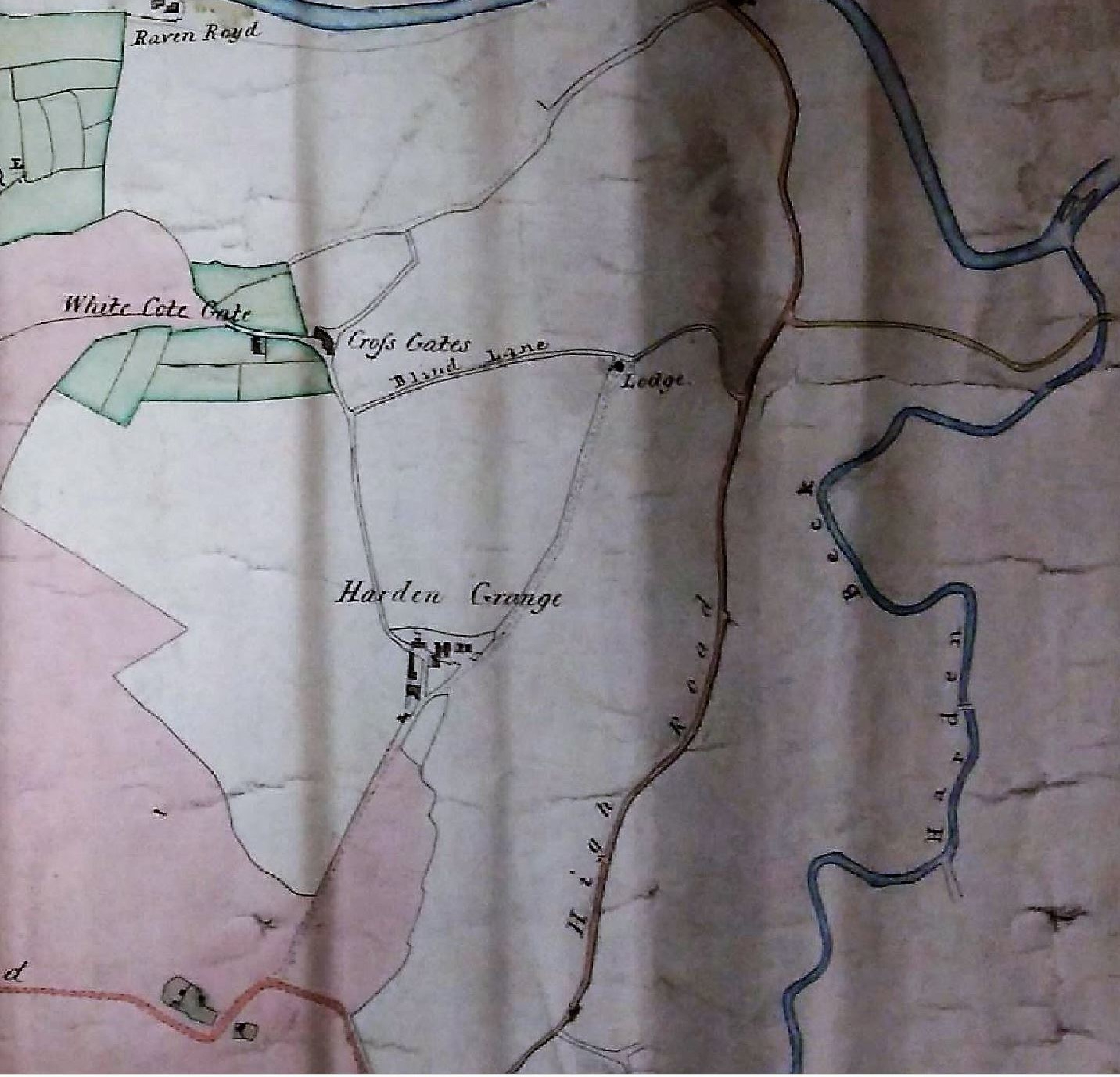
The original map identified in red the trackway which, I assume, the defendant was using without permission. This extended west from the ‘Lodge’ towards Harden Grange and Cuckoo Nest. It is interesting to note that the Fox 1830 map of the roads between Bingley and Keighley also shows the thoroughfare at issue.

033 C

Finally the first OS map of the area which was surveyed around 1847, after the action and the same year that William Ferrand lost his Knaresborough seat, does not mark the trackway as a private road but scarcely shows it at all. The triumph of local landed interest over geography perhaps?

Derek Barker, Local Studies Library Volunteer


Map of the Week: Dubb Mill, Bingley

032 A

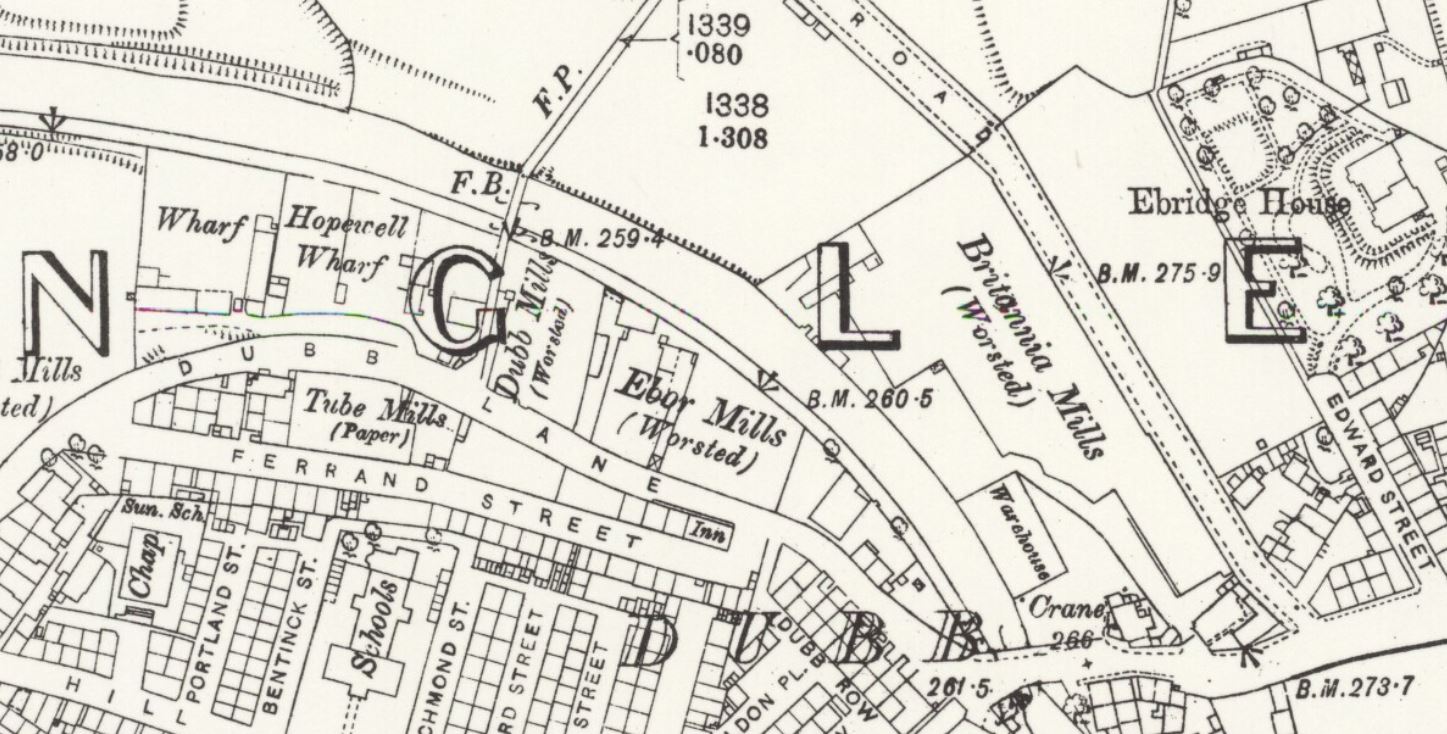
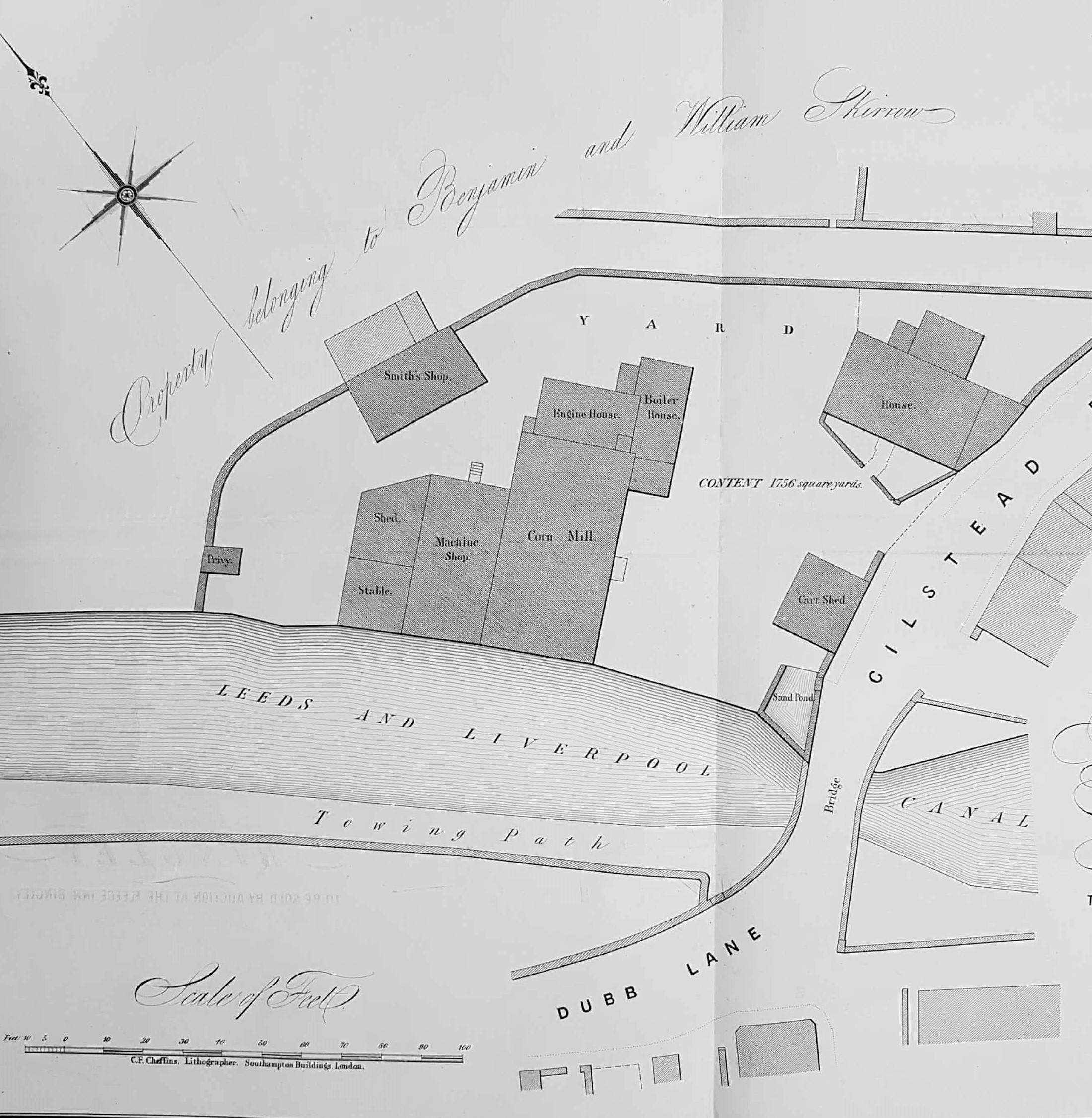
This plan features a site at Dubb Lane, Bingley adjacent to the Leeds and Liverpool canal. It was drawn up by a surveyor, E.S.Knight, in 1853 when the freehold property was to be sold by auction at the Fleece Inn. Sale plans are a significant source of the Local Studies Library’s reserve collection maps, and the buildings or property surveyed in such plans are naturally displayed in far greater detail than in contemporary Ordnance Survey maps. This complete plan should generate a LSL classification of BIN 1853 KNI and indeed there is such a card in the map index file. I cannot find the plan itself however so possibly this reserve collection example is the only copy now available. The main building is clearly labelled Dubb Mill and shows a steam powered corn mill with an adjoining residence. To reinforce this material it was not difficult to find the same auction being advertised in the Leeds Mercury. The mill was apparently three stories high and the house, stables, mechanics’ and blacksmith’s shops were also listed. The grinding was seemingly undertaken by six pairs of French stones. The benefits of the location, close to the canal and railway, are made clear. Mr E.S. Knight, was a land surveyor of Queensgate in Bradford. Particulars concerning the property are said to be obtainable from George Beanland of Great Horton. Identifying him was my first difficulty. There is a man of this name in Horton at the time of the 1861 census who is an agent but George Beanland of Messrs. George, Joseph and John Beanland, corn and flour dealers of Beckside, is perhaps more likely to be the man involved. Unfortunately no owner or vendor of the corn mill is mentioned by name but at the time of the sale the yearly tenants are Messrs William England & Son, and the under-tenant one Jonathan Cryer. According to the London Gazette, in the following year the partnership of William England & Son of Bingley was dissolved and the assets were transferred to brothers Abraham and William England. Interestingly the newspaper advertisement promotes the idea of converting the corn mill to cotton or worsted spinning, which is very pertinent to my subsequent analysis.

I think that we can be sure of the mill’s earliest possible date of construction since it is so closely aligned on the canal. This canal section was completed by 1774. The shape of the site, and its position adjacent to a canal bridge, makes it easy to identify in other maps even if the buildings are unnamed. There is no doubt that the mill is present in the earliest map available to me, the 1819 Fox plan of Bingley, but if Dubb Mill was always powered in the same way it cannot have been as old as the canal since the first steam powered corn mill was only built in Bristol five years after the canal was opened. Moreover the 1819 building block plan does not seem to allow for the engine and boiler house, yet what other power supply could there have been? I should say that it was by no means unknown for corn mills to be converted to textile mills, although was rare for conversions to move in the opposite direction.  Some 35 years after the mill sale, in the OS 25 inch map of 1889, there is simply a warehouse at this situation which appears to be part of Britannia Mills. At that date, if you crossed the bridge and walked along the towpath on the opposite side of the canal in the direction of Bingley town centre, you would pass Ebor Mills (worsted) to reach a second worsted mill by then itself called Dubb Mill.

032 B

A few years before our plan, in the first OS map (surveyed in the late 1840s), the older Dubb Mill is naturally present although no indication is given of its function. At the position where in 1889 there was situated what I might call ‘new’ Dubb Mill there are three buildings labelled as cotton mills. A later map suggests that these units were also called Dubb Mills, which must surely have caused confusion. It may come as a surprise that cotton is being processed in an area so strongly associated with worsteds but in fact Keighley was a centre for the cotton industry in the early 19th century.

Establishing the history and ownership of the Dubb corn mill up to the time of its 1853 sale was the problem I set myself. An obvious source of information was Harry Speight (Chronicles and Stories of Old Bingley, 1898). He mentions a man called Robert Ellis, who seems to have been the brother of Bradford Quaker James Ellis. Robert took ‘the old Dubb corn mill’ about 1818 and was joined by James in 1822. Is this the same Quaker James Ellis who was so active in famine relief in Connemara in the late 1840s? Probably: Ellis & Priestman were partners in corn milling at Queen’s Mill, Mill Bank, Bradford which I believe vanished when Sunbridge Road was constructed. Speight also describes the construction of an ‘early worsted mill’ with an attached residence by Joseph and Samuel Moulding. This would certainly be an accurate description of the building on our plan in all respects except for the type of mill involved.

Speight wrote that about 1825 William Anderton took part of this mill but soon began building premises of his own in Dubb Lane for wool combing and spinning. These later buildings, he wrote, were later occupied by ‘the Ellises’ who raised and enlarged them for cotton spinning, and a new mill was built on the opposite side of the road which for some years (in the late 19th century this would be) was occupied by Samuel Rushforth JP. We seem then to have four mills to explain: the old Dubb corn mill, an early worsted mill constructed by the Mouldings, the Anderton-Ellis mill, and the Rushworth new mill which is perhaps the ‘new’ Dubb Mill. I’m not claiming that they all were in in operation simultaneously, nor that they retained one function during the full periods of their existence. I cannot see that the brothers Ellis took on our corn mill since Speight describes their corn mill as ‘old’ in 1818 when ours was spanking new. If our mill was constructed for textile manufacturing is it likely that the building would subsequently have returned totally to grain processing? The best evidence that touches on this point is the 1865 Smith Gotthardt plan of Bingley.


032 C

The detail is inverted but allowing for this you can clearly see that twelve years after the 1853 sale our mill is still present and is unquestionably labelled as Moulding Mill and the cotton processing units as Dubb Mill. It seems likely then that Speight’s second statement is correct and some members of the Ellis family actually moved to the Anderton worsted mill. I tried to obtain further information about these mills from the on-line 19th century copies of the Bradford Observer and Leeds Mercury. Unfortunately many entries and advertisements simply mention ‘commodious mills at Dubb’, providing neither mill name nor owner. Nor did trade directories provide simple answers. The 1822 Baines directory at least suggested that several characters in our story have an interest in the licensed trade: J & S Moulding were at the Shoulder of Mutton, Bingley and W Anderton at the Pack Horse, Cullingworth. I know that Mr William Anderton (1793-1884) certainly came from Cullingworth, even if he wasn’t the publican mentioned in my last sentence. His Bingley enterprise features in the Factories Inquiry Commission of 1834. His premises were described as steam powered and undertaking worsted yarn spinning. There were 56 people employed (16 under 12 years of age) which seems reasonable for a small mill. The employees’ hours of work were 6 am-7.30 pm. The machinery was stopped for a dinner break of 45 minutes at noon. There were six holidays per year (8 days total) when whole factory ‘stood’ and no wages were paid. Anderton’s mill is described as Dubb Mill, Bingley ‘a mill erected in 1819’ so I am reasonably sure this is the mill in our plan.

Inconveniently 1842 White’s Leeds & Clothing District directory does not record any corn millers working in Dubb, but William Anderton and Joseph Moulding are given separate entries as worsted spinners & manufacturers. Helpfully there is a small item in the Bradford Observer from 1848 to the effect that asignees of John Robinson, a Moulding tenant, were trying to sell power looms and machinery but this attempted sale would be prevented by ‘executors of the late Joseph Moulding’. It seems unlikely that such a building would have been re-equipped as a corn mill before being sold five years later but I cannot think of another explanation that fits. In 1843 a Joseph Moulding (1775-1843) of Dubb was buried at Bingley Parish Church.

Meanwhile life at William Anderton’s mill was not without incident. In 1850 the Bradford Observer recorded an assault on Fanny Broadly which arose from a ‘dispute over bobbins’ at Dubb. In the census of 1851 William Anderton is living at Wellington House, Wellington Street. He describes himself as a worsted spinner & manufacturer employing 240 males 265 females. This sounds like a reasonably large operation and must surely indicate new premises. Remarkably 30 years later William Anderton was still alive, at the age of 88, and living with his daughter Mary and son in law John Brigg (another textile man) at Broomfield House, Keighley. As I have mentioned Anderton’s mills were taken over by the Ellises of Castlefields Mill for cotton spinning, and their operation presumably represents the cotton mills present on the first OS map of the area. At the end of the century the name Dubb Mill is associated with Samuel Rushworth JP, woolspinner and manufacturer. Rushworth was a famous teetotaller who died in 1896 aged 52. His mill must have been the new construction mentioned by Speight. I assume that this is the new Dubb Mill on the 1889 OS map.

I have tried to pull all this together. There must have been an old corn mill in Bingley, possibly close enough to the river Aire to use water as a power source. Castlefields Mill was constructed in the late 18th century and by 1805 was run by Lister Ellis who stayed until 1829. In 1818-19 Messrs Joseph & Samuel Moulding constructed the first Dubb Mill. If it was a worsted mill hand-combing and weaving seem quite likely at that period. William Anderton may have later been involved with this building but by 1825 he was building his own mill nearby in Dibb Lane for wool-combing and spinning. William and James Ellis took this over for cotton spinning and Anderton must have used other premises. In the later 19th century Samuel Rushforth, who had started life working for Anderton, adapted the cotton mills and rebuilt a new Dubb Mill. My guess is that once steam power was introduced at the old Dubb mill it could function either as a corn mill or worsted mill and performed as both at various times. It clearly survived until 1865 but was later converted into warehouse, or rebuilt in that capacity by 1889. I know that interest in local history is very strong in Bingley and I’m hopeful that somebody will be able to put me right on aspects of this complicated story especially the matter of how many men called Ellis were there, and what exactly were their relationships.

Derek Barker, Local Studies Library volunteer

Further Reading

George Ingle, Yorkshire Cotton: the Yorkshire Cotton Industry, 1780-1835: Carnegie Publishing, 1997.
A very readable introduction although there is no mention of any mills in Dubb.

Colum Giles & Ian H Goodall, Yorkshire Textile Mills 1770-1930: RCHME & WYAS, 1992.
A beautifully illustrated general guide but one that does not answer any of my questions.