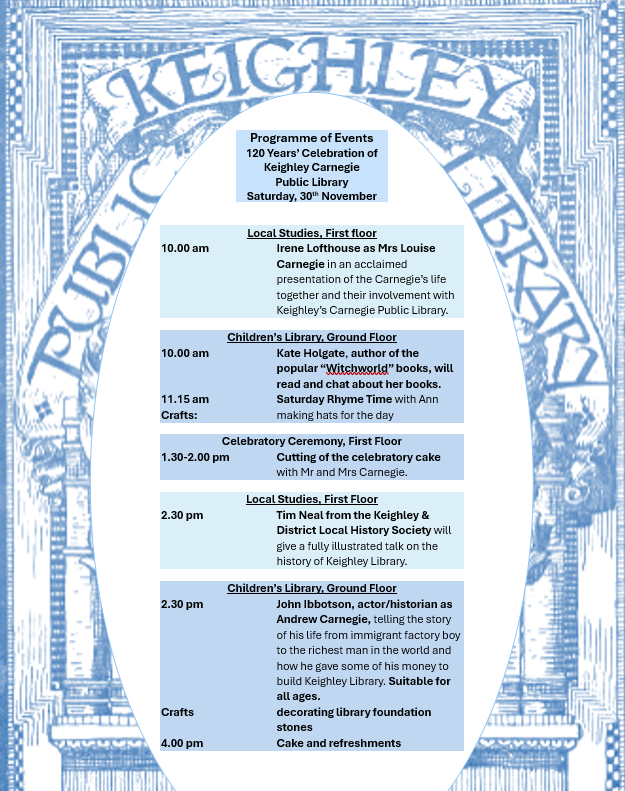
As many of you will know, Keighley Library is 120 years old this year. It was the first library in England to be financed by the Scottish American billionaire and educational philanthropist, Andrew Carnegie and is an architectural gem of the town. It opened its doors on 20 August 1904 and to celebrate this milestone, a programme of events has already been launched for the year ahead 2024-2025 with regular updates on this site.
It is with great pleasure that we would now like to invite you to a day of celebration on Saturday 30th November when we will look at the development of the library, its founders and influencers. As you can see from a packed programme, there is something for all the family and we look forward to seeing you there.
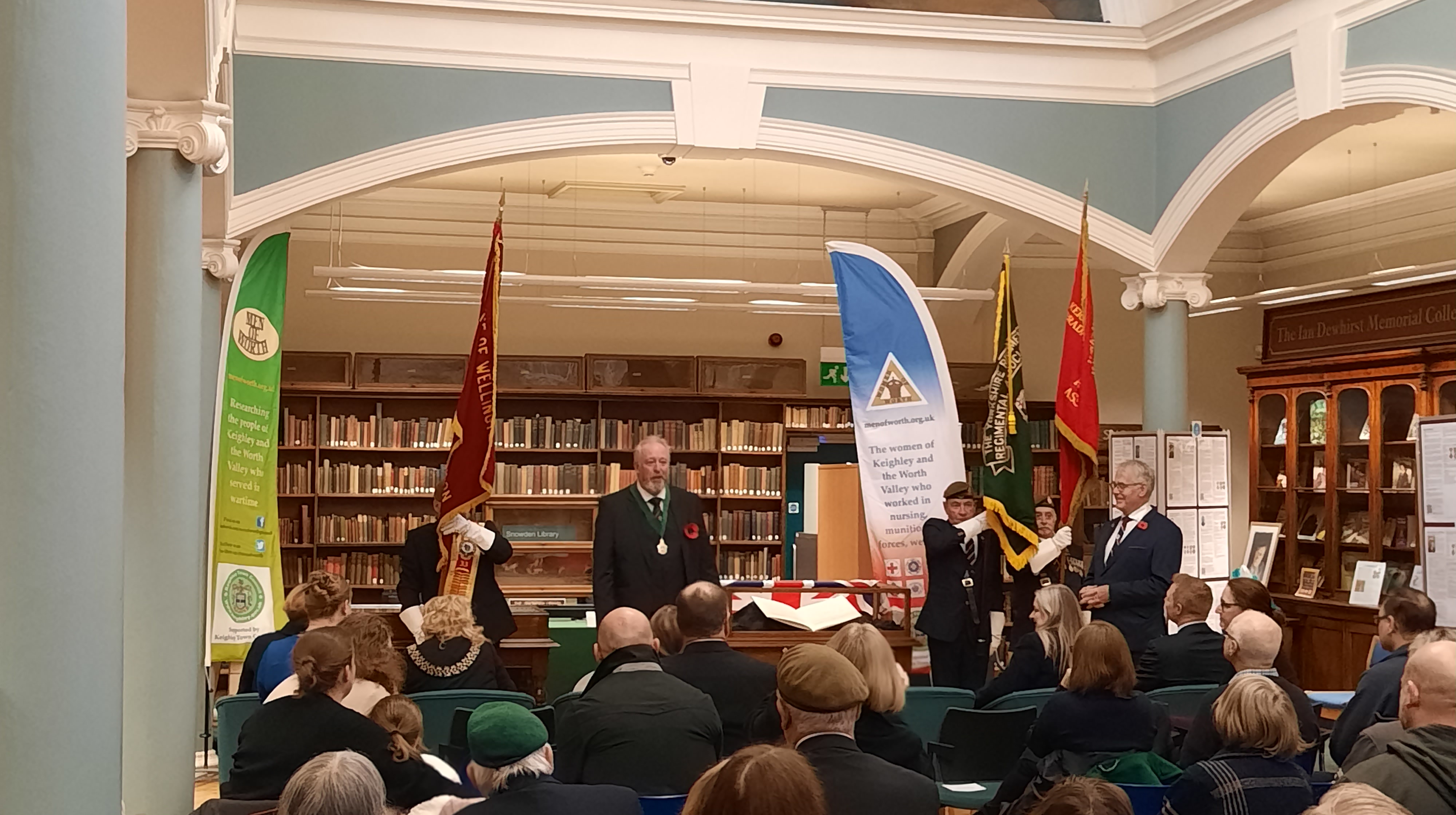
KEIGHLEY’S revised Great War roll of honour was formally unveiled during an event at Keighley Local Studies Library on 9th November. The names of 102 servicemen and one woman who gave their lives during the First World War had been missed from the original roll.
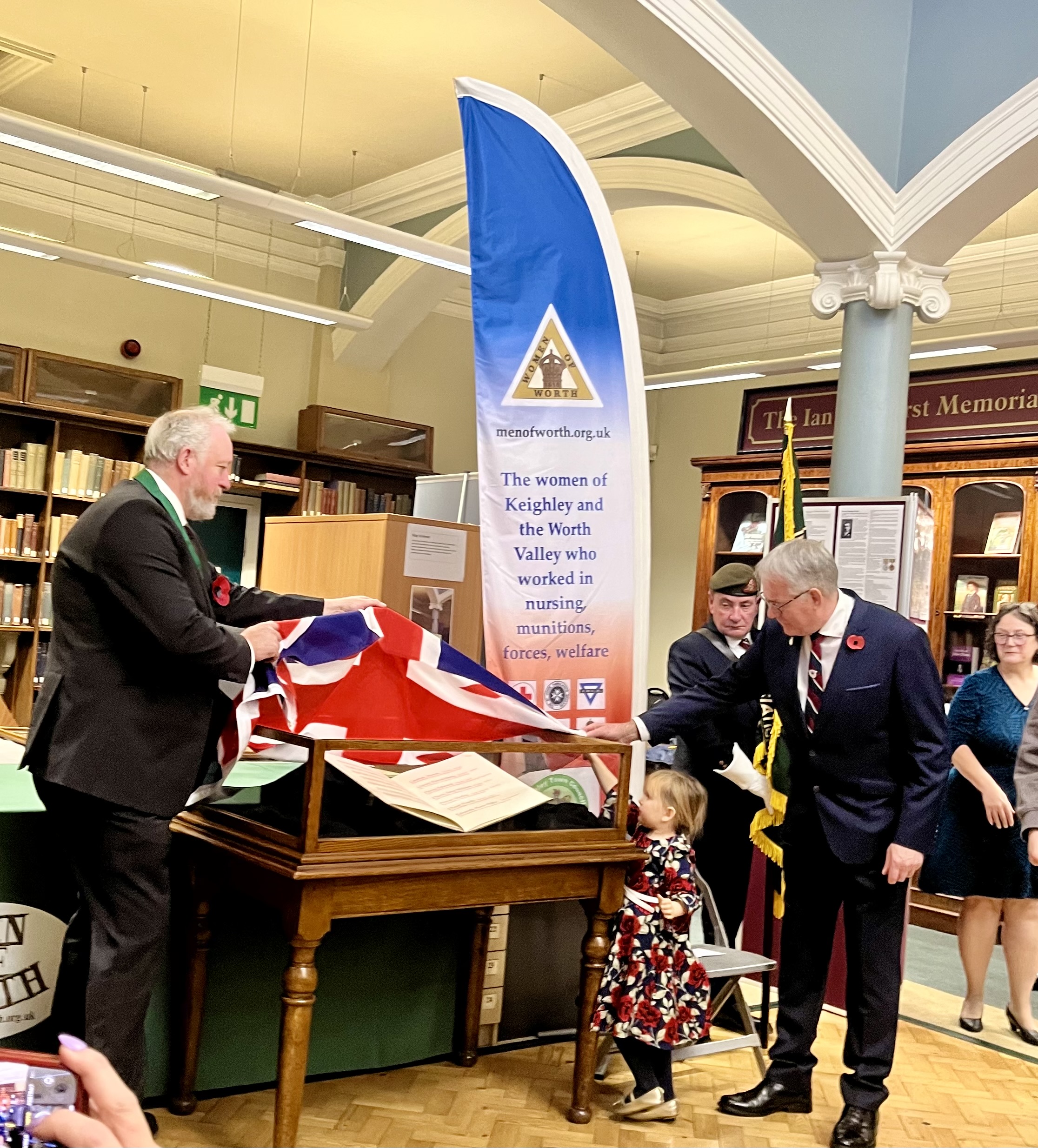
The unveiling was performed by three-year-old Libby Griffiths, Ryan Firth, 16, and Liam Firth, 14. All three are descendants of Private Jowett Coulton, who was born in Keighley and lived in the town before emigrating to Canada, where he enlisted in the army. He was killed in action in France.
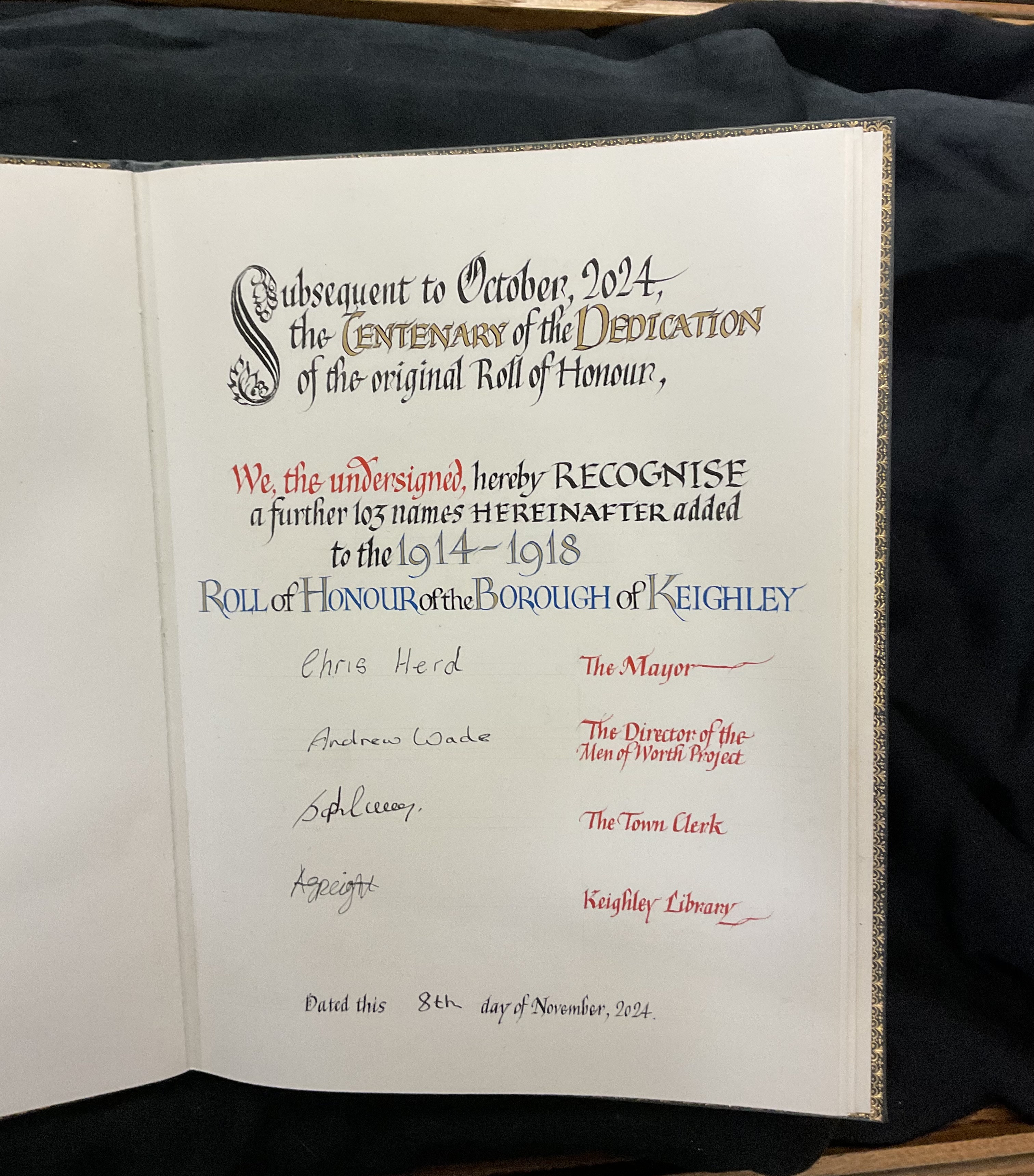
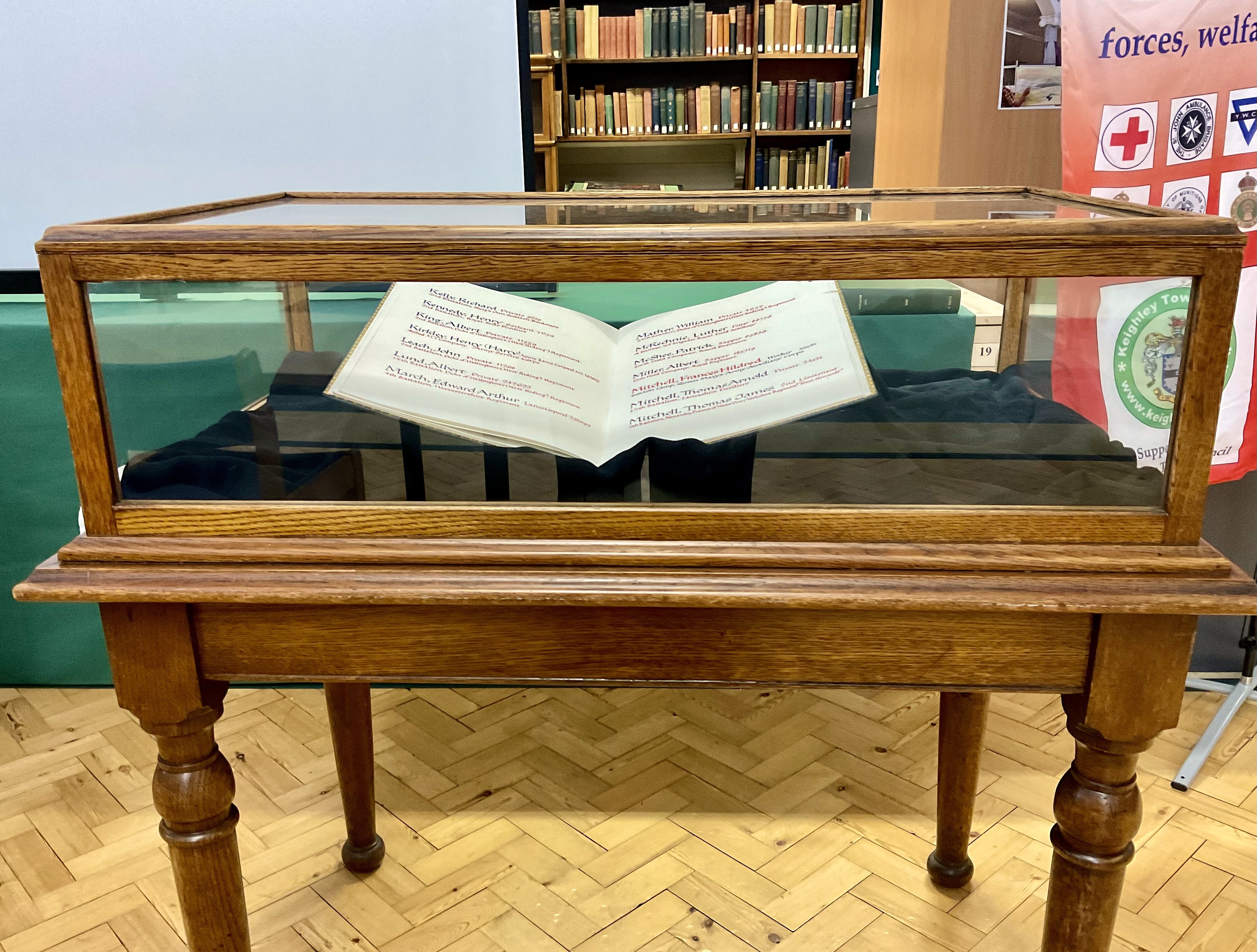
Libby Griffiths unveiling the Roll of Honour with Deputy Town Mayor Cllr Chris Herd and Andy Wade, of The Men of Worth.The signature page of the updated Roll with its 103 new names, signed by the parties involved in its creation. The Updated Roll of Honour on display upstairs in the Local Studies Library, Keighley Library.
The Men of Worth Project were awarded funding by the National Lottery’s Heritage Fund in early 2024 and this has been supported with funding from Keighley Town Council.
The purpose of the grant was to add more names to the Borough of Keighley Roll of Honour and to celebrate the centenary year of the original book and our wonderful Borough of Keighley War Memorial, which was unveiled in Keighley’s Town Hall Square on 7th December 1924, attended by several thousand people.
Lord Mayor of Bradford Councillor Bev Mullaney, Bradford Council Leader Councillor Susan Hinchcliffe, Director of the Men of Worth Project Andy Wade and Bradford Councillor Caroline Firth.
Other relatives of those honoured were present, together with guests including West Yorkshire Deputy Lieutenant David Pearson, MP Robbie Moore, Lord Mayor of Bradford Councillor Bev Mullaney, deputy town mayor Cllr Chris Herd, Bradford Council leader Cllr Susan Hinchcliffe, district and town councillors and standard bearers.
Head of Libraries & Archives, Christine May talks about the libarary’s history with the Roll of honour. Andy Wade of The Men of Worth talks about the project. Irene Lofthouse portrays Frances Hildred Mitchell, the first woman to be added to the Roll.
Cultural historian Irene Lofthouse adopted the guise of Frances Hildred Mitchell – the first woman to be recognised in the roll alongside the men. Frances was a Queen Mary’s Army Auxiliary Corps worker she died aged just 23, from influenza and pneumonia while still nursing in military hospitals a year after the war had ended.
Deputy Town Mayor Councillor Chris Herd with Standard Bearers
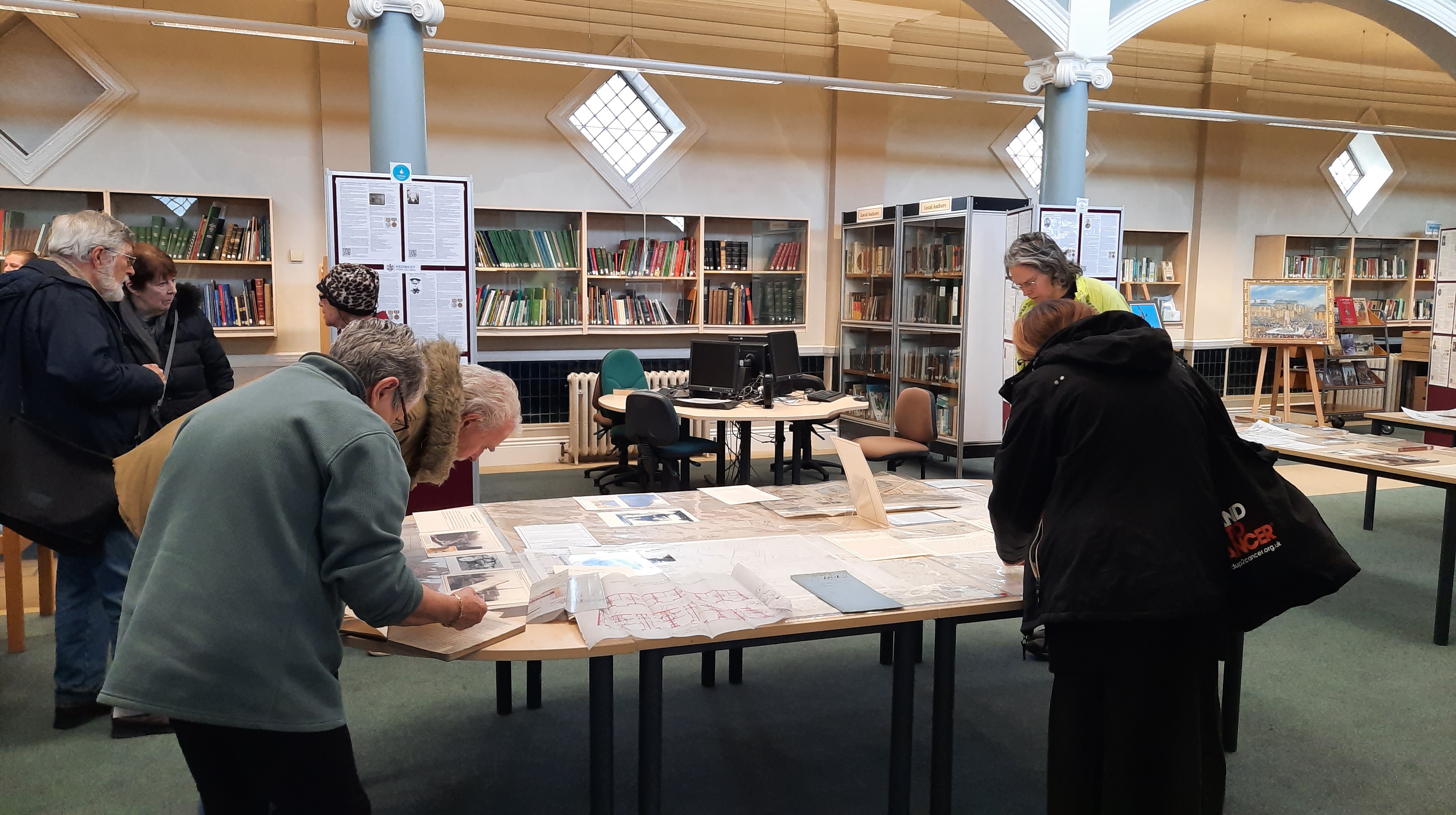
The new Roll of Honour and the original Roll of Honour are on permanent display upstairs in Keighley Local Studies Library and an exhibition by The Men of Worth Project on all those added to the new Roll of Honour is on display until December the 6th 2024.
December the 7th marks the 100 year anniversary of the War Memorial and Roll of Honour, at noon, an interpretation plaque will be unveiled at the town’s war memorial. For more information about the project please see the link below.
Back-to-back housing was the topic of Jude Rhodes’ talk this week, the second in the series of illustrated presentations by this wonderful speaker and although these houses are still all around us in their later improved incarnations, back-to-back history continues to surprise us.
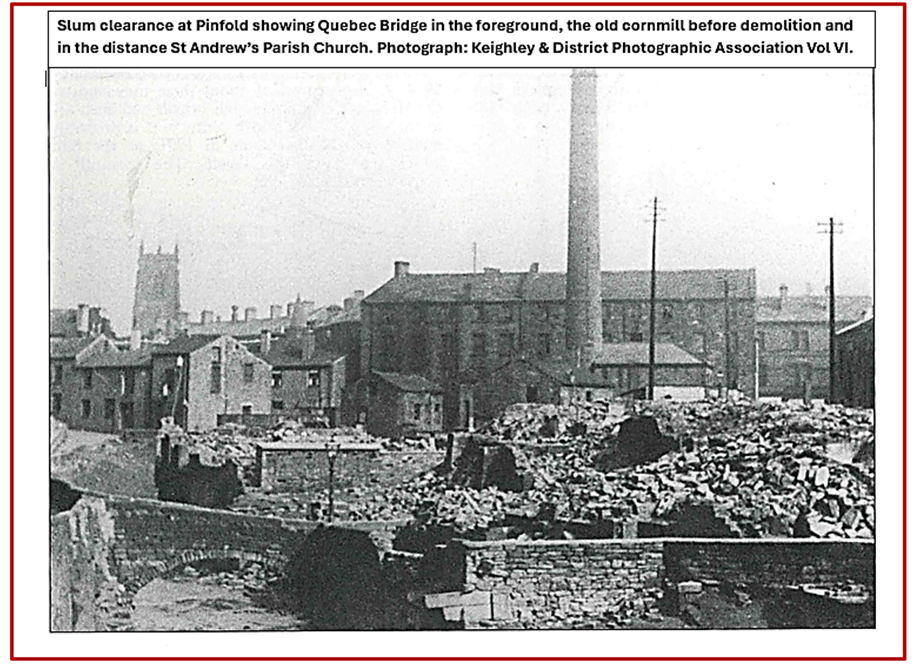
Back-to-backs were first mentioned in Bermondsey as early as 1706 and were built in Birmingham and Nottingham in the 1770s, Manchester and Liverpool in the 1780s. Leeds began to build them in 1787 and has the most back-to-backs in the country. Keighley’s own early workers’ housing was centred around West Lane at Westgate, including the Pinfold area, its terraced early back-to-backs include Leeds Street and Turkey Street, see illustrations.
The early back-to-backs houses usually consisted of a kitchen room with 2 bedrooms on the floor above and a cellar place for coal. Houses at the rear were usually accessed by tunnels from the street. They were popular for cheap rents and running costs but were unsanitary with shared middens and water supply, small windows and generally a lack of ventilation with subsequent damp. There was much overcrowding and Jude illustrated this with 40 Birmingham houses sharing 3 privies, that’s potentially 160 people. Piles of human and other waste were added to make “midden heaps” that were cleared into the rivers, becks or streams by the Night Soil Man or left to pile up in the yard before spilling into open sewers, basically ditches with water running through if the gradient was good, if not then waste was left to stagnate, producing poisonous and noxious fumes. Water from rivers, becks and streams could so easily carry typhoid and dysentery, such was the pollution before proper sewerage systems.
Bye-laws and the Public Health Act of 1875 tried to improve workers’ housing and improved back-to-backs were built. These were referred to as “byelaw terraced” housing. These houses had to meet minimum standards of build quality, ventilation, sanitation and population density. Significantly, this type of housing made up over 15% of the United Kingdom’s housing stock in 2011 and gentrification has taken place for some, as at Chimney Pot Park in Salford.
The overcrowding, insanitary conditions and deterioration of much early housing caused concern, not least amongst employers who required healthy workforces to fill their factories and mills. The Brigg family of Calversyke Mill in Keighley built better back-to-back housing in Lynum Street, however their hopes to build a model village like Sir Titus Salt in Saltaire was prevented due to the inadequacy of the water supply there. Later they sold extensive land around Guard House that enabled the building of Keighley’s first 136 Corporation houses at Guard House in 1928 with gardens, space, light and sanitation. James Lund of North Beck Mill built houses near his gift to the town of Lund Park and some of his houses, post 1878, remain in Calton and Chelsea Streets. Robert Clough of Clough Mills built houses in what is known today as the “Jewel Box” area of Keighley, called after the names of five streets: Opal, Diamond, Ruby, Pearl and Emerald. The list of house planning millowners goes on though not for model villages.
Slum clearance began in the 1930s and went through stages up to the 1970s. In Keighley, much early housing was cleared when the Housing Act of 1930 allowed for compulsory purchase of the proven inadequate housing for demolition. Jude highlighted the destruction of community in the process, however, and some members of the audience noted Parkwood in the 1960s. Not everyone wanted to leave their homes, improvement yes, not demolition and rehousing. Stories from the audience included a de-lousing procedure for inhabitants of “slum dwellings” before access to alternative housing was permitted. Dr Ian Dewhirst MBE in “A History of Keighley”, page 132, highlights the loss of “landmarks in the folk-geography of generations: the Bay Horse Inn and the Angel… the picturesque Quaker meeting-house in Mill Street; the pinfold where stray livestock had been impounded; hump-backed Quebec Bridge, scene of many a Saturday-night brawl…”
Time marches on sometimes leaving shock waves in its wake as in the final fact Jude noted, that her “all time dream home”, her former grandparents’ back-to-back in Leeds, where they struggled to live comfortably, is today not even affordable to her. How things change.
Jude Rhodes is an Associate of the Association of Genealogists and Researchers in Archives (AGRA), specialising in Yorkshire history. She is she explains, “passionate about using local history with family history, this provides the exploration of who our ancestors were, why they lived in a particular place and how they were part of their community at a given time”.
Thank you to all who attended, please find an earlier blog with future talks listed into next year. Please note these are free events and also a place booking is required for that on the 11th December 2024, Christmas Family Traditions and Crafts, contact Keighley Local Studies. Poster with details is with this blog.
Jude highlighted some resources and museums during her talk, here are some mentioned below revealing the back-to-back history experience:
For building plans, OS maps, photographs, town plans, Borough records, and at least 2 in depth studies on the housing of workers and employers, please see Keighley Local Studies Library, North Street, Keighley keighleylocalstudies@bradford.gov.uk
National Library of Scotland online collection of town maps and plans for England and comparative recent aerial photographs for study https://maps.nls.uk/os/
An illustrated talk about the banner of the East Bradford Socialist Sunday School in Laisterdyke
Bradford Local Studies Library, Margaret McMillan Tower, Princes Way, BD1 1NN (side entrance).
Thursday 31st October 2024
Doors open at 1:00 pm for a 1:15 pm start
This is a free event, but booking is essential.
For more information or to book a place please telephone or email Bradford Local Studies Library, Telephone 01274 433688; Email: local.studies@bradford.gov.uk.
These talks are given by members of FoBALS (Friends of Bradford Archives & Local Studies) in association with Bradford Local Studies Library and West Yorkshire Archives Bradford.
The first of a series of talks on family and local history topics was launched on Wednesday, 23rd October in Keighley Local Studies Library with Jude Rhodes as speaker. Jude is an Associate of the Association of Genealogists and Researchers in Archives (AGRA), specialising in Yorkshire history. She is “passionate about using local history with family history, this provides the exploration of who our ancestors were, why they lived in a particular place and how they were part of their community at a given time”.
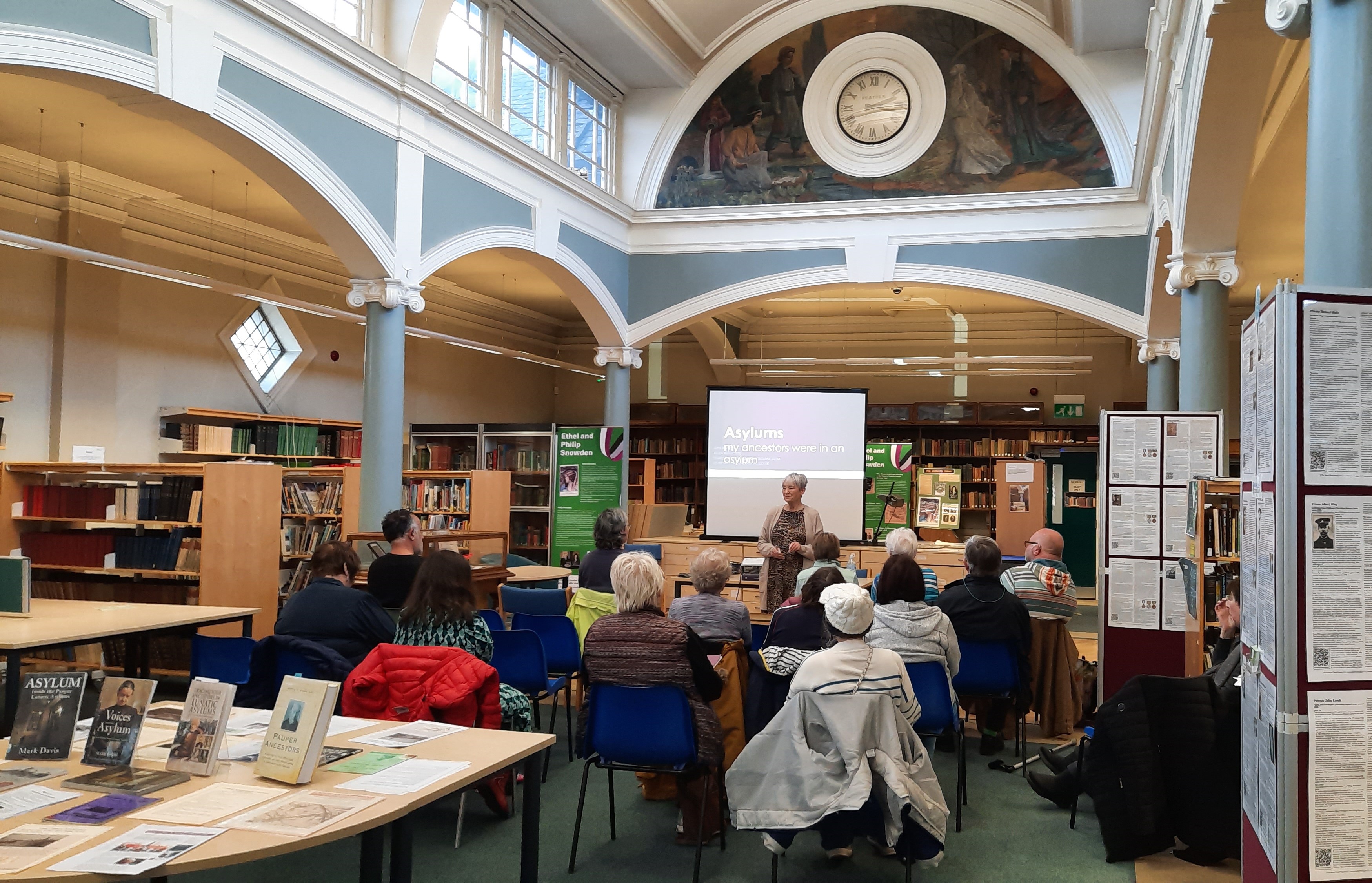
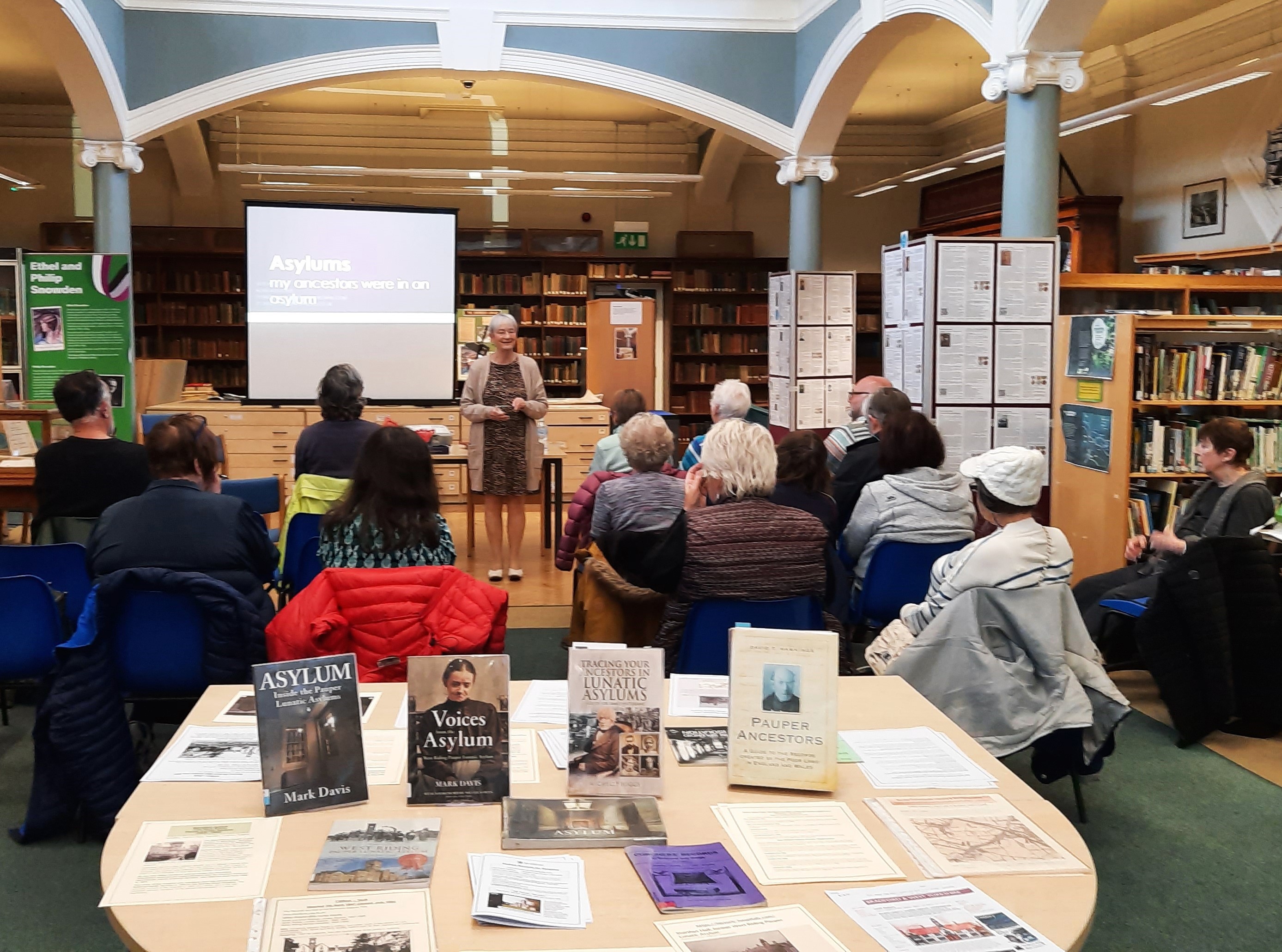
The topic this time was Asylums, looking at their history, categories of patients, care provided and life in an asylum, followed by location and access to records. From the start the audience was advised that some of the terminology was difficult to hear and would never be used today but that these terms were mentioned to accurately depict the historical times and attitudes.
Jude began before Henry VIII and noted how monasteries and nunneries had been a support outside London which was the only place that actually had a hospital, Bethlem, later known as Bedlam. There were private “madhouses” but generally and for those of limited means, care for mental health would be entirely dependent on family and friends and this was the case under the old poor law, when the only alternative was the workhouse or prison. The Lunacy Act of 1845 under the new poor law stated that asylums, “Union Asylums”, had to be built but it wasn’t until the 1930s that asylums started to be called mental health institutes.
Historic categories were quite astonishing and could include: “refusal to pray”, “inability to feel pious”, “weeping”, “talking too much” (known as “excitement”) and even “hatred of spouse”. Syphilis was rife at this time, it ravaged the body but in time, the brain too and there were many innocents infected along the way. According to statistics, industrial areas, ports, the military and some mining towns were especially prone to the spread of this infection also known as “Ladies Disease” for women infected. Jude readily acknowledged the dangers of misdiagnosis in the past, with single pregnant women committed, menopausal women and those with post- natal depression, similarly those people with epilepsy or with bipolar and with dementia in old age. The early years after WW1 saw many former soldiers admitted with the effects of shell shock. It was also agreed during the discussion with the audience after the talk that many people in less supportive historical periods may have suffered circumstantial stress that if continuous had led to total breakdown in mental health.
However, Jude also pointed out the advances made at such as Wakefield’s Stanley Royd (1818-1995), formerly known as the West Riding Pauper Lunatic Asylum, that was one of the world’s most famous and active research institutions and led to global scientific changes in the treatment of the mentally ill. Its collection is held at Wakefield District Archives and there is a digital archive at www.wakefieldasylum.co.uk and an online tour at https://museumofthemind.org.uk . Similarly, Clifton in York (1847-1994), under the Medical Superintendent, Dr John Ivison Russell, pioneered in the field of occupational therapy. These larger institutions such as Menston (High Royds) were run as self-contained communities with their own farms, churches, cricket grounds and in Menston’s case, its own railway line connected to the Midland Railway to carry supplies, mainly coal for the boilers. Menston (1888-2003) site was 300 acres and opened with a capacity of 800 beds. There is a digital archive at www.highroydshospital.com and records are held at Wakefield District Archives.
Other local asylums include Scalebor Park, Burley in Wharfedale, a private asylum, and also with records at Wakefield Archives, with an illustrated history on the Burley Archive’s web site at https://burleycommunitylibrary.weekly.com and Storthes Hall, Kirkburton and you can find more about all the hospitals and see images at https://historic-hospitals.com .
Jude finally spoke about her own personal journey through the archives, having had a great grandfather who was an attendant at High Royds and a grandfather who was a also a patient. She now believes that her grandfather was admitted suffering from the effects of shell shock after the First World War that he never recovered from. Nevertheless, he was allowed to practice the organ and became the main organist for all weddings and funerals in Wakefield. He was also taken to the AGM of the Organist Society in London.
We would like to thank Jude for a very informative talk, handled well on a what is still today but especially as you look into its history, a complex and sensitive subject area. Library staff produced handouts and information sheets and if you would like to see them, please call into Keighley Local Studies library on the first floor of Keighley Library and ask for the file at the counter. We also have a small collection of books that cover the history of asylums and how to trace records for loan and for reference.
Our next events are listed below this blog, they are free as part of the 120 Year Celebrations of the free Keighley Carnegie Public Library (1904-2024), all welcome.