

Andy Wade from Keighley’s Men of Worth project has started to produce a series of articles about Keighley men who fought in the Somme.

Andy Wade from Keighley’s Men of Worth project has started to produce a series of articles about Keighley men who fought in the Somme.
Friday 27th January is Holocaust Memorial Day.
To mark the occasion, a display has been mounted in Ilkley Library featuring the hostel ‘Loxleigh’ that was established in 1939 on the corner of Mount Pleasant and Cowpasture Road.
During the tense pre-war period the British Parliament had agreed to admit an unspecified number of children from Hitler’s Germany who were in danger of being sent to concentration camps. Agonising decisions were made by parents to send their children alone on the ‘Kindertransport’
In Ilkley, a committee for the Care of Refugees was established and the hostel was opened, made possible by the efforts of the local Quaker community and earlier immigrants from Europe, many of whom had been successful in business in the West Riding.
The display features the stories of some of those who passed through the hostel including Sigi Wassermann and Edgar Klugman who came on the kindertransport and the story of Arnold Vanderhorst who came in 1945. Arnold had survived the war by hiding in woods near Arnhem. After the war, malnourished, Arnold was sent to the hostel in Ilkley to recuperate and then to join a new foster family in Ilkley.
On Friday, January 27th at 11.00 at City Hall, Bradford there is the annual Holocaust Memorial Day event, all are welcome.
On Monday January 30th at 11.00 in Ilkley there will be a short walk and talk from the Ilkley Library to the Kindertransport hostel in Cow Pasture Road by Nigel Grizzard.
Here we reproduce an extract from ‘Ilkley at War’ by Caroline Brown
Refugees in World War Two
The first boys coming to the hostel in Ilkley arrived on 6th March 1939, all of Jewish ancestry. These boys were aged between fourteen and sixteen and attended schools in Ilkley. Some of those placed in Ilkley came with the last children’s transport from Germany at the end of August 1939. One of the boys later described to a reporter of The Ilkley Gazette his joy at meeting a brother in England after he had lost all hope. It had been the last train to leave Germany with passengers bound for England. Another boy described waving goodbye to his parents and then a rush to get to the ship.
‘A very nice station master wired to Ostende for us in order to hold up the ship a few minutes…we arrived at Ostende and ran across the quay; the passengers on board were waving to us – and porters threw our luggage on board. Saved!’
Once on board ship he recalled:
‘It is fearfully wet and stormy. There are so many emigrants; it is all so sad – so many people who have lost their fatherland. We rejoice when we see the lights of Dover but we are so exhausted.’
He describes the hostel at Ilkley:
‘I found myself in a very nice little room, with green curtains and a little cupboard and bed…everyone was very kind but I felt terribly lonely and I was tired to death by the unfamiliar work.’
Members of the Ilkley Quaker Community later recalled the difficulty they had in locating these children in the gloom of Leeds Holbeck Station in the blackout.
In August 1939, a writer and teacher from Vienna, themselves refugees, became permanent wardens. In the months and years that followed, many other refugees, younger and older, passed through the hostel fleeing from persecution in Europe, sometimes sleeping eight to a bedroom.

The six boys who arrived at the Hostel in Mount Pleasant, Cowpasture Rd, Ilkley from Dovercourt on 6th March 1939 as refugees from Vienna under the care of the Ilkley Committee for Refugees. Their ages are 14 – 16. Mr H Ferry, Warden of the Hostel is on the right.
Many of the boys learned occupations such as agriculture, joinery and mechanics and entered employment in various parts of the country; others were preparing for emigration and did not remain long. Some joined the forces and others were able to join relatives in Britain and overseas..
If, like me, you spend time studying nineteenth century maps of the Bradford district you are certain to have come across the name of Godfrey Wright as a landowner. Rev. Godfrey Charles Wright (1780-1862) possessed property in what would later become the the city centre but also at Horton, Manningham, Baildon, Eldwick and elsewhere. As a representative of all these maps I have selected, from the Local Studies Library reserve collection, this beautiful plan of Askwith which is a village between Ilkley and Otley north of the Wharfe valley. The plan employs different colours to designate the fields of several tenants but the landowner is clearly Wright.

Stylistically this looks like a late eighteenth or early nineteenth century plan. Wright’s title is not used which also suggests an early date, before his ordination. He was awarded a Cambridge University MA in 1807 and presumably became a clerk in holy orders a few years later, although I don’t have an exact year for this. Wright does not seem to have lived in Bradford for any prolonged period, if at all. Certainly by 1822 was resident at Bilham House, Hooton Pagnell, near Doncaster, where he remained for the next 40 years. In census reports he described himself as a ‘clergyman without cure of souls’, and had an indoor and outdoor staff of a dozen or more. According to newspaper reports he subscribed to Leeds Infirmary and Bradford Infirmary, and was a member of the Camden Society with, presumably, an interest in early British history. He was described after his death as a staunch Conservative and he left to his heirs a substantial fortune. It is very natural to wonder how a clergyman acquired all this property.
Victorian Bradford historian William Cudworth believed that Godfrey Wright’s wealth resulted from a relationship with three local families: the Swaines, the Fields, and the Booths. That there was such a connection is certain since Wright used all three surnames as his own sons’ middle names. A collection of Wright papers in the West Yorkshire Archives (Bradford) contains much earlier material relating to the Swaines and Booths. Cudworth also suggested that Wright benefited indirectly from the estate of Abraham Sharp of Horton Hall, the famous mathematician. This is true but the amount involved may not have been significant. There is little doubt that, however he acquired them, the fields and cottages in his possession became substantially more valuable as space in an expanding Bradford became increasingly necessary for new roads, mills, dwellings and public buildings. Wright owned the land on which Little Germany and St George’s Hall were eventually built, for example. Consequently Wright reaped a substantial fortune from the prosperity of the Bradford borough, a fact that evidently had occurred to his contemporaries if newspaper reports are to be believed. The development of Little Germany is a particularly interesting story and one to which I must return in the future. Godfrey Wright left £80,000 at his death in 1862 which equates, according to the National Archives currency converter, to £3,452,800 at 2005 values.
You will, I am sure, have heard of Abraham Sharp who was a distinguished mathematician and scientist. He lived and worked at Horton Hall in Little Horton Green but sadly the hall was demolished many years ago. Cudworth mentions a certain ‘Dr Swaine of Hall Ings’ who was an eminent apothecary and a great friend of Abraham Sharp. There is also a Swain (sic) tablet in Bradford cathedral. It commemorates William Swain of Bradford and his family:
William Swain d.1737 aged 71
Son, William d.1715 aged 20
Son, Abraham d.1732 aged 34
Abraham Swain (brother of elder William) d.1731 aged 58
Son, Abraham d.1733 aged 28
I think it is reasonable to assume that only wealthy families of some consequence had commemorative tablets inside the old Parish Church. The monument was erected by Mary and Elizabeth Swain, co-heiresses of the family. Mary seemingly stayed single but Elizabeth was to make a significant marriage.
George II became king in 1727. The following year, according to a West Yorkshire Archives indenture, two spinsters Elizabeth & Beatrix Field (daughters of William Field ‘late of Bradford’) are involved financially with an Abraham Swaine. He is possibly the elder man of this name on the Parish Church tablet. The document mentions a great many fields, barns and dwellings. Some familiar place names are: Goodman’s End, Silsbridge and Penny Oak, all in Bradford. One dwelling is occupied by ‘the widow Beatrix Field’ who is likely, I suppose, to be the girls’ mother. Clearly the Field family must also be linked to Godfrey Wright if their family papers ended up in his archive.
Remember the two Swaine girls, Mary & Elizabeth? Mary Swaine may be the ‘Aunt Swaine’ who lived in Hall Ings, dying in 1759. Her sister Elizabeth Swaine definitely married Rev Charles Booth snr. They had a number of children including Charles Booth jnr. who was born in 1734. Fortunately the will of Rev Charles Booth snr. survives in the West Yorkshire Archives. Amid the legal language there are three important facts: Rev Charles Booth was a wealthy man himself with much cash and property. Sarah & Beatrix Booth were his only surviving daughters who were left £500-£1000 each, which would be hundreds of thousands of pounds in a modern money equivalent. Finally, Charles Booth jnr. was his only surviving son being made executor, land inheritor and residuary legatee. The lands involved were in the parishes of Halifax and Bradford although the only names I am certain about are Ovenden and, I am glad to say, Askwith. I think then that we can be certain that the plan I have selected displays property that Godfrey Wright eventually inherited from Charles Booth jnr.
Charles Booth jnr. was a wealthy young barrister. He changed his name to Charles Swaine Booth after inheriting yet more property from his aunt who, as I say, was presumably Mary Swaine of Hall Ings. By this means I believe he obtained the whole of the Booth and Swaine inheritances but he had one more piece of financial luck, and one more name change, to come. A lady called Hannah Gilpin had already changed her own name to Hannah Gilpin Sharp. Essentially Hannah had inherited Abraham Sharp’s Horton estate via his niece Faith Sawrey who died in 1767 without any children. As you may have guessed Charles Swaine Booth married Hannah. After 1769 the couple lived together at Horton Hall under their final married names of: Charles SB Sharp (1734-1805) & Hannah Gilpin Sharp (1743-1823). The custom at the time would have been for Charles to have acquired control of his new wife’s considerable wealth. A married woman could not own property of her own but in rich families her future could be protected by a marriage settlement, which was in some ways like a modern pre-nuptial agreement. Under such a settlement some property was placed in the hands of trustees who would manage it to provide an income for a wife or, in due course, a widow. Thus the interests of a wife would be protected if the husband was a poor businessman, or developed expensive hobbies like drinking or gambling. She was, of course, still dependant on the business acumen of the trustees but rental properties or consolidated stocks will have represented secure investments.
A marriage settlement between Charles and Hannah survives and Hannah seems to have been well provided for after her husband’s death in 1805. When he died Charles had no living brothers or children and was clearly in need of an heir. He seems to have left his own considerable property to his sisters Sarah & Beatrix, but when in turn they died without children control of the inheritance was passed to Godfrey Wright although on the face of it he was a rather distant family member. The closest common relative would appear to be the Rev Marmaduke Drake, a vicar in Derbyshire, who was Godfrey Wright’s great grandfather and who married a Field. If any local historian has studied his extended family I would be pleased to learn more.
Godfrey Wright was born in 1780 at Kimberworth, Rotherham and educated at Hipperholme Grammar School (like Sir Robert Peel) and Trinity College, Cambridge after 1799 (MA 1807). He married in 1812, at Huddersfield, Mary Stables (1790-1821) but his wife died at Bath while still a young woman. Wright was already described as being ‘of Bilham House’. He frequently visited Bath, York & London for the season according to contemporary newspapers. He was also Lord of the Manor of Marton, Sinnington, near Pickering, NRY. In the 1800s his land agents were reported as being Joseph Smith and then Thomas Hirst of Hall Ings, Bradford. Wright was involved in a legal action, Rawson v. Wright, brought by the Lord of the Manor against him in 1825 for the erection of the Waterloo market in Hall Ings (Charles St). Rawson won although Cudworth records that Godfrey Wright attracted considerable public sympathy since more market accommodation was certainly needed in Bradford. Wright was also involved in some controversy over paving Hall Ings in 1836. In 1850 he owned the land on which a public hall (St George’s) was built and got £15,000 for it (Bradford Observer October 17 1850). The Bradford Observer February 26 1857 stated that he owned The Beehive Inn and other ‘low’ dwellings in the Silsbridge Road area. This Beehive estate was eventually purchased by the Council from his trustees for £5,775, in 1864.
Cudworth states that Hannah Gilpin Sharp (aka Madam Sharp) long outlived her husband finally dying in 1823 at the age of eighty. Godfrey Wright didn’t inherit the Sharp property although he was executor of, and beneficiary from, Hannah Gilpin Sharp’s will. The Hall and the associated land went to Mrs Ann Giles, who also figures regularly as a landowner in maps of Bradford and Horton. I assume that this property was managed for her by trustees. My conclusion is that in the nineteenth century people could do well financially by surviving and being prepared to change their surnames. If you want to learn the fascinating history of Horton Hall, both before and after Charles Swaine Booth and Hannah Gilpin Sharp, you must read the excellent Sharp to Blunt by local historian Astrid Hansen (Bradford Libraries, 2000). Copies are available in the library.
Derek Barker, Local Studies Library Volunteer
In 2011 military historians from the Men of Worth Project carried out a survey of all war memorials in the Keighley area removed from churches and other buildings because of their closure.
One of these was from Cross Roads Primitive Methodist Sunday School. A photograph of the original memorial was included in an album in the Keighley Local Studies Library but the whereabouts of the memorial was a mystery.
In 2015 the photographs were discovered listed in archive BK115, Cross Roads Primitive Methodist Chapel records. At some time in its history the photographs had been taken out of the frame to preserve them from water damage and stored in the Keighley archives for conservation purposes.
Once these images came to light, historians from the Men of Worth project set about recreating the memorial with the original photograph as a guide. Using copies of the original photographs, the images were digitally enhanced and a replica of the memorial was made.
Business people in the town assisting in the making of it including Robert Riley of R & J Riley Joiners who built the frame while M J Framing on High Street cut and made the mount for the sections. Sheila Butler carried out calligraphy for the men’s names.
Congratulations to all involved, especially Ian Walkden and Andy Wade from Keighley’s Men of Worth project for all their painstaking work in bringing this piece of history back to life, commemorating the bravery of local men from the First World War.
The replica memorial features names and photographs of many men. However sadly, some of the photographs are not present. These are:
Pte. Alfred Firth
2nd South Staffords
Pte. Fred A. Pickles
1/6th Duke of Wellingtons
Pte. Arthur Dinsdale
6th West Riding Regiment
Pte. John R. Bowker
Somerset Light Infantry
Pte. Asa Aspinall
Royal Fusiliers
Perhaps photographs of these men may exist in private collections and come to light in the future.
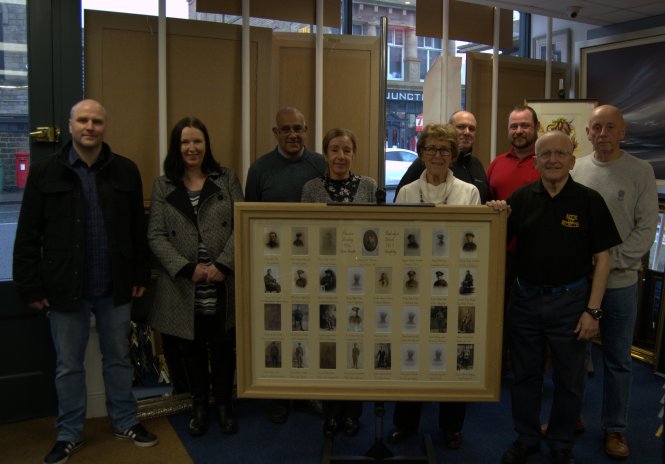
The completed memorial is presented to Cllr Tito Arana of Haworth Cross Roads and Stanbury Council at a presentation event attended by military historians from Men of Worth project, local tradespeople and library staff.
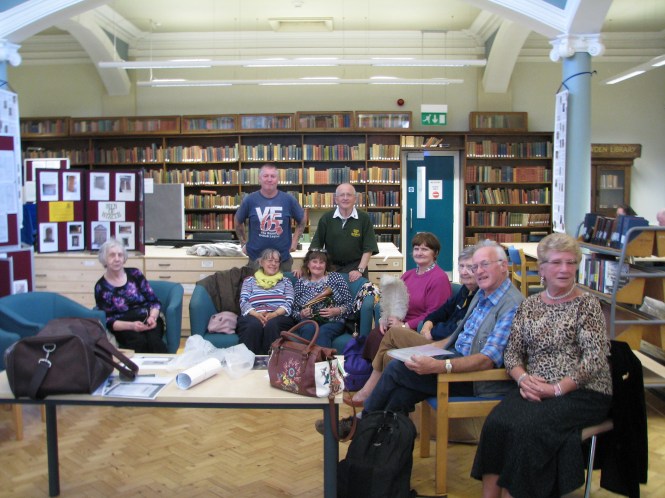
Ian Walkden (back right) from Men of Worth project speaking to a group in Keighley Local Studies Library
The Land! By Joseph COCKIN. Printed by Henry D. & C. Tapp, 1895. 32 pp.
JND 187/19 (Please quote this number if requesting this item)
Throughout the nineteenth century, and earlier, there were many attempts by groups of people to live a communal life by the common ownership of land. The following ‘treasure’ records one such attempt that was made in Bradford.
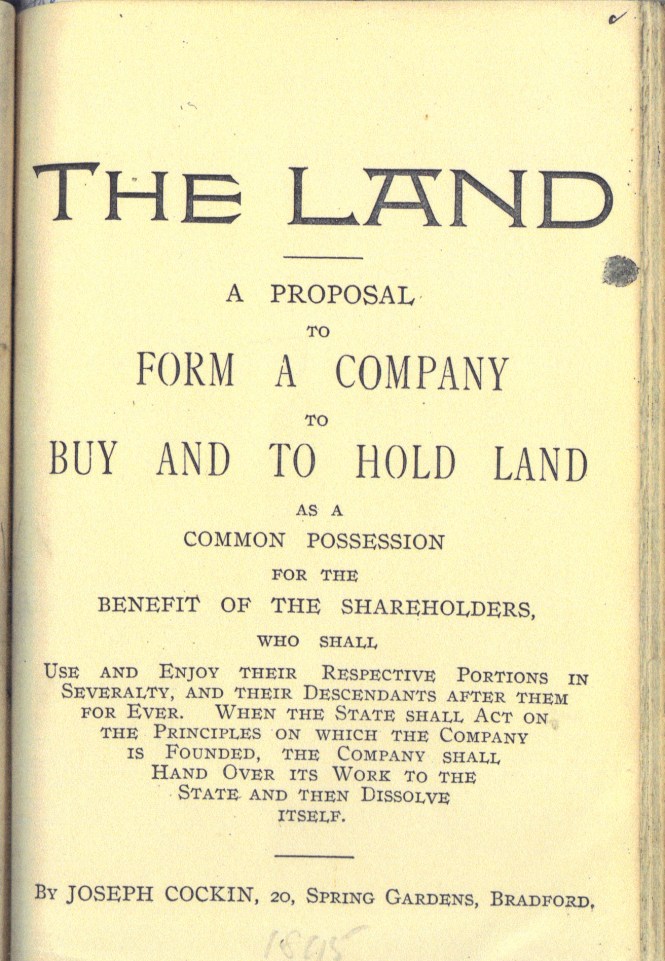
The title page continues:
A Proposal
to
form a Company
to
Buy and to Hold Land
as a
Common Possession
for the
Benefit of the Shareholders
who shall
use and enjoy their respective portions
in severalty, and their descendents after them
for ever. When the State shall act on
the Principles on which
the Company is founded, the Company shall
hand over its work to the
State and then Dissolve
itself.
“At the present time there is much distress arising from want of employment and the unprofitableness of agriculture and commerce. Part of the evil comes from temporary and part from more permanent causes. These latter I propose to inquire into, and to point out one remedy.” Mr Cockin’s solution is complex but the character of his thoughts are indicated by some of the section headings:
Today, the attempt seems impossibly idealistic and the faith in government naive, but the motive was common currency at the time. Indeed, some small-scale attempts were made: the author quotes Haxby, near York and some French experience. In Bradford, the growth of the allotment movement and the rise of the Independent Labour Party could be cited in this context.
“Correspondents wishing for answers must send stamps.” (Joseph Cockin, 20 Spring Gardens, Bradford)
Stackmole

