Book Review: Bradford in 50 Buildings. By George Sheeran

Bradford in 50 Buildings. By George Sheeran. Amberley Publishing, 2017. 96 pp. ISBN: 978-1-4456-6848-2 (print); 978-1-4456-6849-9 (ebook). £14.99.

George Sheeran book

Available from Bradford Libraries

George Sheeran should be known to all students of Bradford history, and probably is. A steady stream of books, articles and talks, not to mention his work at Bradford University’s Pennine Studies Centre, all testify to his long involvement in this area.1

Bradford in 50 Buildings explores the history of Bradford through a selection of its buildings, not just the better-known iconic public ones, but from all social levels and cultures. Yes, City Hall, the Cathedral, Wool Exchange and the Alhambra Theatre are here, but so are mills, schools, churches, mosques and terrace houses. The focus of the book is more on illustrating the diverse history of Bradford through its buildings than a straightforward architectural narrative. The buildings are all present today: this is Bradford as we see it now. History is all around us. We are looking at it, but what do we see?

The book features just over a hundred coloured photographs of high quality interspersed with prose commentary highlighting the architectural features and giving historical background of the fifty selected buildings. There is a succinct introduction giving context and background to Bradford’s history and a delightfully clear map showing where the buildings are.

Here we have Cotton Weavers’ Cottages in Little Horton Green (testament to the cotton industry), cottages in Dracup Street, Great Horton (characteristic of Bradford’s early nineteenth century industrial development) and mill workers’ terraces in Gathorne Street; on the educational front we have Feversham Street School (built in 1873, with a discussion of the advent of Board Schools), Bradford College (with both the original 1883 building and the striking multi-coloured façade of the new Hockney Building) and Dixon’s Trinity Academy (a 1994 example of post-modernism); industrial buildings include Manningham Mills, Canon Mill and Mitchell Brothers (Bowling Old Lane), while the Midland Hotel, Yorkshire Penny Bank and the red brick Prudential building in Sunbridge Road are other examples of commercial buildings; Churches and mosques are well represented, plus the Hindu Temple in Leeds Road and the Bradford Reform Synagogue in Bowland Street. Council flats (Longlands), large houses (e.g. Bolling Hall), public buildings (e.g. Cartwright Hall, St George’s Hall) and a public house (Shoulder of Mutton, Kirkgate) are some of the other types of building in the author’s selection.

Not all the buildings selected are beauties. High Point, the former Yorkshire Building Society tower in Westgate is ‘the city’s outstanding piece of brutalist architecture … Its walls of corrugated concrete provide a texture … that gives the building more the feel of a piece of urban sculpture’  (plus note on the rise of building societies), the Margaret Macmillan Tower (with a note on Stanley Wardley’s plan to modernise the city and provide a trouble free flow of traffic); and the old  GPO Telephone Exchange (superficially a boring modern cube – but is a much under-rated style of the 1930s ‘stripped classicism’). Yet the author is quick to point out unusual features which will encourage us to take a second look. Thus, ‘ … the Margaret Macmillan Tower … seems just another tower block at first sight, but look again. It rests on a rustic base of slate and rises clad in Portland Stone as a chaste block overlooking the city centre. The stanchions (the vertical members) are also clad in slate producing a fine counterpoint to the Portland stone.’ Indeed, with informed architectural analysis to guide us, together with an equally informed historical background, we see Bradford with new eyes. A wide variety of eras, styles and innovative features are covered. Students of architecture will value these accounts.

Omissions? Of course there are. Magistrates Courts? Transport Interchange? Paper Hall? The Bradford Club? Bradford has far too rich an architectural heritage to be limited to a mere fifty. Maybe the author could be persuaded to do another fifity!

Sheeran wears his learning lightly: we are in the hands of an experienced and knowledgeable teacher. We are not swamped in technical terms yet learn a lot. One grouse I have is that the Contents listing omits the page numbers to the fifty listed buildings, so that I was for ever hunting for page numbers using the entry numbers!         There is no index, though the contents page is detailed.

Two final points. ‘It may seem strange in a book about the architectural riches of a city to show a derelict industrial site, but this one is important for two [historical] reasons.’ (p. 57) The site is that of the Providence and Thompson Mill sites just up from the Alhambra Theatre and the reasons are given, which lead on the second point: ‘This is a sensitive site given its historical provenance. Recent fires in derelict mill buildings and resulting demolitions provoke debate about the future development of the area, and invidious decisions that will need to be taken.’ (p. 58) ‘Let us not make the mistakes of the past.’ pleads the author. Amen to that!

Enjoyable and informative. Essential reading for Bradford city planners and their favoured architects!

(Bob Duckett)

1 Books such as Brass Castles: An Illustrated Guide to the City’s Heritage (1993); The Victorian Houses of Bradford (1990); The Buildings of Bradford: An Illustrated Architectural History (2005); Good Houses Built of Stone: The Houses and People of Leeds/Bradford 1600-1800 (1986); The Mosque in the City: Bradford and its Islamic Architecture (2015).

Map of the Week: Dubb Mill, Bingley

032 A

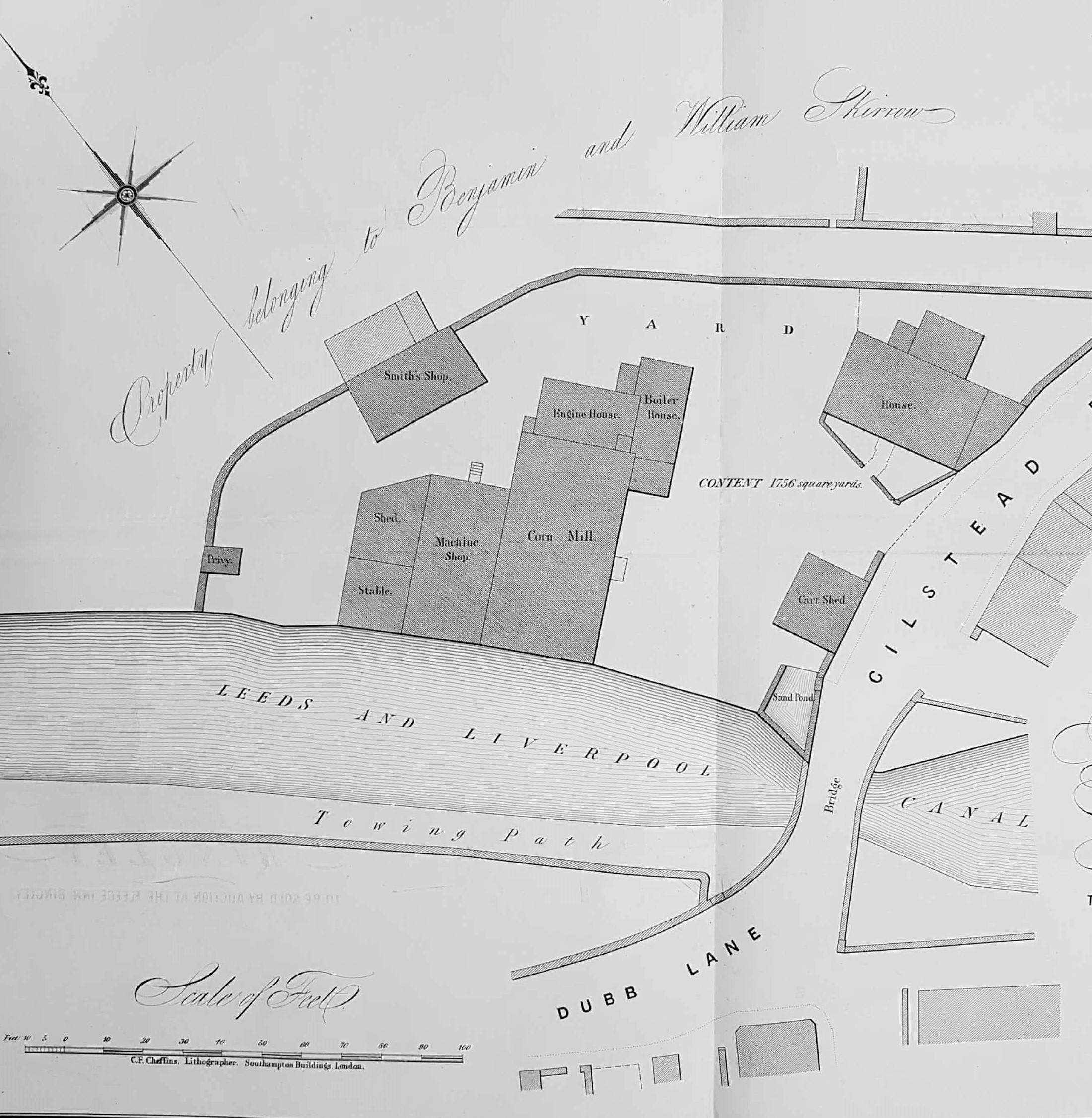
This plan features a site at Dubb Lane, Bingley adjacent to the Leeds and Liverpool canal. It was drawn up by a surveyor, E.S.Knight, in 1853 when the freehold property was to be sold by auction at the Fleece Inn. Sale plans are a significant source of the Local Studies Library’s reserve collection maps, and the buildings or property surveyed in such plans are naturally displayed in far greater detail than in contemporary Ordnance Survey maps. This complete plan should generate a LSL classification of BIN 1853 KNI and indeed there is such a card in the map index file. I cannot find the plan itself however so possibly this reserve collection example is the only copy now available. The main building is clearly labelled Dubb Mill and shows a steam powered corn mill with an adjoining residence. To reinforce this material it was not difficult to find the same auction being advertised in the Leeds Mercury. The mill was apparently three stories high and the house, stables, mechanics’ and blacksmith’s shops were also listed. The grinding was seemingly undertaken by six pairs of French stones. The benefits of the location, close to the canal and railway, are made clear. Mr E.S. Knight, was a land surveyor of Queensgate in Bradford. Particulars concerning the property are said to be obtainable from George Beanland of Great Horton. Identifying him was my first difficulty. There is a man of this name in Horton at the time of the 1861 census who is an agent but George Beanland of Messrs. George, Joseph and John Beanland, corn and flour dealers of Beckside, is perhaps more likely to be the man involved. Unfortunately no owner or vendor of the corn mill is mentioned by name but at the time of the sale the yearly tenants are Messrs William England & Son, and the under-tenant one Jonathan Cryer. According to the London Gazette, in the following year the partnership of William England & Son of Bingley was dissolved and the assets were transferred to brothers Abraham and William England. Interestingly the newspaper advertisement promotes the idea of converting the corn mill to cotton or worsted spinning, which is very pertinent to my subsequent analysis.

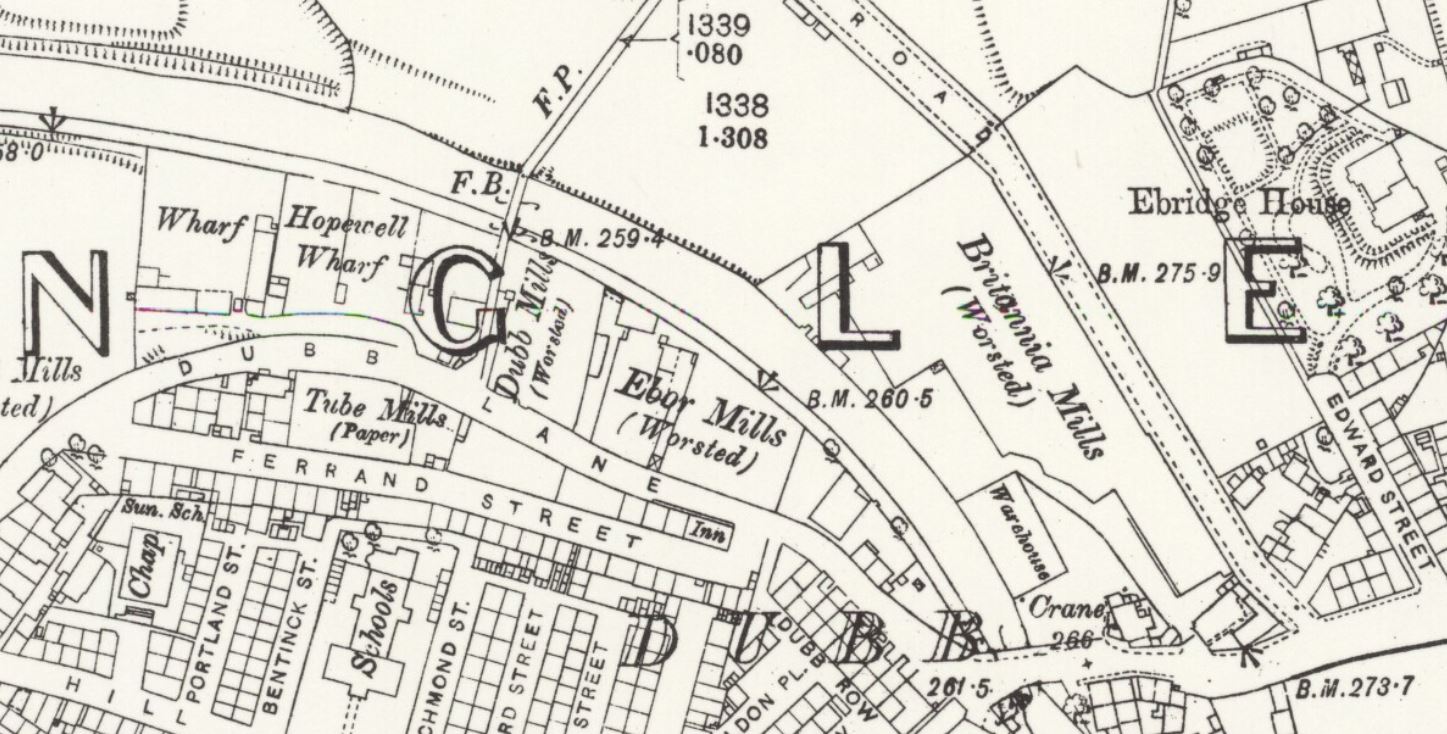
I think that we can be sure of the mill’s earliest possible date of construction since it is so closely aligned on the canal. This canal section was completed by 1774. The shape of the site, and its position adjacent to a canal bridge, makes it easy to identify in other maps even if the buildings are unnamed. There is no doubt that the mill is present in the earliest map available to me, the 1819 Fox plan of Bingley, but if Dubb Mill was always powered in the same way it cannot have been as old as the canal since the first steam powered corn mill was only built in Bristol five years after the canal was opened. Moreover the 1819 building block plan does not seem to allow for the engine and boiler house, yet what other power supply could there have been? I should say that it was by no means unknown for corn mills to be converted to textile mills, although was rare for conversions to move in the opposite direction.  Some 35 years after the mill sale, in the OS 25 inch map of 1889, there is simply a warehouse at this situation which appears to be part of Britannia Mills. At that date, if you crossed the bridge and walked along the towpath on the opposite side of the canal in the direction of Bingley town centre, you would pass Ebor Mills (worsted) to reach a second worsted mill by then itself called Dubb Mill.

032 B

A few years before our plan, in the first OS map (surveyed in the late 1840s), the older Dubb Mill is naturally present although no indication is given of its function. At the position where in 1889 there was situated what I might call ‘new’ Dubb Mill there are three buildings labelled as cotton mills. A later map suggests that these units were also called Dubb Mills, which must surely have caused confusion. It may come as a surprise that cotton is being processed in an area so strongly associated with worsteds but in fact Keighley was a centre for the cotton industry in the early 19th century.

Establishing the history and ownership of the Dubb corn mill up to the time of its 1853 sale was the problem I set myself. An obvious source of information was Harry Speight (Chronicles and Stories of Old Bingley, 1898). He mentions a man called Robert Ellis, who seems to have been the brother of Bradford Quaker James Ellis. Robert took ‘the old Dubb corn mill’ about 1818 and was joined by James in 1822. Is this the same Quaker James Ellis who was so active in famine relief in Connemara in the late 1840s? Probably: Ellis & Priestman were partners in corn milling at Queen’s Mill, Mill Bank, Bradford which I believe vanished when Sunbridge Road was constructed. Speight also describes the construction of an ‘early worsted mill’ with an attached residence by Joseph and Samuel Moulding. This would certainly be an accurate description of the building on our plan in all respects except for the type of mill involved.

Speight wrote that about 1825 William Anderton took part of this mill but soon began building premises of his own in Dubb Lane for wool combing and spinning. These later buildings, he wrote, were later occupied by ‘the Ellises’ who raised and enlarged them for cotton spinning, and a new mill was built on the opposite side of the road which for some years (in the late 19th century this would be) was occupied by Samuel Rushforth JP. We seem then to have four mills to explain: the old Dubb corn mill, an early worsted mill constructed by the Mouldings, the Anderton-Ellis mill, and the Rushworth new mill which is perhaps the ‘new’ Dubb Mill. I’m not claiming that they all were in in operation simultaneously, nor that they retained one function during the full periods of their existence. I cannot see that the brothers Ellis took on our corn mill since Speight describes their corn mill as ‘old’ in 1818 when ours was spanking new. If our mill was constructed for textile manufacturing is it likely that the building would subsequently have returned totally to grain processing? The best evidence that touches on this point is the 1865 Smith Gotthardt plan of Bingley.


032 C

The detail is inverted but allowing for this you can clearly see that twelve years after the 1853 sale our mill is still present and is unquestionably labelled as Moulding Mill and the cotton processing units as Dubb Mill. It seems likely then that Speight’s second statement is correct and some members of the Ellis family actually moved to the Anderton worsted mill. I tried to obtain further information about these mills from the on-line 19th century copies of the Bradford Observer and Leeds Mercury. Unfortunately many entries and advertisements simply mention ‘commodious mills at Dubb’, providing neither mill name nor owner. Nor did trade directories provide simple answers. The 1822 Baines directory at least suggested that several characters in our story have an interest in the licensed trade: J & S Moulding were at the Shoulder of Mutton, Bingley and W Anderton at the Pack Horse, Cullingworth. I know that Mr William Anderton (1793-1884) certainly came from Cullingworth, even if he wasn’t the publican mentioned in my last sentence. His Bingley enterprise features in the Factories Inquiry Commission of 1834. His premises were described as steam powered and undertaking worsted yarn spinning. There were 56 people employed (16 under 12 years of age) which seems reasonable for a small mill. The employees’ hours of work were 6 am-7.30 pm. The machinery was stopped for a dinner break of 45 minutes at noon. There were six holidays per year (8 days total) when whole factory ‘stood’ and no wages were paid. Anderton’s mill is described as Dubb Mill, Bingley ‘a mill erected in 1819’ so I am reasonably sure this is the mill in our plan.

Inconveniently 1842 White’s Leeds & Clothing District directory does not record any corn millers working in Dubb, but William Anderton and Joseph Moulding are given separate entries as worsted spinners & manufacturers. Helpfully there is a small item in the Bradford Observer from 1848 to the effect that asignees of John Robinson, a Moulding tenant, were trying to sell power looms and machinery but this attempted sale would be prevented by ‘executors of the late Joseph Moulding’. It seems unlikely that such a building would have been re-equipped as a corn mill before being sold five years later but I cannot think of another explanation that fits. In 1843 a Joseph Moulding (1775-1843) of Dubb was buried at Bingley Parish Church.

Meanwhile life at William Anderton’s mill was not without incident. In 1850 the Bradford Observer recorded an assault on Fanny Broadly which arose from a ‘dispute over bobbins’ at Dubb. In the census of 1851 William Anderton is living at Wellington House, Wellington Street. He describes himself as a worsted spinner & manufacturer employing 240 males 265 females. This sounds like a reasonably large operation and must surely indicate new premises. Remarkably 30 years later William Anderton was still alive, at the age of 88, and living with his daughter Mary and son in law John Brigg (another textile man) at Broomfield House, Keighley. As I have mentioned Anderton’s mills were taken over by the Ellises of Castlefields Mill for cotton spinning, and their operation presumably represents the cotton mills present on the first OS map of the area. At the end of the century the name Dubb Mill is associated with Samuel Rushworth JP, woolspinner and manufacturer. Rushworth was a famous teetotaller who died in 1896 aged 52. His mill must have been the new construction mentioned by Speight. I assume that this is the new Dubb Mill on the 1889 OS map.

I have tried to pull all this together. There must have been an old corn mill in Bingley, possibly close enough to the river Aire to use water as a power source. Castlefields Mill was constructed in the late 18th century and by 1805 was run by Lister Ellis who stayed until 1829. In 1818-19 Messrs Joseph & Samuel Moulding constructed the first Dubb Mill. If it was a worsted mill hand-combing and weaving seem quite likely at that period. William Anderton may have later been involved with this building but by 1825 he was building his own mill nearby in Dibb Lane for wool-combing and spinning. William and James Ellis took this over for cotton spinning and Anderton must have used other premises. In the later 19th century Samuel Rushforth, who had started life working for Anderton, adapted the cotton mills and rebuilt a new Dubb Mill. My guess is that once steam power was introduced at the old Dubb mill it could function either as a corn mill or worsted mill and performed as both at various times. It clearly survived until 1865 but was later converted into warehouse, or rebuilt in that capacity by 1889. I know that interest in local history is very strong in Bingley and I’m hopeful that somebody will be able to put me right on aspects of this complicated story especially the matter of how many men called Ellis were there, and what exactly were their relationships.

Derek Barker, Local Studies Library volunteer

Further Reading

George Ingle, Yorkshire Cotton: the Yorkshire Cotton Industry, 1780-1835: Carnegie Publishing, 1997.
A very readable introduction although there is no mention of any mills in Dubb.

Colum Giles & Ian H Goodall, Yorkshire Textile Mills 1770-1930: RCHME & WYAS, 1992.
A beautifully illustrated general guide but one that does not answer any of my questions.


Treasure of the week no. 23: Billygoats, frogs, & pickle-pot : ‘The Old Inquirer’ and the ‘March of Reason’.

The Old Inquirer [The Rev. Wm. Atkinson] A volume of tracts.

B 042 ATK (Please quote this number if requesting this item.)

In my trawl through the basement of Local Studies Library I came across a volume of tracts by ‘The Old Inquirer’. The use of pseudonyms was quite common in the eighteenth and nineteenth century, especially for authors writing on controversial topics or opposing the views of other writers. The Old Inquirer did both. His spat with ’Trim’, the Headmaster of Bradford Grammar School in the years from 1787 to 1791 was very public, bad tempered, and yet clever – both Trim and the Old Inquirer were well educated and highly literate. The prose (and sometimes verse) is fun to read even if we don’t fully understand what it was they were arguing about! The Old Inquirer was a prolific writer: the volume I came across had 16 separately paginated tracts containing some 70 individual letters, essays and other items. He even had his own printing press!

To provide extracts from these writings would be far too ‘heavy’ for these ‘Treasures’. Instead I have extracted some of the verse he used to illustrate his opinionsand  which can be enjoyed just for themselves. They are indicative of the rumbustious satire of The Old Inquirer.

‘The Old Inquirer was the Reverend William Atkinson, M. A. , ‘Lecturer’ or ‘Afternoon Man’ at the Parish Church in Bradford (now the Cathedral) from 1784 till his death aged 89 in 1846, a period of 62 years. The ‘Afternoon Man’ was so-called because he was only required to be in attendance on Sunday afternoons. According to newspaper cuttings in the Local Studies Library, Atkinson was a man of herculean build and of singular strength of mind as well as body. He used to walk from his home in Thorpe Arch on Saturdays and walk back to his home on Mondays, staying over in Bradford for his Sunday lectures. So what did he do for those 62 years? Well, among other things, he wrote letters, essays and poems.

Rev William Atkinson MA

‘Rev William Atkinson’ from ‘Bradford Fifty Years ago, 1807’ by William Scruton

Parish Church and Vicarage 1810

‘Parish Church and Vicarage in the year 1810’ from ‘Pen and Pencil Pictures of Old Bradford’ by William Cudworth

The range of subjects he wrote on was wide: the exportation of wool;  tithes; political reform; dissenters from the Church of England; the Pope; press bias; agriculture; even banking. Anyone interested in understanding our history from 200 years ago would do well to read these tracts. Here, though, we just relish his gift for verse and satire, and be amused at the wit, boldness, and candour of the ‘Old Inquirer’. And maybe wish he was around today!

…  Fee fau fum,

I smell the stink of democratic plum;

And though I love Reform disclosed,

And would by no means clog them;

Yet meeting with bare r – ps exposed

I cannot help but flog them.

(A Letter to the Reforming Gentlemen. 1817, p. 1. Tract no. 5)

Their arms, their arms,

Are the Radical charms,

With which they’ll lay about them;

Order, order,

Says R. D. our Recorder,

They’d better be quiet without them.

(Free Remarks upon the Conduct of the Whigs and Radical Reformers in Yorkshire; with some Slight Allusions to the Court Party, 1819, p.1. Tract no. 7.)

How Johnny Bull

Is made the Gull,

Of Men who love his money,

The wasps who thrive,

Within his hive,

And live upon his honey. (p.12)

(Remarks on the Strictures in the Leeds Mercury upon the Rev. M. Jackson’s Coronation Sermon, &C. &c. &c., 1821. p. 12. Tract no. 7)

A Lily sprung in foreign land,

And grew to be a flower,

It was transplanted to this strand,

But flourish’d not an hour.

(As above, p. 16)

“Alas! No rest to mortal man is given,

Till they are safe arriv’d in heaven.”

(A Speech Intended to have been spoken at a Second Meeting of the Clergy upon the Popish Question, 1821, p 41. Tract no. 13)

The man in the moon,

Has ordered a spoon,

To give all there maniacs their pottage;

No, no, let them go

To the region below,

For the pickle-pot must be their cottage.

(As above p. 51)

I am the Prince’s Dog at Kew,

Whose Dog are you?

(A letter to the Reforming Gentlemen, 1817, p. 14. Tract No. 5)

Granting that he had much wit,

He was rather shy of using it.

(As above, p.13.)

Hallo, hallo, away they go,

Unheeding wet or dry,

And horse and rider snort and blow,

And stars on all sides fly!

Hold  Parsons, hold, on Peggy’s rig,

For stormy is the wind,

Or like John Gilpin’s hat and wig,

You’ll soon be left behind.

(A Letter to one suspected to have been written by a Stranger, assisted by the Jacobin priests of the West Riding, 1801, p. 43. Tract No. 1)

Your reasoning, with wondering stare,

Quoth Tom, is mighty high, Sir;

But pray forgive if I declare,

I doubt it is a lie, Sir:

We ne’er shall get, I really think,

Lord H….w..d’s land to us, Sir,

I’d rather have a pot of drink,

Than hang up like a truss, Sir:

If you think thus, my honest clown’

We’ll take another sight on’t –

Just turn the picture upside down,

And you will see the right on’t.

(Lucubrations in Prose and Verse written during the Awful Revolution in 1829, p. 12. Tract no. 16)

Jerry’s Song to his Tippling Wife.

Upon her cheek so fair,

The lily and the rose,

Of flowers a pretty pair,

Did all their sweets disclose.

But time has cropt that rose,

The lily too doth fade,

Such are the cruel foes;

In wedlock to a maid.

And has time cropt that rose?

Ah, no! it grows it grows,

Upon her well-fed nose,

You yet may see my pretty little rose.

(As above, p.13)

And what of the Frogs, Billygoats, and The March of Reason of the heading to this blog? See:

Tract number 14: A Rapid Sketch of Some of the Evils of Returning to Cash Payments, and the only remedies for them. To which are added The Leeds Mercury turned into a Frog, the Billygoats in Leading-Strings, and The March of Reason. 1823.

A full listing of Atkinson’s tracts can be found in the folder ‘Federer, Dickons and Empsall tracts in the Local Studies Library’. Listed under  B 042 ATK

Stackmole

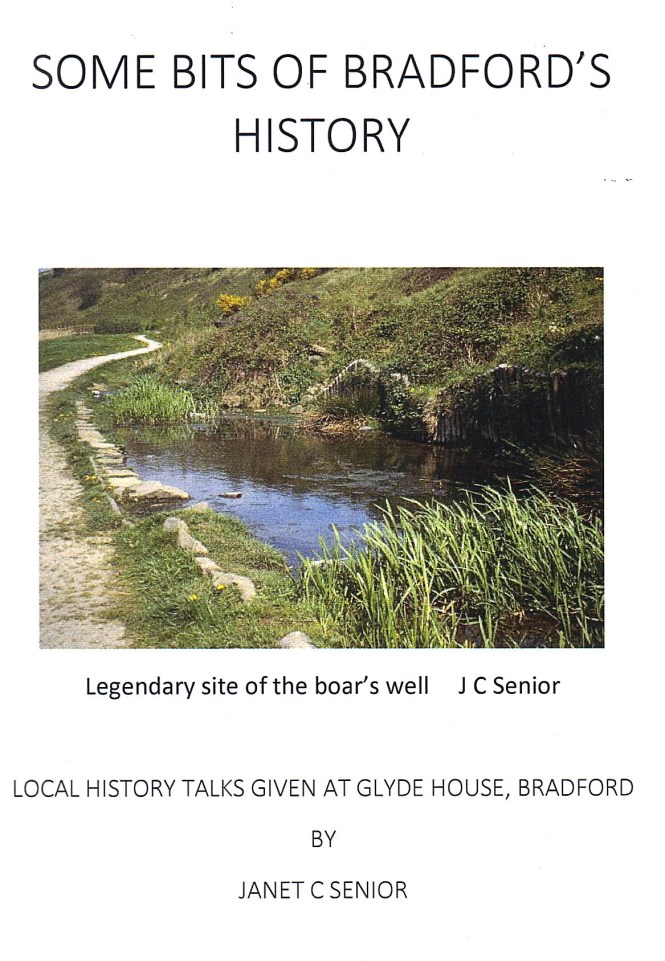
Book Review: Some Bits of Bradford: Local history talks given at Glyde House. By Janet C. Senior

Some Bits of Bradford: Local history talks given at Glyde House. By Janet C. Senior.

Published by Bradford Historical & Antiquarian Society, 2018. 112 pp. ISBN: 978-1-9996419-0-0. £7.99.

Reserve a copy  from Bradford Libraries

We are pleased to welcome this attractive little book based on talks given by local historian Janet Senior. Retired teacher and volunteer archivist Janet has gathered quite a following for her monthly talks on local topics at Glyde House in Bradford, and now a wider public can enjoy a selection. Nine of the talks are featured here augmented by photographs from a variety of sources, new and old, and some drawings by Mary Tetlow.

Starting with the Legend of the Boar of Bradford we progress to the history of the Established Church in Bradford from the 7th to the 17th century, and on to Jonathan Glyde. The legend of the boar is well known, but, as with all these chapters, Janet’s knowledge and enthusiastic research into the archives and her skill at presenting complex subjects borne of her many years as a teacher, will provide much that is new to all. The topics will be sure to interest and enthuse newcomers, young and old. Thus the legend of the boar is set against the earlier, and later, history of Bradford; the history of the established church is made clear and interesting; while Jonathan Glyde (1808-1854) emerges as a profoundly influential figure in the development of Bradford and whose importance has hitherto been poorly recognized.

Charles Samuel Joseph Semon is another of those influential Bradfordians who have found a champion in Janet. Like Jonathan Glyde, he did much to improve the conditions of the populace, and in an aside, we learn that Janet was born in the Semon Nursing Home in Ilkley. Bradford and the Parks Movement is another slice of Bradford history brought to life as public-spirited civic leaders sought to improve the lot of the town’s population. Returning to religion, Janet gives an account of the 1851 Religious Census and what it revealed of worship in Bradford, in particular the decline of church attendance, the strength of non-conformity, and how social life was changing.

Nowhere was this more evident than in the long-standing debate over education, where the National Schools (Anglican based) and British Schools (Non-conformist supported) debated, a debate which local MP, W E Forster, endeavoured to end with his 1870 Education Act. A nice touch in this book is the author’s personal interest in these many subjects. Here, as a teacher, Janet wanted to know why the structure of the school system was so confused and hoped to find out by going back in time by trawling the archives. The Early Years of the Bradford School Board is the result. The chapter on Youth Offenders in Late Victorian Bradford will provide more surprising new knowledge for most of us. Another personal link gives us something very different, bringng us a positive ‘spin’ on the glory days of Bradford when, at its peak, there were no fewer than nineteen Foreign Consulates in Bradford, this internationally famous city of trade.

Each chapter has a brief personal introduction and ends with a glossary and references. Attractively produced, lucid, and full of interest, the BHAS is to be congratulated on this entry into book publishing. And thanks to Janet Senior for sharing her knowledge and enthusiasm. More please Janet!

Bob Duckett

Janet Senior book.jpg

Keighley Library Heritage Open Day 2018

Keighley Library celebrated Heritage Day on Saturday 15th September 2018 with a feast of history and culture celebrating local heritage, community and history. The day was a roaring success with something for everyone in the mix.

Billy Barton from legendary Keighley band Dawnwatcher took us back to the 1970’s and the new 1970’s Musical Heritage exhibition was launched.

Billy Barton talk 4

Billy Barton

Malcolm Hanson told the story of  the Civil War  and local people’s heroic stand. It is a most uplifting story!

Malcolm's talk 3

Malcolm Hanson

Historian Robin Longbottom gave a fascinating and  informative talk about the boundary stones based on his new publication.

BS1a

Robin Longbottom

History Societies exhibiting included Keighley and District Family History Society, Keighley and District Local History Society, Men of Worth project and Keighley Model Railway Club all with a wealth of information about the local heritage.

The highlight of the day for many was live music from Keighley band ‘Howlin’ Johnny and the Devil’s Rejects’ who had the audience on their feet and the building rocking to the rafters.

A comment from the Visitors book:

Comments book

‘Howlin’ Johnny brought the house down, people stood, clapped and sang to give a good time feel to Keighley. Skiffle, Rock and Blues mixed to perfection; and to end with thunderous applause.’

The 1970’s exhibition will be up in the library until the end of October.

There are still  opportunities to hear Malcolm Hanson’s Civil War talk in libraries on the following dates:

Saturday September 22nd, 2.00pm, Denholme Library
Saturday September 29th, 2.00pm, Eccleshill Library
Saturday October 6th, 2.00pm, Bingley Library
Saturday October 13th, 2.00pm, Shipley Library
Saturday October 20th, 2.00pm, Bradford Local Studies Library
Saturday 27th October, 2.00pm, Ilkley Library
Saturday 3rd November, 2.00pm Wyke Library

October 1642. ‘When the battle began, the Royalist Commanders laughed at Bradford’s rabble army, but help for Bradford was at hand.’ Join Local historian Malcolm Hanson as he  brings to life this story of great heroism. These are free events. No booking required.