What brick?

I spend a great deal of time studying maps, and writing about maps. Many people feel I should get out more: so here is the result of a Bradford history outdoor trip. Most readers will know Infirmary Field, a green space which begins at the junction of Westgate and Lumb Lane, and which for many years was the location of Bradford Infirmary. The Infirmary was already present in the first OS map of the area (c.1852) but was relocated between the 1932 and 1938 OS maps. At the rear of the site is a snicket connecting Westgate and Lumb Lane.  There has been much modern housing redevelopment in this area but the snicket may have started life as the back lane of Queens Street which, together with Kings Street, was once a terrace that ran parallel to it.

The perimeter wall separating Infirmary Field from this snicket is basically constructed of sandstone masonry, but has evidently been patched or repaired on many occasions and with many materials. A piece of rather sloppy brick-laying placed three bricks on their long edges to reveal the brick mark [P&S] placed in a rather whimsically shaped depression, or frog.

What brick Fig 1

They look like late Victorian machine-moulded bricks, although I have never seen any other examples of exactly this type, among the hundreds of Bradford bricks I have examined. Could the resources of the Local Studies Library be used to identify the original maker of these bricks? Sadly there is no ‘Bradford Brick Book’ in which you may identify individual brick marks, but there are a large collection of Victorian trade directories in which you can investigate local brick manufacturers. Brick works and kilns are marked on the LSL’s extensive collection of maps, and there are also newspaper advertisements and census reports.

Essentially I was looking for a maker who generated the initials P & S, where previous experience teaches me that ‘& S’ was likely (but not certain) to represent ‘and sons’. There seemed to be three possibilities. The least likely were Parkinson and Spencer, a Halifax company making refractory bricks and fireclay items, who survived well into the 20th century. They did not seem likely to have made Victorian house bricks which penetrated as far as Bradford.

William Pickard & Sons operated at Wellington Street, Laisterdyke and they appear in many trade directories: 1867, 1872, 1875-1880, 1881, 1883 and 1887-88. In the 1883 Directory, for example, they are listed as ‘William Pickard, builder, stone merchant and brick-maker’ and the works (probably called Wellington Works) could have had a 25 year existence. But there is a known mark [WP & S] which would fit this manufacturer better than the puzzle brick, so consequently they are only my second choice.

The most likely candidate seems to be the firm of Pearson & Son. Samuel Pearson was a Cleckheaton brick-maker who founded a contracting dynasty. His first contracting works was in Silver Street (off Tabbs Lane) in Scholes around 1856.
What brick Fig 2

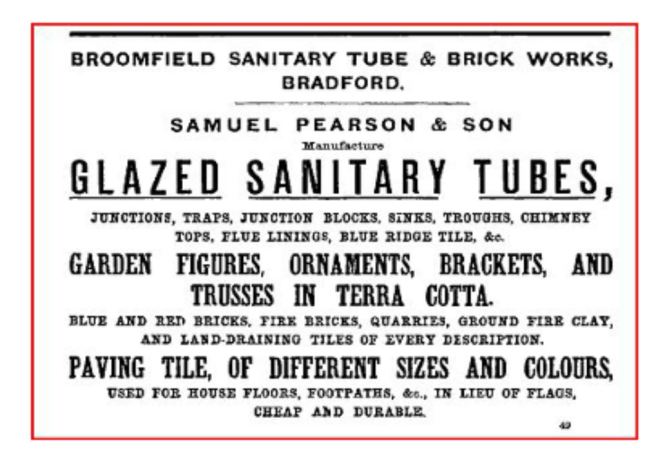
His largely forgotten works in Bradford, which he probably acquired from a man called William Poulter, was known as the Broomfield Clay works and later Broomfield Sanitary Tube & Brick Works. In describing the work involved in taking the GNR railway line from Exchange Station towards Leeds in 1866 Horace Hird (Bradford in History, 1968) mentions the activities of Pearson & Son who took over responsibility for the clay excavated from a cutting. They created a ‘great mound’, and for 15 years 60 men were employed making drain pipes, chimney pots and bricks from this mound. One of their brick marks (which I have only seen in a damaged state) is [PEARSON & SON][BRADFORD] but [P&S] could easily have been an earlier alternative. Examination of the Heaton Local Board accounts for 1877 shows that Samuel Pearson & Son were supplying 15” ceramic pipes ‘to be delivered at the Turf Tavern’. Their works can be also identified on the 1871 map of Bradford, but apparently closed in 1885 when a ‘spoil bank’ was exhausted. The site is described as a ‘disused brick-works’ by the time of the 1895 OS map, and Pearson & Sons are not recorded in an 1898 trade directory. In the 1881 census Samuel Pearson is described as a retired brick-maker, born in Scholes, and living in Greenside. He evidently died in 1884 (worth £20,000) at the Elms, Scholes Road.

By the time of his retirement Pearson’s were already undertaking contracts in many major industrial cities. Samuel Pearson’s son was called George Pearson but the firm’s success was largely due to the energy of his grandson, Weetman Pearson (1856-1927), to whom Samuel transferred all his personal holdings. Weetman may have started as a brick manufacturer but the company he managed evolved into the great firm of Samuel Pearson & Sons which considered brick, tile and sanitary-ware making as only a very minor part of their activities. The firm undertook many contracts for the British Government and within a generation it became an international contractor. It was particularly associated with Mexico under the presidency of Porfirio Diaz. Canals, railways, and oil were among the company’s many interests. Weetman Pearson was eventually created the first Viscount Cowdray and died in 1927.  The company still exists as Pearson plc but has widely diversified its interests into the media, which is a very long way from a Bradford snicket.

Derek Barker, Local Studies Library Volunteer

Gary Cavanagh and Noise of the Valleys -Bradford Local Studies Library

Earlier this year, Gary Cavanagh one of the co-authors of Noise of the Valleys books, gave a talk at Bradford Local Studies Library on the music scene in Bradford and surrounding areas. He focused upon musical acts from the 60’s to the 80’s and mainly upon the more mainstream and ear friendly artists which included a band called Three Good Reasons  from Keighley that reached no 1 in the Dutch charts with a cover version of the Beatles ‘Nowhere Man’!

GC

He also charted the history of the hidden musical gems of the area whilst giving the backstory to better known artists like Kiki Dee and her history with Motown and even Bingley’s Rodney Bewes with the single for the theme tune from his first sitcom, on which he performed the vocals. Gary outlined his quest to seek out these and other rare tracks for his ‘Noise of the Valleys’ project which now comprise of 14 CDs worth of music from the local area and two volumes of books.

It was an informative and entertaining talk and Gary’s enthusiasm for and knowledge of the local music scene and its history and importance shone through and some  members of the audience remembered going to the old venues and clubs he mentioned in association with the artists and bands. The talk was interspersed with snippets from rare tracks including a song from Keighley’s own Linda Russell and former Shipley based American soul star Tommy Hunt!

The Noise of the Valleys books and CDs are a real labour of love for Gary Cavanagh and Matt Webster and an important preservation of the rich spectrum of local music heritage for the people of Bradford and surrounding areas.  Volume three of the books which will cover the era 1999-2009 is currently being compiled and written. You can support this project here:

https://www.bradfordnoise.com/

NOV


Peaceful Women

Bradford and Keighley Local Studies Libraries celebrated International Women’s Day with a series of events over the week featuring ‘Peaceful Women’  by local author, playwright, actor and historian, Irene Lofthouse.

Irene Lofthouse took on the role of ‘Mrs Norton’, an ordinary working class woman actively involved in the campaign for social reform who is given just a few lines in a Bradford newspaper of the time and then lost in history until now.

Over the week, we were pleased to welcome school classes from Worth Valley Primary, Fagley Primary and Beckfoot Allerton Primary as well as Keighley Association for Women and Children, Keighley Women’s network and a great turnout from the general public on the mid-week performance.

‘Peaceful Women’ looked at the era following the end of WW1 and the efforts to use peaceful methods for change.

The performance explored the stories of local women of the time who campaigned for peace during WW1 or for rights following the end of the war. ‘Mrs Norton’ characterised each person through voice and props. The interactive performance raised awareness of known and hidden histories of local women and their impact locally and nationally through an entertaining and educative piece of theatre.

Some of the women included, campaigned for peace in WW1 such as Fanny Muir and Esther Sandiford from Bradford Women’s Humanity League/Women’s Peace Congress.

Also included were those who campained for social reform after WW1 such as Julia Varley, Ethel and Philip Snowden, Margaret McMillan, Bradford MP Muriel Nichols and Barbara Castle. Margaret Wintringham from Silsden was the first British born woman to take her seat  in the House of Commons.

Local archive materials and Electoral Registers from the local studies collections were on display. Bradford Local Studies Electoral Registers began in 1848 and Keighley’s registers began in 1882 when the town was incorporated.

Pictured below are some of the items from the Local Studies collections on display at the event.

Brontë Images: 116 Years of Brontë Studies

CaptureBronte

To facilitate exploration of local history and the Brontë family, the Keighley Local Studies Library now has a catalogue file of all images that have appeared in its bound editions of the Brontë Society’s Transactions and Journals from 1898 through to 2014. This means that it is possible to find, for example, a facsimile of a letter written by Patrick Brontë, or a pen sketch of the Black Bull pub by Arthur North, given the name of the author or item.

This collection comprises over 1000 Brontë related images, including familiar ones that may be found on exhibition at the Brontë Parsonage Museum, as well as others of interest such as photographs of extended family members, charts of family genealogy, pictures of places that may have featured in their novels, andgeographical locations that hold the Brontë name (e.g. Brontë, Texas).

There are also pictures of Brontë Society members, who have appeared over the years,
including Butler Wood, the Society’s first editor and Bradford’s Chief Librarian 1887-1925, international members as far away as China, and visiting dignitaries to the Parsonage Museum, such as James Roosevelt, son of U.S. President Franklin Roosevelt, whose family was connected to the Butterfields in Keighley.

Bronte Images BLOG copy

The Keighley Local Studies Library of Bradford Council is opened Monday-Saturday and is located at the Keighley Library, an historic Andrew Carnegie Library on North Street,
Keighley BD21 3SX.

Email: keighleylocalstudies@bradford.gov.uk
Phone: 01535 618215

Mary E. Adamson
Library Volunteer and Brontë Society Member

‘Peaceful Women’ visits Bradford and Keighley Local Studies Library during International Women’s Week 2019

‘Peaceful Women’ is a performance exploring local women who campaigned for peace during WW1 and following the end of WW1 and their efforts to use peaceful methods for change.

All are welcome to join Irene Lofthouse , local author, playwright, actor and historian, at Keighley Local Studies Library on Wednesday 6th March for a performance of ‘Peaceful Women’.  This is a free event, open to all. It will take place between 1.15pm and 2.45pm.

There will also be events for invited schools in Bradford and Keighley Local Studies Libraries over the course of the week.

‘Mrs Norton’ (Irene Lofthouse) retold her story as a suffragette for Bradford Local Studies Libraries during 2018. This year she will introduce ‘Peaceful Women’ characterising each person through voice and props.

Irene Lofthouse d

Irene Lofthouse as Mrs Norton

The interactive performances will raise awareness of known and hidden histories of local women and their impact locally and nationally. It will connect the local past with its present and future through an informative and entertaining piece of theatre.

Libraries will have a display of archive materials for audiences to explore hands on and ‘Mrs Norton’ will answer questions.