If you had been lucky enough to accompany SJ on a country walk you would not have progressed very far without the topic of carved stone heads being raised. They form regular entries in the Archaeology Group Bulletin. There is no doubt that he recognised, and brought to prominence, a huge number of these objects (in Yorkshire particularly) found in walls, as garden ornaments, and on the gables of houses or barns. His card index of heads listed 650 from all over the country, but particularly West Yorkshire (378), and was eventually given to the Yorkshire Archaeological Society. He considered that the heads were originally free-standing and distinguished them from gargoyles and corbels. He speculated that they might have been associated with springs and wells, or had an apotropaic function, being intended to ward off evil influences. He believed that the finding of heads indicated continuity of farming sites from prehistoric times until the 17th century.
SJ concluded that the heads were Romano-British or ‘Celtic’ in origin and were linked to a series of similar heads, described by his friend Dr Anne Ross in Scotland. To the best of my knowledge all the Yorkshire heads were surface finds none having been located in context at excavation. This represents an important difference with the celebrated and enigmatic Pictish stone carvings from Scotland. Some Pictish carved stones have been on the surface since they were executed about 1500 years ago, or have been incorporated into more modern buildings. But others have been found buried at excavation, for example a bear carving discovered at Old Scatness Broch by the Bradford University archaeology department. Not so with the Jackson heads.
So I, and indeed some of his contemporaries, couldn’t except the strange heads as having an Iron Age origin. In a stone quarrying area, where chisels and stone carving tools must have been common, there are surely more plausible explanations. SJ produced only two publications: ‘Nature Rambles in mid-Airedale’ (1952) and ‘Celtic Carved Heads’ (1973), which he wrote after his retirement. Despite a forward from his friend Dr Anne Ross, his last book (when it finally appeared) proved controversial. Critics felt that few of the heads had provenance and any link with the ‘Celts’ was tenuous. I think SJ would have been profoundly saddened by this response but there had been considerable public interest in his collection which appeared on television and was given exhibitions in the 1960s and early 70s. Surprisingly, as late as 1967, he admitted to not having a television although he and his carved heads appeared on BBC TV during the same year in ‘Blue Peter’ and ‘Chronicle’. The illustration is a Bradford head found in a wall at Heaton Woods by Carol & Christine Lister (1965). I don’t have an exact findspot but if either of the discoverers were to read this account I should be very interested to have additional details.
It is hard not to feel a certain nostalgia for SJ’s world. Modern archaeology, with its greater reliance on theory and science, does in the end offer a more fruitful approach but perhaps it has lost some romance in the exchange.
At this time of continued lockdown for popular public spaces such as libraries and archives, it’s good to know what’s online and apparently many of you are still keen to pursue your local history research or are inspired to make a start in this fascinating area. Following the posting in the recent newsletter, it’s clear that many of you are particularly interested in tracing your house history or maybe just that of a particularly interesting building in your area.
A general overview of the property location is probably the best initial way to start and, for the Bradford MDC area, check out the sites recommended for local mapping. Local authorities have also addressed conservation area issues and free access to Bradford’s conservation area assessments can be found at www.bradford.gov.uk just search ‘conservation area assessments’ for a list available online. These reports include maps and details of building materials with some local history, your street or property may well be highlighted. If not, you will at least get a reasonable idea of the age and development of your local area. If your property is a listed building, then look at the listed building sites recommended on the leaflet.
Photographs can reveal the age of your property and building/land additions, as well as the development of the local surroundings and land usage. They sometimes even show you who once lived there if you are very lucky. As well as the sites noted on the leaflet, many local history sites are a wonderfully rich source of postcards and photographs available online.
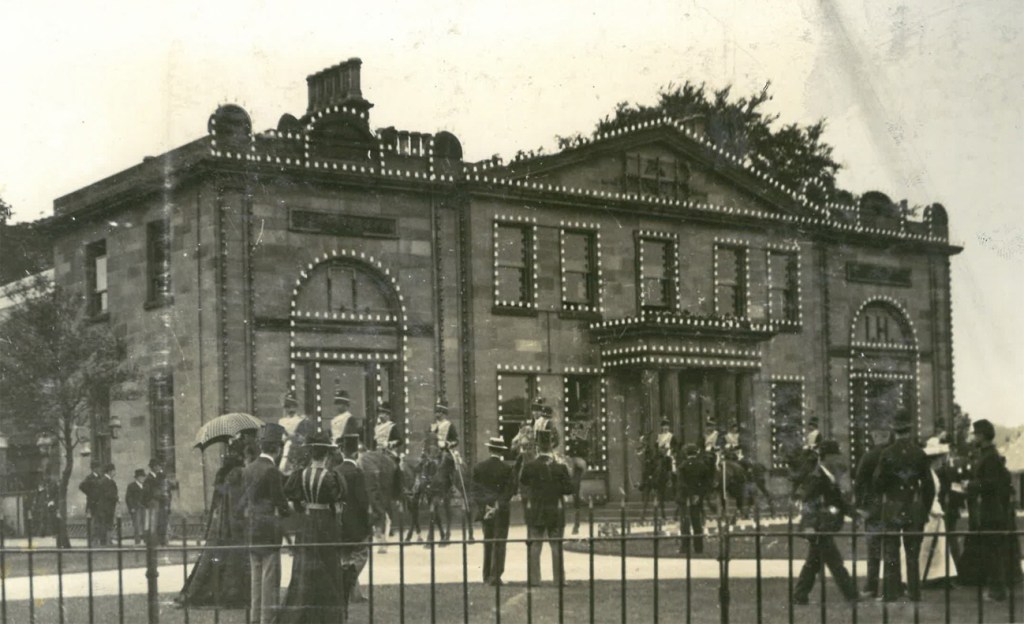
Photograph of the Hall from the Keighley Photographic Society Collection showing the opening of the Mansion House with a day of celebrations, 6th July 1893, the official handing over of Eastwood House and grounds (Victoria Park) to the public.
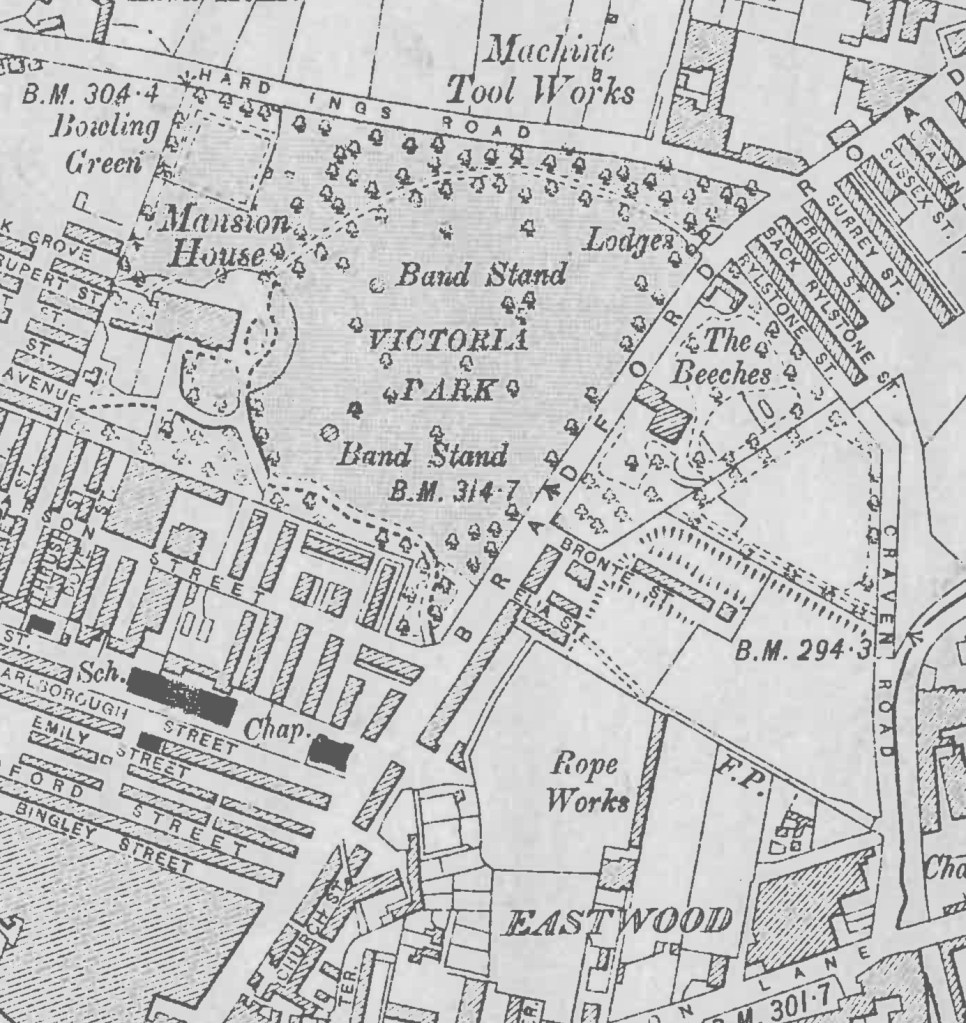
Maps of Yorkshire that show historical details such as wapentake, parish and riding divisions can be found on sites such as https://www.genuki.org.uk/big/eng/YKS/ and the National Library of Scotland web site and that of the Ordnance Survey have free access to old maps and township plans for the mid 19th and early 20th Century.
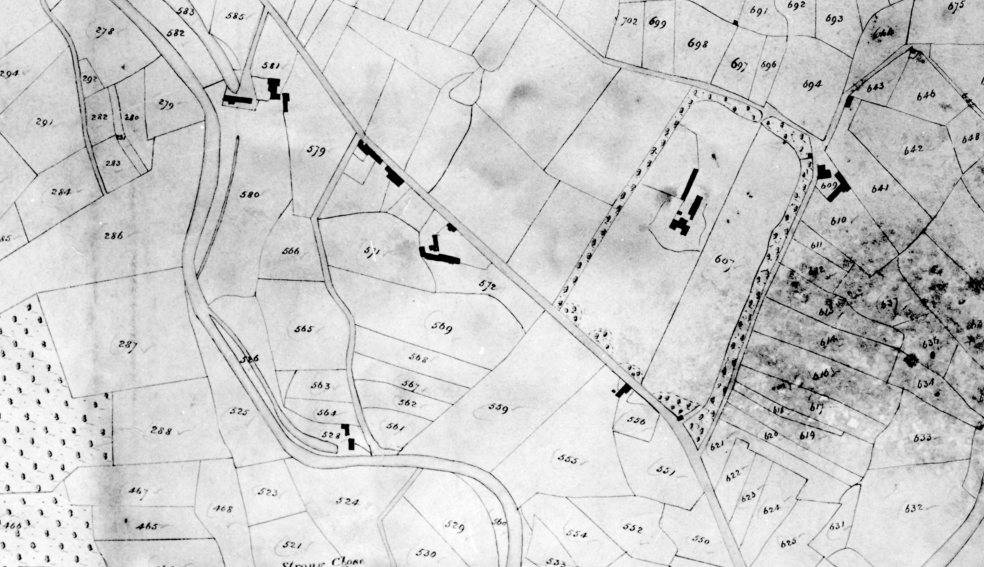
Station Rd Cullingworth 1840’s’Eastwood Tithe 1842
People and trade
If you are not living in an ancestral pile, then you may wish to start looking at who lived in your property. Believe it or not, quite a few customers have come into libraries simply to research supernatural phenomena or to try and discover more about family papers found under floorboards or left in attics.
The first port of call would be Ancestry or Findmypast, available freely in all Bradford Libraries but fortunately during this lockdown period, Bradford Libraries is providing free access to Ancestry for all customers with a library card, follow the instructions below. On here you can use the census records 1841-1911 and the special 1939 England and Wales register is also available on the web site free of charge.
To access Ancestry Library you will need a Bradford Libraries membership card. Go to https://capitadiscovery.co.uk/bradford/ and log in to your library account with your card number and pin. Remember to input just the numbers. Next, click on the special link to Ancestry Library Edition.
Maybe the former inhabitants or your property were involved in trade or your house was a former shop or even church. Trade directories are useful as they list local traders and in some editions their introductions give a useful overview of the township as a whole and of its main families, religious buildings, prominent houses and other services and amenities and local farms. These supplement the census records and although you will usually get a more comprehensive collection in your local studies library or record office, you can find a few relevant directories online. Check out this handy leaflet produced by Bradford Libraries’ staff: https://bradfordlocalstudies.com/wp-content/uploads/2015/03/trade-directories-new1.pdf and try the addresses shown on the leaflet.
You may also want to look at www.millsarchive.org if you live in a mill conversion and you can try www.gracesguide.co.uk for local industry and engineering research.
Probate and Wills
Once you have names for owners/occupiers you can then trace death years through your free access to Ancestry, looking at births, marriage and death certification years and/or any church or chapel records to verify identities, with many available on this site. Click on the Search tab on the home page and look at UK record listings, if applicable, for your chosen subject area or click on the card catalogue for a full listing of all types of available records that are included. If you are lucky with this search, you may well then be able to trace probate and will records on the National Archives’ web site. There are also appropriate leaflets explaining such records in more detail on this site: www.nationalarchives.gov.uk
Conveyancing documents and title deeds
These can be difficult to trace outside of lockdown and would involve, for the Bradford area, a trip to Wakefield District Archives, Registry of Deeds, www.archives.wyjs.org.uk for the period before 1970 in most instances and contacting The Nottingham (West)District Land Registry, www.landregisteronline.gov.uk for property built after 1974. However, records are not accessible freely online so the next best thing for properties built before 1970 is the available study of tithe maps. The location manorial records such as tenancy lists, rentals, survey maps and estate documents to search outside lockdown can be discovered at www.nationalarchives.gov.uk/mdr and for enclosure awards by searching local archive catalogues online. It’s also worth noting that land registration was not compulsory until 1990 and that voluntary registration began only in 1863. The National Archives has information guides for tracing deeds, see:
Tithe maps produced after the Tithe Commutation Act of 1836, together with the Tithe Award, give information about the township at the time and the tithes due from it to the Church. From the related apportionments you can get the owner/occupiers’ name, description of land and premises, extent and use of land. Some local tithe maps are available at http://tithempas.leeds.gov.uk
Other tax records
For other land tax and window tax (from 1696) assessments see the National Archives web site. Also see Hearth Tax online at https://www.roehampton.ac.uk/research-centres/centre-for-hearth-tax-research/ . When searching these you need to know the wapentake for your house location. Bradford was in Morley, Bingley in Skyrack and Keighley was in East Staincliffe, for a full listing see the following: https://www.genuki.org.uk/big/eng/YKS/ . Genuki holds a lot of information that will prove very useful in your research , including a number of links to other useful sites.
Local Newspapers Online
Yes, they are available online and many are on the 19th Century newspapers from the British Library through Bradford Libraries digital library now available to all Bradford Libraries’ card holders from home. You may even find a report of a relevant court case or an obituary. Local publications include The Bradford Observer 1834-1875, The Leeds Mercury 1807-1900 and The Northern Star 1838-1852. The text is searchable in a variety of ways including keywords or topics.
You can access it from home via the Bradford Libraries website. Go to https://www.bradford.gov.uk/libraries, click on Digital Library and scroll down to ‘Nineteenth Century Newspapers’. You will then need to enter your library ticket number without any letters.
Here’s hoping this short outline has been of help and inspires you to further explore this subject area online and in fact all the information available for local historical research on the Bradford Libraries’ web site.
New TV Programme
If you would like to simply enjoy watching someone else do the work, the award-winning history format, A house Through Time, is returning to BBC2 this month with David Olusoga, historian and presenter.
Old Job Senior, the Rumbold’s Moor Hermit. An account of his Eccentricities & Remarkable Life. Printed and published by Thomas Harrison, Queen Street, Bingley. c.1880. 14 pages. No author is given. The account includes a verse ‘Elegy by Silas Cryer. (Reference: JND 116/4)
Old Job is dead, that droll old man,
We ne’er shall see him more;
He used to wear a drab old coat.
With buttons and bands before.
A low crowned hat, with brim much torn,
To keep his old head warm;
His clogs were made of blocks of wood;
His stockings straw and yarn.
So opens this account of Old Joe Senior, the Hermit of Rumbold’s Moor. The poem continues with another seven verses describing Job’s ragged appearance. Here we content ourselves with the accompanying engraving, which is graphic enough!
Job was not always so scruffy, or a hermit. “When young, he was a good-looking and spruce young man, employed amongst the famers in the neighbourhood, driving the plowing team, &c, and afterwards became a regular farm servant about Ilkley.”
He later went to Whitkirk, near Leeds, where he courted a young woman, the result of which he became a father. The Parish authorities made him ‘pay the smart’, which cleared him out of money. The young woman later refused to have anything to do with him, probably because Job “… had already acquired indifferent habits, losing his sprightliness of appearance, and becoming careless and unsteady.” He returned to Ilkley, and continued as a farm labourer, and in winter, wool combing.
[He later] became acquainted with an old widow, living alone in a cottage near Coldstone Beck, Burley Wood Head, on the borders of Rumbold’s Moor … her little cottage stood within a small garden, she also claimed an adjoining field which had been left by her husband, and which he had taken from the common. Old Job again fell in love – if not with the widow, probably with her property.
Job and the widow, Mary Barret, married; she was eighty, he about sixty. After Mary’s death, catastrophe struck. Mary’s relatives determined to rid the old man off the property. Job resisted, but one day he returned to the cottage to find it in ruins. Job then built himself a sort of kennel with the largest of the stones from the rubble. “Here he lived for many years, forlorn, and poor, and miserable, in a place scarcely fit for a pig, and here he remained nearly to the time of his death.” He grew potatoes and other food on his land.
Job, however, was a fine singer, able to sing ‘in four voices’ – alto, treble, tenor and bass – which he claimed to have learnt at the Leeds Parish Church. He went about the country in the winter season and sung at such places as Headingly Gardens, the Woolsorters’ Gardens in Bradford, and was once fetched to sing at the theatre in Leeds. Athough he was generally well supported, he would sleep in any outbuilding or smith’s shop.
Old Job died aged 77 and was buried in Burley churchyard.
How old does graffiti have to be before it stops being wilful damage and starts being a work of art, or a significant part of the historical record? In the Archaeology Group Bulletin of May 1964 Sidney Jackson included his drawing of a rock from the Silsden area which he had seen on the road between Silsden and West Morton. Does anyone recognise it? The figure that looks, to me, rather like a member of the Royal Canadian Mounted Police was seemingly a boy scout, or perhaps General Baden-Powell himself. The image was on a large, flat, gritstone rock and SJ commented that ‘one needed a helicopter to do justice to such a subject’. He believed that the rather enigmatic inscription at the bottom were letters worn away by weathering and defacement by passing feet. He was keen to hear the full story of the carving.
Several correspondents later contacted him to confirm that the carving did show Lord Baden-Powell together with the Scouts’ motto ‘Be Prepared’. Remarkably they stated that the work was effected with a nail and a stone by a boy called Randolph Churchill Longbottom of Jay Tail Farm, who grew up to be the sculptor of the lions in City Square, Leeds. It is many years since I lived in Leeds but to me City Square is the area between the railway station and the post-office. It contains several fine statues including nymphs by Alfred Drury, and Edward the Black Prince by Thomas Brock: but no lions. To the best of my knowledge, the lions outside Leeds Town Hall (which since they are of Portland limestone are suffering from serious stone erosion) were created by William Day Keyworth in the 1860s, long before the Boy Scouts were thought of.
Ancestry UK is very helpful in such circumstances and could normally be accessed free in the Bradford Local Studies Library. A Randolph Longbottom existed and was born in Silsden around 1886-87. He did live with his parents at Jay Tail Farm and was still there, aged 14, at the time of the 1901 census, his father having died. It seems that he moved to Leeds and in the 1911 census is recorded as being a stone carver. He later married Carrie Gaunt in Leeds and died there in 1933. On his death probate was granted for substantially more than £1000 so he must have made a success of the stone carving. The story that SJ reported would seem to be at least partially confirmed. Does anyone know more?
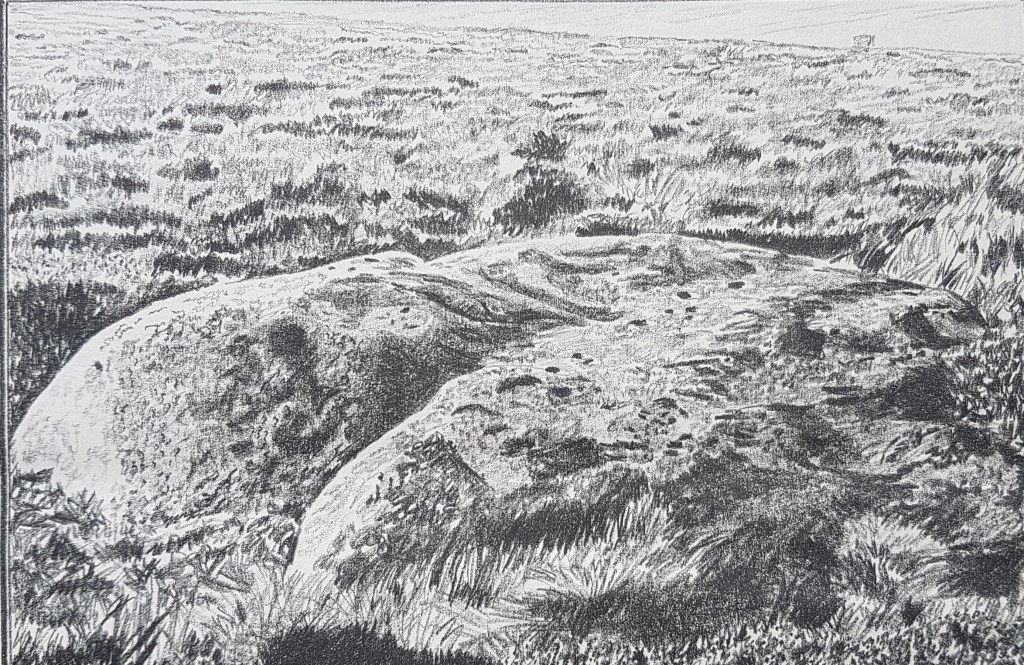
If you had participated on one of Sidney Jackson’s walks across an upland area near Bradford he certainly would have pointed out to you any cup and ring marked stones (petroglyphs or inscribed stones) that you passed. In this article I have included a beautiful drawing SJ made of such a stone on High Moor, near Keighley and two of my photographs of well-known examples on Baildon Moor. I must be honest and say that I am in a minority but I don’t share the enthusiasm that many people evidently feel for these objects. My main interest is in Industrial Archaeology so that I visit Baildon Moor for its treasure house of quarries and coal shafts rather than insights into pre-history. There is an inscribed stone quite near in Northcliffe Woods but its main value to me is to indicate that a glacial erratic gritstone boulder has been on the surface in this position for 4000 years.
Inscribed stones, which are still commonly called cup and ring marked stones, are founded all over upland Britain. There must be scores in the Bradford area alone and I have personally seen them as far north as Shetland. They are certainly found in most other parts of Atlantic Europe, and also in Italy and Greece. Whether they were ever found in lowland areas I am not sure. Perhaps in such locations they would not have survived several millennia of agricultural practices. The dramatic changes to the landscape means that stones found on bleak upland areas today might well have been created in warmer wooded conditions. Dating unreadable inscriptions clearly presents difficulties but inscribed stones are generally regarded as Neolithic or Early Bronze Age in date, say 4000-2000 BCE.
Creating them by ‘pecking’ out material from the naturally occurring rock faces would not have been too difficult but remember that we may not be seeing the stones in their original form. There would be a degree of subsequent natural weathering in any case. SJ reports moving one on Baildon Moor to protect it, and one of his correspondents reports using modern tools to make the marks more obvious. Please never undertake either of such actions. The meaning of the carvings is not known although there have been many speculations: territory markers, memorials, star-maps? Could they really have had the same meaning throughout the extensive areas of Europe in which they are found?
The meaning of the carvings is not the only mystery. The great archaeologist Sir Mortimer Wheeler spent part of his boyhood in Bradford. In his autobiography, Still Digging, he mentioned being taken by his father to see a cup and ring marked stone in Hirst Wood, Shipley. He even wrote to the Archaeology Group Bulletin in February 1964 to confirm his memory. This would have been before the Great War but it is disappointing to report that nobody, including Sidney Jackson, has ever been able to find it since. But the truth is out there.

 If you had been lucky enough to accompany SJ on a country walk you would not have progressed very far without the topic of carved stone heads being raised. They form regular entries in the Archaeology Group Bulletin. There is no doubt that he recognised, and brought to prominence, a huge number of these objects (in Yorkshire particularly) found in walls, as garden ornaments, and on the gables of houses or barns. His card index of heads listed 650 from all over the country, but particularly West Yorkshire (378), and was eventually given to the Yorkshire Archaeological Society. He considered that the heads were originally free-standing and distinguished them from gargoyles and corbels. He speculated that they might have been associated with springs and wells, or had an apotropaic function, being intended to ward off evil influences. He believed that the finding of heads indicated continuity of farming sites from prehistoric times until the 17th century.