Continental Coffee House/Godwin Street

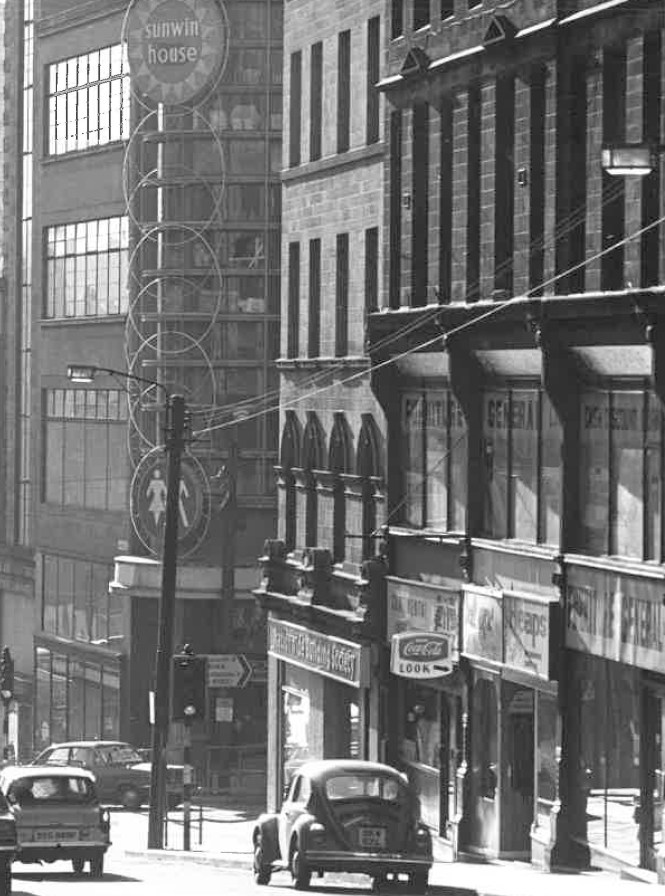
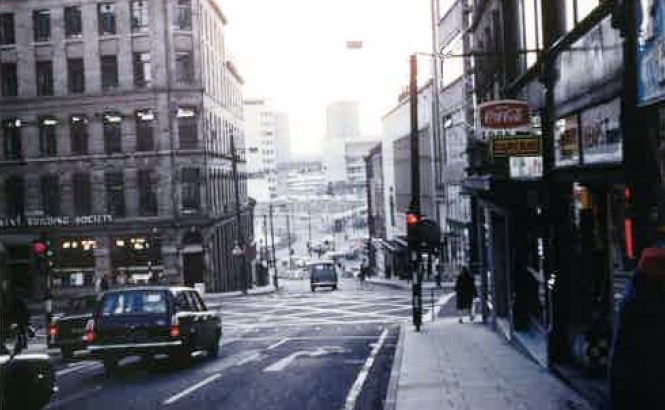
An enquiry was received recently in Bradford Local Studies library for photographs of the Continental Café on Godwin Street from the 60’s and 70’s. The downstairs area of the café was known as the ‘Hole in the Wall’ coffee bar.

These images show the lower part of Godwin Street and the Continental Café can be identified on the right by the distinctive ‘Coca Cola’ sign.

In the late ‘60s and early ‘70s the cafe was frequented by Mods of the day who would park their scooters the full length of Godwin Street. Thanks to our enquirer for this detail and the trip down memory lane.

KM1817943243-20191210153720

Bradford looking towards Sunbridge Rd’, Jack Booth collection, 11.11.1973

KM1817943243-20191210153646

Godwin Street, Bradford Libraries collection, date unknown


Undercliffe Cemetery and Nancy De Garrs

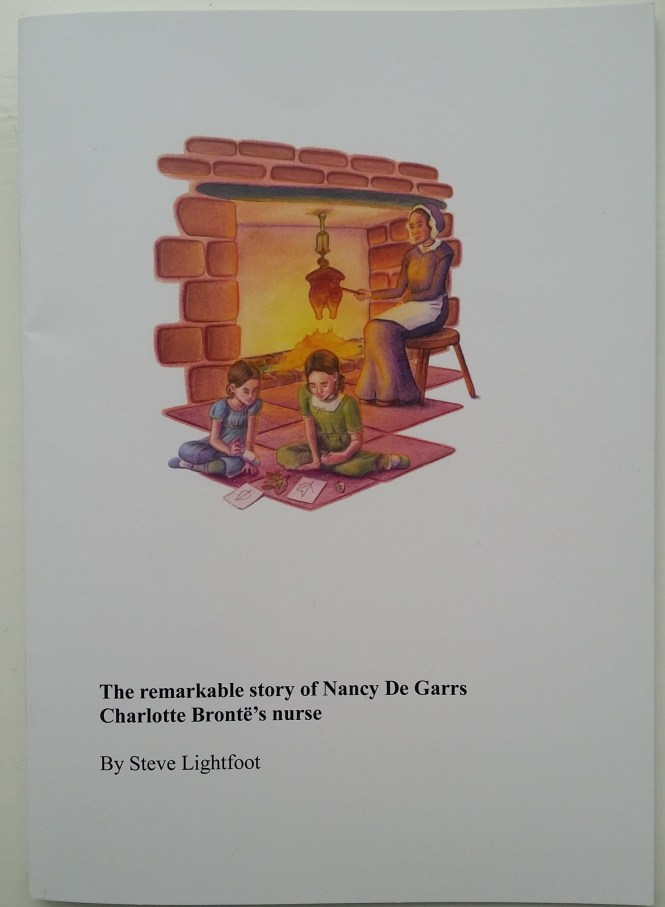
The article here was kindly sent in by Steve Lightfoot, Undercliffe Cemetery Volunteer and author of the recent publication ‘The remarkable story of Nancy De Garrs Charlotte Brontë’s nurse’

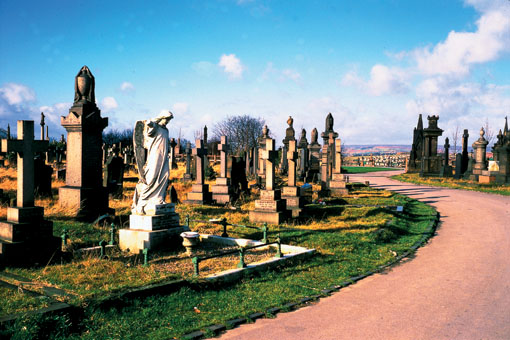
Recently the Undercliffe Cemetery Charity have been building a team of volunteers to research some of the more well known occupants of the cemetery. The first task was to install QR codes on the six listed monuments so that visitors to the cemetery could find out more about the people to which the monuments were dedicated. The volunteers then moved on to the so called Bradford Worthies, of which there are many. These were some of the most important people in Bradford’s history, including more than twenty of Bradford’s Mayors, who are buried at the cemetery. As new research is completed the information is posted on the Undercliffe Cemetery website under the history section. So far approximately thirty of the Worthies have been researched. Some of the grave sites have magnificent monuments but others are unmarked. Regular tours of the cemetery take place to raise funds for maintenance. The volunteer guides take visitors to some of the most interesting grave sites to tell the story of Bradford’s history and the people who made Bradford the place that it is. At one time of course it was the wool capital of the world.

During the research the location of Nancy De Garrs grave was finally found, underneath some undergrowth, and unmarked. Nancy was Charlotte Brontë’s nurse, she served the Brontës for eight years and helped to bring the Brontë children up at Thornton and Haworth. It was known that Nancy was at Undercliffe but nobody knew where. She died in the Bradford workhouse and could have well have ended up in a paupers grave. After some research it was found she was buried as Nancy Malone. The records showed the plot number and the maps showed the location of this, but who were the other people buried with her, Mary Stocks, James Scholey and John William Scholey. We just had to find out, and why was the grave unmarked? The last twelve months have revealed some fascinating detail about the life of Nancy De Garrs. Having found just how important Nancy was in the life of the Brontës the Charity have decided to launch an appeal for funds for a headstone to be erected and for the area to be made safe. Future visitors to the cemetery will be able to find out more about Nancy and her life with the Brontës and after. A booklet has been compiled and is currently being sold in bookshops in Haworth, in the tourist office in Bradford and in other locations in Thornton and elsewhere. All money raised will go towards paying for the work required to get Nancy a headstone and to make the area safe for visitors. So far we have had good publicity from the Telegraph and Argus, the Sunday Express and the Times but more funds are needed. Donations can be made through the Undercliffe Cemetery website or by purchasing one of the booklets. A provisional date has been fixed for the 9th May  2020, by which time, providing enough funds can be raised, the stone will be in place and a service will be conducted. See website for details of forthcoming events.

Steve Lightfoot
Undercliffe Cemetery Volunteer

undercliffe cemetery (2)

A Review of the Book

The Remarkable Story of Nancy de Garrs, Charlotte Brontë’s Nurse. By Steve Lightfoot. 2019. 32 pages.

Nancy Garrs was born in 1803, the oldest in a family of twelve children. Her father, Richard De Garrs, was a shoemaker of French descent who had a shop in Bradford. Nancy and a younger sister Sarah (b. 1806) went to the Bradford Industrial School where they learnt housekeeping and childcare skills. In 1816, aged 12, Nancy went to work in the Brontë’s Thornton home to look after the three young Brontë children. Three more children later, sister Sarah came to assist, with Nancy promoted to be cook and assistant housekeeper. In 1820 the Garrs twosome accompanied the Brontë family in their move to Haworth. Here they experienced the sad early years there and the coming of ‘Aunt Branwell’ (‘cross like and fault findin’). After serving the Brontës for eight years, Nancy left in late 1824, shortly followed by Sarah, when the oldest Brontë children went to Cowan Bridge School.

Nancy then worked as a dressmaker, marrying John Wainwright in 1830. They had two children, Emily Jane and Hannah. Significantly, Nancy signed her wedding banns with ‘her mark’ (which I found a surprise, Nancy having lived in such a literary household). Husband John, a wool comber, later an engine tenter, died after a horrific accident at work in one of Titus Salt’s Bradford mills. He was buried in the Dr Garrs family plot in Bradford where four of Nancy’s sisters were buried. The 1841 census shows Nancy and a daughter living with sister Sarah and her children, just a few doors away from their sister, Martha, who had married Benjamin Hewitt. Clearly the families were supporting each other, with their parents also nearby. In 1844, Nancy married Irishman John Malone, a warehouseman. After John’s death in 1881, Nancy fell into poverty and three years later she was taken in at the Bradford Workhouse, where she died in 1886 aged 82.

Of her years with the Brontë family, author Steven Lightfoot highlights a number of incidents and myths – of Mrs Gaskeill’s hurtful remarks in her Life of Charlotte Brontë; of the confusing comment of Patrick’s about Nancy leaving the parsonage to marry a ‘Pat’ – not in 1824 she didn’t! And there is new information about the Brontë mementoes that Nancy had, of how they were displayed in a public bazaar in 1885, acquired by John Widdop, a son of Mary, another of Nancy’s sisters, and how they may have been sold to alleviate Nancy’s penury.  Other members of the Dr Garrs family are briefly featured, notably her brother Henry, and sisters Ruth (who married John Binns) and sister Sarah, who married William Newsome in 1829, had five children, and eventually settled in Iowa, USA.

This focus on Nancy and her family circle does a good job of widening our knowledge of the social context of the time.

Bob Duckett
Past Editor Brontë Studies and The Bradford Antiquary.

Book (2)

Trace your Family Tree

Have you ever wondered how to get started with researching your Family Tree and using the array of records available?

Or have you already started your quest and reached a point where you need a helping hand?

Wherever you are on your journey into your past, the friendly helpful experts from Bradford Family History Society will be on hand in Bradford Local Studies Library to give help and guidance with this fascinating and rewarding pastime.

Thursday 28th November.

Drop in anytime between 10.00am and 12 noon.

Christmas Day and the Keighley Stagecoach

By the nineteenth century, stagecoaches in England had been a vital part of its
infrastructure for nearly two hundred years. Though the steam train, at least in the south, was replacing the need for coaches by the 1830’s, they still remained an important mode of transportation and mail in the north.

Through donation, the Keighley Local Studies library has been fortunate to obtain the
records for the Keighley stage coach covering the years for 1841-1843. Opening the ledger a curious researcher will find the lined and long dried inked pages remarkably preserved.  Within its leaves, a pink piece of blotting paper remains where the clerk left it when it was closed nearly two hundred years ago.

Capturesc


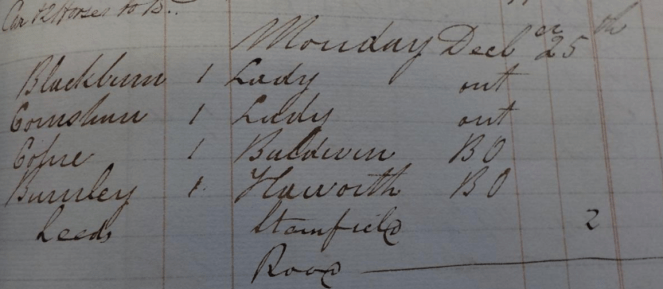
The ledger for the stagecoach Invincible reveals that Keighley ran an active stagecoach
business running every day of the week, except Sundays, including Christmas Day.  One can imagine a jolly Dickensian coachman bundling his Keighley passengers into the Christmas coach and on to their holiday destinations. It is left to us today to wonder who they were, but there are clues in the ink:

25 December 1841 ‘Burnley, Wilde Ballet’…1842 ‘Leeds, Firth in’…1843 ’Blackburn, 1, Lady out.’

Capturelady

A look at the William White’s History, Gazetteer, and Directory of the West-Riding of
Yorkshire,
Vol. I reveals that in 1837, Keighley was running seven coaches: Union, Invincible, Airedale, Alexander, Tradesman, Wonder and Cars (690). All of these coaches had different departure points. The Union and Invincible, which the ledger is for, departed from the Devonshire Arms Inn.

Devonshire p2
devonshire photo

In order to learn about one’s family history, or lay groundwork for a period drama or novel, one might check records such as birth certificates, marriage licenses, censuses, or diaries, but what about stagecoach records? The study of such a resource would give valuable historical information about who may have lived and traveled through an area, where they traveled to and from or even where they sent their mail. This opportunity is not often possible because very few have survived until the 21st century; however, this rare insight is available at the Keighley Local Studies Library.

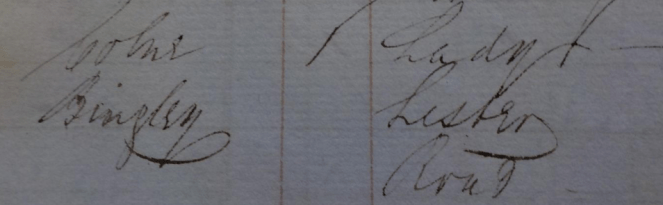
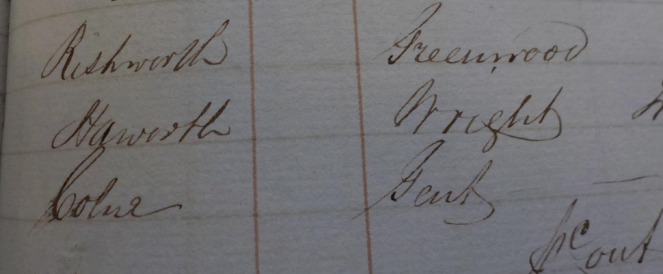
A perusal of its leaves reveal names still familiar in Yorkshire, such as Hargreaves, Ibbotson, Firth and Laycock, and those not as locally known, as Lomax, Mulligan, Brookslaw, and Critchley. There are surnames that we associate with the Brontës – Nichols, Earnshaw, Taylor, Greenwood, and Heaton – and names with famous or infamous associations, such as Grimshaw, Turpin, Shuttleworth and Dickenson. And what Lister rode to Bingley on Saturday the 12th of November, 1842?

Capture3

The titles and labels of the passengers given by the ledger keeper are also of interest. The
‘Sheriff for Colne’ rode on 30
th of June 1842. If the passenger was known, or perhaps
prominent, they might be titled, as Mr. Butterfield or Mrs. Hinchcliff were; but, if they were not, they might be labeled simply as ‘Lady’ , ‘Gent,’ ‘boy,’ or even ‘poor woman’ or ‘poor old man’.

The stagecoach places of originations or destinations to and from Keighley are impressive. These include the expected Yorkshire towns and villages, such as Cross Hills, Skipton, Harrogate and Wakefield, as well as Barrowford, Chorley, Colne and Preston in Lancashire.  Haworth is also mentioned (e.g. Monday 1st November 1841), but, alas, we are left to ponder who the passengers may have been. The places listed take in the cities of Leeds, York and Lancaster and extend as far west as Liverpool and east as far away as Scarborough. There is even a mystery destination called ‘Dolly’s’ the location of which is yet to be discovered (10 May, 23 June, 30 June 1842).

Keighley appears to have been quite a transportation hub in its day!

Miriam Adamson, Keighley Local Studies Library volunteer

Capture4

Secret Ilkley Book Launch

Ilkley Library was the venue for the launch of a new book by local author and historian Mark Hunnebell.

Mark, of White Wells, gave a talk about his new book Secret Ilkley and also signed copies.

Launch2 (2)

Mark Hunnebell

Secret Ilkley goes behind the façades of the familiar to discover the lesser-known aspects of the Ilkley’s long and illustrious past.

The inspiration for this book originally came from an information card available for visitors to White Wells in the 1950’s. The card was produced by the Ilkley Gazette office and provided a useful guide to some of the prominent features that could be seen in the valley from White Wells on the moors above the town.

Mark writes in his introduction:

‘This book is a record of many of the developments and changes that occurred in Ilkley during the second half of the nineteenth and throughout the twentieth century, much of the information being sourced from efforts to compile an index of the Ilkley Gazette for my own interest in local history. Many of the articles referred to have not seen the light of day since their original publication and the details simply lost or forgotten. I am grateful that the Ilkley Library holds old copies of the local newspapers.”

In the book, Mark takes the reader on an enlightening and entertaining journey through the past, delving beneath the surface to reveal dark deeds and strange tales with long-forgotten facts and amusing stories. This book lifts the lid on the hidden secrets that even most local people don’t know.

Supporting Mark at the book launch were his parents Edwin and Margaret Hunnebell and his partner Joanne Everall. Also there was Sally Gunton who kindly supplied many images for the book.

Launch1

Frazer Irwin, Mark Hunnebell, Edwin Hunnebell, Margaret Hunnebell, Sally Gunton, Joanne Everall

Mark said: “It was very well attended and was a pleasure to talk about “Secret Ilkley” to so many familiar faces. And thanks to everyone who bought a copy too!”

Secret Ilkley by Mark Hunnebell: ISBN 9781445684475