
The initial meeting to consider the desirability to erect a memorial to the participants of the Great War was held during December 1918, inviting suggestions as to the form the memorial should take.
Following submissions an appointed sub-committee recommended in April 1919 a suitable monument be erected in the Town Hall Square replacing the central garden then in place. The proposed site was subsequently ratified by the Ministry of Health during July 1919, but it wasn’t until three years later that the project was commenced.

Original minutes from Keighley’s War Memorial Committee 14th August 1923.

Original minutes from Keighley’s War Memorial Committee 14th August 1923.
During July 1922 the War Memorial committee consulted with Mr. Henry C. Fehr, sculptor of South Kensington, who had earlier designed memorials for the cities of Leeds & Hull amongst others, to submit designs for the memorial they proposed to be erected in the Town Hall Square. Henry C. Fehr accepted the invitation proceeding to make a model from his design. The model upon completion was submitted to the committee who gave it their immediate approval and instructions to immediately commence preparations for the erection of the monument which would consist of local stone for the masonry work.
A memorial fund with target figure of £5,000 was commenced with one week in July 1923 being suggested as a week of appeal. By August 1923 the committee could report the memorial fund had £6,348 subscribed or promised.
Contracts
These had been let as follows:
Masonry Work – Tom Moore & Co. of Alice Street Keighley
Eastburn Stone – Richard Dixon & Co. of the Eastburn Quarry
Bronze Figures & Inscriptional Tablets – Henry C. Fehr
In addition, Edward Johnson of London noted artistic calligrapher was commissioned to write a separate Book of Remembrance with the leather binding by Douglas Cockerell of W. H. Smith, London.
The erection of the monument continued steadily until 30th October 1924 when the platform was completed and the superstructure had commenced, that a ceremony took place in the presence of the mayor. A casket containing war decorations, copies of the Keighley News and a parchment document summarising activities in the town during the late war was sealed in a prepared cavity.
Following this ceremony work continued, the monument rising to 35 feet from ground level with two pedestals rising from the platform base. On each pedestal was erected a bronze figure 7 feet in height, a soldier and a sailor representing the two arms of the then fighting forces.

Workmen on scaffolding, building Keighley war memorial
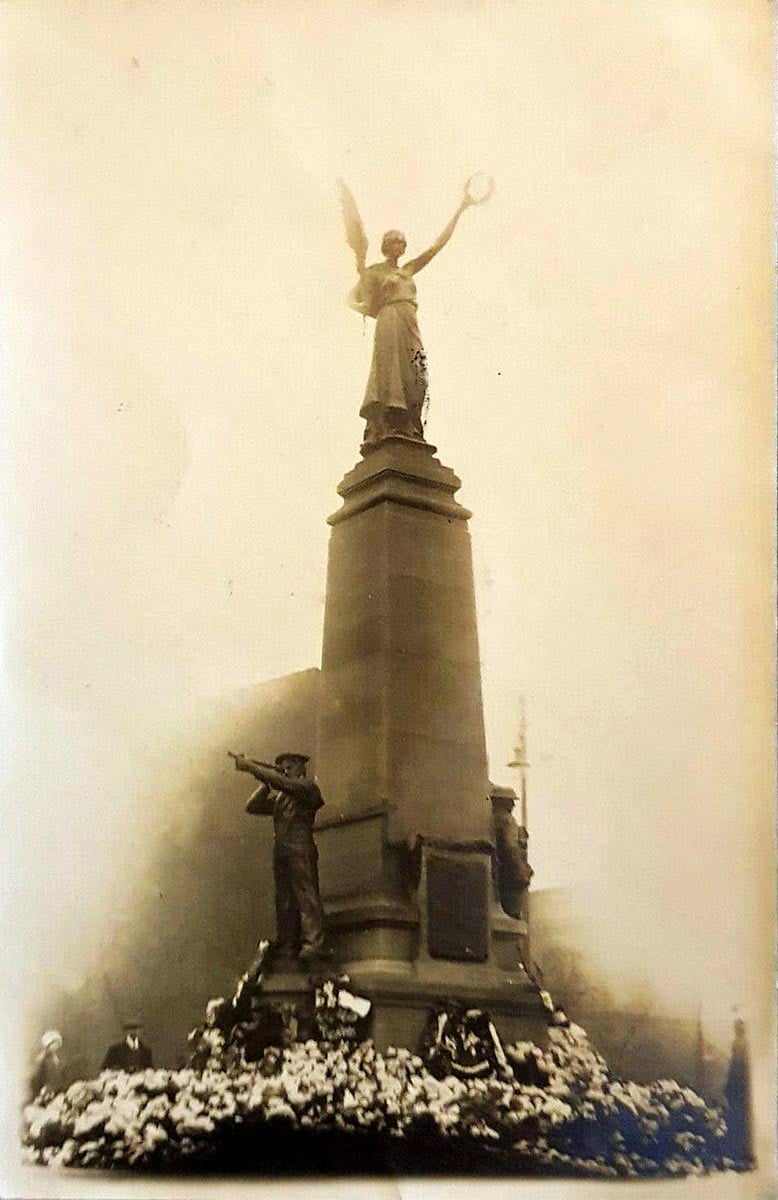
Keighley’s war memorial after the unveiling.
The central column rising 20 feet from the platform, topped with a 9 feet female figure holding a wreath in one hand and a palm branch in the other representing ‘Peace & Victory’ won through service & sacrifice. At the front & back of the central column are wrought bronze panels with appropriate inscriptions.
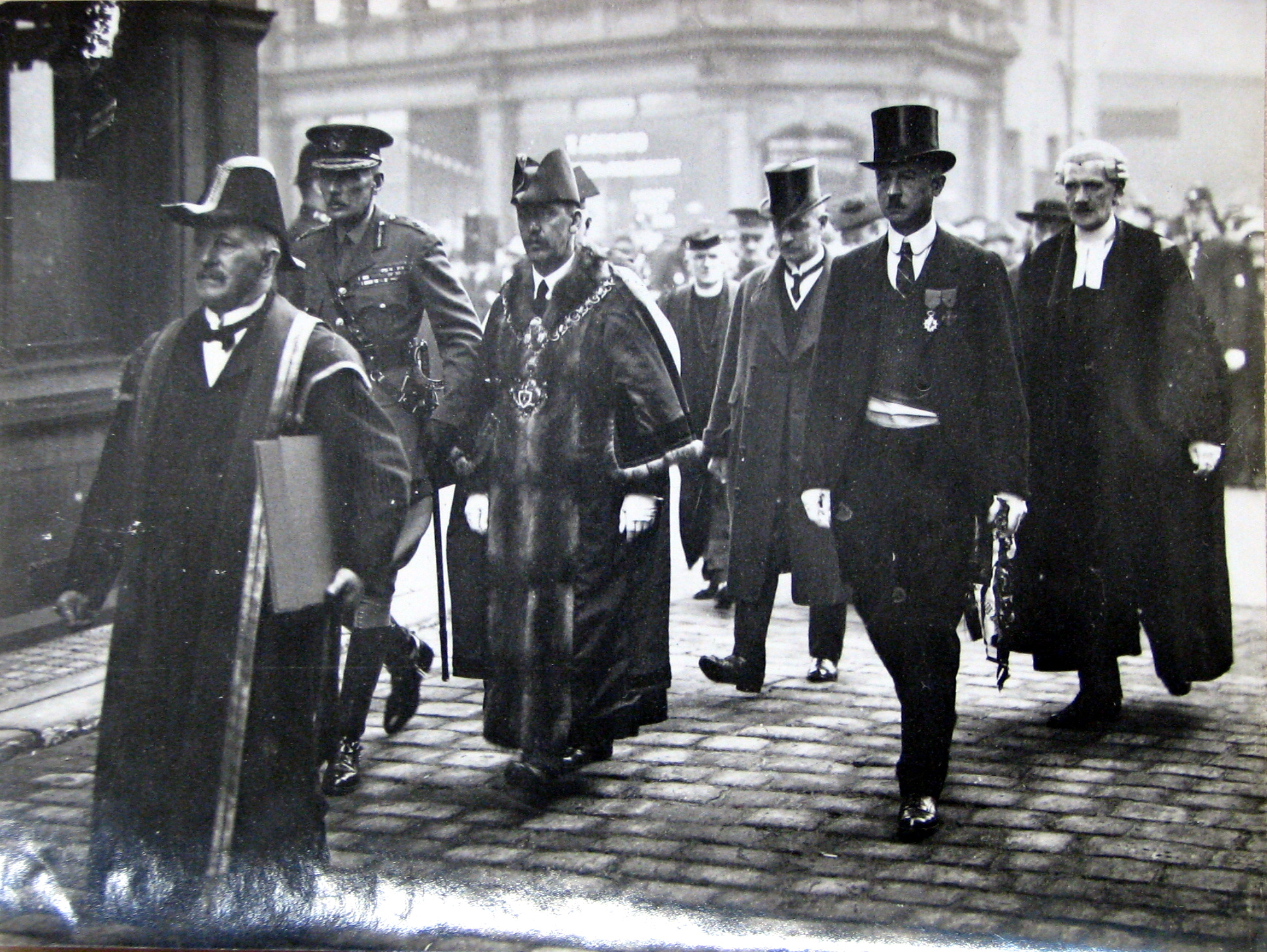
The memorial party including Lieutenant General Harrington, Keighley Mayor R. Calverley and Monsieur G. Ducornet, Maire of Poix du Nord. Following them are Mr. Newman King and Keighley Town Clerk Smith Terry.
The mayor of Poix-du-Nord in France attended the opening ceremony, presenting on behalf of the people of his town a bronze emblem representing an olive branch. This bore an appropriate inscription in French, was decorated with two tricolours and the names of the two towns stamped in gold. This was later affixed to the monument.
All contents supplied by Eddie Kelly.


