
A library outranks any other one thing a community can do to benefit its people, it is a never failing spring in the desert.
Andrew Carnegie
Andrew Carnegie was born in Dunfermline, Scotland on the 25th November 1825, in a small one roomed weavers cottage where his family lived and worked. Despite his family’s poverty he did receive some early education at the free school in Dunfermline, that had been gifted by philanthropist Allan Rolland.
Then in 1848 when he was 12 his family moved to Pittsburgh in the hope of improving their lives. Andrew began work as a bobbin-boy in a cotton factory but through hard work and study in libraries, he became one of the most successful businessmen in America’s history.

Augustus Spencer.
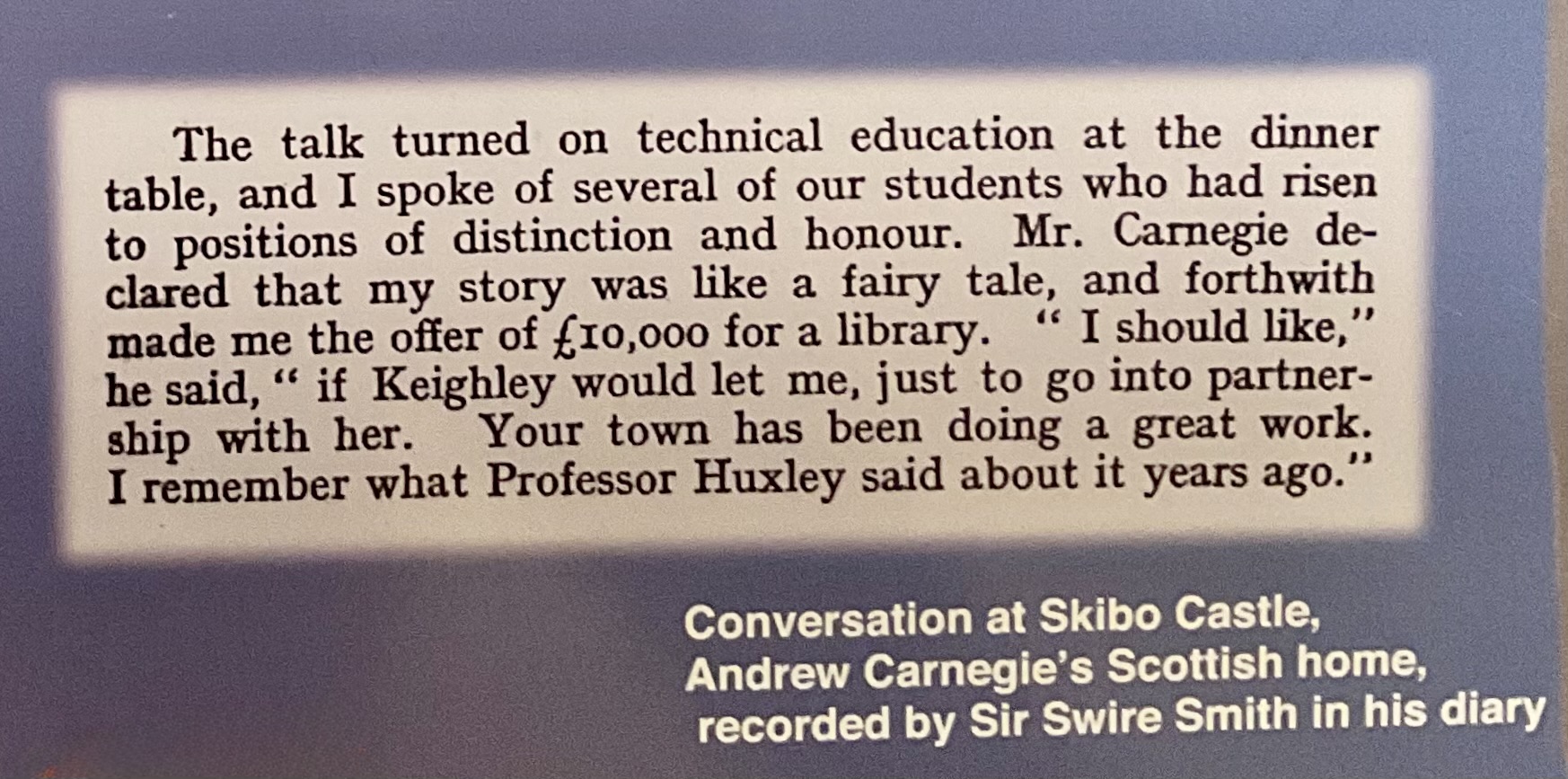
He met Swire Smith on a trans-Atlantic voyage and was so impressed with Smith’s work and the success of Keighley’s Mechanics’ Institute and its students that he visited Keighley with his wife, Louise, his most trusted confident. The two men became friends and it was on a trip to Andrew’s Scottish residence Skibo Castle in 1899 that a bet was made whist playing golf, if Smith could beat Carnegie at golf he would fund a library in Keighley.
Andrew offered to donate £10,000 for a public library in Keighley, the first to be funded by him in England. The Carnegies later went on to fund libraries and educational establishments all over the world.

The memorial stone was laid in a ceremony on the 9th August 1902, the same day as the Coronation of Edward VII. Sir Swire Smith laid the stone using a silver trowel and oak mallet.

The library was officially opened on the 20th August 1904 by His Grace the Duke of Devonshire, K.G. with an Art exhibition on the first floor.


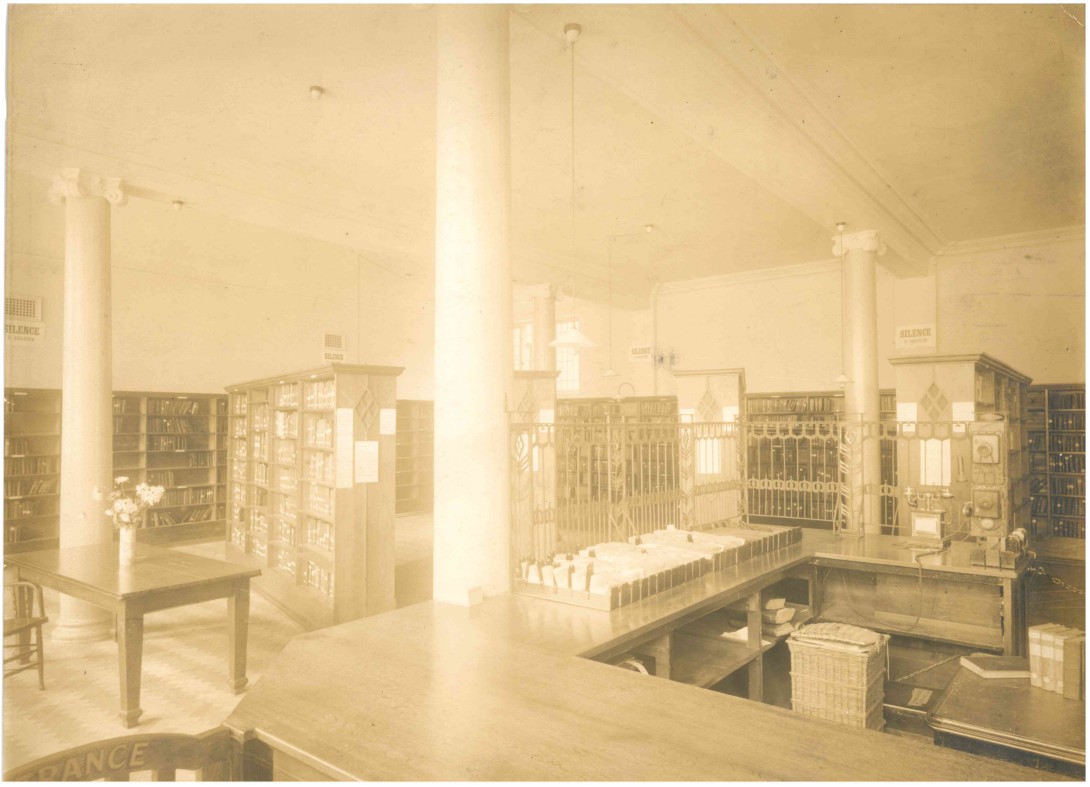
On first opening the library consisted of a Lending Library, Reading Room, Patent Library and small study room. In 1912 a reference library was opened upstairs, which had been until then a gallery and exhibition space.
The new library was fortunate to acquire the library from the Mechanics Institute, 13,000 volumes were transferred for the libraries opening. However borrowers were not allowed to take their own books from the shelves, instead an indicator system was used with slots to mark which books were out and which were available, you would then ask the librarian for the book. Open access was eventually introduced in 1922 and by 1929 the library had been extended and a new children’s library room was built. The library was further extended in 1961 with the children’s library moving into the new extension and a lecture hall added, which was opened by the town Mayor, Alderman JS Bell.


