A walk with Sidney Jackson #3

If you had participated on one of Sidney Jackson’s walks across an upland area near Bradford he certainly would have pointed out to you any cup and ring marked stones (petroglyphs or inscribed stones) that you passed. In this article I have included a beautiful drawing SJ made of such a stone on High Moor, near Keighley and two of my photographs of well-known examples on Baildon Moor. I must be honest and say that I am in a minority but I don’t share the enthusiasm that many people evidently feel for these objects. My main interest is in Industrial Archaeology so that I visit Baildon Moor for its treasure house of quarries and coal shafts rather than insights into pre-history. There is an inscribed stone quite near in Northcliffe Woods but its main value to me is to indicate that a glacial erratic gritstone boulder has been on the surface in this position for 4000 years.
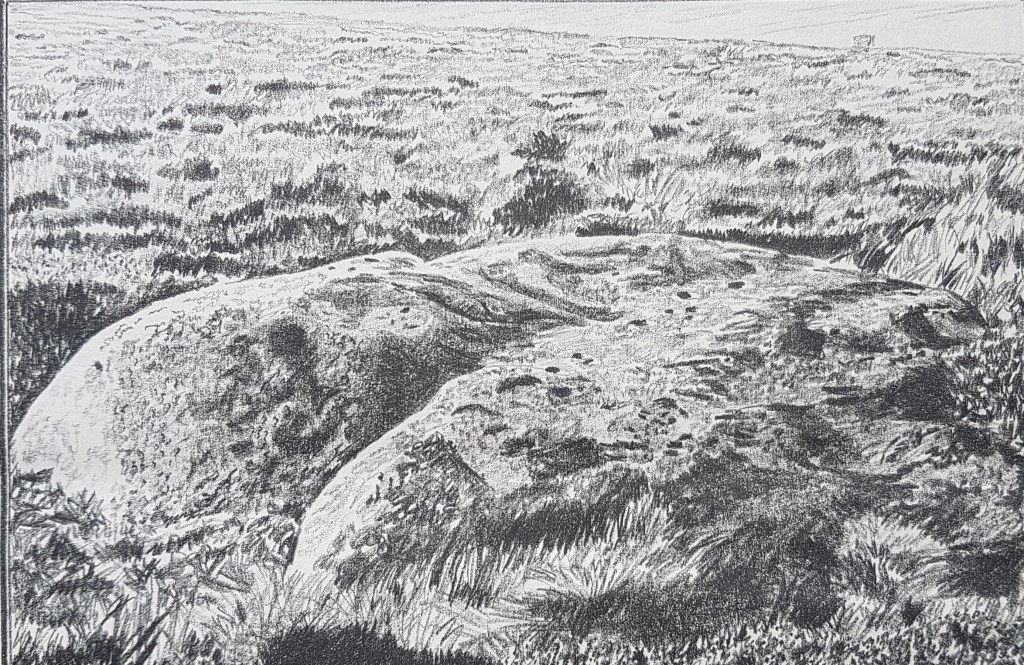
Inscribed stones, which are still commonly called cup and ring marked stones, are founded all over upland Britain. There must be scores in the Bradford area alone and I have personally seen them as far north as Shetland. They are certainly found in most other parts of Atlantic Europe, and also in Italy and Greece. Whether they were ever found in lowland areas I am not sure. Perhaps in such locations they would not have survived several millennia of agricultural practices. The dramatic changes to the landscape means that stones found on bleak upland areas today might well have been created in warmer wooded conditions. Dating unreadable inscriptions clearly presents difficulties but inscribed stones are generally regarded as Neolithic or Early Bronze Age in date, say 4000-2000 BCE.

Creating them by ‘pecking’ out material from the naturally occurring rock faces would not have been too difficult but remember that we may not be seeing the stones in their original form. There would be a degree of subsequent natural weathering in any case. SJ reports moving one on Baildon Moor to protect it, and one of his correspondents reports using modern tools to make the marks more obvious. Please never undertake either of such actions. The meaning of the carvings is not known although there have been many speculations: territory markers, memorials, star-maps? Could they really have had the same meaning throughout the extensive areas of Europe in which they are found?

The meaning of the carvings is not the only mystery. The great archaeologist Sir Mortimer Wheeler spent part of his boyhood in Bradford. In his autobiography, Still Digging, he mentioned being taken by his father to see a cup and ring marked stone in Hirst Wood, Shipley. He even wrote to the Archaeology Group Bulletin in February 1964 to confirm his memory. This would have been before the Great War but it is disappointing to report that nobody, including Sidney Jackson, has ever been able to find it since. But the truth is out there.
A walk with Sidney Jackson #2

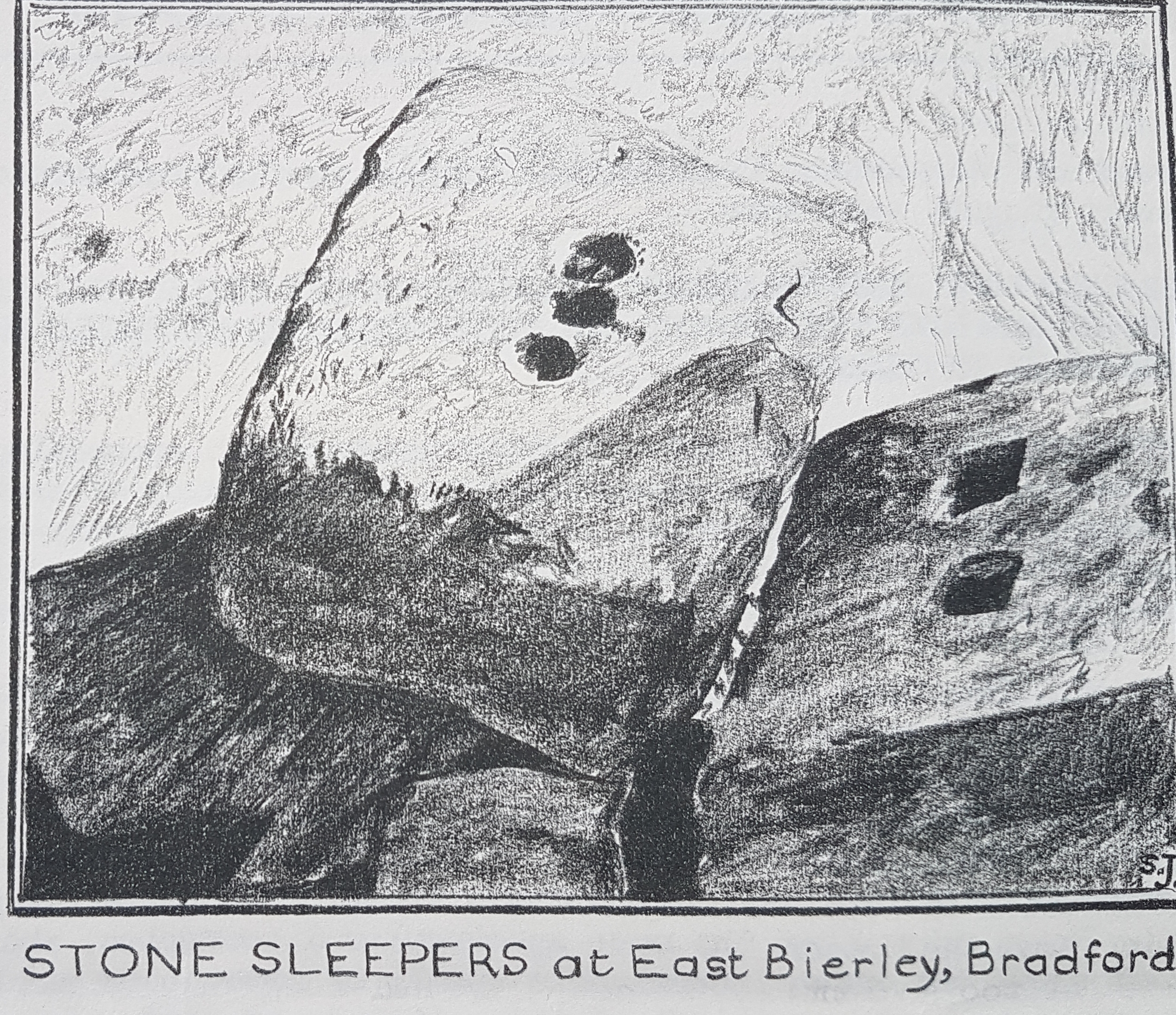
SJ would certainly have told us that during a walk you can never look too hard at the constituent parts of a dry-stone wall. Most readers will know that Bradford once had two great iron works at Bowling and Low Moor. The blast furnaces were fed by local iron ore found in the roof of the Black Bed coal seam, and coke made from the deeper Better Bed coal. As the mineral resources in the neighbourhood of the iron works were worked out great networks of tramways, or mineral lines, grew up to transport the precious commodities from further and further afield. Naturally the lines rested on sleepers which in this area are likely to have been made of stone. I have never been lucky to locate any of these myself but most of my walking is done in north Bradford where mining was uninfluenced by the iron works. In the Archaeology Group Bulletin of March 1964 SJ published his drawing of stone sleepers from East Bierley which seemingly had been found on a wall top. He gave approximate dimensions of 20 by 12 by 8 inches and described the rails themselves, long vanished of course, as being of cast iron and approximately one yard in length. Cast iron was brittle and consequently wrought iron, and then steel, were preferable for railway tracks.

Stone Sleepers

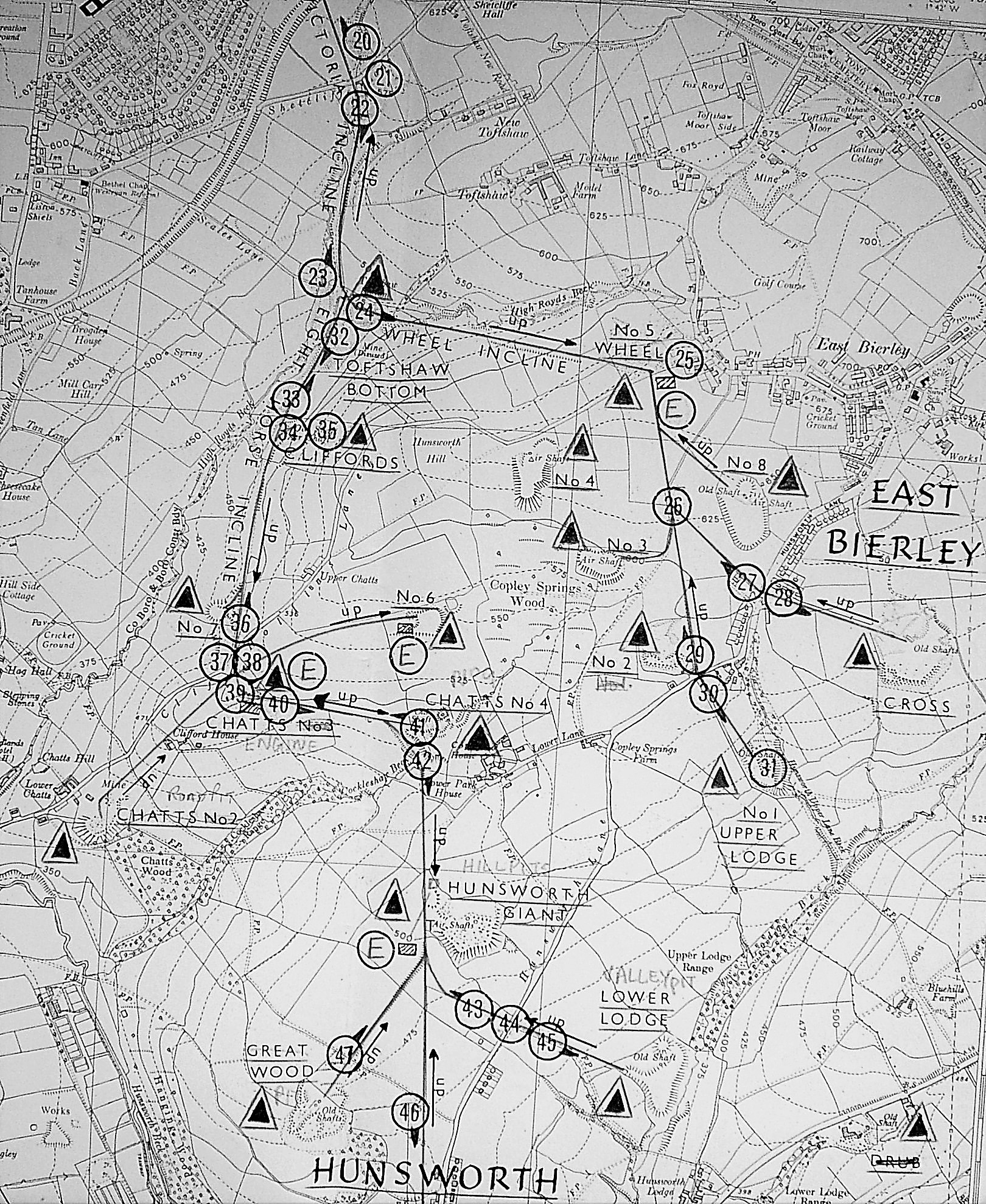
In the article it is suggested that pits at East Bierley supplied Low Moor ironworks but it seems that this wasn’t the case. At the time SJ wrote Derek Pickles was already working on his very detailed study of Bowling Iron Company’s mineral tramways, now curated by Bradford Industrial Museum.

East Bierley tramways

He recorded that ‘in 1839 the company leased 1200 acres of land in Toftshaw and Hunsworth from the Earl of Scarborough, and began to work pits in the area’. Bore hole reports available from the British Geological Survey suggest that Shertcliffe Coal was at 30m depth in this area, and was widely exploited. The fact that there were also ironstone miners and ironstone pits in East Bierley suggests that the ironstone containing Black Bed Coal seam was also being accessed about 67m below the Shertcliffe Coal. Derek Pickles reported that the Bowling Iron Company already had shafts of 95m depth to reach the Better Bed coal but when it ‘extended its operations into Hunsworth, Toftshaw and Tong much larger and deeper pits were sunk’.

A walk with Sidney Jackson #1

Note from Bradford Libraries: please send us any photographs of observations or historical curiosities on your country walks and we will be happy to share and comment where possible.  You can share your images or thoughts via Twitter @bradfordlibs247 or via our Facebook http://www.facebook.com/BradfordLocalStudies/

When Sidney Jackson was keeper of Archaeology, Geology and Natural History at Cartwright Hall he edited a subscription journal called the Archaeology Group Bulletin. Although compiled over 50 years in the past it can still be read with interest today. I am impressed by the quality of both articles and the correspondence. Many contributors were concerned with local dry-stone walls and the interesting things that can turn up in or around them.

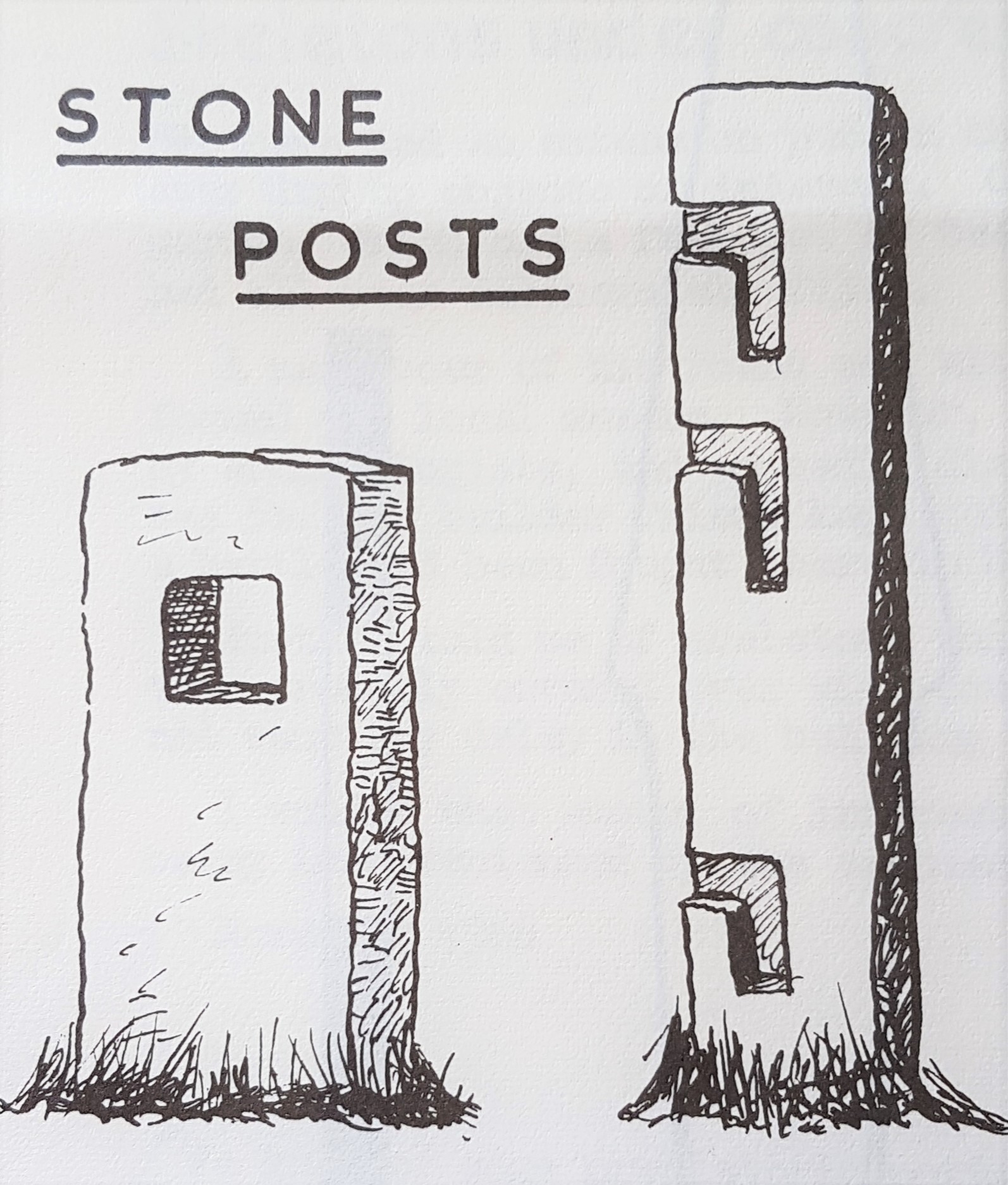
Loose rail posts preceded iron fences, and hinged gates, as a method of confining stock on farmland. Fig. 1 shows a drawing from the AGB.

Fig 1

Fig. 1

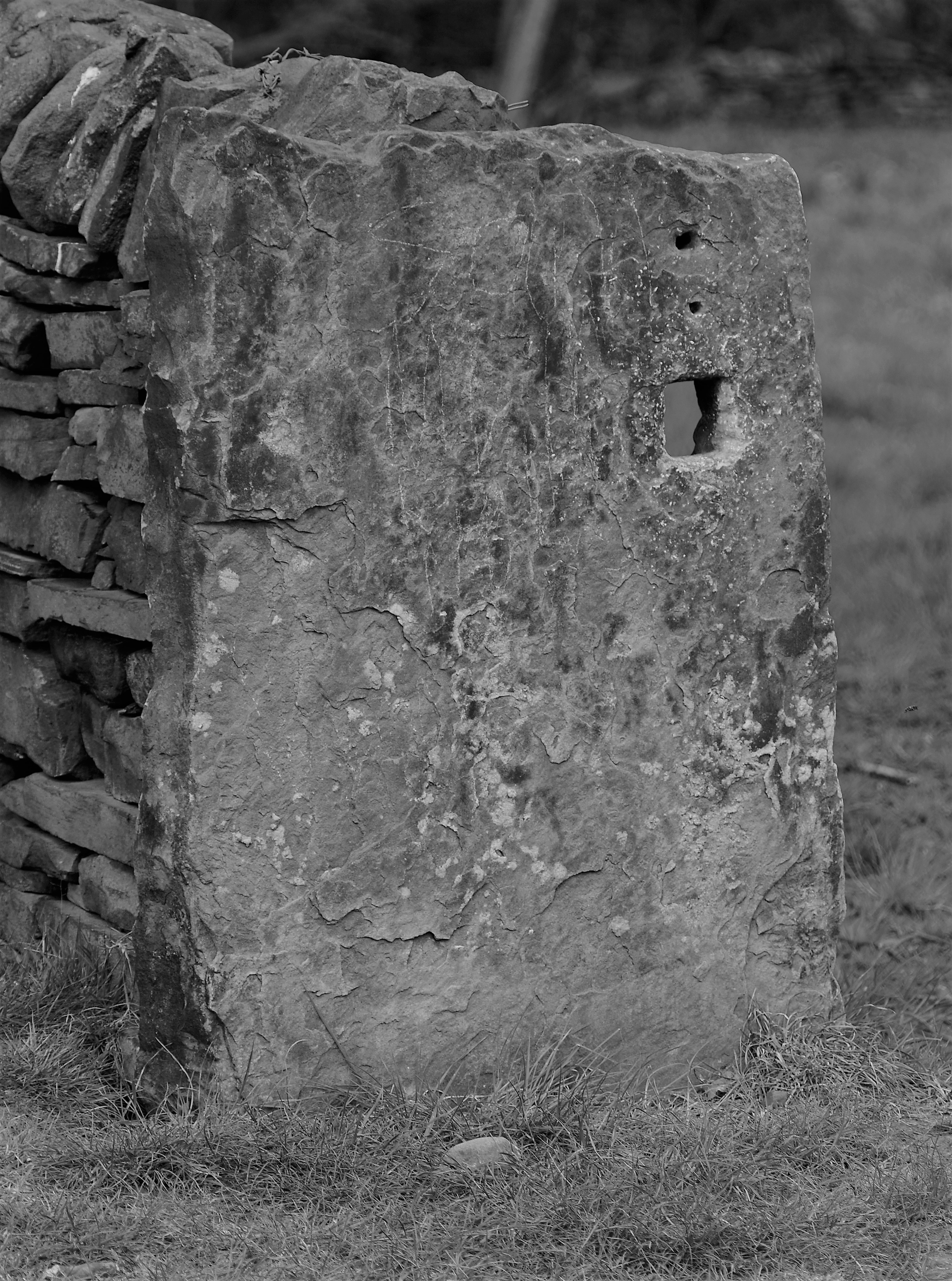
You can see how a wooden pole would fit into the slots to provide a barrier.  Both wooden poles and quarried stone posts were readily available in an area like West Yorkshire. You do occasionally still see residual loose rail posts today and I have provided an example (Fig.2) from Heaton Royds Lane, on the scenic route between Shipley and Heaton.

Fig 2

Fig. 2

Quite exciting objects can be collected to plug holes in field walls, and Fig.3 shows the base of a quern drawn by Sidney Jackson.

Fig.3

Fig. 3

Querns were stone devices used for grinding corn and were certainly employed in Britain from the Neolithic to the early Medieval period. They were ultimately replaced by wind or water mills which would grind everybody’s corn, at a price. It was suggested in the AGB that this quern base was from the Iron Age. I have never been fortunate enough to find one: in my experience old bricks or lumps of iron-making slag were more frequently used round Bradford.

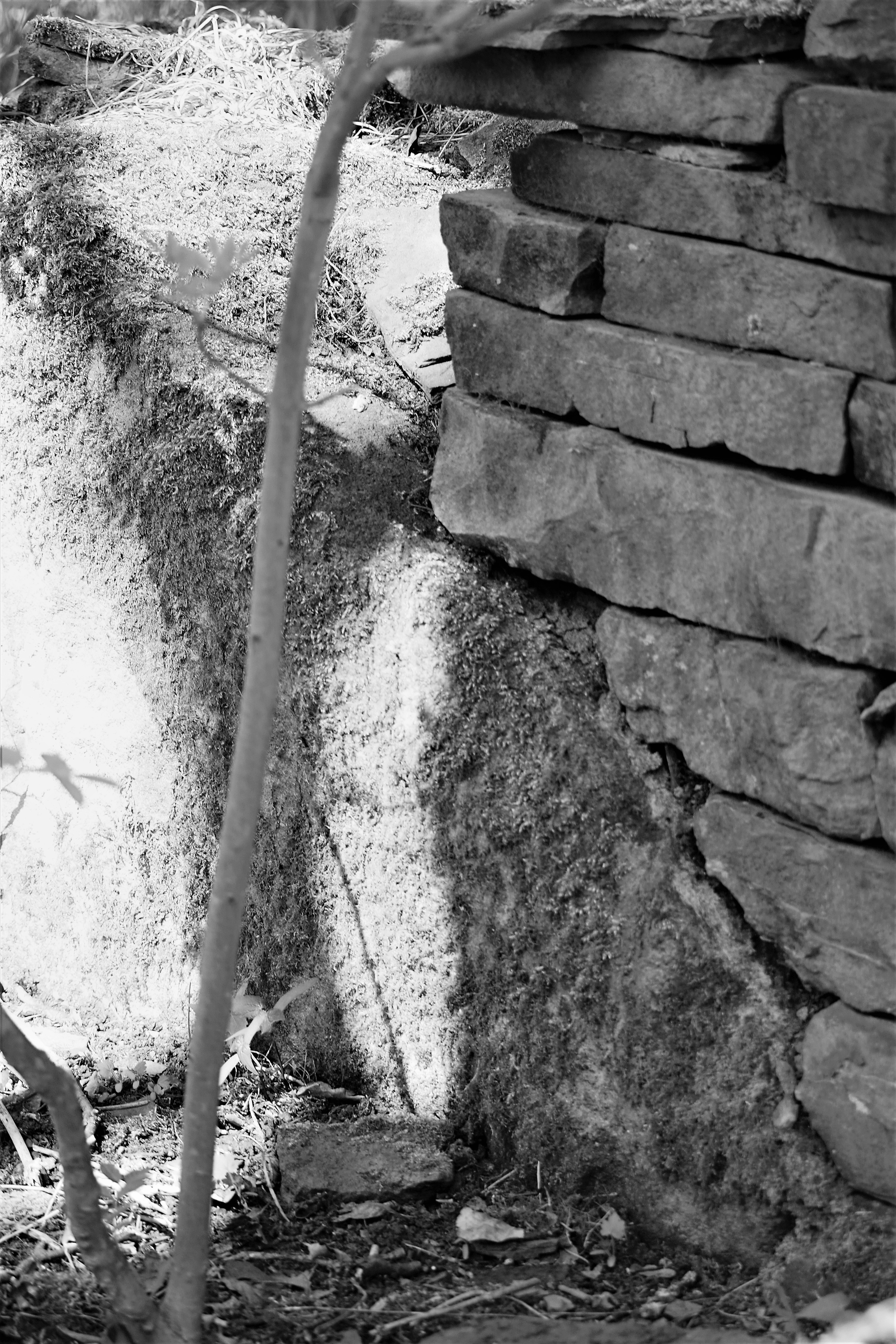
Fig.4 shows a situation I have found involving a dilapidated dry-stone wall on the margin of Heaton Woods.

Fig 4

Fig. 4

On the right you can see the end of some perfectly ordinary masonry, consisting in all probability of Elland Flags wall stone which was widely quarried in 18th and 19th century Heaton. This wall stone conforms to, ‘respects’ is the archaeological term, a huge earth-fast boulder. This is not an isolated phenomenon but there is a linear arrangement of such boulders with a more modern wall built over them. The boulders consist of rounded gritstone and don’t show any obvious signs of dressing. Presumably they were glacial erratics which are not uncommon in this area. Boundaries consisting of large earth-fast boulders, like querns, were a feature of the Iron Age but I’m not claiming that I have been that lucky!

Derek Barker

Historical Objects on Country Walks

Finding historical objects on country walks

It is well known that spending some time outdoors for daily exercise can have a positive effect on physical and mental wellbeing.

However, it is an often overlooked fact that observations on country walks can also provide fascinating insights into the natural history, geology and archaeology of an area.

We are pleased to share here the first in a series of articles by renowned local historian Derek Barker on the historical objects which may be seen on walks.

These articles will be based on the historic bulletins of Sidney Jackson (1902-1979), eminent expert in Natural History, Geology and Archaeology and curator in Bradford Museums until 1967.

Important note:

As long as government guidelines on social distancing are being followed people are allowed to leave their homes in certain circumstances. Woodlands, moorlands, public rights of way and other public green spaces remain open for individuals and households to take daily exercise.  Anyone venturing out should follow government advice.

Please use the link below for information and guidance from Bradford Council about the use of public green spaces at the current time:

https://www.bradford.gov.uk/emergencies/council-service-disruptions/public-green-space-and-rights-of-way-guidance/

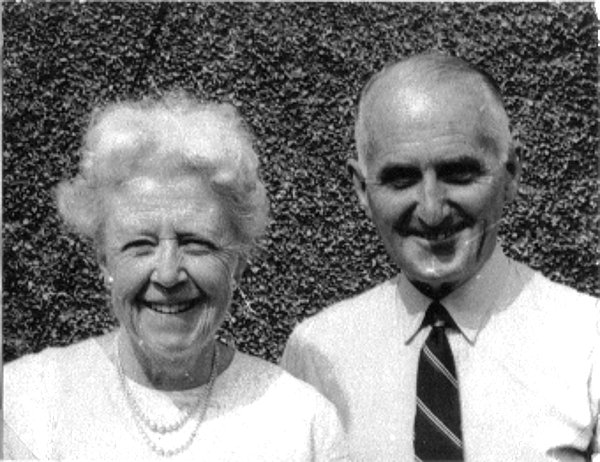
Sideny & Marie Jackson

Marie and Sidney Jackson


Sidney Jackson ‘Jacko’ (1902 – 1979), despite being self-taught, was in charge of Natural History, Geology and Archaeology at Bradford museums (based at Cartwright Hall) for 28 years before retiring in 1967. I never met him, moving to Bradford in 1979 the year he died, but there must still be Bradford people in their late 60s and 70s who attended one of the memorable educational walks he provided for children. When I looked into this topic, some years ago, I found several of his former pupils were now in senior archaeological and scientific posts. Jacko attended Bradford School of Art in 1915-17 to train as a textile designer: later he was justly famous for the quality of his archaeological drawings. I have provided two examples: showing cup and ring marks, and loose-rail fence posts. He introduced the concept of the glass-fronted beehive to Cartwright Hall, an example of which is still to be found at Cliffe Castle Museum.

Carved stone heads, which he believed were often of ‘Celtic’ origin, were Jackson’s great interest. His card index lists over 650 from all over the country, but particularly West Yorkshire (378). His second love was for Iron Age querns which were once used for hand-powered corn grinding. I think we can be quite certain that few today could match his knowledge in the combined fields of natural history, archaeology and geology. Public enquiries on these subjects were frequently answered by return of post. There cannot be many people in modern Bradford appreciate what a cultural debt is owed to Jacko. Traditional archaeology and natural history are still represented at Cliffe Castle Museum, Keighley but with only a fraction of the prominence he would have considered appropriate. His successor, Stuart Feather, was responsible for the creation of Bradford Industrial Museum. Feather felt, and I feel, that the study of industrial history and archaeology was very suitable for Bradford, but I’m fairly certain his illustrious predecessor would not have agreed. Although not without his faults Sidney Jackson was a unique and irreplaceable man.

The extent to which archaeological inferences can be securely drawn from surface finds, rather than finds discovered in context by excavation, is still an important a question and one which was frequently explored in the excellent Archaeology Group Bulletin which Jacko edited. The journal was founded in May 1954 and appeared monthly until 1967. Copies are still available in Bradford Libraries, and the Yorkshire Archaeological & Historical Society transcribed the whole series for a CD-ROM. The AGB is an extremely good source of information about what might be called ‘country walk archaeology’. What was the function of that odd shaped piece of stone? Is that a prehistoric flint tool? Is that a Neolithic cup and ring mark? What is the likely date of that barn? Topics that have rather been abandoned by the professional but can still be of great interest to the amateur and to which I shall return in the future.

When the Local Studies Library re-opens you can learn more about the subject in ‘Mr Jackson at Cartwright: A Gentleman and Scholar’: The Bradford Antiquary (2012) 3rd series 16, pp. 75-87.

Derek Barker