A walk with Sidney Jackson #8

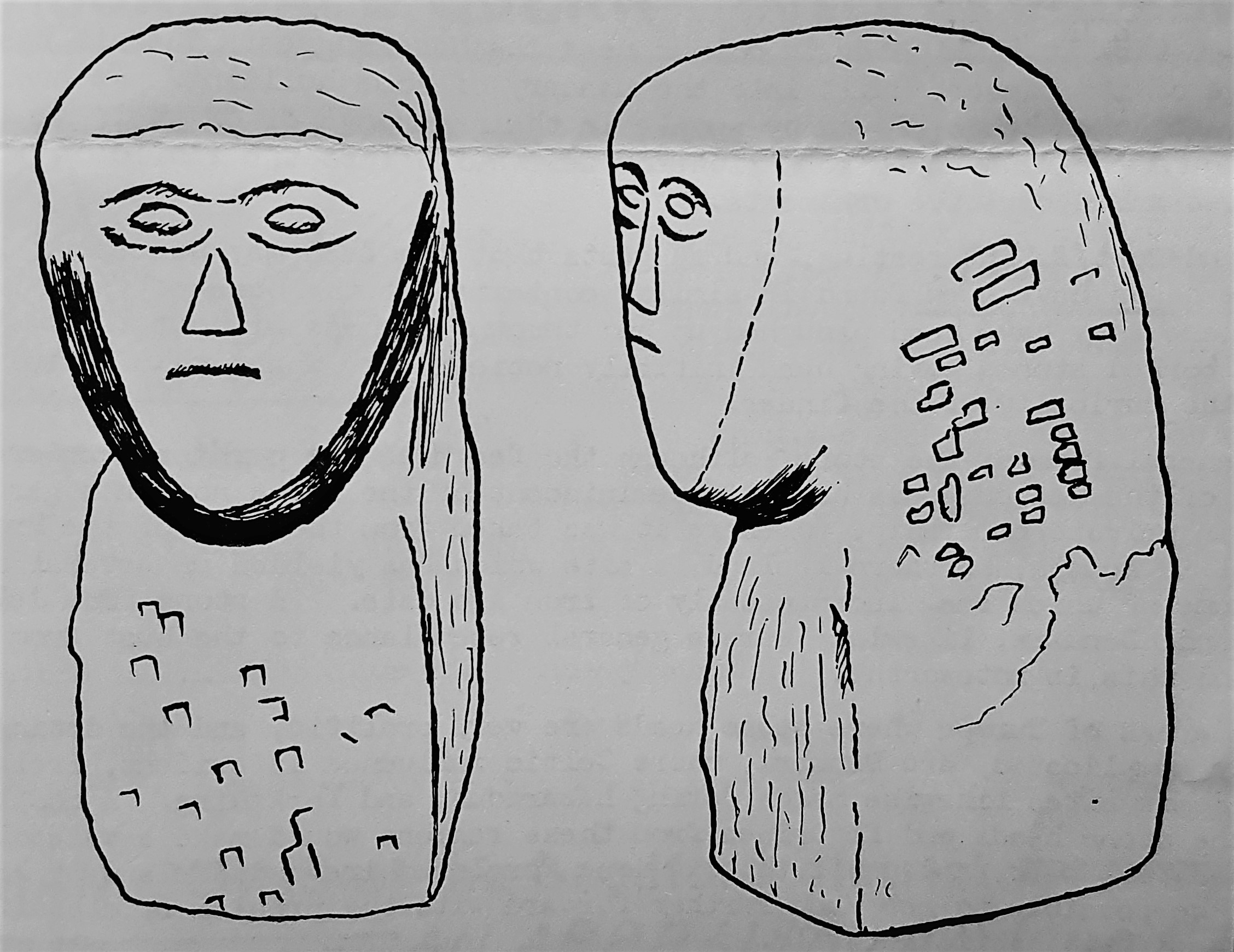
Never take dry-stone walls for granted, although any walker in this area will see plenty of them. A great many miscellaneous materials will be built into the walls, often as small repairs. Since my own main interests are in industrial archaeology and geology I am on watch for bricks, iron-making slag, fragments of carved stone, fossils and glacial erratic boulders. I have never been lucky enough to see a ‘rack stone’, three of which are included in SJ’s drawing here.

In the March 1965 edition of the Archaeology Group Bulletin he explains that they obtain their name because their notched shape resembles the rack in a rack-and-pinion arrangement.

Such stones seem to have been reasonably common even if I have never encountered one. They can be built into cottages and boundary walls. The ones pictured were considered to have originally been fragments of a single stone over 6 feet long. SJ states that they were original part of a grain drying kiln but doesn’t explain exactly how they functioned. As I understand it the corn grains were dried on a heavy wool cloth suspended by poles over a low fire. The poles seemingly sat on groves cut into stones placed near the fire, and I assume the rack stones were upright Were there multiple levels of drying? I have seen Iron Age and Roman corn driers but these seemed to employ a stone drying floor, so I will not claim to understand exactly how the rack stones functioned. Can anyone help?

At first sight Bradford seems an unpromising place to grow wheat and barley, with oats being a more plausible grain crop. But in Heaton alone I know of three malting kiln sites and the survival of the place name ‘Whetley’ suggests that wheat was also grown. Corn driers must once have been quite common since the cool, damp, climate in northern upland Britain must have made outdoor drying of wheat prior to storage difficult. But as a child in sunny Sussex, nearly 70 years ago, I well remember ‘stooks’ assembled in the cornfields where the drying took place.
A Walk With Sidney Jackson #7

We are very pleased to continue with the series of articles by local historian Derek Barker.

Derek wrote in his introduction:

‘When Sidney Jackson was keeper of Archaeology, Geology and Natural History at Cartwright Hall he edited a subscription journal called the Archaeology Group Bulletin. Although compiled over 50 years in the past it can still be read with interest today. I am impressed by the quality of both articles and the correspondence.’

A walk with Sidney Jackson #7

Sidney Jackson inhabited a totally different world to that of present-day archaeologists. A world in which boy-scouts could excavate caves, and amateur collectors amass large numbers of ancient objects. A world where cruck-built barns, querns, and lengths of Iron Age walling would occupy the thoughts of museum curators for months on end, and the museum service of the City of Bradford would actually spend good money to identify the rocks, potsherds, clay pipe bowls, and coins brought back by its citizens from summer holidays, or turned up in their allotments.

However, in many respects, SJ’s views on investigating and exploring the past were quite modern. In the November 1966 edition of the Archaeology Group Bulletin he tried to promote the concept that those who wished to be involved in archaeology should first learn what could be seen above ground. Members of the public had approached him when they wished to be involved in ‘digging’. SJ tried to explain that dry stone walls in this area were very worthy of study. Many dated from the application of Enclosure Acts to areas of local common land. But some include earth fast boulders or orthostats which might have been as old as the Iron Age. The materials subsequently built into such walls has included: querns, carved heads, mortars, bricks, iron making slag, fossils, and a variety of glacial erratic cobbles. All are well-worth identifying and may well contribute more to our knowledge than yet another Roman coin of a common series.

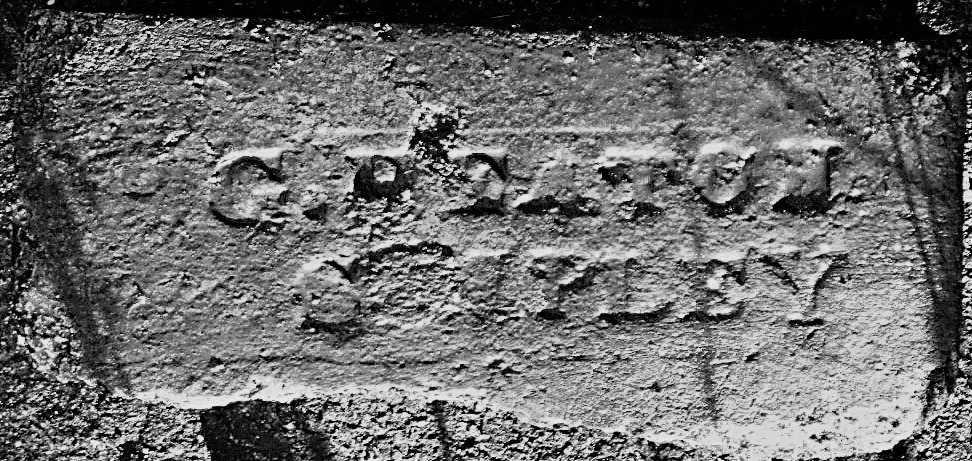
Although even SJ had his limitations. He once hurriedly arranged a party to excavate a stone circle noted in the woodland between the Hirst Wood and Nab Wood Cemetery, Shipley. His group removed the brambles and other plants growing over the small boulders that formed the circle, but it was soon evident, from the looseness of the boulders, that they had not been in position since prehistoric times. Eventually they came to a hearth made of bricks imprinted with ‘G. Heaton, Shipley’, and it was then pointed out the corners of what had been a square or rectangular hut. It seemed that children in playing on the site had used material from this building to make a small circular enclosure.

While the result of the afternoon’s work was a disappointment to the participants for those of us interested in Victorian industry for several years it was the single piece of evidence that George Heaton, who operated a coal mine at the Shipley end of Heaton Woods (c.1845- c.1875), made bricks too and marked them with his own name. Eventually one of the bricks was spotted at Goitside confirming Sidney Jackson’s observation, but I have never seen another. Derek Barker, Local Studies Library Volunteer

A walk with Sidney Jackson #6

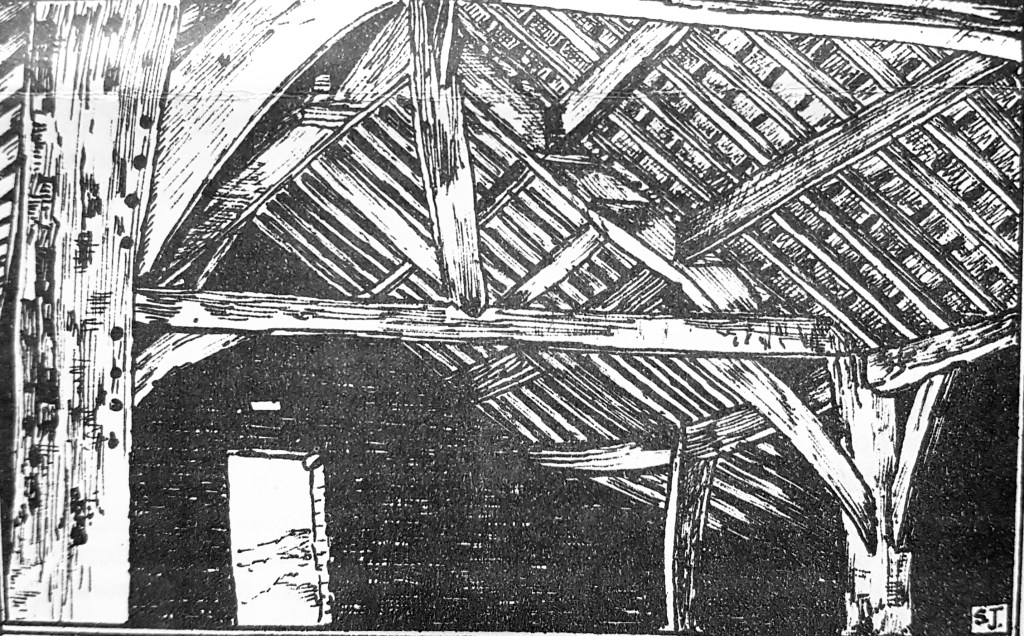
The Archaeology Group Bulletin gave its readers an opportunity to publish interesting historical structures or objects observed on country walks, and then to receive informed comment about them. I cannot think of an obvious forum for such interactions today. That is not to say there is not still considerable interest in local history. There is a Bradford Historical & Antiquarian Society which, in more normal times, holds regular meetings at the Bradford Club. Some of its members undertake research of real value which is published in an excellent journal, The Bradford Antiquary, copies of which can be found in the Local Studies Library. Bradford U3A has groups devoted to Archaeology and Old Buildings, and there are area historical societies in several parts of the city. But where would you present an interesting farm building that you had just seen? In March 1965 a gentleman from Allerton sent Sidney Jackson some photographs of a barn he had examined at High Bradley, near Skipton. SJ redrew an illustration for the Bulletin, which seemingly couldn’t cope with photographic images. The building was identified as an ‘aisled barn’ and attention was drawn to the roof truss and supporting wooden pillars. The basic design consisting of a central ‘nave’ and two supporting aisles, a pattern that echoes the Roman basilica and was widely used for church design.

If you would like to examine an almost identical building I can strongly recommend the Grade 1 listed, seventeenth century, Great Barn at East Riddlesden Hall: I have included a recent photograph.

The barn is 120 feet long, 40 feet wide, and consists of eight bays. The external stone walls, pierced for lights especially at the gable ends, are load-bearing so this is not a timber-framed structure, although many wooden members are incorporated. The oak upright timbers support the roof trusses. They stand on stone bases since wooden posts buried in the soil inevitably rot within a century or so. The oak roof trusses are of the ‘king post’ type. The supporting timbers running lengthways along the roof are called purlins. The purlins engage on the ‘principle rafters’: the other roof members are ‘common rafters’. The rafters support stone slates which keep the barn weather-proof and mean that the pitch of the roof is kept relatively low, unlike a steeply pitched thatched roof. There is a solid stone and brick floor and two pairs of doorways with arched porches. Doors placed opposite one another in a barn indicate that it was once used for threshing. The through draught helping the separation of grains from the chaff. The stone surface was the threshing floor which needed to be kept clean. The aisles are fitted with cattle stalls so, like many northern barns, it was used both for crop storage and stock. In his original article Sidney Jackson rightly pointed out the value of such barns to those who appreciate fine carpentry.

A walk with Sidney Jackson #5

SJ 4 FigIf you had been lucky enough to accompany SJ on a country walk you would not have progressed very far without the topic of carved stone heads being raised. They form regular entries in the Archaeology Group Bulletin. There is no doubt that he recognised, and brought to prominence, a huge number of these objects (in Yorkshire particularly) found in walls, as garden ornaments, and on the gables of houses or barns. His card index of heads listed 650 from all over the country, but particularly West Yorkshire (378), and was eventually given to the Yorkshire Archaeological Society. He considered that the heads were originally free-standing and distinguished them from gargoyles and corbels. He speculated that they might have been associated with springs and wells, or had an apotropaic function, being intended to ward off evil influences. He believed that the finding of heads indicated continuity of farming sites from prehistoric times until the 17th century.

SJ concluded that the heads were Romano-British or ‘Celtic’ in origin and were linked to a series of similar heads, described by his friend Dr Anne Ross in Scotland. To the best of my knowledge all the Yorkshire heads were surface finds none having been located in context at excavation. This represents an important difference with the celebrated and enigmatic Pictish stone carvings from Scotland. Some Pictish carved stones have been on the surface since they were executed about 1500 years ago, or have been incorporated into more modern buildings. But others have been found buried at excavation, for example a bear carving discovered at Old Scatness Broch by the Bradford University archaeology department. Not so with the Jackson heads.

So I, and indeed some of his contemporaries, couldn’t except the strange heads as having an Iron Age origin. In a stone quarrying area, where chisels and stone carving tools must have been common, there are surely more plausible explanations. SJ produced only two publications: ‘Nature Rambles in mid-Airedale’ (1952) and ‘Celtic Carved Heads’ (1973), which he wrote after his retirement. Despite a forward from his friend Dr Anne Ross, his last book (when it finally appeared) proved controversial. Critics felt that few of the heads had provenance and any link with the ‘Celts’ was tenuous. I think SJ would have been profoundly saddened by this response but there had been considerable public interest in his collection which appeared on television and was given exhibitions in the 1960s and early 70s. Surprisingly, as late as 1967, he admitted to not having a television although he and his carved heads appeared on BBC TV during the same year in ‘Blue Peter’ and ‘Chronicle’. The illustration is a Bradford head found in a wall at Heaton Woods by Carol & Christine Lister (1965). I don’t have an exact findspot but if either of the discoverers were to read this account I should be very interested to have additional details.

It is hard not to feel a certain nostalgia for SJ’s world. Modern archaeology, with its greater reliance on theory and science, does in the end offer a more fruitful approach but perhaps it has lost some romance in the exchange.

A walk with Sidney Jackson #4

How old does graffiti have to be before it stops being wilful damage and starts being a work of art, or a significant part of the historical record? In the Archaeology Group Bulletin of May 1964 Sidney Jackson included his drawing of a rock from the Silsden area which he had seen on the road between Silsden and West Morton. Does anyone recognise it? The figure that looks, to me, rather like a member of the Royal Canadian Mounted Police was seemingly a boy scout, or perhaps General Baden-Powell himself. The image was on a large, flat, gritstone rock and SJ commented that ‘one needed a helicopter to do justice to such a subject’. He believed that the rather enigmatic inscription at the bottom were letters worn away by weathering and defacement by passing feet. He was keen to hear the full story of the carving.


Several correspondents later contacted him to confirm that the carving did show Lord Baden-Powell together with the Scouts’ motto ‘Be Prepared’. Remarkably they stated that the work was effected with a nail and a stone by a boy called Randolph Churchill Longbottom of Jay Tail Farm, who grew up to be the sculptor of the lions in City Square, Leeds. It is many years since I lived in Leeds but to me City Square is the area between the railway station and the post-office. It contains several fine statues including nymphs by Alfred Drury, and Edward the Black Prince by Thomas Brock: but no lions. To the best of my knowledge, the lions outside Leeds Town Hall (which since they are of Portland limestone are suffering from serious stone erosion) were created by William Day Keyworth in the 1860s, long before the Boy Scouts were thought of.

Ancestry UK is very helpful in such circumstances and could normally be accessed free in the Bradford Local Studies Library. A Randolph Longbottom existed and was born in Silsden around 1886-87. He did live with his parents at Jay Tail Farm and was still there, aged 14, at the time of the 1901 census, his father having died. It seems that he moved to Leeds and in the 1911 census is recorded as being a stone carver. He later married Carrie Gaunt in Leeds and died there in 1933. On his death probate was granted for substantially more than £1000 so he must have made a success of the stone carving. The story that SJ reported would seem to be at least partially confirmed. Does anyone know more?