Book Review – We who served … Stories of Addingham and the Great War, 1914-1918.

We who served … Stories of Addingham and the Great War, 1914-1918. By Catherine Snape.

Addingham Civic Society (email: info@addinghamcivicsociety.co.uk), 2015. x + 310 pp. ISBN: 978-1508859536. £10.00.

wewhoserved

“From Addingham, a close-knit village of millworkers and farmers, with a population of less than 2,000, over 400 men marched off to fight in the 1914-1918 war.

The war brought many changes and much hardship. Families rallied to help each other in the hope that their menfolk would return. More than 80 did not, but the true unsung heroes are those who did, and the families who supported them through those long dark years and helped to rebuild their community.

The book tells about these families, their remarkable stories of stoicism, hope and sacrifice, and about their men who went to war.”

This text from the book’s cover indicates the nature of this attractively-produced book.

Chapter One establishes the pre-war context, covering Addingham’s changing society, its businesses and shops, children at work, industrial unrest, and the outbreak of war. Chapter Two features each of the years 1914 to 1919 with text taken from local newspapers. Chapter Three looks at the Home Front, featuring attitudes to Germans, postal services, the fear of invasion, the garrison town of Skipton, the White Feather Movement, women in the workforce, women’s magazines, volunteering, local war hospitals, DORA (Defence Of the Realm Act), conscription and war memorials. Chapter Four – Taking the King’s Shilling – looks at joining the army, its requirements and service conditions, daily life in the army, postal and medical services, and prisoners of war. Chapter Five – For King and Country – covers the service given by Addingham families, medals, where the servicemen lived and what news was received from the Front.

An impressive 140 pages (almost half the book) gives copious details of all the Addingham men who served, with supplementary lists by the categories: Regulars and Reservists, Territorials, Places men served, Naval personnel, Lord Derby recruits, and the ultimate sacrifice. An impressive range of sources has been used, including illustrations, many from the Addingham Digital Archive

This book came about in response to publicity surrounding the centenary of the outbreak of the First World War:

One objective was to research the names on the Addingham war memorial in the Main Street, but when it became apparent that there were names of village servicemen who were not on the memorials, it was decided to extend the research to the lives, times and service of all men who served their country in the armed forces.

This book joins others that have been compiled in memory of those who fought and died in the 1914-18 war, and those who lived through it, three of which – those on Bradford, Low Moor and Ilkley – were reviewed in the 2015 issue of The Bradford Antiquary.

Bob Duckett

Review reprinted from the Bradford Antiquary, 2016, courtesy of the Bradford Historical and Antiquarian Society.
Map of the Week: Little Germany

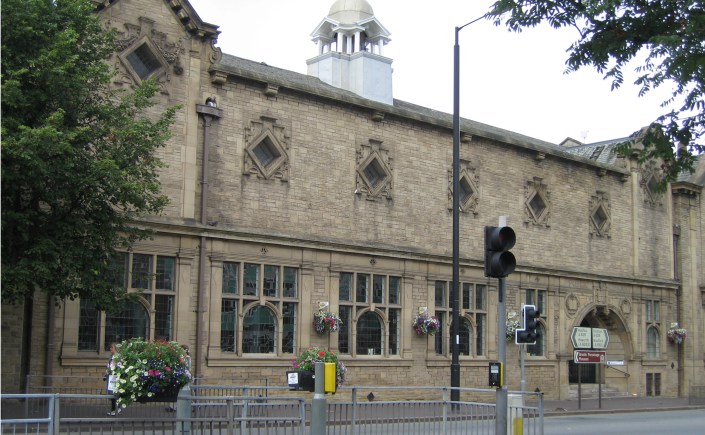
The district known as Little Germany  is close to Bradford Cathedral. It is unquestionably one of the glories of the city being famous for a unique collection of magnificent, stone-built, Victorian textile warehouses. In many cases their original occupiers were German merchants, which provided the  name. In 1977 John S Roberts produced an invaluable short pamphlet entitled Little Germany which was my personal introduction to the history of the area. More recently Susan Duxbury-Neuman published Little Germany: a History of Bradford’s Germans (Amberley, 2015) which is full of information about the warehouses, and the merchants that owned them, with much else besides. Despite the existence of these excellent accounts I wondered if anything in the Bradford Local Studies Library reserve map collection could provide a useful additional ‘taster’.

On the 1800 map of Bradford the future Little Germany was a green field site. Fortunately two roads of that period, Church Bank and Vicar Lane (earlier Dead Lane) have retained their names, which makes the placement of the location on more modern maps relatively easy. Leeds Road, which originally formed part of the Leeds-Halifax turnpike, was created in the late 1820s or early 1830s. The Library has several plans showing portions of adjacent land. Some of these are in excellent condition but one has been subject to considerable deterioration.

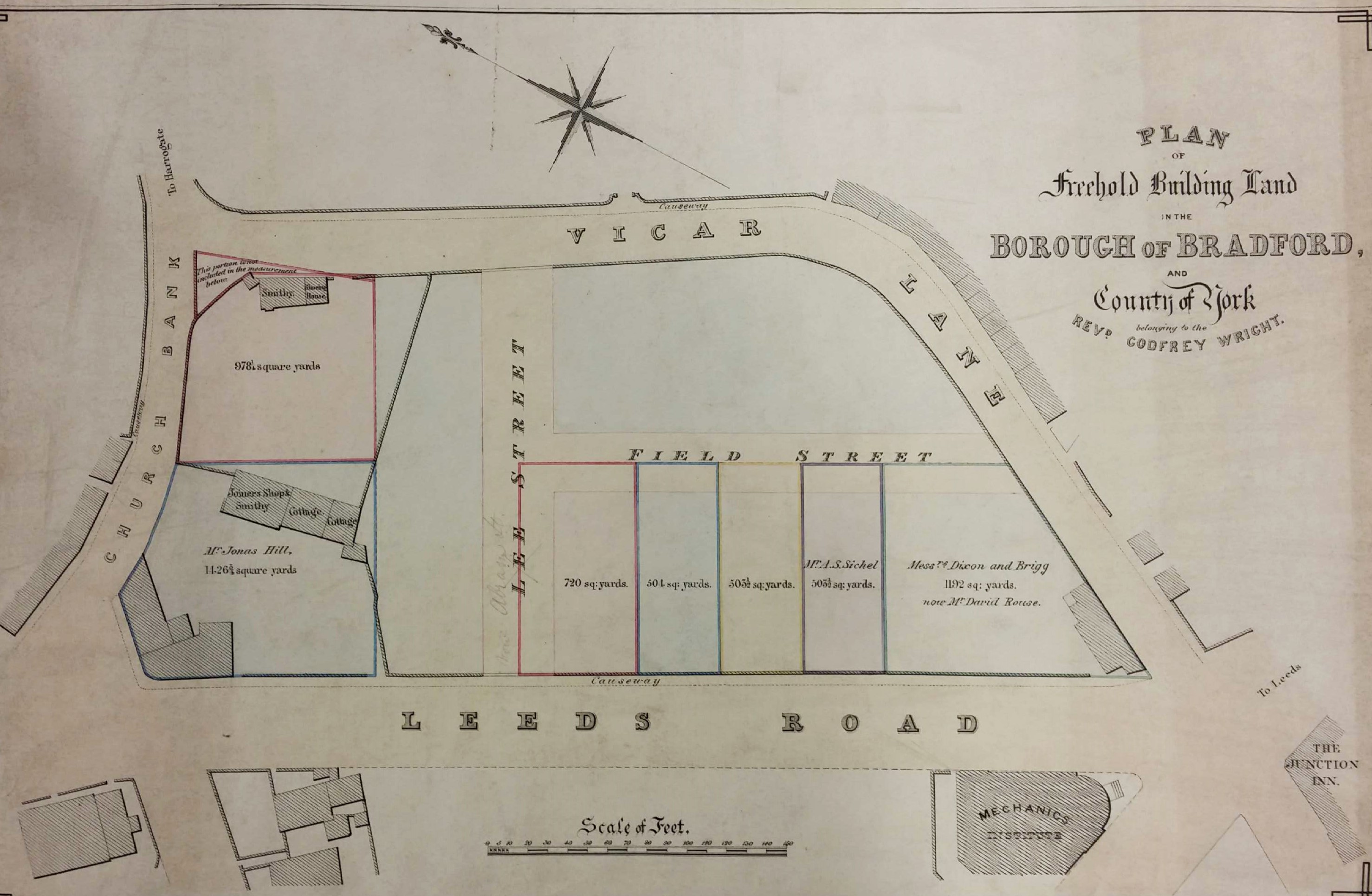
The first plan here is essentially of the lower part of Little Germany. It shows the first Bradford Mechanics Institute which was founded in 1832 being aligned on Leeds Road. The plan is annotated on the back as ‘Colliers Close’. I have found no other record of this name but it is perfectly credible since coal was mined all over the city, and Roberts reports that building on some of the Little Germany sites was difficult because of old mine workings.

map-of-the-week-19a

A huge help in dating this first plan is that Bradford is referred to as a Borough, a status achieved in 1847. On the other hand the first OS map of the area, which was issued in 1851 and surveyed in the late 1840s, shows no sign of any new street development. If we said that the plan was from 1848-49 I do not suppose we should be far wrong. It is interesting to note that the area was the location of two blacksmiths and a joiner’s workshop. So in 50 eventful years the green fields of 1800 had been mined for coal, transected by a major road, and become the site of several small businesses and the first Mechanics Institute. Leeds Road on the plan, confusingly, is not the major route of that name but a short branch which was soon renamed Well Street. The name Lee Street was also soon changed, to Currer Street. There is a pencil annotation describing it as ‘Abram Street’, presumably another name that was considered. Field Street seems to have been so called originally and has retained its name. The owner of the land west of Vicar Lane, both north and south of Leeds Road, was Rev. Godfrey Wright (1780-1862). A detailed account of his life was included in the description of my previous map.

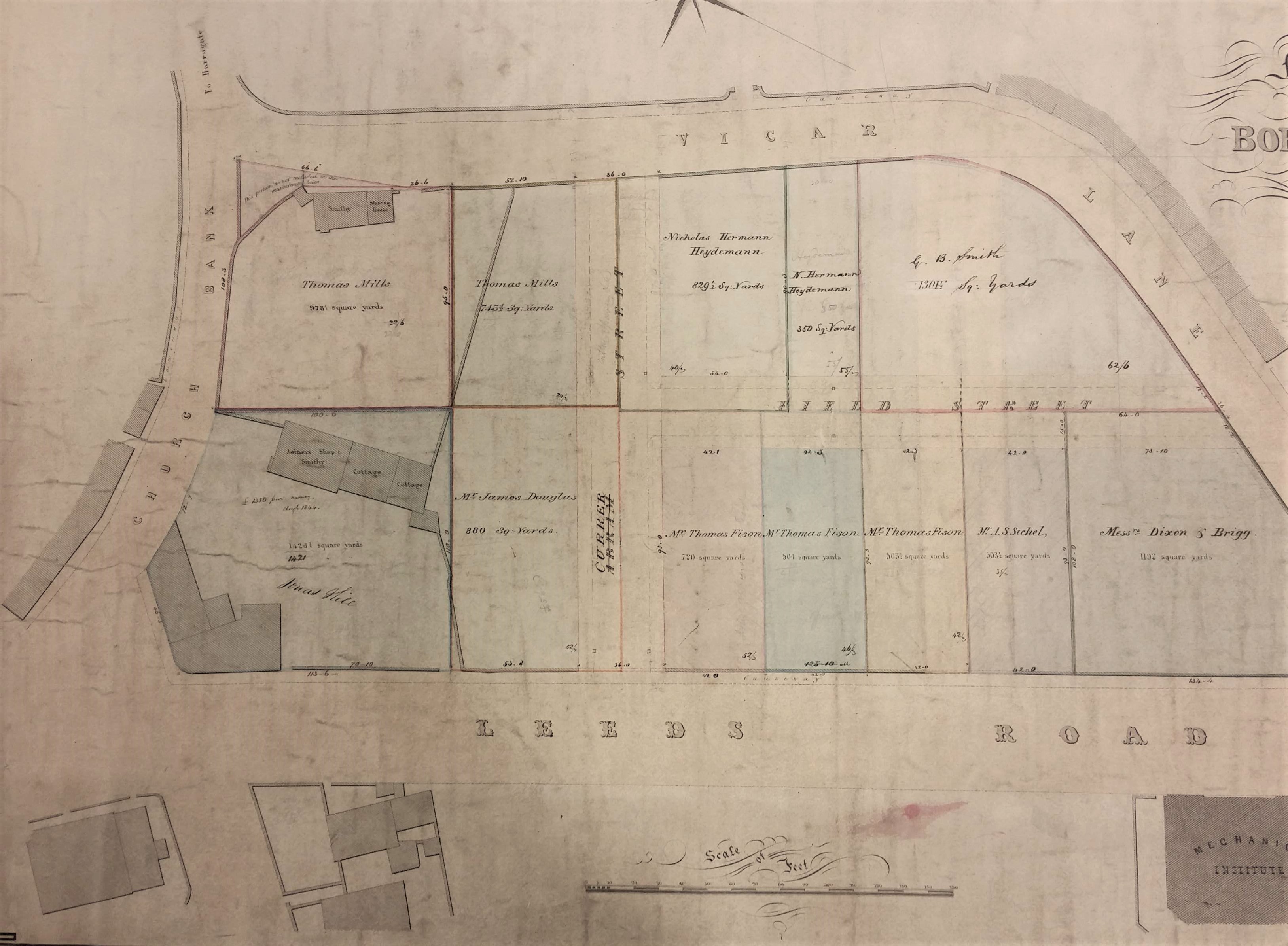
The second map is essentially the same but provides more information about the purchasers.

map-of-the-week-19b

The names recorded do not seem to be the same as those who were associated with the famous Little Germany warehouses 10-20 years later. I’m not certain if the parcels of land were sold on or whether the original purchasers simply leased the warehouses. In any case individual buildings will have had many owners and occupiers since their construction. Augustus Silvestro (AS) Sichel were a Manchester textile firm. Augustus’s son, Sylvester Emil Sichel, later lived at Shipley Grange. As early as 1856 Sichel Bros were trading in Well Street. I’m not sure what their relationship was with Victor Sichel, manager of Reiss Brothers yarn and stuff merchants in Currer Street. Victor was the father of the Bradford artist Ernest Sichel (1862-1941). Both families originated in Frankfort am Main, Germany but were they directly related? Thomas Mills was a Bradford furniture merchant and upholsterer. Thomas Fison was in the partnership of Fison & Lister, wool merchants at Well Street. Nicholas Hermann Heydemann (1817-89) was both a cloth merchant and the German Consul. He is buried at Undercliffe cemetery. In 1859 on his land at 4 Currer Street the premises of Nathan Reichenheim, yarn merchants, was constructed. This is probably the oldest of the surviving buildings. In 1874 on GB Smith’s site at the junction of Field Street and Vicar Lane was built Law Russell’s magnificent Victorian warehouse. This was constructed by Bradford contractor Archibald Neill. Both these buildings were designed by the famous Bradford partnership of Lockwood & Mawson.

The third plan is severely damaged. The section reproduced indicates that the main interest of the surveyor was surface water drainage from Burnett St, Cator St, and the upper part of Currer Street.

Map of the Week 19C.jpg

The original land-owner is not recorded but these lands to the east of Vicar Lane were part of the Vicarage Trust. I do not know if the vicar at this period, John Burnett, benefited personally from land sales but he presumably gave his name to the street. Another series of purchasers are recorded. Leopold Reiss has already been mentioned as one half of Reiss Brothers. As far as I can tell William Bollans and James Wilman were both publicans in other parts of Bradford. Eli Milnes (1830-1899) was the leading warehouse architect. He designed several of the warehouses and the fact that one carries his EM monogram suggests that he was also involved in speculative construction. Not all the land-owners are traceable. Jacob Philipp & Co. seems to have puzzled Duxbury-Neuman and certainly defeated me.  Roberts explained that most of the building occurred in the period 1860-67. The Borough Map of 1871 shows the whole area completely filled with buildings. I imagine that by 1875 the appearance of Little Germany was very much as it is today although one or two later premises were still to be constructed. Most still survive and if you are not familiar with Little Germany do please experience its delights for yourselves.


Derek Barker, Local Studies Library Volunteer

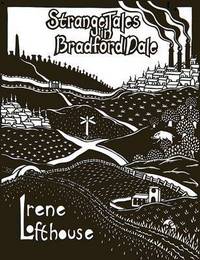
Book Review – Strange Tales in Bradford Dale

Strange Tales in Bradford Dale, by Irene Lofthouse. Gizmo Publications (www.gizmo.co.uk), 2015. 124 pp.   ISBN: 978-1-900827-54-6   £7.99 (Strange Tales Book 2) Available in many of Bradford’s Libraries.  You can check the catalogue here

strange-tales-in-bradford-dale

 What a delightful read is this book! It is clearly fiction, but so well grounded in Bradford history that I finished my read both pleasantly amused and historically richer. I learnt that a ‘cottar’ is a peasant farmer or a tenant renting land from a landlord, and that a ‘piecer’ is someone who pieces broken threads together. I also learnt that Bram Stoker, the author of Dracula, was the manager of actor Henry Irving who died at the Midland Hotel in 1905 leaving, some say, a ghost, and that a brownie, once asked its name, turns into a boggart and will plague you for ever!

This book, Number 2 in the Strange Tales Books series* consists of seven Bradford-based stories for 7-12 year olds. Here we find an alternative account of the killing of the Bradford Boar; child labourers in a mill befriended by a brownie; a nightmare ride in a haunted carriage; the city hall statues frolicking in City Park after midnight; a local tribe defeated by Romans from Olicana (but carrying on the head cult); a theatre rehearsal terrorized by ghosts; and twilight terrors in a Victorian cemetery.

Irene Lofthouse writes well: her style is well-suited to pre-teens and her stories are well told. More impressive for readers of this journal though, is that the stories are clearly Bradford-focused. Here we find Roger de Manningham and John Northrop, Spinkwell and Cliff Wood, a large cemetery with Egyptian portals, and City Park. In her endnotes the author admits being inspired by the Bradford Playhouse, Undercliffe Cemetery, the Bradford Beck and a real-life mounting block. Other end-matter includes Fun Activities such as protecting yourself against a boggart; drawing pictures of a stone head and a phantom carriage; a Wordsearch; a Did You Know? (six items); some websites; and a Glossary of special words such as Green Man, Scour, Tenterfield and Sphinx.  I particularly liked the author’s matching of language and personal names to the period covered by the stories. The Boar-scared children are Ranulf, Aleycia, Elfric, etc., good medieval names; the mill kids are Tom, Sarah, Zach and Edie, while today’s kids scared in the cemetery are Sienna, Fatima and Luca. Some of the quoted speech is in dialect, thus: “You do look nithered. Come t’fire an’ warm thissen.” (My 9 yr old grandson is fascinated by dialect!). And while today’s kids use their mobile phones and i-pods as torches in Undercliffe’s Egyptian vault, the youngsters in Cliff Wood use knives and a bow-and-arrow! Context and background are impressive.

How to get youngsters interested in history is ever a problem. Maybe Irene Lofthouse has the answer – though I would have liked to have seen more illustrations.      Bob Duckett

 *Book 1 was Strange Tales in the Dales (2015) and Book 3, Strange Tales in Caldervale (2016).

Review reprinted from the Bradford Antiquary, 2016, courtesy of the Bradford Historical and Antiquarian Society.

Talks at Keighley Local Studies Library

Next week there will be two more in the series of regular talks hosted by Keighley Local Studies Library.

On Monday 6th February, courtesy of Keighley & District Family History Society, Edgar Holroyd-Doveton will speak about The English Woollen Industry 1500 – 1750.

This talk looks at the structure, operation and development of the English Woollen Industry in the Early Modern period. Almost everyone who has family history connections in Yorkshire and in many other parts of England will have had ancestors involved in the wool trade. What were the different types of occupations involved? What did they do and how did they live? What importance was the spread and development of the industry for migration and movements of families? These and other questions will be addressed which will be of interest to the family historian.

On Wednesday 8th February, courtesy of Keighley and District Local History Society, some of the lesser known aspects of local railway history will form the subject of a talk by Graham Mitchell.

The subject of his presentation will be: “Why Stanbury Never Got a Station & Other Local Railway Politics.”

Both talks will start at 7.30pm. Please use the side entrance on Albert Street  from 7.00pm. There will be a small entry fee at both events.


Somme 100 – Keighley’s Men

Bradford Libraries's avatarBradford Libraries World War One Blog

Andy Wade from Keighley’s Men of Worth project has started to produce a series of articles about Keighley men who fought in the Somme.

adamsjeYou can access the articles here.

View original post