“Our Criminal Ancestors”

Do you have a criminal ancestor?

Police constable or prison officer in the family?

Victims or witnesses of crime?

Find out more about the history of crime and criminal records…

Meet leading experts and uncover the secrets of finding, interpreting and using criminal records at this FREE introductory workshop.

Wednesday 18th April – 11am– 1.15pm

Bradford Local Studies Library
Old Central Library, Princes Way, Bradford

Please contact the library to book: 01274 433688 or local.studies@bradford .gov.uk

This event has been organised by the Bradford Police Museum and supported by Bradford Local Studies Library


Lord Asa Briggs of Lewes , born and schooled in Keighley: 07 May 1921 – 15 March 2016

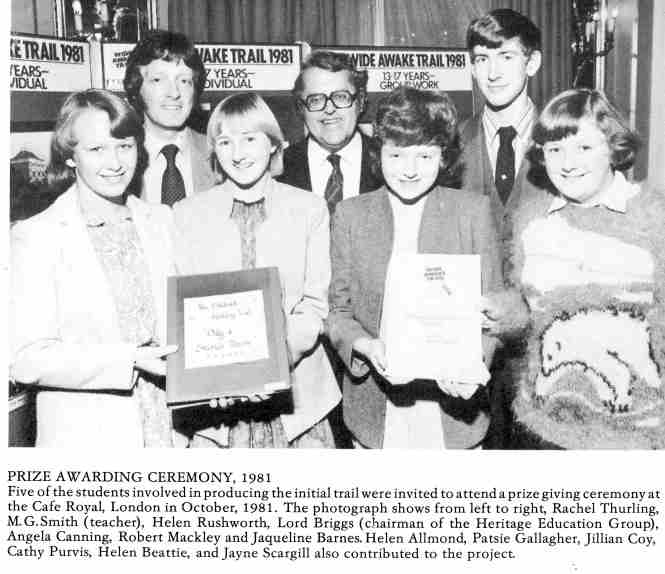
Lord Briggs Prize Award Ceremony 19811mb

Image taken from the book ‘Oakbank History Trail’ © Maurice G. Smith

Keighley Boys’ Grammar School produced not one, but two, great historians in the early part of the twentieth century. Both were to have an impact on the study and philosophy of history and were to become amongst the most prominent historians of their day, their names were Asa Briggs and Herbert Butterfield (1900-1979). This blog concentrates on Lord Asa Briggs who sadly died last year and in whose honour the Historical Association have kindly donated a collection of books to Keighley Library, where the young Asa Briggs loved to study.

Keighley Library view c19291mb.jpg

Asa Briggs, historian and public servant, was born in Keighley 7th May 1921. He was the son of William Walter Briggs, a skilled engineer and a good pianist. His mother, Jane, was the daughter of a greengrocer, who, prior to the depression, had been part of a small farming family in Yorkshire.

Asa initially attended Eastwood council school, followed by the school, said to have had the most influence on his development and future studies, the Keighley Boys’ Grammar School, adjacent to the old Mechanics’ Institute in North Street and opposite this library.  He used this Carnegie public library, regularly. This is where he first learned to browse. Here too, amongst the newspapers in the reading room, and the large collection of books from the Philip Snowden collection that specialised in social economic and political interests,  Briggs says that he studied the politics that he would later introduce to his own version of social history, (Special Relationships, Frontline Books , 2012, p.9).

Keighley Library Reading Room

Boys studying in reading room 1mb

Briggs enjoyed his school days at Keighley, especially his English and drama lessons with Kenneth Preston, of whom he speaks as the ablest of teachers. He seems to have made the most of his time there, becoming a school prefect and a member of a variety of societies including the Literary and Debating Society, the Stamp Society and the “Thirty- Three” Society. Despite a general love of history, Briggs in fact wanted to become a writer and, during this time at school, wrote poetry and various society reports for The Keighlian, the school magazine. However, another revered mentor at the school, the headmaster Neville Hind, did not favour the further study of English and encouraged students to pursue other subjects and to also try for his old Cambridge College, Sidney Sussex. Briggs was to adhere to this advice, so following in the footsteps of Herbert Butterfield from Oxenhope. By this time Herbert Butterfield was also lecturing at Cambridge. In 1944, Butterfield was elected Professor of Modern History, later Regius Professor and Vice Chancellor of Cambridge University from 1959-1961. He was knighted in 1968. On arrival at Cambridge, Brigg attended his lectures which influenced the young historian, (Special Relationships, Frontline Books, 2012 p.5).

In 1937, with war imminent, Briggs was accepted as a scholar by Sidney Sussex College, Cambridge at the very young age of 16. In Special Relationships, the tutor, James Passant, is quoted as saying, “You’re only a baby, Briggs – but since we are sure there is going to be a war, we would like you to complete your degree before you are called up for military service,”( p.68).

Briggs went on to achieve first class honours in History Tripos Parts 1 and 2. He also graduated from the London School of Economics before his call-up to the Army. He was posted to Bletchley Park as a cryptographer under Frank Adcock. He worked mainly on signals traffic from the Mediterranean using Alan Turing’s proto-computers (Bombes). These allowed them to read enemy signals. He also helped to dupe the Germans into thinking D-Day would not be carried out in Normandy. A full account of his life at Bletchley is given in the acclaimed book Secret Days Code-breaking in Bletchley Park (Frontline Books, 2011), available for loan in Bradford Libraries.

He left Bletchley for Oxford in 1944 where he became Fellow of Worcester College and his academic career began in earnest. His main areas of interest were the social and cultural history of the 19th and 20th centuries and the history of broadcasting in Britain. The following list is taken from the University of Sussex site: http://www.sussex.ac.uk

  • 1944-1955 Fellow of Worcester College, Oxford
  • 1950-1955 University Reader in Recent Social and Economic History, Oxford
  • 1953-1955 Faculty Fellow of Nuffield College, Oxford
  • 1953-1954 Member of the Institute for Advanced Studies, Princeton, New Jersey, United States
  • 1954-1967 Deputy President, President of the Workers’ Education Association
  • 1955-1961 Professor of Modern History, co-Head of the History Dept., Leeds University
  • 1961-1967 Professor of History, Dean of the School of Social Studies, Pro-Vice- Chancellor, University of Sussex
  • 1967-1976 Vice-Chancellor, University of Sussex
  • 1976-1991 Provost of Worcester College, Oxford
  • 1978-1994 Chancellor of the Open University
  • 1988 A founder, first chair of the Commonwealth of Learning

Asa Briggs was also active in a very large number of societies:

  • President of  Haworth’s  own  Brontë Society and also of the following:
  • Social History Society
  • William Morris Society
  • Victorian Society
  • Ephemera Society
  • British Association for Local History
  • Association of Research Associations

He also served on a variety of committees:

  • member of the University Grants Committee
  • governor of the British Film Institute,
  • a trustee of the Glyndebourne Arts Trust, the International Broadcasting Institute, the Heritage Education Group  and the Civic Trust
  • chairman of the Standing Conference for the Study of Local History, the European Institute of Education, the governors and trustees of the Brighton Pavilion, and the Advisory Board for Redundant Churches.

Briggs also undertook several public appointments: most notably chairing a committee on the future of nursing, which in 1972 recommended improvements in nurses’ pay and conditions and an overhaul of nurses’ training that were later accepted by the Conservative government.

To quote Tam Dalyell in the Independent, Wednesday, 16th  March 2016,

“…his output in the written word, and in broadcasts and lectures, was awesome. It is doubtful whether Briggs ever spent a truly idle moment in his life.”

In fact, following his 90th birthday, he completed 3 books including Loose Ends and Extras in 2014.

Asa Briggs always kept in touch with Keighley and regarded himself as a “Lawkholme Laner”, (Keighley News 1930s Special, 16 February 1996). He was brought up in Emily Street, just off Lawkholme Lane.

Emily St Keighley1mb

In 1962,  he became the first vice-president of the newly formed Friends of Cliffe Castle. He attended Old Keighlian reunions, and followed the developments of his old school. Keighley Boys’ Grammar School had been renamed Keighley School in 1964, when it became a County school, and it became known as Oakbank Grammar School in 1967. In 1982, Asa Briggs wrote the Foreward of the prize- winning, The Oakbank History Trail, published to commemorate the official opening of the new Oakbank school buildings. He had already attended the prize-giving ceremony in 1981 in London, as Chairman of the Heritage Education Group hosting the ceremony.

In 2015, Keighley Library was contacted regarding Lord Briggs’ time at Keighley Boys’ Grammar school and regarding the first poem that he ever had published, which was in the school magazine, the Keighlian’s December issue 1936, part of our own archive collection. The Complete Poems of Asa  Briggs, was subsequently published in 2016 and it was a real privilege for Keighley Library staff to play even a minor role in this last published work of one of Keighley’s greatest sons.

Lord Briggs died at Lewes 15th March 2016, leaving his wife, also an historian, whom he married in 1955, (then Susan Banwell), four children and 14 grandchildren, to whom this last book is dedicated.

Gina Birdsall, November 2017
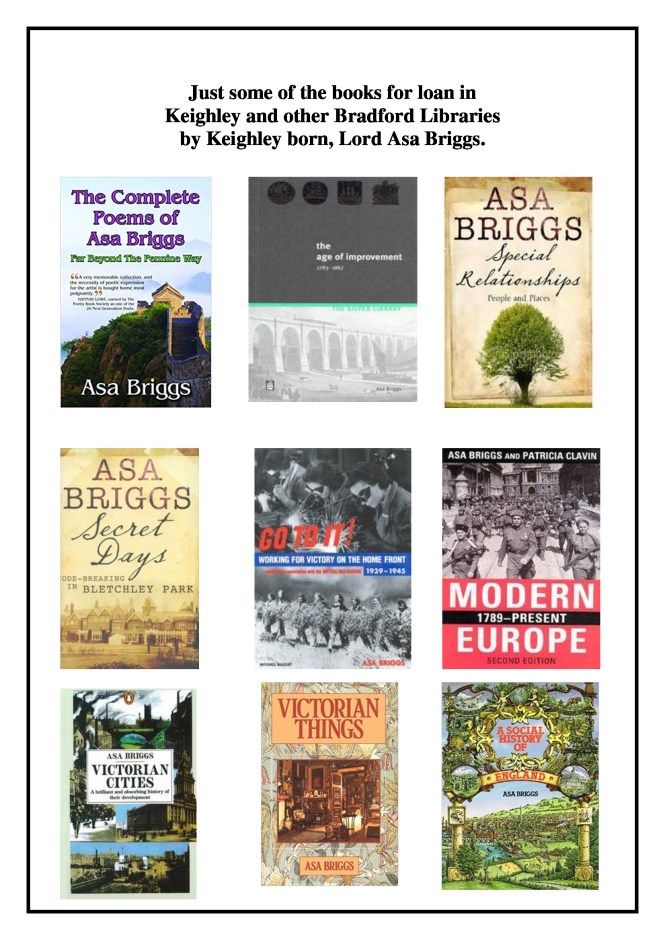
Asa-Briggs_-books-for-loan

Bradford Libraries Family History courses in October 2017

People can trace their roots and find out more about their ancestors on courses starting soon at Bradford libraries

Family History Courses will be starting soon at Bradford Local Studies Library, Keighley Local Studies Library and Ilkley Library.
Researching family history can be a rewarding and exciting experience and these courses can help to guide people to the unique resources they need to investigate the past and provide a fantastic opportunity to learn new skills.
They will use library resources such as Ancestry websites and are suitable for beginners or those who have already started on their Family Tree and need a helping hand from our friendly expert tutor.
The courses cost £18 for a three-week course of two hours each session. Some concessions apply for people on certain benefits including Job Seekers Allowance. Enrolment is at the first session.
The courses will start in Keighley Local Studies 10am – 12 noon on Tuesday 17 October, Ilkley 2-4pm on Tuesday 17 October and Bradford Local Studies 10am-12noon on Wednesday 18 October.

For more details contact:
Keighley Local Studies Library,
North Street,
Keighley,
BD21 3SX
01535 618215

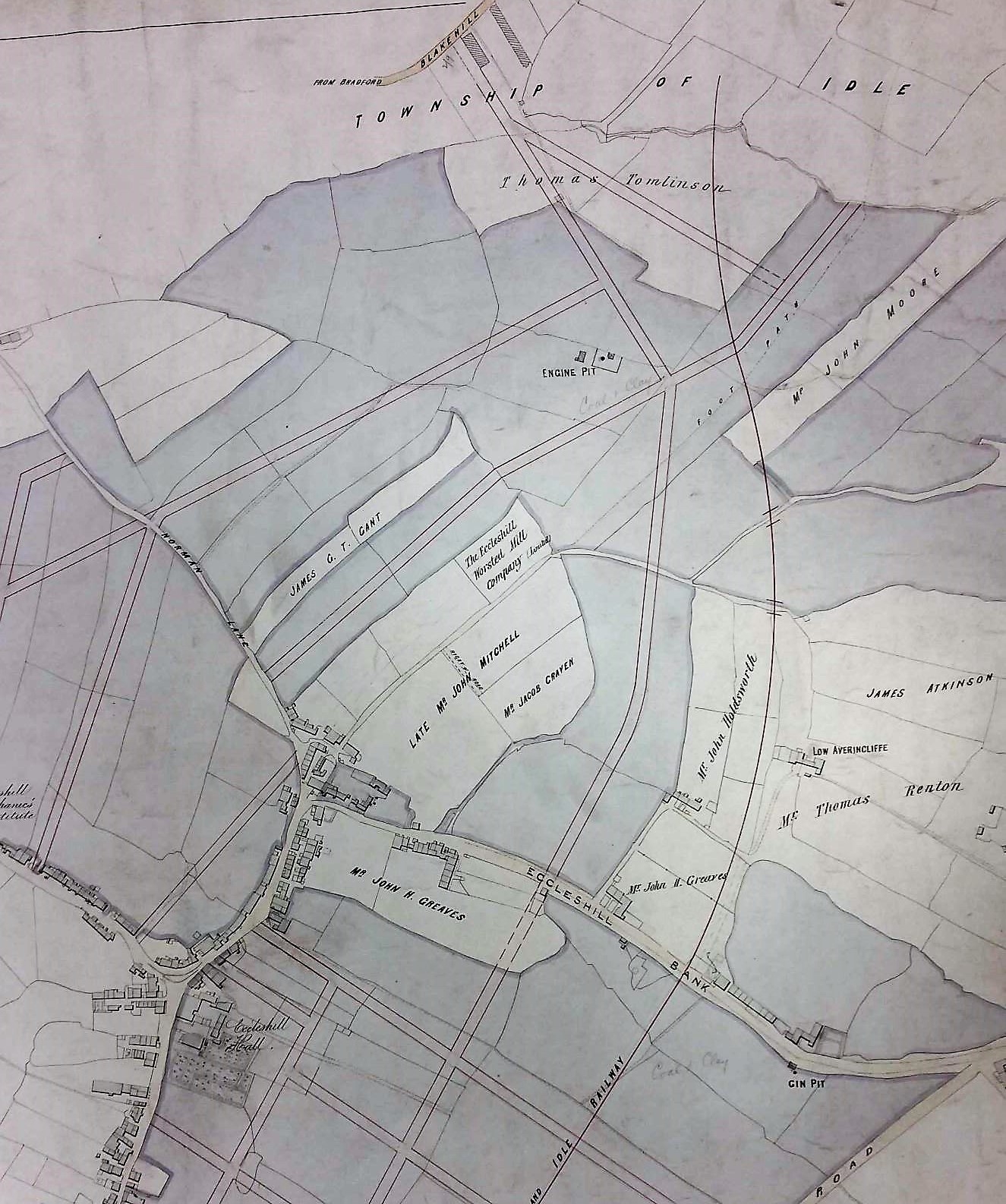
Map of the Week: Eccleshill – coal, iron, and waving wheat.

The ancient township of Eccleshill is well represented in the Local Studies Library reserve map collection, although many of the maps are in poor condition. The following images are details which I have enhanced to make them more visible. It is hard to believe today but the whole of Eccleshill was once mined for coal, with mining features commonly being seen on nineteenth century maps of the district. The seams that could be accessed included the Hard and Soft Beds (sometimes called the Upper and Lower Beds) which were widely exploited all over the north Bradford area. Above these in the geological sequence was the important vein of sandstone called the Elland Flags, which was extensively quarried. The well-known George Vint, with his various partners, owned quarries in nearby Idle extracting this valuable rock. Modern geology maps suggest that the centre of Eccleshill was high enough to include the Better Bed coal and fire-clay seams, positioned above the Elland Flags. The Better Bed was also extensively mined as coking coal in south Bradford for the iron-smelting industry at Bowling and Low Moor. William Cudworth, in his account of Eccleshill, mentions the Better Bed, and also an associated fire-clay and brick making industry based at Manor Potteries in Eccleshill.

Ecc1

Click on map to enlarge

The first map shows the township field names with buildings and the names of their occupiers. At the bottom right is Eccleshill Hall built in 1713 and the home of the Stanhope (later Stott-Stanhope) family. As far as I know Lt.-Col. George Stott-Stanhope was the last family member to actually live there. He was a large landowner whose name frequently appears in local maps. He died in 1874 and the hall was demolished in 1878. Slightly to the left you should be able to make out the name J.A. Jowett. This was James Atkinson-Jowett (1817-1886) of the Clockhouse Estate, Manningham. The Clockhouse name survives as one of the Bradford Boys’ Grammar School buildings. James Atkinson-Jowett was the son of Nathan Atkinson-Jowett. Both men changed their surname from plain Atkinson in the 1860s in order to claim the large Jowett property inheritance. The field names are not likely to be easily visible but include: Windmill Field and Tenter Croft. A tenter croft, or ground, was an area used for drying newly woven woollens after fulling. The wet cloth was attached to frames called tenters by means of, naturally, tenter-hooks. Town Street, today called Victoria Road, divides at Bank Top into Norman Lane and Eccleshill Bank, named the ‘Old Turnpike Road’ in early maps. This division is very helpful in orientation, with portions of Eccleshill Bank being included in all the maps included here.

The second, rather clearer, map enables us to examine the northern part of Eccleshill. It is obvious that a planned street grid has been superimposed on an older map but I do not think that all those roads were actually constructed. On the right side of the map a railway line has appeared. The Eccleshill & Idle Railway was incorporated in 1866 and was assimilated into the GNR Laisterdyke to Shipley line. Eccleshill Station was closed to passengers in 1931. A land-owner whose name appears approximately in the centre of the map is described as the ‘late John Mitchell’. Eccleshill historian Ken Kenzie told me that John or Jonathan Mitchell was a coal merchant who once lived at Eccleshill Bank. He was clearly a big man in Eccleshill mining and, among others, ran Park Pits which were sold off in 1860 when he was in his 70s. On the map above his surname you may be able to make out the location of ‘Eccleshill Worsted Mill Company’ and above this, and to the left, ‘Engine Pit’. The enterprises of John Mitchell are well represented in the Local Studies map collection.

ecc2

Click on map to enlarge

The third image is taken from a plan dated 1847 and described as ‘coals leased to Mr John Mitchell, surveyed by Ingle & Smith’. Once again you can see Eccleshill Bank and the fine line grid above it represents underground mine galleries. I presume these were entered from the Engine Pit shaft. Elsewhere the map reveals extensive coal mining to the south-west of the township.

ecc3

Click on map to enlarge

The final map is the oldest and most damaged. In one area I can identify George Baron as a landowner. George Baron, of Drewton in the Wolds, was an earlier possessor of the Clockhouse Estate than the Atkinson-Jowetts. He inherited the estate from Sarah, last of the original Jowett family, and died in 1854. The West Yorkshire Archives (Bradford) has a huge collection of Jowett family documents (10D76/3/190). In box 6 of these is a lease dated 1842: ‘George Baron to John Mitchell, Eccleshill’. This document is a 28 year lease of Upper Bed and Lower Bed coals in the area of Greengates, Eccleshill. The price seems to be £60 per acre. This is somewhat north of the area discussed so far, but Greengates and Apperley Bridge were traditionally considered to be part of Eccleshill.


ecc4

Click on map to enlarge

The short horizontal trackway at the top of the last map is called Green Lane. It joins a bridleway which is now Carr Bottom Lane. We have moved west since the curved roadway at the top left, marked Otley, is the far end of Eccleshill Bank where it joins the Dudley Hill & Killinghall turnpike. A number of coal shafts are present on the first OS map of the area (which is of approximately the same date) together with a limekiln at the end of the short track leading to Wheat Close. I’m not sure if these are drawn here or not since the script is so hard to read. What fascinates me about this map are the field names themselves. At the bottom right you may be able to make out Wheat Close and, below this, Cinder Hills. Today it is hard to imagine ripe wheat being harvested in Eccleshill although we have already mentioned Windmill Field which suggests subsequent grain processing. Cinder Hills is a name normally associated with heaps of iron-making slag. Pre-Industrial iron making has been suggested in other townships which now form part of Bradford: Harden, Baildon and Bierley for example. Faull & Moorhouse (West Yorkshire Survey to AD 1500) speculated that Eccleshill should join this list on the basis of two areas called ‘Cinderhills’ in old township maps.


Derek Barker, Local Studies Library Volunteer

National Dementia Awareness Week: Memory Boxes

14th-20th May is National Dementia Awareness Week as the Alzheimer’s Society asks people to unite against dementia, to raise awareness and to offer help and understanding.

Memories, first hand recollections and experiences of people are extremely important and valuable to us all and thoughtful and engaging use of reminiscence when used well can be especially effective for those with dementia.

With this in mind we have refreshed and updated the Memory Boxes available to borrow from the Local Studies library.

The packs contain a selection of multi-sensory objects, pictures and memorabilia plus a beautifully illustrated book which reflects the topic.

We all like an occasional trip down Memory Lane and reminiscence can be great fun for everyone involved, as well as being an important activity that affirms our sense of identity.  These Memory Boxes can stimulate arts, history and memory groups. They can be used in a variety of settings including social and community groups, day centres and residential homes.

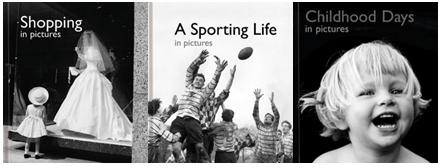
Our boxes include a book in the series of ‘Pictures to Share’ books designed for people with dementia. These books can help and encourage communication and discussion when shared with carers, provide a calming activity for the person to do alone, and promote a feeling of worth and well-being.

memory books

Pictures to Share books are based on a variety of general themes. They include a wide selection of powerful, colourful and attractive images and texts.

For more details please see our leaflet here:

Memory boxes for reminiscence

Bradford Libraries would like to thank the ‘The Memory Bank’ forum for creating the original concept and sourcing artefacts which form the basis of these collections.