TREASURE OF THE WEEK No. 10 – UNCLE OLIVER IN A FIX WITH ‘AN ABSURD MAN OF STRAW’

UNCLE OLIVER IN A FIX WITH ‘AN ABSURD MAN OF STRAW’


JND 193/25 and 27 (Please quote these numbers if requesting these items)

[Uncle Oliver on the Parson’s Income. 1878]

[Uncle Oliver in a Fix]

 An Examination of the Authorities Cited by the Writer of ‘Uncle Oliver in a Fix’ by A Searcher.  Bradford: Wm Byles & Sons, Printers, 1882.  16 pages. Reprinted from the Bradford Observer of 27 Dec. 1881.

 ‘A Searcher’ Lost in a Liberation Fog: the Official Report of ‘A Searcher’s Examination of the Authorities Cited by the Writer of ‘Uncle Oliver in a Fix’ dissected by H.B. Mis-statements and Fallacies Exposed. Partly reprinted and revised from the Bradford Observer.  With Sequal: ‘Uncle Oliver’s‘ Act of Parliament Abandoned, by ‘A Searcher’ as ‘An Absurd Man of Straw’. Bradford: Chronicle and Mail, 1882. 34 pages.

A feature of Victorian literature is the number of disputes that were carried on in printed leaflets or ‘tracts’. In the days without phones and e-mails, the printed word was, apart from face-to-face contact, the main means of communication. Often these disputes were carried out anonymously or using false names (pseudonyms). The value of printing these exchanges was that far more people could be reached than in meetings, and that the arguments could be read and studied at leisure. The volumes of bound pamphlets, such as we have in the Local Studies Library, feature some of these disputes. Pamphlet volume JND 193 has a sequence of these, and while the subject – the income of the clergy – may not excite many people, the nature of the heated exchange may. We seem to be missing the first two exchanges, the titles of which are noted at the head of this blog, but ‘Stackmole’ is on the lookout! The sequence of tracts is a touch confusing, and seemingly the person who prepared these tracts for binding was also confused, since he duplicated the first one here, placing it after the second tract! So here is a challenge!

Tract number 25,  An Examination of the Authorities Cited by the Writer of ‘Uncle Oliver in a Fix’ by A Searcher, concerns the publication of an earlier tract entitled Uncle Oliver on the Parson’s Income. This was published in 1878 by the Society for the Liberation of Religion from State Patronage and Control. This tract gave offence to the Rev. John Lightfoot and the Committee of the Bradford Church Defence Institute, who reprinted articles in answer to that publication in a tract with the title Uncle Oliver in a Fix. This had originally appeared in the Bradford Daily Chronicle and Mail. The pamphlet here, the third published, examines that pamphlet, the text of which was first published in the Bradford Observer a few days earlier. Pencil marks on the first page tell us that the ‘Searcher’ was Elias Thomas (Hon. Sec. of the Local Committee of the Liberation Society) and that the author of the Uncle Oliver tract was Henry Boardman, the ‘H.B.’ of the following tract.

Tres 10

This is Tract 27, ‘A Searcher’ Lost in a Liberation Fog: the Official Report of ‘A Searcher’s Examination of the Authorities Cited by the Writer of ‘Uncle Oliver in a Fix’ dissected by H.B. Mis-statements and Fallacies Exposed. It was partly reprinted and revised from the Bradford Observer.

Not content with two leaflets, H.B. adds a sequel: ‘Uncle Oliver’s’ Act of Parliament Abandoned, by ‘A Searcher’ as ‘An Absurd Man of Straw’.

The first tract was reprinted in the Bradford Observer while the second was printed by the Bradford Chronicle and Mail, rival newspapers. This dispute clearly reached a lot of people. But what was it all about? And why were people so interested? Whatever the content and context of this spat between ‘Uncle Oliver’ and ‘An Absurd Man of Straw’, I found it amusing.

“He that is first in his own cause seemeth just, but his neighbour cometh and searcheth him.” (Proverbs, xviii, v.17) This Biblical text was used by the writer of our first pamphlet, but it seems like the neighbour, himself, got searched!

 Stackmole


TREASURE OF THE WEEK No. 9 – BRADFORD COFFEE TAVERN No. 18

JND 193/23 (Please quote this number if requesting this item)

Opening of the Old Mechanics’ Institute Branch No. 18. The Bradford Coffee Tavern Company (Programme and Advertiser No. 108), c. 1885. 4 pages.

tres-9

This news-letter of the Bradford Coffee Tavern Company reminds us that coffee houses are nothing new. Costa, Caffè Nero and Starbucks are just a continuation of a long tradition going back to the eighteenth century when coffee houses became the places to meet people and do business. Whether the Bradford Coffee Tavern Company can claim the first coffee house in Bradford will require research, though 18 Branches and 108 news-letters indicates several years in the business.

Branch 18 was located in part of the old Mechanics’ Institute building at the corner of Well Street and the Leeds Road. “In several respects it is a most desirable situation for a Coffee Tavern, being in the heart of the neighbourhood frequented by warehousemen and others most likely to become good customers of the Establishment.” The accommodation comprised two rooms, one in the basement “being intended for the supply of refreshment, suitable for warehousemen and others; and to some extent it will doubtless supersede the less comfortable resort hard by, known as the Warehouseman’s Exchange”. The two rooms would seat at table about ninety customers. “The fittings are to some extent superior to those ordinarily provided, those in the basement being of polished mahogany and whitewood, and in the best room of Spanish mahogany and bird’s eye maple, relieved with plate-glass mirrors, &c.”

In introducing the speaker, the President, Dr Maffey, referred to the rapid progress which the company had made, with another branch due to open the following week. In his opening address the Vicar of Bradford, the Rev. Dr Bardsley, saw the success of the company as a success for the temperance movement. He thought the coffee, the tea, and the cocoa offered by such establishments “would prove not only to be more economical, but more serviceable, especially to working men, than the commodities in the way of beer, brandy, and so on.” The vote of thanks was proposed by Mr Henry Mitchell, which was followed by the Company’s  Chairman who reported a turnover of £25,000 a year, which represented three million transactions over the counter every year.

The newsletter also advertised entertainments at Coffee Tavern No. 6 (Wakefield Road) including ’Ventriloquist Entertainment (with life-size figures)’ and also at Branch No. 5 (Thornton Road) of songs (including ‘Eggs for your Breakfast’ and ‘Have you seen my Michael?’) and an ‘American Knockabout’!

This ‘treasure’ from the Library’s store provides a fascinating and unexpected insight into a late Victorian coffee-drinking society, warehousemen included, and popular entertainment.

Stackmole

TREASURE OF THE WEEK. No. 8 – A FEAST OF FOOD AND DIALECT

In the basement of Bradford’s Local Studies Library are collections of nineteenth century pamphlets (and some of earlier date). Ranging from sermons and programmes of royal visits, to reports, articles, obituaries and regulations, they are a treasure-trove of local history. What follows is an account of one of these treasures. To consult any of these items please ask the staff. Card catalogues of these collections are located in the Local Studies Library.

JND 193/14 (Please quote this number if requesting this item)

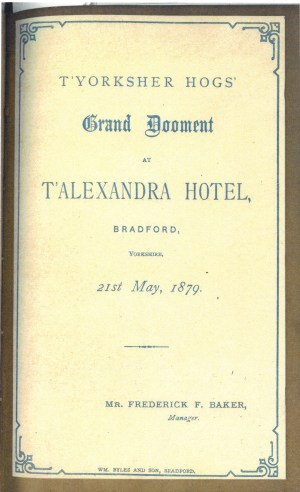
 T’Yorksher Hogs’ Grand Dooment at T’Alexandra Hotel, Bradford, Yorkshire, 21st May, 1879. 4 pages. Text by Frederick F. BAKER.  Bradford: Wm Byles and Son, 1879.

19-10-2016-17-53-02

This unusual item is a glossy printed menu (T’stuff to go at) in dialect verse by the Manager of the Alexandra Hotel. There were five courses (tuck ahts) plus ‘finishin’-up Oddments’. Quite what the dooment (feast, merry making) was in aid of, or whose souvenir menu we have here, are both unknown, but I’m glad the stylish menu has been preserved. Forgive me for not quoting the menu in full, but my computer spell-check would drive me mad, and the script is in a Gothic typeface, which would drive any scanner mad! In any case, the menu is in the Library for anyone to see. It is worth a view. Here are a couple of ‘tasters’!

O’ t’famed Alexandra i’Bradford’s big tahn,
Whear they turn fleecy whool into fine frock an’gahn,
I’ Bradford i’Yorksher, that cahnty so big
Whear thear’s plenty o’ rahm ta eyt an’ to swig.

4th Tuck Aht

Then, withaht onny flam,
Thear’s a Baron o’ Lamb,
An’, by t’way a’ nice baits
Some brand New Pottates;
An’ some Beans three France,
As streyt as a lance;
An’ withaht onny chucklin’s,
Some Aylesbury Ducklin’s;
An’, sweet to be seen,
Some Peys ‘at are Green;
An’ for summat to drink,
‘At’ll mak ye all wink,
Some Burgundy grand
O’t’Chambertin brand,
Ta sip an’ ta smack,
Whol yer jokes ye crack.

The Alexandra Hotel was demolished a few years ago, but I’m glad its Manager, Frederick F. Baker, a dialect poet of merit, lives on in the Library’s basement!

Stackmole

TREASURE OF THE WEEK. No. 7 – THE LAND!


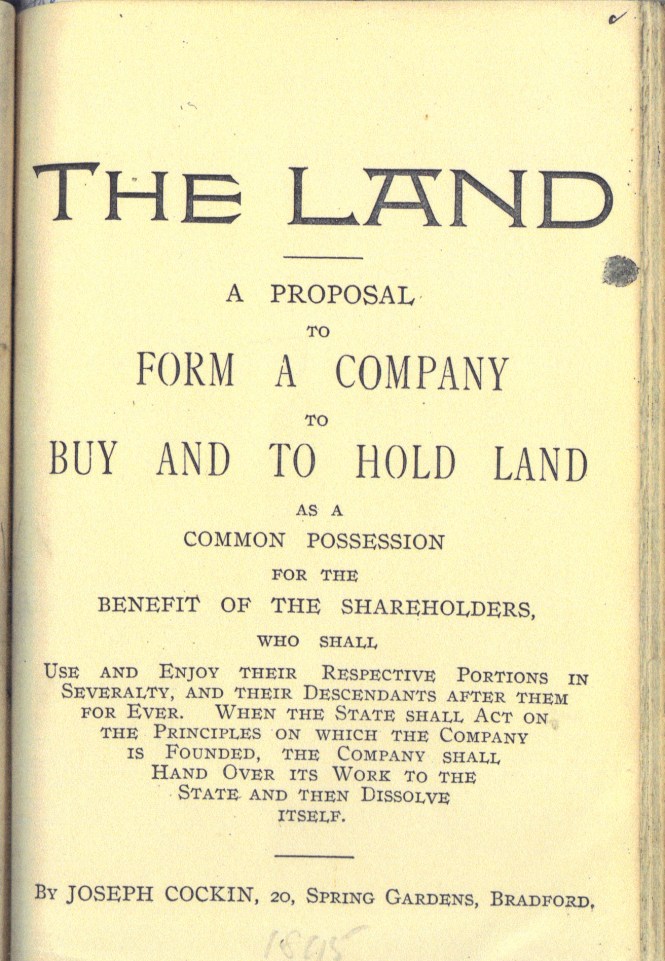
The Land!  By  Joseph COCKIN.   Printed by Henry D. & C. Tapp, 1895.  32 pp.
JND 187/19 (Please quote this number if requesting this item)

Throughout the nineteenth century, and earlier, there were many attempts by groups of people to live a communal life by the common ownership of land. The following ‘treasure’ records one such attempt that was made in Bradford.


treas

The title page continues:

A Proposal
to
form a Company
to
Buy and to Hold Land
as a
Common Possession
for the
Benefit of the Shareholders
who shall
use and enjoy their respective portions
in severalty, and their descendents after them
for ever. When the State shall act on
the Principles on which
the Company is founded, the Company shall
hand over its work to the
State and then Dissolve
itself.


“At the present time there is much distress arising from want of employment and the unprofitableness of agriculture and commerce. Part of the evil comes from temporary and part from more permanent causes. These latter I propose to inquire into, and to point out one remedy.” Mr Cockin’s solution is complex but the character of his thoughts are indicated by some of the section headings:

  1. Proposal to Form Home Colonies.
  2. What form should the Movement take, and by what Machinery shall the Work be done.
  3. The Commoners’ Occupation of their respective Individual Land should be Hereditary.
  4. Trustees to watch proceedings on behalf of the Public.
  5. State Rents and Homage Money.
  6. The Character of the Pioneer Commonists and the Engagements which they should be required to enter into.
  7. Successive Purchasers of Land.
  8. Buildings.
  9. Help to People of Small Means.
  10. How to Provide Land Sufficiently for a Growing Population.
  11. Overseas Colonies.
  12. Missionary Colonies.

Today, the attempt seems impossibly idealistic and the faith in government naive, but the motive was common currency at the time. Indeed, some small-scale attempts were made: the author quotes Haxby, near York and some French experience. In Bradford, the growth of the allotment movement and the rise of the Independent Labour Party could be cited in this context.

“Correspondents wishing for answers must send stamps.” (Joseph Cockin, 20 Spring Gardens, Bradford)

Stackmole

TREASURE OF THE WEEK No.6 –   EXAMS ARE TOO HARD ( IN 1880)!

In the basement of Bradford’s Local Studies Library are collections of nineteenth century pamphlets (and some of earlier date). Ranging from sermons and programmes of royal visits, to reports, articles, obituaries and regulations, they are a treasure-trove of local history. What follows is an account of one of these treasures. To consult any of these items please ask the staff. Card catalogues of these collections are located in the Local Studies Library.

JND 193/18 (Please quote this number if requesting this item)

Memorial to the Members of School Boards and Managers of Voluntary Schools in the District Inspected by J.B.Haslam, Esq., Her Majesty’s Inspector of Schools. 1880.  Published by the Bradford and District Teachers’ Association. Printed by Henry Gaskarth of Bradford. 11 pages.

This slim pamphlet is a complaint by local teachers about “the unusual severity of the annual examination, and the exceptionally high standard of Her Majesty’s Inspector for this district.” It outlines the reasons why local teachers feel the examinations are unfair on the students – because they are too hard – and compare unfavourably to other districts. The Bradford Inspector, Mr Haslam, is severely criticised.

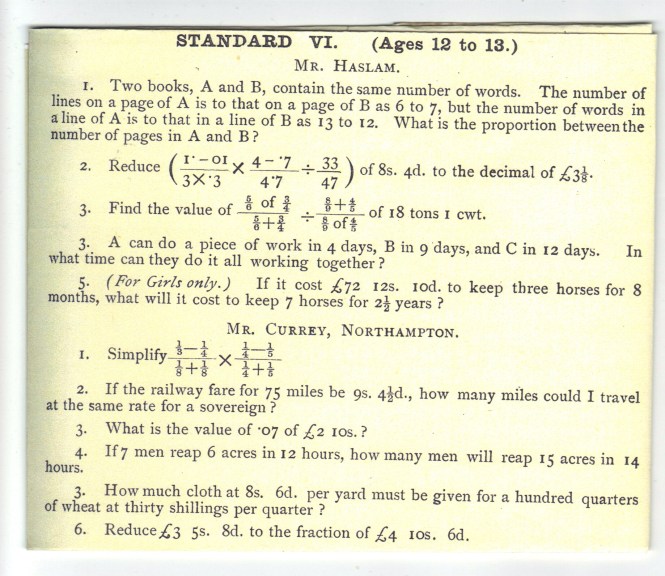
The ‘memorial’ gives many examples of the actual examination, some of which are reprinted below. Apart from the severity of the questions, we can see how fortunate we are today to be using decimals for money than the old £ s. d. And calculators!

Standard II (ages 8 to 9)

  • How much is six hundred and eighty-nine times eighty thousand seven hundred and sixty-five?

Standard III (ages 9 to 10)

  • (For girls only) Divide four hundred and eighteen thousand seven hundred and three by five hundred and nine.

Standards IV to VI (ages 10 to 13)

  • What is an adverbial sentence and what is an adverbial clause?
  • Draw two diagrams, showing the position of the earth as it would appear from the sun on June 21st and September 21st.
  • What is the size of the earth, and how has this been ascertained?
  • What is a participle, and how is it used in the formation of tenses?

Standard V (ages 11 to 12)

  • How many tons, &c., should be carried 187 miles for the same sum for which 29 tons 14 hundredweight are carried 119 miles?
  • A fishmonger brought 26,700 herrings at 2s. 11d. a hundred; he sold them at five for 2d. What did he gain on every guinea he laid out?

Standard VI (ages 12-13)

  • Reduce £3 5s. 8d. to the fraction of £4 10s. 6d.

standard-6
A list of members of the Committee of the Association is given. The Officers were:

William Wright of the Wesleyan School, Keighley (President)
Richard Lishman of Belle Vue Board School, Bradford (Vice-President)
Thomas Potter of Borough West School, Bradford (Treasurer)
William Thompson of Bowling Back Lane Board School, Bradford (Secretary)

An Appendix gives percentage passes for Board Schools in the district:

Halifax              93.7
Sheffield           86.4
Leeds                 85.2
Huddersfield   84.4
Dewsbury         81.0
Bingley             79.3
Keighley           77.3
Bradford           73.0

The National average was 81.8%. The passes for Denominational Schools were lower than for Board Schools: 79.4% for the whole country and 69% for Bradford.

An interesting observation made in this Memorial was that “While many other Inspectors allow this exercise [writing] to be done on slates in Standard II, Mr Haslam insists on the use of paper.” Has the day arrived when students today can quit paper for (computer) tablets?

Stackmole