Treasure of the week no. 25: ‘Iron lungs’ Ferrand and Disraeli’s last (wicket) stand – who c’d a’thou’t it?

FERRAND, William.   Memorable Speeches of William Ferrand, Esq. Reprinted from The Devonport Independent and Plymouth and Stonehouse Gazette of April 21st 1860.  16 pp.

(Please quote this number if requiring this item: JND 196/5)

It seems odd that a collection of memorable speeches by a prospective Member of Parliament for Devonport and Plymouth on the south coast of England in 1860 should have been collected by a Bradford historian. And also odd that the candidate should be heir to an estate in the Aire Valley 300 miles distant! But William Ferrand was no ordinary person.

William Busfeild Ferrand, Esq. (1809-1889), was heir to a prosperous Airedale estate of over 2,000 acres centred on Harden Grange (St Ives), Bingley. He entered politics as a right wing Tory, upolder of the rights and virtues of the English squirearchy, yet a supporter of Richard Oastler’s ten-hour movement and the campaign to reform factory conditions. He was an outspoken champion of the working classes, favoured economic protection, and was opposed to the new Poor Law. After failing to get elected as Bradford’s MP in 1837, he succeeded at Knaresborough in 1841, but lost his seat in 1847. After two failures in Devonport, he finally succeeded there in 1863.

william ferrand

Ferrand was a formidable speaker, both in open air public meetings (‘Iron Lungs’) and in Parliament. There he promoted the interests of the industrial and agricultural workers, notably in his ‘Bill for the Allotment of Waste Lands’. In this he wanted land that had not been enclosed to be given to the poor for them to cultivate, land we now know as ‘allotments’. The Bill never became law, but Ferrand’s support of the working classes earned him the epithet of ‘The Working Man’s Friend’. It had also attracted the attention of Benjamin Disraeli, who was to become Prime Minister in 1868.

In October 1844, Disraeli and Lord John Manners stayed at Harden Grange. These two were members of the’ Young England’ group of dissident Tories, who had ideas in common with Ferrand.  Of particular interest is that some local Bingley and Aire Valley locations and characters appear in Disraeli’s novel, Sybil, published in 1845. Writes Robert Blake in his biography Disraeli:

Much of Sybil is devoted to the conditions of the working class in the great manufacturing capitals. Disraeli probably obtained a good deal of local colour in the course of a prolonged stay in the north … He … visited … William Busfeild Ferrand, M.P., at Bingley. Ferrand, a man of most intemperate language, was a stout alley of Young England and a great expert on the malpractices of manufacturers and millowners.
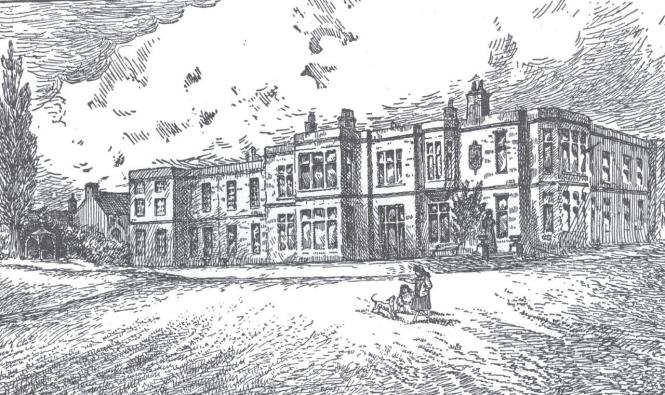
st ives, bingley

Harden Grange (St. Ives)

While Disraeli was at Bingley, there was a ceremonial opening of some land given by Lady Ferrand to the community as an allotment in Cottingley. Part of the celebrations was a cricket match in which Disraeli, a future Prime Minister of Great Britain, partnered the local shoemaker in a winning last wicket stand! This event does not appear in Ferrand’s Memorable Speeches, but is a local event of interest.

Five of Ferrrand’s speeches are reported in this pamphlet. In his ‘Speech at the Dinner’:

He said he brought that notorious system [the truck system] before the House of Commons, and though the cotton lords first denied the truth of his representation, yet when he produced an enormous packet of ‘abatement tickets’ they all sat as mute as mice with a cat in the room. (cheers). He convinced those men of the atrocious cruelty, and the truck system was put down by the legislation. (cheers)

Ferrand also covered the evils of the long hours worked by children in the mills and factories, and much else. These ‘Memorable Speeches’ are worth reading for those wishing to learn more about nineteenth century social and industrial history. And for learning more about this remarkable local celebrity.

Stackmole

Treasure of the week no. 24: ‘Wot! No telly!’ – Creative recreation for 1858’s working man

Popular Amusements. Four Essays by Working Men of Bradford. (Bradford Review, 1858)

JND 196/1 (Please quote this number if requesting this item.)

Football challenge 001

In 1858, the Bradford Review of 21st August offered a prize of one guinea (£1.05) for the best paper, and half-a-guinea (52½p) for the second best in reply to the following question:

What are the best and most practicable means of promoting recreation among the people, during the winter months, in manufacturing towns?

It is hard to imagine life without television and radio, phones (mobile and landline), i-pads, video and CDs, the internet, even electric light and motorized transport. What were young people to do in the evenings after work but congregate in the streets, visit the pubs and betting shops, and generally be a raucous nuisance? What was needed to provide a positive solution to the problem?

Fourteen essays were submitted and forwarded to the adjudicators, the Rev. J.P. Chown and W.R.Haigh, Esq. In addition to the prizes for the first two, Mr Haigh offered a third prize, and the proposer thought that one of the unsuccessful essays contained suggestions of so practical a character that he thought a pity if these hints could not be discussed. Four essays, then, were printed in the Bradford Review, and reprinted in a 32-page pamphlet by James Hanson of Bradford. It is this latter that is to be found in the Dickons Collection of Bradford tracts.

The prize was won by William Harrison, a compositor, who proposed singing classes, Saturday evening concerts and entertainment, a public gymnasium and popular lectures. Chess, draughts and billiards were also suggested.

Second prize went to Malcolm Ross, a lithographic printer, who urged the establishment of a Working Man’s Literary Association to embrace  debating and other classes of an improving character; also a reading and news-room of social and political knowledge. This reminds us that there were no public libraries in Bradford at this time.

Benjamin Preston, a wooolsorter, won the third prize. He suggested cheap music or popular concerts, together with dancing and theatrical entertainments under judicious regulation.

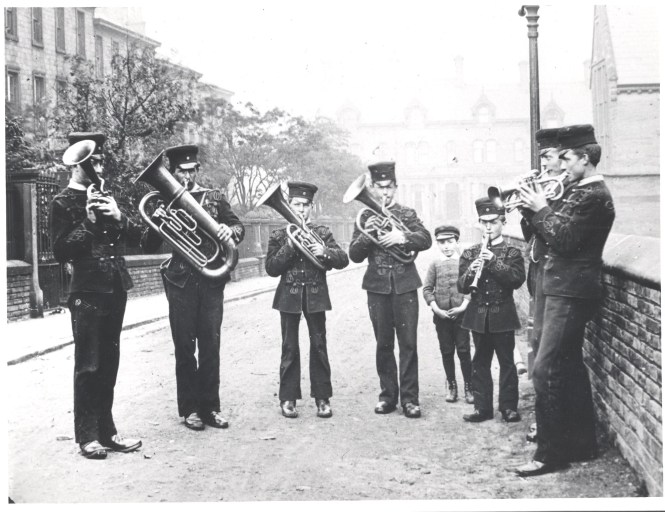
Brass Band 001

The final prize winner was Edward Sloan, a book canvasser, who proposed that the workmen of each establishment, firm, or location, should form themselves into a small society for their mutual instruction and amusement. As with all the candidates, Sloan emphasized the need to provide creative opportunities to counteract, in his words, “depression of spirits, exhaustion of body, a sickness and deadness of the whole man, [which] cry out imperatively for a change. But hitherto the world has provided for the ignorant no place of recreation half so enticing as the public house.” Wise words from a woolsorter.

Reading these accounts emphasizes how much society has changed since those mid-Victorian times. The essays were followed by a feature article in the Review of October 9th, 1858, commenting on the proposals. Reading them today we see that what was proposed closely foreshadows the establishment of public libraries, youth clubs, and many of the social and cultural activities we have today. Maybe the essays of William Harrison, Malcolm Ross, Benjamin Preston and Edward Sloan had a part to play!

Stackmole

Treasure of the week no. 23: Billygoats, frogs, & pickle-pot : ‘The Old Inquirer’ and the ‘March of Reason’.

The Old Inquirer [The Rev. Wm. Atkinson] A volume of tracts.

B 042 ATK (Please quote this number if requesting this item.)

In my trawl through the basement of Local Studies Library I came across a volume of tracts by ‘The Old Inquirer’. The use of pseudonyms was quite common in the eighteenth and nineteenth century, especially for authors writing on controversial topics or opposing the views of other writers. The Old Inquirer did both. His spat with ’Trim’, the Headmaster of Bradford Grammar School in the years from 1787 to 1791 was very public, bad tempered, and yet clever – both Trim and the Old Inquirer were well educated and highly literate. The prose (and sometimes verse) is fun to read even if we don’t fully understand what it was they were arguing about! The Old Inquirer was a prolific writer: the volume I came across had 16 separately paginated tracts containing some 70 individual letters, essays and other items. He even had his own printing press!

To provide extracts from these writings would be far too ‘heavy’ for these ‘Treasures’. Instead I have extracted some of the verse he used to illustrate his opinionsand  which can be enjoyed just for themselves. They are indicative of the rumbustious satire of The Old Inquirer.

‘The Old Inquirer was the Reverend William Atkinson, M. A. , ‘Lecturer’ or ‘Afternoon Man’ at the Parish Church in Bradford (now the Cathedral) from 1784 till his death aged 89 in 1846, a period of 62 years. The ‘Afternoon Man’ was so-called because he was only required to be in attendance on Sunday afternoons. According to newspaper cuttings in the Local Studies Library, Atkinson was a man of herculean build and of singular strength of mind as well as body. He used to walk from his home in Thorpe Arch on Saturdays and walk back to his home on Mondays, staying over in Bradford for his Sunday lectures. So what did he do for those 62 years? Well, among other things, he wrote letters, essays and poems.

Rev William Atkinson MA

‘Rev William Atkinson’ from ‘Bradford Fifty Years ago, 1807’ by William Scruton

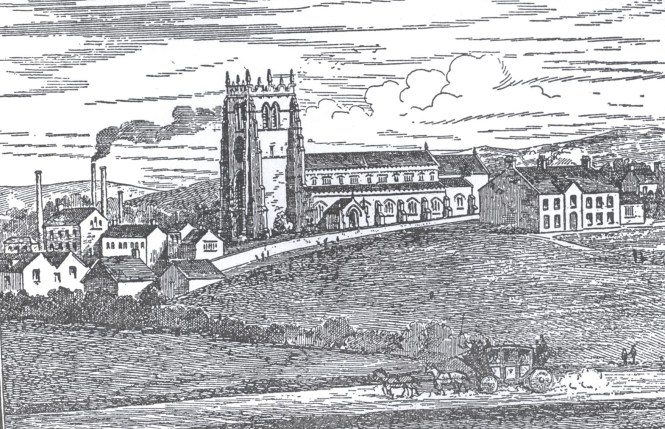
Parish Church and Vicarage 1810

‘Parish Church and Vicarage in the year 1810’ from ‘Pen and Pencil Pictures of Old Bradford’ by William Cudworth

The range of subjects he wrote on was wide: the exportation of wool;  tithes; political reform; dissenters from the Church of England; the Pope; press bias; agriculture; even banking. Anyone interested in understanding our history from 200 years ago would do well to read these tracts. Here, though, we just relish his gift for verse and satire, and be amused at the wit, boldness, and candour of the ‘Old Inquirer’. And maybe wish he was around today!

…  Fee fau fum,

I smell the stink of democratic plum;

And though I love Reform disclosed,

And would by no means clog them;

Yet meeting with bare r – ps exposed

I cannot help but flog them.

(A Letter to the Reforming Gentlemen. 1817, p. 1. Tract no. 5)

Their arms, their arms,

Are the Radical charms,

With which they’ll lay about them;

Order, order,

Says R. D. our Recorder,

They’d better be quiet without them.

(Free Remarks upon the Conduct of the Whigs and Radical Reformers in Yorkshire; with some Slight Allusions to the Court Party, 1819, p.1. Tract no. 7.)

How Johnny Bull

Is made the Gull,

Of Men who love his money,

The wasps who thrive,

Within his hive,

And live upon his honey. (p.12)

(Remarks on the Strictures in the Leeds Mercury upon the Rev. M. Jackson’s Coronation Sermon, &C. &c. &c., 1821. p. 12. Tract no. 7)

A Lily sprung in foreign land,

And grew to be a flower,

It was transplanted to this strand,

But flourish’d not an hour.

(As above, p. 16)

“Alas! No rest to mortal man is given,

Till they are safe arriv’d in heaven.”

(A Speech Intended to have been spoken at a Second Meeting of the Clergy upon the Popish Question, 1821, p 41. Tract no. 13)

The man in the moon,

Has ordered a spoon,

To give all there maniacs their pottage;

No, no, let them go

To the region below,

For the pickle-pot must be their cottage.

(As above p. 51)

I am the Prince’s Dog at Kew,

Whose Dog are you?

(A letter to the Reforming Gentlemen, 1817, p. 14. Tract No. 5)

Granting that he had much wit,

He was rather shy of using it.

(As above, p.13.)

Hallo, hallo, away they go,

Unheeding wet or dry,

And horse and rider snort and blow,

And stars on all sides fly!

Hold  Parsons, hold, on Peggy’s rig,

For stormy is the wind,

Or like John Gilpin’s hat and wig,

You’ll soon be left behind.

(A Letter to one suspected to have been written by a Stranger, assisted by the Jacobin priests of the West Riding, 1801, p. 43. Tract No. 1)

Your reasoning, with wondering stare,

Quoth Tom, is mighty high, Sir;

But pray forgive if I declare,

I doubt it is a lie, Sir:

We ne’er shall get, I really think,

Lord H….w..d’s land to us, Sir,

I’d rather have a pot of drink,

Than hang up like a truss, Sir:

If you think thus, my honest clown’

We’ll take another sight on’t –

Just turn the picture upside down,

And you will see the right on’t.

(Lucubrations in Prose and Verse written during the Awful Revolution in 1829, p. 12. Tract no. 16)

Jerry’s Song to his Tippling Wife.

Upon her cheek so fair,

The lily and the rose,

Of flowers a pretty pair,

Did all their sweets disclose.

But time has cropt that rose,

The lily too doth fade,

Such are the cruel foes;

In wedlock to a maid.

And has time cropt that rose?

Ah, no! it grows it grows,

Upon her well-fed nose,

You yet may see my pretty little rose.

(As above, p.13)

And what of the Frogs, Billygoats, and The March of Reason of the heading to this blog? See:

Tract number 14: A Rapid Sketch of Some of the Evils of Returning to Cash Payments, and the only remedies for them. To which are added The Leeds Mercury turned into a Frog, the Billygoats in Leading-Strings, and The March of Reason. 1823.

A full listing of Atkinson’s tracts can be found in the folder ‘Federer, Dickons and Empsall tracts in the Local Studies Library’. Listed under  B 042 ATK

Stackmole

Treasure of the week no. 22. A terrible calamity in 1882

A Terrible Calamity in Bradford: being the entire story from beginning to end, of the Fall of Ripley’s Mill Chimney on Thursday, Dec. 28th, 1882, along with All the Particulars, List of Killed, Accounts of Startling and Extraordinary Escapes, etc. Published by Willie Reynolds.

JND 187/11 (Please quote this number when requesting this item.)

tc

1882 was, the author claims, a disastrous and eventful year:

From its very commencement it was a year ever to be remembered by poor and rich alike, if such events as the useless Egyptian war, outrageous practices and barbarous murders in Ireland, destructive fires in all parts of England, colliery accidents, and calamities of all kinds by land and sea could make it so.

In Bradford the year ended in the collapse of the chimney at Ripley’s Mill in Spring Street off the Manchester Road, at a few minutes past eight on Thursday morning, killing 53 people and seriously injuring 50. The mill was used for spinning and top making and was occupied by several companies. The chimney was said to weigh over 4,000 tons and was 255 feet high. It had been built over twenty years earlier but was never regarded as being quite safe. A week before its fall, pieces of lime and stone had fallen from it. After slight repairs, the architect passed it as being safe. But high winds, incessant rain, frost and heavy falls of snow followed. The gigantic stack collapsed at a point a few feet above the ground.

This modest leaflet of sixteen pages gives an account of the collapse, details of prior warnings and graphic eye witness reports. A list of those killed is given with their ages and we note that many children were killed. The youngest were 8-year-old Susan Woodhead, 9-year-old Emma Pearson, and Edgar North, Arthur Smith and Lydia Lightowler, all 12.

The pamphlet is of interest, not just for the details of the tragedy, but for how it was published. No author is given but we assume it was the publisher. It was priced at One Penny and “The proceeds from the sale of this work is intended for the ‘relief’ fund for the sufferers by the accident.” It was to be “had by all News Agents and News Lads”. One imagines that Willie Reynolds took it upon himself to interview participants, research background, write up the story – and well-written it is – print (probably out of his own pocket), then do the rounds of local newsagents, recruit an army of news lads, then collect and distribute the income, all within a short space of time. That was no mean achievement. No Facebook, Twitter or Internet in 1882!

Stackmole

Treasure of the Week no. 21. The Low Moor Iron Works – what poetry!

Low Moor Iron Works: a poem. By John Nicholson. 1829 (1856 reprint).

JND 187/1 (Please quote this number if requesting this item.)

Tres 21 John Nicholson

Image reproduced from ‘Poets of Keighley, Bingley, Haworth and District’ by Charles F Forshaw.

In common with other writers of the early nineteenth century, John Nicholson (1790-1843), ‘The Bard of Airedale’ found romance in the achievements of industry.  The coal-fired flares of the iron works at Low Moor were compared to the smoking volcanoes of Etna and Strombolo. Beyond romance though, were the utilitarian products that issued

When first the shapeless sable Ore
Is laid in heaps around Low Moor,
The roaring Blast, the quiv’ring Flame,
Give to the mass another name;
White as the Sun the Metal runs,
For Horse Shoe Nails, or thund’ring Guns;
The trembling hair-spring of a Watch,
An Anchor, or a Cottage latch –
Most implements the Farmers have,
And those of Steamers on the wave
The Tailor’s Needle, or the Shell
The levell’d once where Princes dwell;
The Engine, Boiler, Cobler’s awl,
The Carronade, the pond’rous ball;
The place where Steam first moved his wings,
The Nails in Beggars’ Shoes and Kings’;
The Anchor’s Chain, the Fisher’s Hook,
The Sword – the Hatchet – and the Crook,
The sounding Anvil, all the blades,
The cause of many thousand trades;
No pen can write, no mind can soar
To tell the Wonders of Low Moor.

The importance of the Low Moor Iron Works in the manufacture of weapons is noted:

Throughout the world thy heavy Guns are known:
From the Pacific to the Indian shore,
Nations have heard their dread tremendous roar.

And at the Woolwich arsenal:

There Pyramids of balls for battle form’d,
By which each fortress of our foes is storm’d,
The bursting bombs of every size are there,
To guard the land Britannia holds so dear.

But now

Silent the Cannon, peaceful all the host;

In particular, and prophetically, the coming of the railways is noted: the days of the Courier, the Pilot, and the Duke of Leeds, stage coaches all, are ending:

Ye panting horses, smoking on the road,
Mark’d with the whip, and struggling with your load;
Your race of cruelties will soon be done,
The mail without you soon will swiftly run.

Summing up, Nicholson tells how Low Moor helped make Bradford:

What millions sterling have been made,
What tens of thousands have been paid,
What thousands here has genius fed,
Since the first blast has rear’d its head,
Crown’d with flame that dar’d on high,
And cheer’d the midnight cloudy sky.
But for Low Moor, old Bradford Town,
Had never like a City grown.

This poem was first published in 1829 and reprinted in 1856 by J Dobson of the Market Place, Bingley.

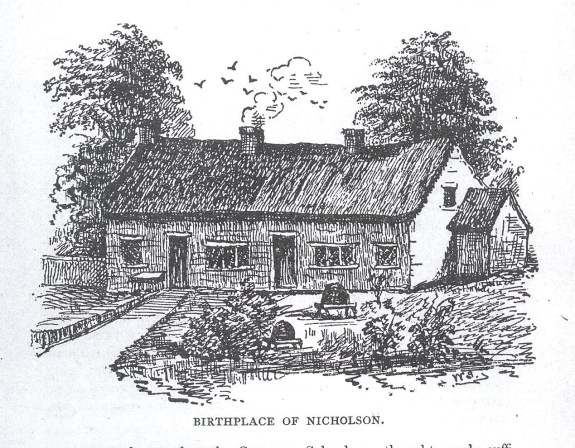
Nicholson started his working life in the mills but aged 32 moved to Harden Beck and became an established poet. After success with works such as Airedale in Ancient Times and The Siege of Bradford, he tried his luck in London, but soon returned to Bingley. In the 1841 Census, John (aged 50) and his wife Martha (45) were living with their eight children, aged 6 through to Ann (22) and Sarah (20), both worsted warpers, and Thomas (20), a wool sorter. John Nicholson was drowned while trying to cross the River Aire on stepping stones on a stormy night.

Tres21 birthplace of Nicholson

Image reproduced from ‘Poets of Keighley, Bingley, Haworth and District’ by Charles F Forshaw.

The Low Moor Iron Works have long since gone, but the recent re-opening of Low Moor station would surely have pleased ‘The Bard of Airedale’!

Stackmole