Treasure of the week no. 30: Quit rents, happy money and Queen Elizabeth’s dole: Bradford charities get a visit from Arthur

The Charities of Bradford. Government Inquiry by Arthur Cardew, Barrister at Law. 1894.

(Information reprinted from the Bradford Observer newspaper by William Byles and Sons.)

JND 18/15 (Please quote this number when the Local Studies library reopens if requesting this item.)

At ten o’clock on Tuesday, January 23rd, 1894, Arthur Cardew, Esq., Barrister-at-Law, Assistant Commissioner, opened an inquiry in Bradford’s town hall. This was on behalf of the Charity Commission who had been asked to look into all charities within the County Borough of Bradford, under the Charitable Trusts Acts 1853 to 1891, and the Charities Inquiries (Expenses) Act, 1892. The inquiry was instigated by the Bradford Council so as to ensure that local charities conformed to recent legislative changes.  Among those in the large attendance were the Mayor of Bradford (James Whitley), two aldermen (Smith Feather and William Lister), the Town Clerk, the Deputy Town Clerk, and two MPs (A. Illngworth and W .P. Byles).

The Town Council had originally thought to examine a few old-established and parochial charities, but the Charity Commission wanted all charities included so that the result would be a complete report valuable for future reference. [Like now!] The charities included large ones such as the Infirmary and the Grammar Schools which had from time to time had endowments given to them as sums of money to be invested and treated as capital. There were also many smaller charities. Over the years practice had varied and there had been occasional suspicions of financial malpractice and partiality. The Town Clerk took it that this inquiry was just to collect information and embody it in a report. The Commissioner assented. [The meeting must have breathed a sigh of relief to hear this, though some charity trustees were given a rough ride!]

Forty-eight charities were examined, ranging from the Grammar Schools, with benefactors such as John Crosse, Henry Brown, Titus Salt and S. C. Lister; the Bradford Infirmary; orphanages, convalescent homes, places of worship, and The Organists’ Charity. Information about their foundation, financial information and management were all investigated. For the information of researchers today, all 48 charities are listed here. Collectively they indicate how much education, health and social welfare in Victorian Bradford owe to charitable activity.
The term ‘Happy Money’ came from the fact that the collector of rents for ‘The Poors’ Estate and Quit Rent’ (No. 3 below) was Mr Henry Happy! Of interest to local historians is that one of the council officials much involved in this inquiry was Thomas Empsall, whose large collection of books on local history was acquired by Bradford Libraries after his death.

THE CHARITIES

  1. The Free Grammar School, including the scholarships of John Crosse, Henry Brown, Titus Salt, and S. C. Lister.
  2. The Girls’ Grammar School, including the scholarships of Henry Brown and Titus Salt.
  3. The Poors’ Estate and Quit Rents.
  4. Richard Pollard’s Charity.
  5. Mary Ann Jowett’s Charity.
  6. William Field’s, or the Black Abbey Dole.
  7. Thomas Farrand’s Charity.
  8. Elizabeth Wadsworth’s Charity for Bradford Township.
  9. John Appleyard’s Charity.
  10. The Rev. Dr. Jobson’s Fund.
  11. The Organists’ Charity.
  12. Susannah Stott’s Charity.
  13. The Bradford Lectureship.
  14. William Wilson’s Charity.
  15. Benjamin Illingworth’s Charity.
  16. Mechanics’ Institute: Brown’s Endowment.
  17. General Infirmary: Endowments of Musgrave, Semon, Leather, and Brown.
  18. Fever Hospital: Nutter’s Endowment.
  19. Eye and Ear Hospital: Semon’s Endowment.
  20. Woodlands Convalescent Home: Nutter’s Endowment.
  21. Orphanage for Boys: Nutter’s Endowment.
  22. Orphan Home for Girls: Nutter’s Endowment.
  23. Nutter’s Scholarship Charity.
  24. Tradesmen’s Benevolent Institution: Nutter’s Endowment and Brown’s Endowment.
  25. Tradesmen’s Home: Brown’s Endowment and Wright’s Endowment.
  26. Spinsters’ Endowment Fund: Brown’s Endowment.
  27. John Harrison’s Charity for the Blind.
  28. Samuel Broadley’s Charities.
  29. Bailey’s Endowment for Minister of Westgate Baptist Chapel.
  30. Endowment of Old and New Wesleyan Chapels at Bradford Moor.
  31. Endowment of Manchester Road Primitive Methodist Chapel.
  32. Endowment of Salem Congregational Chapel in Manor Row.
  33. Endowment of Kirkgate Wesleyan Chapel.
  34. Endowment of Eastbrook Wesleyan Chapel.
    34A. Holling’s Charity for Friend’s Meeting House.

Township of Allerton

  1. James Sagar’s Charity.
  2. The British School.

Township of Bowling

  1. Endowment of Dudley Hill Wesleyan Chapel and School.

Township of Horton

  1. John Ashton’s Charity.
  2. Elizabeth Rand’s Charity.
  3. Dixon’s Charity for Chapel Lane Chapel.
  4. Endowment of Great Wesleyan Chapel.

Township of Manningham

  1. Elizabeth Rand’s Charity.

Parish of Calverley

  1. Queen Elizabeth’s Dole.

Township of Pudsey

  1. Lipton’s Charity.
  2. Gibson’s Charity.
  3. Neville’s Charity.
  4. Simpson’s and Hay’s Charity
  5. Elizabeth Wadsworth’s Charity for Calverley Township.

Stackmole
Treasure of the week no. 29: A free library for Bradford

Report of the Finance and General Purposes Committee as to the operation of the Free Libraries Act.1868.  Printed by M. Field of Bradford. 23 pages.

JND 1/12 (Please quote this number if requesting this item when we reopen again.)

At a meeting of Bradford’s Finance and General Purposes Committee, held on 6th March, 1868, it was ‘Resolved that the Report of the Sub-Committee on the proposed Free Library, now read, be and the same is hereby approved, and adopted, and that the same be presented to the Council at their next Meeting … . (W. T. McGowen, Town Clerk.)’ The Council did approve the report and Bradford’s ‘Free’ (i.e. ‘Public’) Library opened in 1872.

The Sub-Committee was appointed ‘to inquire into and report upon, the working of the Free Public Libraries Act, in those Towns in which the Act is now in force.’ The Chair was John V. Godwin, an active proponent of Free Libraries. The public library is now very much part of the social landscape, but before the Public Library Act of 1850 people had to pay a subscription to use a library, either by becoming a member of an organisation, such as the Literary and Library Society, or by using a commercial ‘circulating’ library. The move to provide libraries ‘on the rates’ was hotly contested, especially by the limited number of those wealthy enough to pay for them! So the acceptance of the report was a momentous event.

The Sub-Committee had contacted 13 of the 28 towns in England and Scotland which had adopted the Act. To a list of twenty-one questions, “replies were furnished in the most cheerful and courteous manner.” The report had three tables. One gave the dates when the Act was adopted, composition of the management body, whether both Lending and Consulting (i.e. Reference) libraries were established and what other libraries existed in their area. Second: the amount produced by the rates, cost of land, buildings and books, and how met. Third: Opening hours, number of volumes, issues, security and loss. There were also statistics on art galleries.

The libraries consulted were Bolton, Cambridge, Oxford, Blackburn, Liverpool, Sheffield, Cardiff, Birmingham, Airdrie, Manchester and Salford. Much can be learned from these tables about the concerns people had about how a ‘free’ library would work, and about the early history of public libraries. Particularly interesting are the occupations of users, and what sort of books libraries stocked. Liverpool had a reading room that held 600 people, and the most consulted reference source were Patent Specifications.

Stackmole


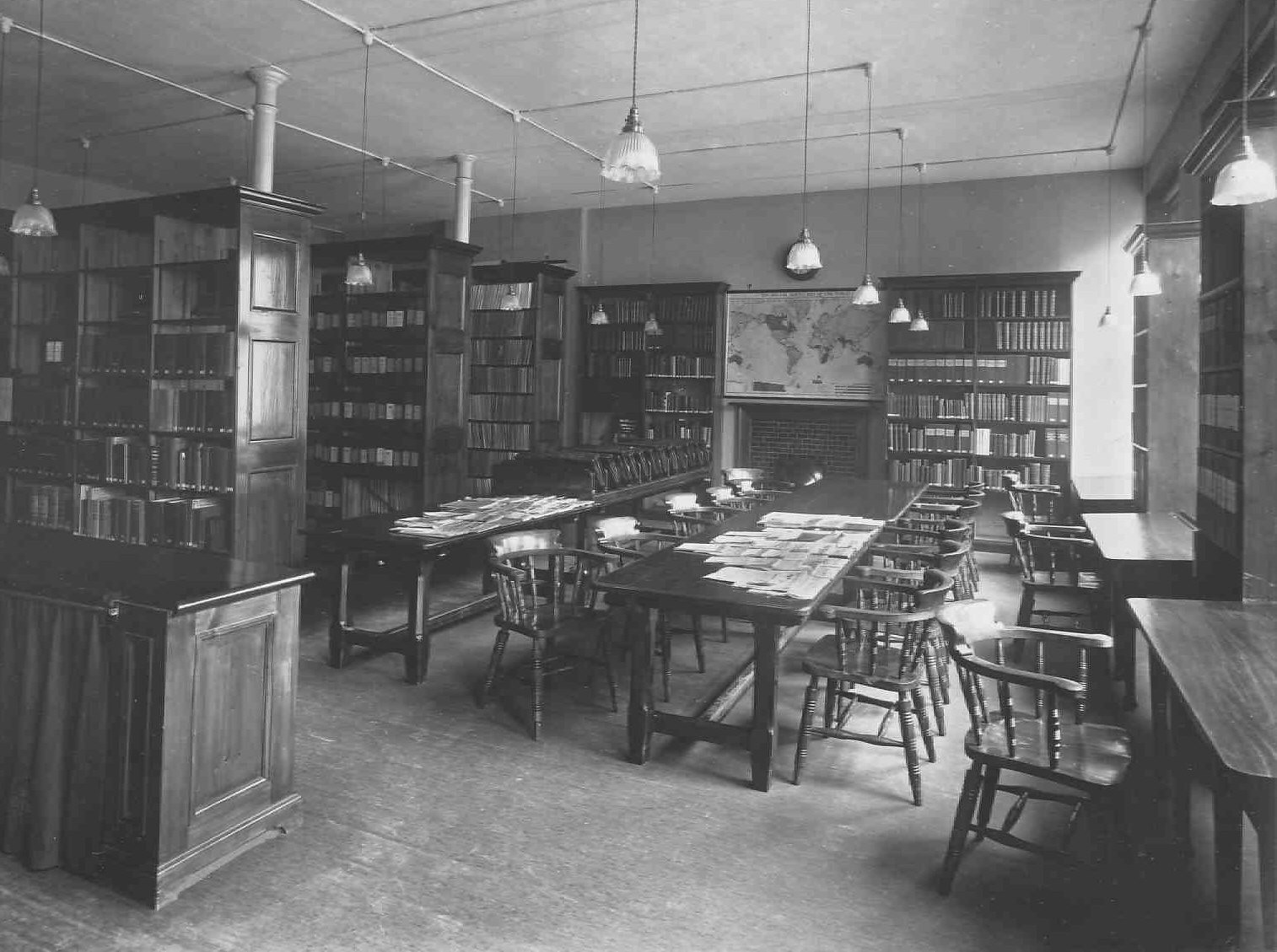
View more historical images of Bradford Libraries across the years here:

https://www.flickr.com/photos/bradfordlibraries/albums/72157630018371031


Treasure of the week no. 28: A pot of green feathers and problems in schools

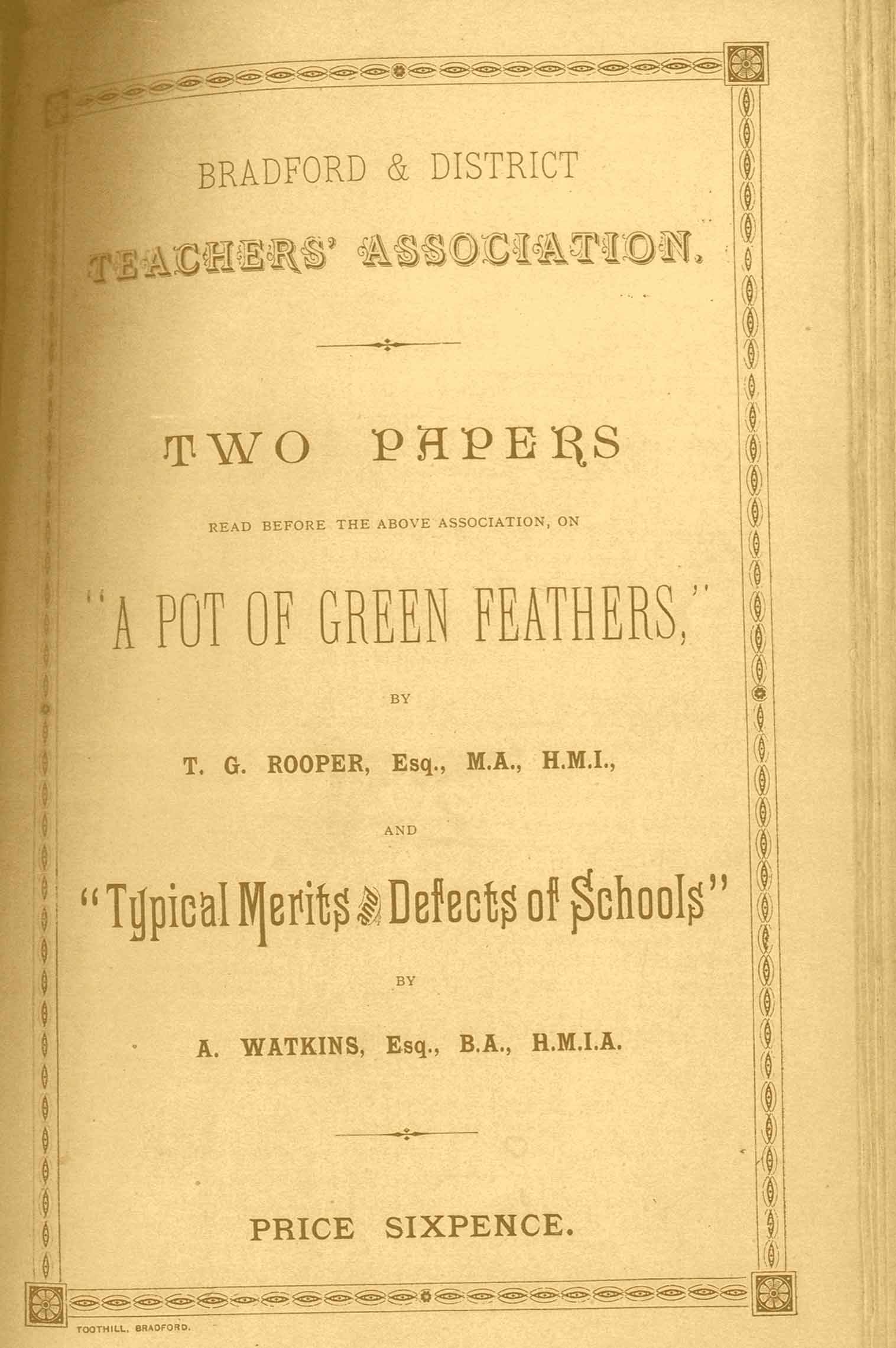
‘A Pot of Green Feathers’ by T. G. Rooper and ‘Typical Merits and Defects of Schools’ by A. Watkins: Two Papers Read Before the Bradford & District Teachers’ Association, circa 1890. Printed by J. Toothill of Bradford. 40 pages.           

JND 1/19 (Please quote this number if requesting this item when we are open again.)

tres-28-image-web

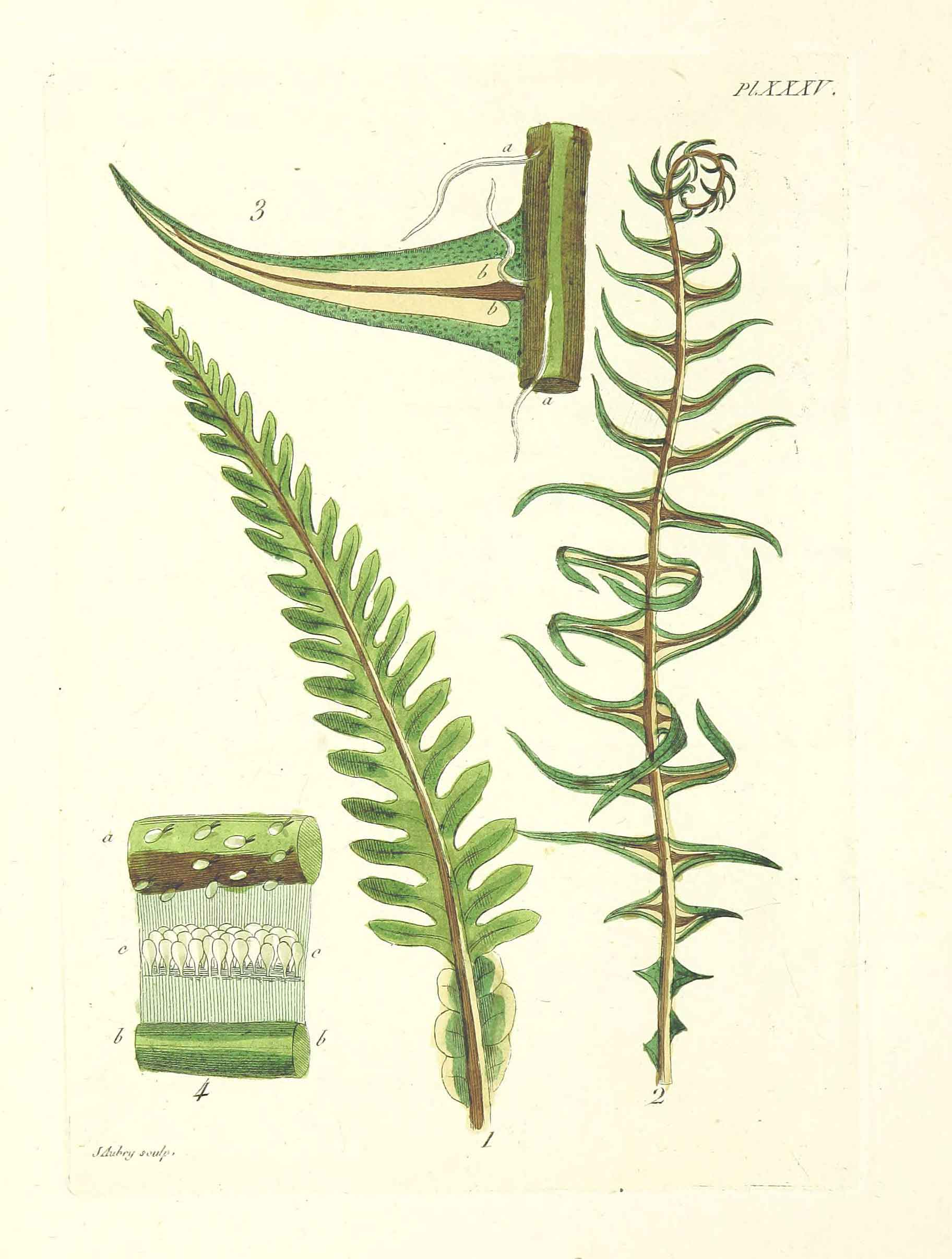
fern-pic-web

Image from ‘Oeuveres complètes de Jean Jacques Rousseau’ 1788 p. 144 https://www.flickr.com/photos/britishlibrary) Flickr Commons

A young child was shown a pot of beautiful fresh green ferns by a student teacher. The teacher asked the child to say what it was. “It is a pot of green feathers”, the child answered. “Poor little thing! She knows no better”, commented the student teacher to her supervisor.

Some time later the supervisor, Mr Roper, who happened to be an Inspector of Schools, addressed a meeting of Bradford teachers and referred to this incident. “Did the child really suppose that the ferns were feathers?” This got the inspector thinking and researching. The lecture was the result of his labours. Big questions emerged: What do we know of the outer world? Of what is not self? Of objects? How do we know anything of the outer world?

Quite what the meeting made of the inspector’s answers is not recorded. The account covers seventeen pages of closely argued, though lucid, text, and not for repetition here! But it is worth a read for those philosophically inclined, or concerned with educational psychology. Briefly, one learns by extending what one already knows – the child already knew about feathers but not ferns – hence the value of extending one’s experience.

There was a second inspector at this meeting, a Mr Watkins. The title of his talk was ‘Typical Merits and Defects of Schools’. I suspect the teachers would have felt on surer ground and a little nearer home with Mr Watkins. Those who study Victorian education will also profit. Here are uncovered the mysteries of disciplining children, of well-ordered schools, teaching children to concentrate, mechanical versus intelligent learning, reading, speaking, writing, and teaching methods. Exactly what student teachers needed to know!

There was a sting in the tail though: “I believe in having a high ideal, and by steady perseverance, every teacher should strive to reach as near perfection as abilities and circumstances permit.” Maybe Her Majesty’s Inspector of Schools Watkins would be visiting their school in the near future!

Finally, said Mr Watkins, “In conclusion, I feel sure that the inordinant length of my paper must have bored you.” Er … !

Treasure of the week no. 27: Full dress subscription concert, February 1886

In the basement of Bradford’s Local Studies Library are collections of nineteenth century pamphlets (and some of earlier date). Ranging from sermons and programmes of royal visits, to reports, articles, obituaries and regulations, they are a treasure trove of local history. What follows is an account of one of these treasures. To consult any of these items please ask the staff. Catalogues of these collections are located in the Local Studies Library.

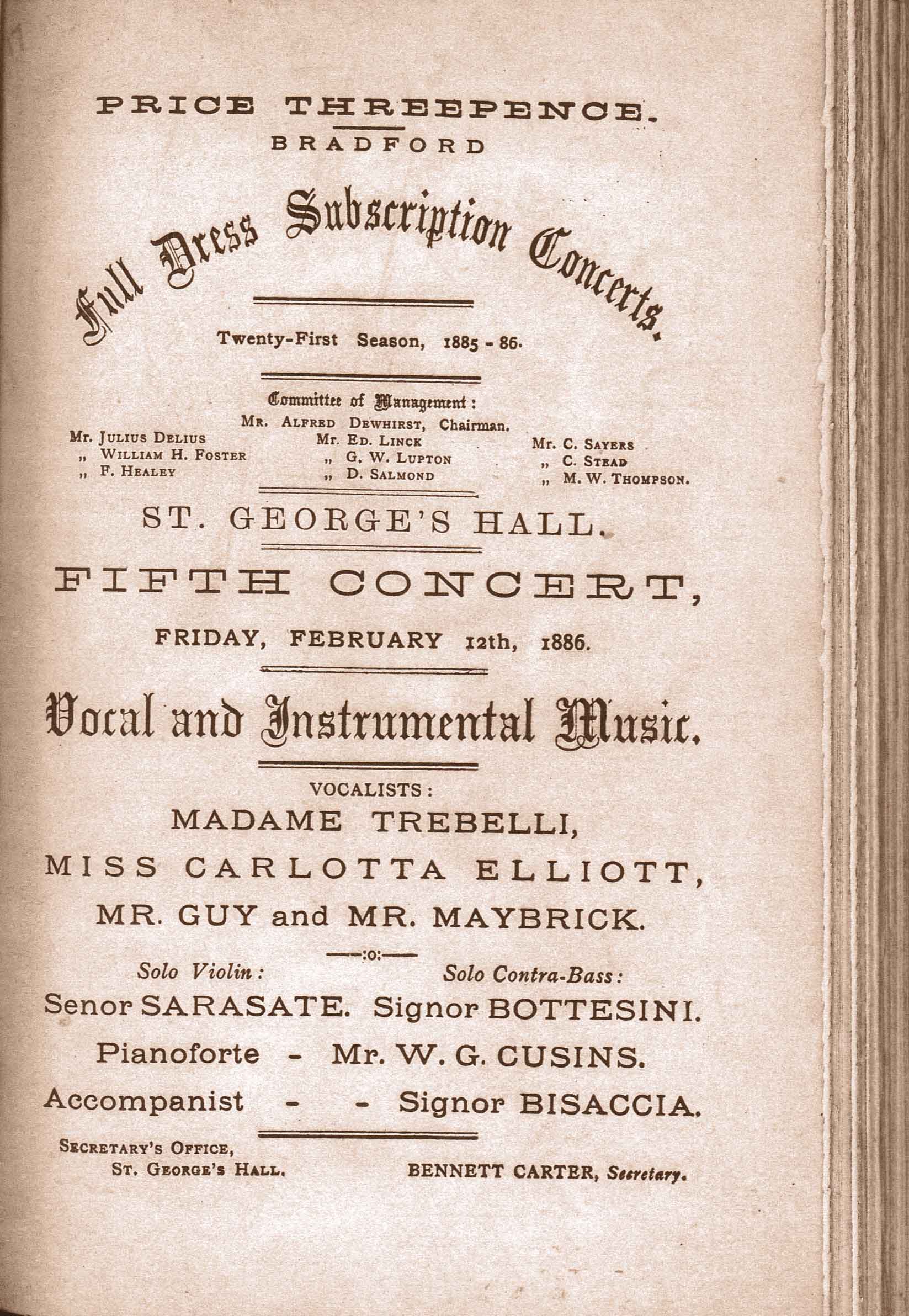
BRADFORD SUBSCRIPTION CONCERTS. Full Dress Subscription Concert. 21st season, 1885-6. February 12th. Vocal and Instrumental Music. Printed by John Dale & Co. of Bradford, 1886. 24 pages.

JND 1/16 (Please quote this number if requesting this item when we are open again)

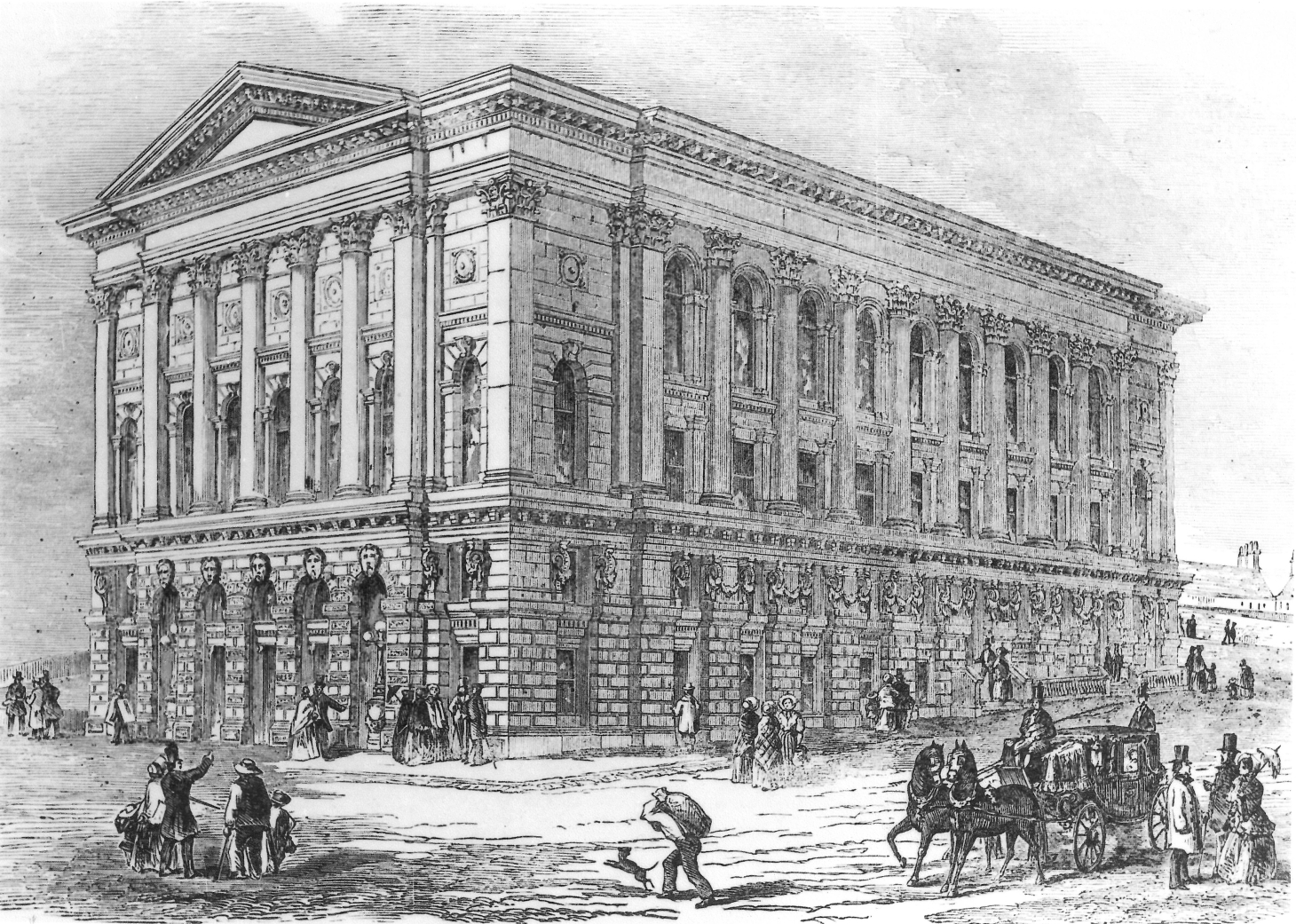
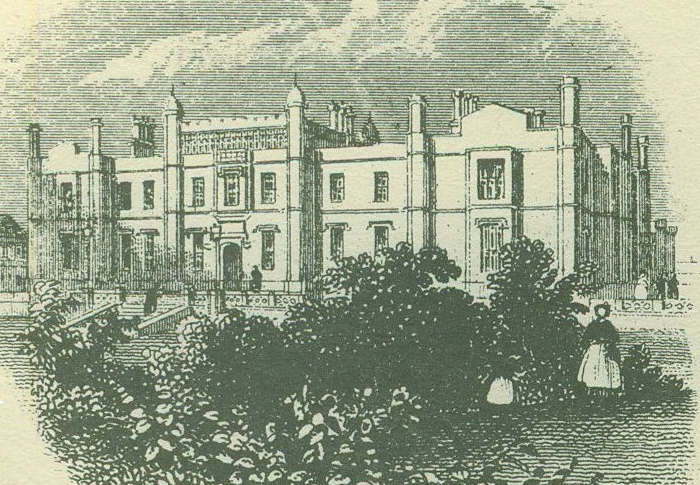
st-georges-old

Tres-27-image-copy-web

A healthy cultural life was a measure of the success and standing of Britain’s Victorian towns. An important cultural institution in Bradford was its Subscription Concerts held in the St George’s Hall. The 24-page pamphlet JND 1/16 in the Dickons Collection is a programme from the 21st season. So what went on in February 1886? In typical wordy Victorian fashion we start with the Regulations:

With a view to facilitate the INGRESS and EGRESS … the GRAND ENTRANCE is exclusively appropriated to the visitors to the STALLS. Holders of Tickets bearing ODD NUMBERS will proceed to their seats by the Stairs on the RIGHT HAND SIDE of the Grand Entrance. Subscribers having Tickets with the EVEN NUMBERS will proceed on the LEFT HAND SIDE.

And further: Private Conveyances and Engaged Conveyances must fall into line as usual in Hall Ings, and there wait till called for. Finally, The Police have strict instructions to enforce the above Regulations. By Order, THOMAS HILL, Mayor.

Then comes a list of SUBSCRIBERS to the STALLS: 210 of Bradford’s Good and the Great, including such luminaries as Sir Jacob Behrens, Julius Delius and W E B Priestley. This is followed by RESERVED AREA SUBSCRIBERS, another 210, and then SUBSCRIBERS FOR THE WEST GALLERY, 105 of them.

And who did they see and what did they hear? Vocalists Madame Trebelli, Miss Carlotta Elliott, Mr Henry Guy and Mr Maybrick; Señor Sarasate (Violin), Signor Bottesini (Contra-Bass), and Mr W G Cusins (Pianoforte) accompanied by Signor Bisaccia. Texts and translations are given of the songs. Composers included Chopin, Gounod, Sarasate, Gluck, Bottesini and Rossini. The Pianoforte was ‘kindly provided by Messrs John Brinsmead & Sons’.

The printed programme ends with a timetable of ’Railway Arrangements’ for those without their own conveyances. The 11.20 Lancashire and Yorkshire service was to call at Cleckheaton, Liversedge, Heckmondwike, Thornhill, Horbury and Wakefield; and the 11.25 at Wyke, Lightcliffe, Hipperholme, Sowerby Bridge, North Dean, Elland, Brighouse and Mirfield (though not, I suspect, in that order!). Times are also given for the Midland and Great Northern train services.

And so ended a February’s evening’s cultural entertainment in Bradford.

Stackmole

Treasure of the week no. 26: Hedgehogs, polecats and churchwardens.

This week we resume our popular ‘Treasure of the Week feature by our volunteer ‘Stackmole’. These treasures are from 19th Century Publications which give a varied insight into the Bradford of the 19th Century – history as it happened. We hope these articles will encourage people to study these items and to pursue this interest into other aspects of Bradford’s history.

Natural History Notes from the Bradford Churchwarden’s Accounts by Herbert E. Wroot. Offprint of pages 183-187 from The Naturalist, June 1895. Contains a transcript of the entries relating to payments for catching wild animals from 1668 to 1748.

JND 18/12 (Please quote this number if requesting this item)

Tres 26 image

The Churchwardens were very much the local officials in the seventeenth and eighteenth centuries and were responsible for the administration of the law. Interesting are the payments made for catching vermin and wild animals. The entries in The Accounts of the Bradford Churchwardens date from 1668 to the end of 1748. From these, journalist and naturalist, Herbert Wroot, transcribed the entries that relate to wild animals. They give evidence that in and near Bradford there were:

  • Hedgehogs (or ‘Urchins’)
  • Wild Cats
  • Foxes
  • Otters
  • Badgers (or ‘Greys’)
  • Polecats (or Foumarts)

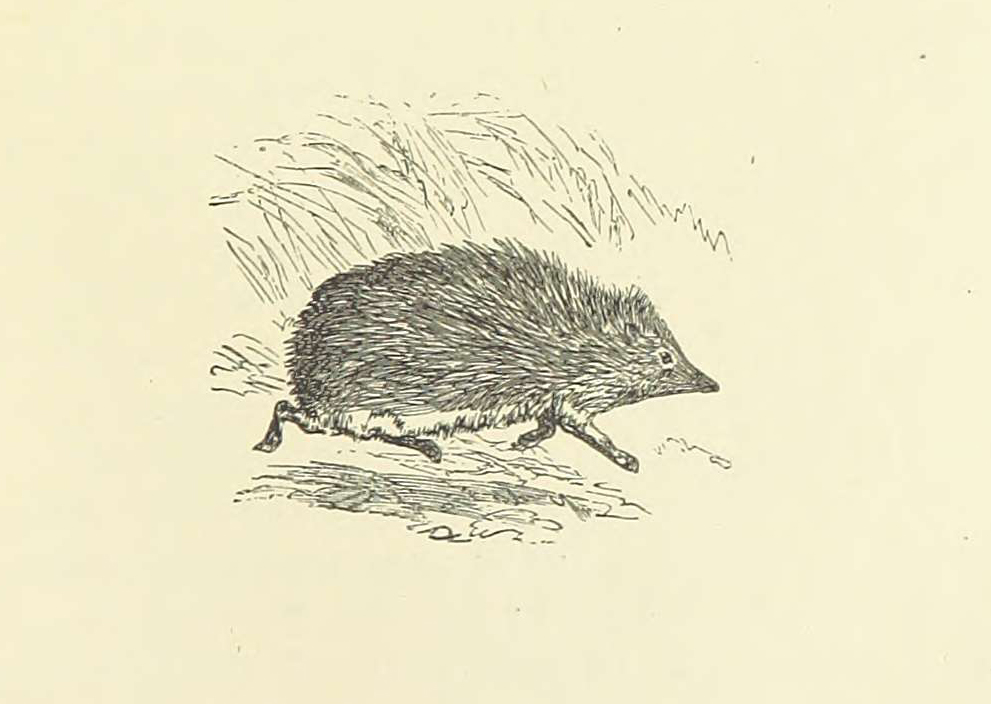
hedgehog from Eileen Aroon p 127

Image from ‘Eileen Aroon’ by Stables, Gordon, 1884 https://www.flickr.com/photos/britishlibrary Flickr Commons

Most common of these were hedgehogs, the deaths of 180 being recorded. Superstition against this harmless creature was strong – they were supposed to seek the milk from the udders of cows as they lay on the ground. The existence of the wild cat in the district is especially interesting; the animal being long ago extinct in England. Four specimens are referred to – two were caught in 1676, one in 1678, and the last in 1680. The badger or ‘gray’ seems to have been scarce or rarely seen. The sole specimen referred to was killed in 1676 at Shipley. Although polecats are several times noted, there were no martins, weasels or stoats. Otters were not uncommon, five having been killed, the last mentioned in 1731.

No payment was made for any of the birds whose destruction was prescribed by the Acts; birds such as hawks, kites, the buzzard, magpie, jay, rave or kingfisher. Likewise, there is no record of smaller vermin such as rats, mice or moles. The rewards paid, one shilling each for foxes and greys, and two pence each for hedgehogs, otters, wild cats and polecats, were in conformity with the scale prescribed by the Government.

The struggles of the illiterate churchwardens with spelling of the words ‘urchin’ and ‘hedgehog’ are amusing. Two examples are:

1670, April 23   Paid to Thomas Roe for Catshing two heg hoges ..… 4d.

1679-9   Aloud to the Churchwarden of Shipley for 6 uerchanes & for a wild cat ….. 2s. 02d.

Stackmole

Image from ‘Eileen Aroon’ by Stables, Gordon, 1884 https://www.flickr.com/photos/britishlibrary Flickr Commons