Another Keighley Local Studies Archive Treasure

What’s in the Box?

BK15, The 1763 Keighley Methodist Records.

When, in 1763, William Grimshaw, the famous perpetual curate of Haworth died, John Wesley sent in some quite capable preachers to take control of the Methodist Circuit built around him. The superintendent he chose was William Fugill, who, although of a dissolute character (he was sacked shortly afterwards for drunkenness and immorality), was an extremely capable organiser. The circuit, based on Keighley was enormous, stretching from Elland through north west England to Longtown at the Scottish Border. In total there were 63 societies and 1804 members. Fugill followed Wesley’s instructions and the preachers visited each society every quarter and interviewed the members, recording their names, marital status, occupation, residence, and their spiritual attainment, which the superintendent copied into a register. That register is held in the Keighley Local Studies Archive and is the earliest full record in existence in the country holding more than simply members’ names. This is a gold mine for researchers and has been used several times in the past to understand something of what Methodism meant to the ordinary people in the mid eighteenth century. A treasure indeed!

A workshop, illustrating these records will be held via Zoom at the Really Useful Show of the Federation of Family History Societies on Saturday, 12th November.

Robert Schofield,
Oxenhope,
Editor, E-Bulletin, Family and Community History Research Society.
Treasure of the Week no. 34: Holroyd’s almanac for 1864 – and the morals of Bradford. From Cab Fares and Public Baths to Thumps and Rushbearings

In the basement of Bradford’s Local Studies Library are collections of nineteenth century pamphlets (and some of earlier date). Ranging from sermons and programmes of royal visits, to reports, articles, obituaries and regulations, they are a treasure trove of local history. What follows is an account of one of these treasures.

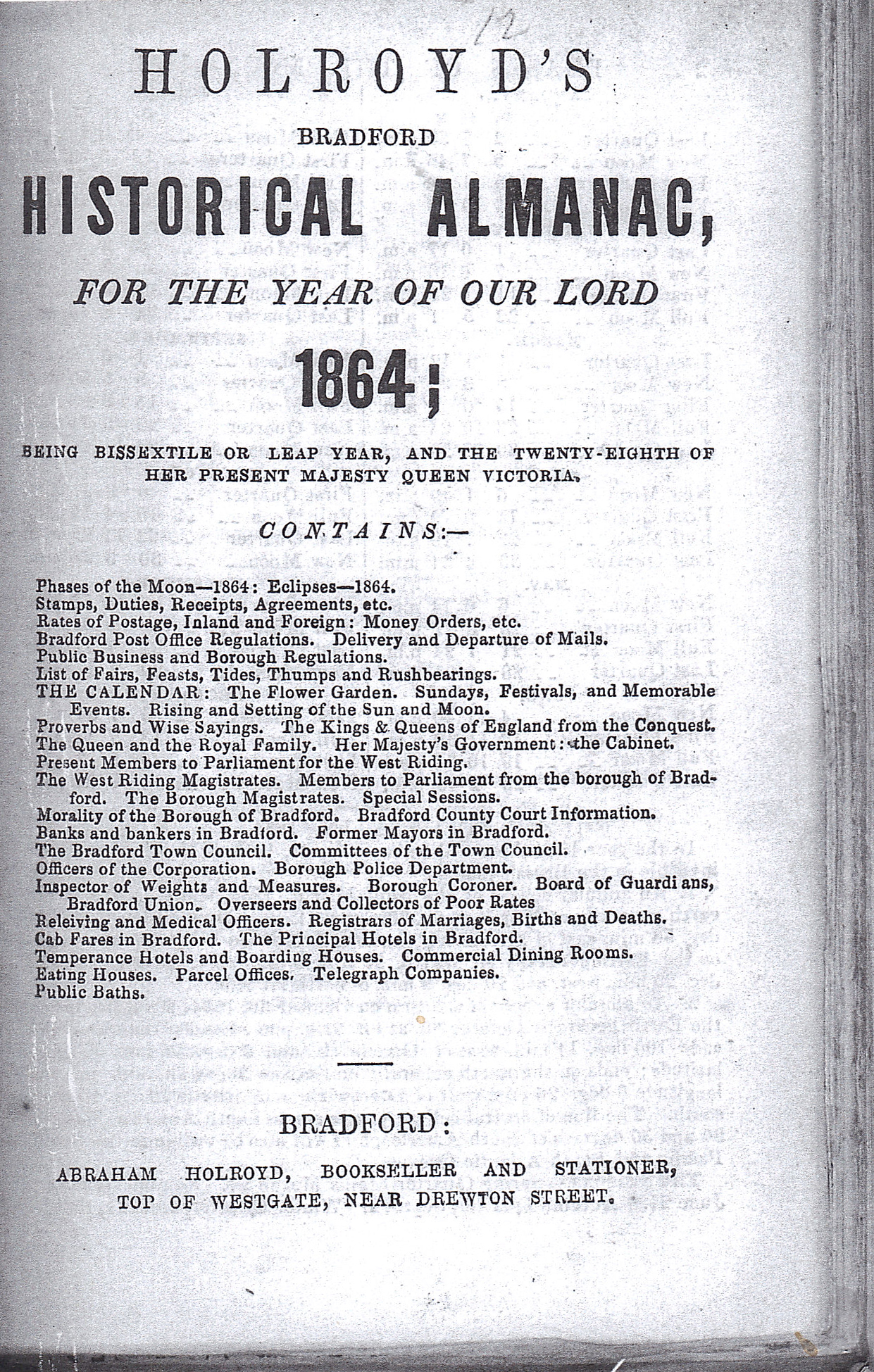
Holroyd’s Historical Almanac for the Year of Our Lord 1864. Published by Abraham Holroyd, Bookseller & Stationer, Bradford. 32 pages (Reference: JND 130/11)

Almanacs (or ‘almanacks’) were popular in the mid-to-late nineteenth century. These annual compilations of local information, often produced by local newspapers, contained a rich mixture of facts: astronomical, calendar, national, local, political, legal, administrative and sometimes hints and anecdotes. The following from the contents pages of Holroyd’s 1864 Almanac is typical:

Phases of the Moon -1864; Eclipses – 1864
Stamps, Duties, Receipts, Agreements, etc.
Rates of Postage, Inland and Foreign
Money Orders, etc.
Telegraph Companies
Delivery and Departure of Mails
Bradford Post Office Regulations
Parcel Offices
List of Fairs, Feasts, Tides, Thumps and Rushbearings

THE CALENDAR with page per month noting:
The Flower Garden
Sundays
Festivals, and Memorable Events
Rising and Setting of the Sun and Moon

The Kings & Queens of England
The Queen and the Royal Family
Her Majesty’s Government: the Cabinet
Present MPs for the West Riding.
MPs from the Borough of Bradford
The West Riding Magistrates
The Borough Magistrates
Special Sessions
Morality of the Borough of Bradford
Bradford County Court Information
Public Business and Borough Regulations
Banks and Bankers in Bradford
Former Mayors in Bradford
The Bradford Town Council
Committees of the Town Council
Officers of the Corporation
Borough Police Department
Borough Coroner
Inspector of Weights and Measures
Board of Guardians, Bradford Union
Overseers and Collectors of Poor Rates
Relieving and Medical Officers
Public Baths
Registrars of Marriages, Birth and Death
Cab Fares in Bradford
Proverbs and Wise Sayings
The Principal Hotels in Bradford
Temperance Hotels and Boarding Houses
Commercial Dining Rooms
Eating Houses

All human life is here, or a lot of it. Anyone wanting to know what life was like in the past would do well to quarry these yearly almanacs. Absent in this one are descriptions of the towns and village covered by the publication, but we learn that there were three temperance hotels in Rawson Place; that Bradford’s MPs were Henry Wickham and W. E. Forster; that hackney cab fares were a shilling for up to a mile, thence six pence a mile and that the Post Office opened at 7 a.m. (7.30 in winter).

Ah! But what about the ‘Morality of the Borough of Bradford’ as noted in the Contents above? Well:

Number of Constables 119
Known Thieves 91
Receivers of Stolen Goods 5
Prostitutes 151
Suspected Persons 114
Vagrants 491
Houses of Bad Character 5
being Public Houses 20

Brothels 58
Tramps’ Lodgings 45
Crimes Committed 247
Apprehensions 170
Committed for Trial 84
Burglaries 3
Breaking into shops 29
Highway Robbery 4
Laceny 173
Offences against the Person 5
Drunkeness 162

The meaning of some of these headings will have changed over the last century and a half, and also how crimes are allocated to headings, but it is clear that the Borough police force and the courts had plenty to do.
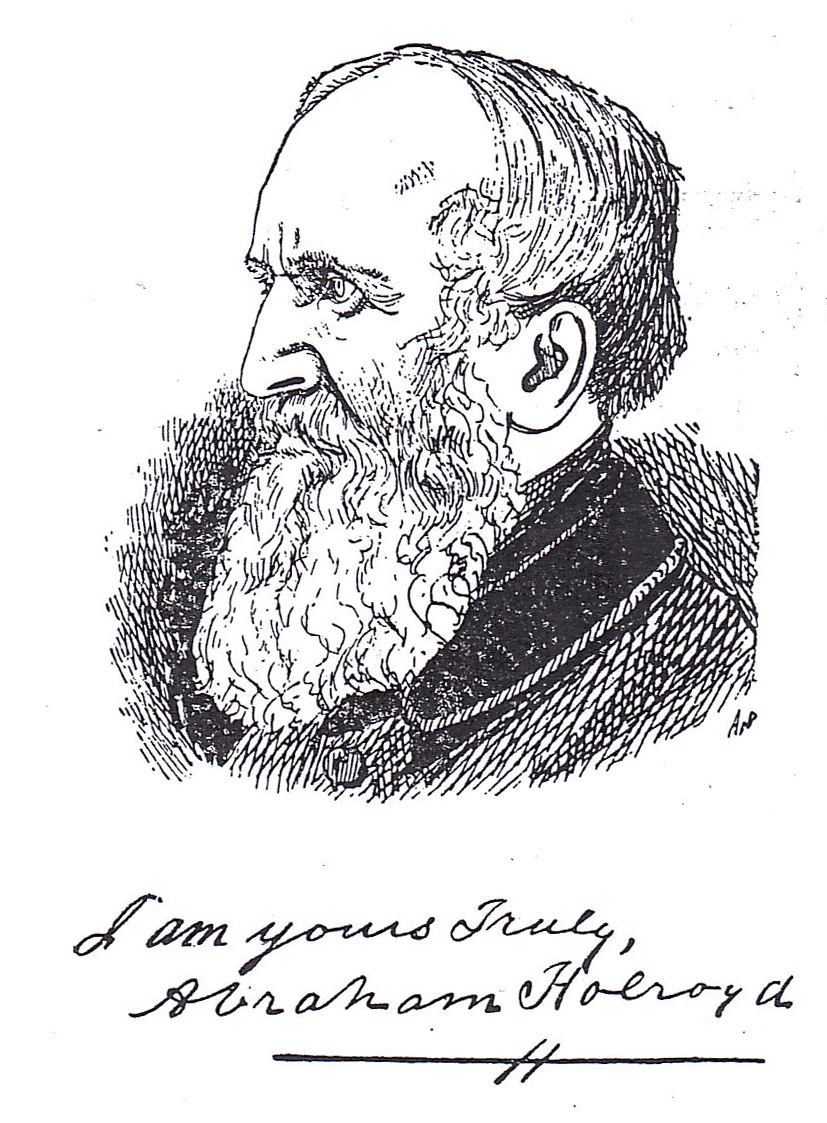
Compiler of the Almanac, Abraham Holroyd, was born in Clayton in April 1815, one of four children. His parents were both handloom weavers and the family were very poor. Self-educated, Abraham joined the army and saw service in Canada, hunting down rebels. He bought himself out of the army, settled in New Orleans, and married. After eight years in North America, Holroyd returned to England, setting up in business as a stationer and bookseller in Bradford’s Westgate. With the assistance of Titus Salt, Holroyd published a number of books on local history and become well-known in literary circles. He died in 1888.
We conclude this peek into 1864 Bradford with some entries from October:

  1. Sudden death in Bolton Road, Bradford, of John Howard, the pedestrian’
    Fire at Bank Mill, Morley, occupied by Mr. James Bradley; damages £2000.
    Luke Knowles, 24, carter, of Bingley, drowned by falling into the Bradford Canal at
    Spinkwell Locks.
    Gale on the East Coast and loss of life.
  2. Mortality of Bradford for the week ending this day, 90.
    William Frankland, 7. Of Lidget Place, Great Horton, killed by being run over by a
    contractor’s cart, in Beckside Road.
    Opening of a new school at Low Moor, erected by the Low Moor Company.
  3. Opening of new Independent Chapel and schools at Little Horton.
    18 John Egan, labourer, killed by being run over on the Midland Line, near Shipley.
    A resolution passed at the West Riding Sessions at Wakefield, pointing out the evils
    caused by the great increase of grocers’ drink licences, and asking that the
    magistrates should have the same control over those licences as they have over
    others.
    Laying of the memorial stone of a new United Methodist Free Church at Morecambe.
  4. Death of Professor Wheatstone, the inventor of the electric telegraph.
  5. Samuel Waite, lately manager of Messrs. W. H. Smith & Son’s bookstall at Keighley
    Station, sentenced at the West Riding Sessions to six month’s imprisonment for
    embezzling the moneys of his employers.
    Heavy gales and floods throughout England and Scotland.
  6. Opening of the winter campaign of the Liberation Society by a large meeting in St.
    George’s Hall, Bradford; addresses by Messrs. R. W. Dale and J. G. Rogers.
  7. Further gales and floods in the North and Midland Counties; great loss of life and
    destruction of property.
  8. Mortality at Bradford for the week ending this day, 102.
    The body of Henry Taylor, shoemaker of Cleckheaton, found in Bowling Tunnel
    Laying of the memorial stone, by the Rev. J. G. Miall, of the new Greenfield
    Congregational Chapel, Lumb Lane, Bradford.
  9. Visit of the Royal Italian Opera Company to Bradford.
  10. Explosion of an ammonia still at Messrs. T. Illingworth & Co’s chemical works, Frizinghall.

Stackmole

Treasure of the week. No. 33: The wild man of Cottingley : the wandering life of Jack Lob

‘A Sketch of the Life and Vagaries of ‘Jack Lob’ of Cottingley, near Bingley; a wandering beggar’, pages 10-16 in Interesting Interludes in the Singular Life of William Sharp, alias ‘Old Three Laps’. Printed by Thomas Harrison of Bingley, c. 1856. (Reference: JND 116/4)

mr-william-busfield-ferrand

The life of Jack Lob was a continual struggle for existence; want of instruction, deprived of his parents when young, and isolated from the working classes by his own indolence and partial insanity, he wandered from one place to another wherever he could pick up a penny of a crust of bread. In the cold nights of winter, in frost and in snow, he crept into old barns, mistrals, pig styes, under hay stacks, and into hedge row bottoms, with an empty stomach and scanty clothing.

John Robinson, better known by the name of Jack Lob, was born at Coppy Coppice, near Cottingley. His father was a soldier but died when John was young. “He was rather short, his physiognomy exhibiting a want of intelligence, having the appearance of an Ourang Outang or wild man of the woods.”

His friends persuaded him to take work in the various coal pits, where he could find employment as a drawer up of coals, but his long habits of vagrancy and mendacity led him to fall back again to his old course of begging, for he said he liked liberty with all its privations better than labour.

He was once confined, as he called it, in the Bastile, or Thackley Workhouse, where his wants were amply supplied but one night escaped though the closet seat. Efforts were made to find him and bring him back, but he managed to evade the vigilance of the parish officers.

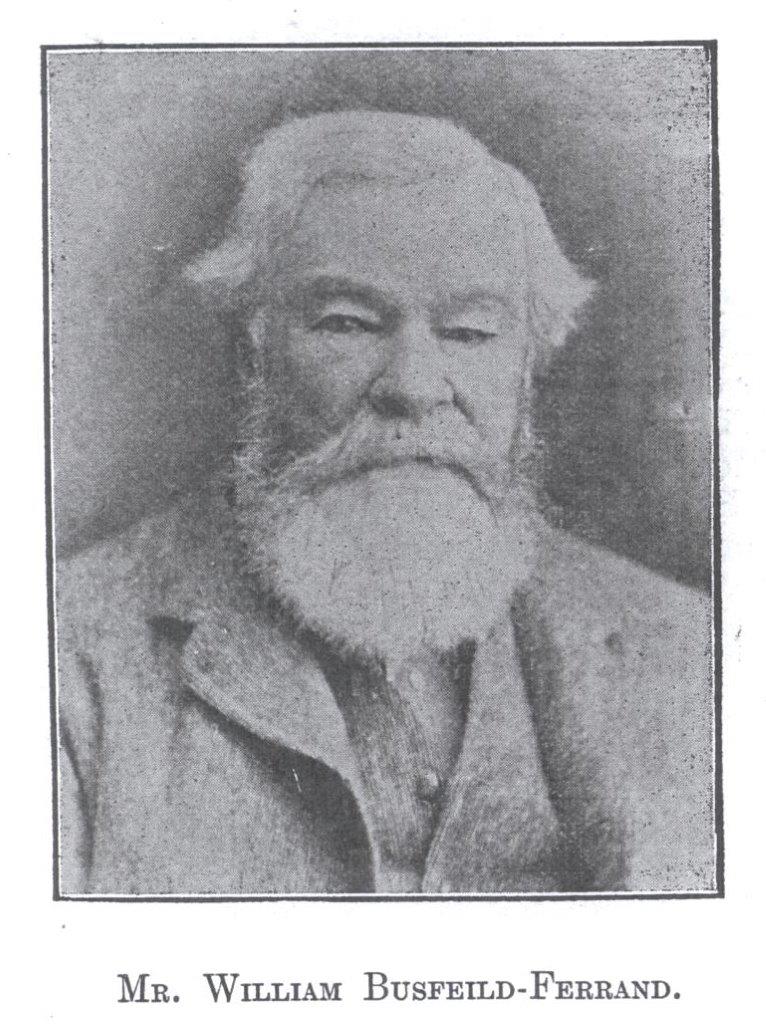
Some exploits of this wandering and homeless man are recounted in this tract, giving us, today, something of the flavour of a problem still with us. On his death, local landowner, William Ferrand, without being asked. generously made up what was necessary.

Stackmole

Treasure of the week no. 32: Old three laps and the 47 -year bed sulk

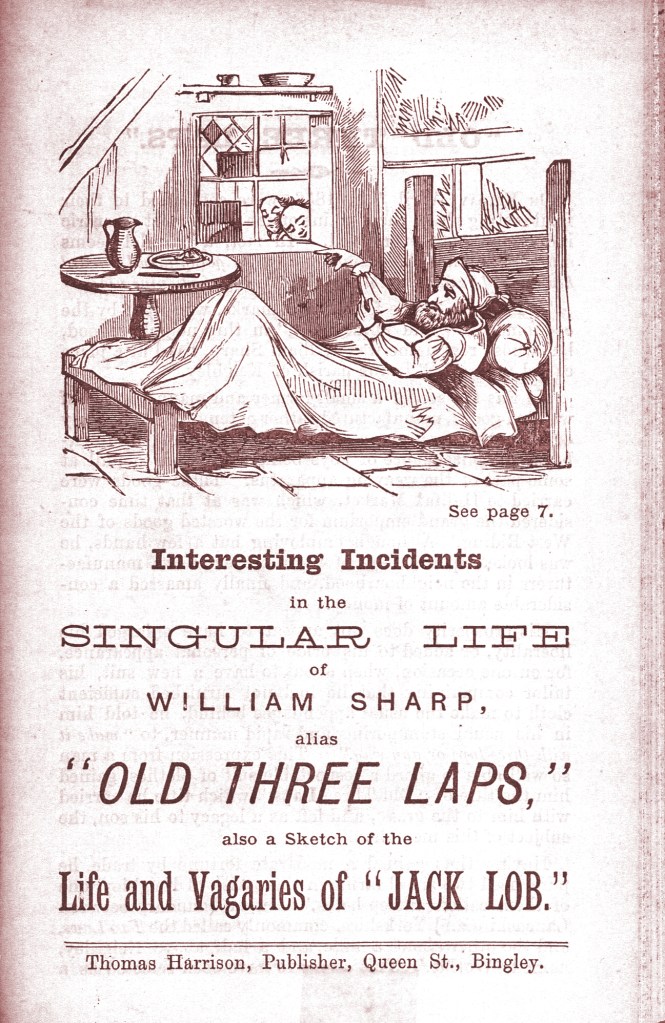
Interesting Interludes in the Singular Life of William Sharp, alias ‘Old Three Laps’.

Published by Thomas Harrison of Queen Street, Bingley, c.1856. 16 pages. No author is given. (Reference: JND 116/5)

On Friday, April 7th, 1856, were consigned to their final resting place, the remains of one of the most eccentric individuals that ever lived. In fact, a parallel seems scarcely possible, of a man voluntarily going to bed in good health, and remaining there for a period of forty-nine years!

‘Old Three Laps’ lived at a place called ‘Worlds’ in Keighley. His nick-name derives from an incident when a tailor was making his father a new suit, but had not been given sufficient cloth. He was told to “make it with three laps or any way.” The acquired nick-name was passed onto his son.

William lived a normal life, making a living manufacturing worsted goods and shooting birds by Keighley Tarn. In due course he fell in love with Mary Smith, daughter of a neighbouring farmer, by whom he had a son. William and Mary planned to marry but their fathers quarrelled over money, William’s father being notably mean with his money – as with the tailor. At the planned wedding, Mary failed to appear. This shook William:

He became moping and melancholy, abandoned his business and the spoils of his gun, and finally betook himself to that bed to which he clung to resolutely during the remainder of a long life. … He never spoke to the person waiting upon him. The only sign of intelligence he exhibited were those common to the brute, by taking his food, and hiding himself from intruders by covering himself with the bed clothes.

Word of this eccentric behaviour spread and visitors were attracted to his home, peering through his bedroom window. William ‘Three Laps’ Sharp, died aged 79.

Stackmole

Treasure of the week no. 31: The hermit of Rumbold’s Moor – the story of old job senior

Old Job Senior, the Rumbold’s Moor Hermit. An account of his Eccentricities & Remarkable Life. Printed and published by Thomas Harrison, Queen Street, Bingley. c.1880. 14 pages. No author is given. The account includes a verse ‘Elegy by Silas Cryer. (Reference: JND 116/4)

Old Job is dead, that droll old man,

   We ne’er shall see him more;

He used to wear a drab old coat.

   With buttons and bands before.

A low crowned hat, with brim much torn,

   To keep his old head warm;

His clogs were made of blocks of wood;

   His stockings straw and yarn.

So opens this account of Old Joe Senior, the Hermit of Rumbold’s Moor. The poem continues with another seven verses describing Job’s ragged appearance.  Here we content ourselves with the accompanying engraving, which is graphic enough!

            Job was not always so scruffy, or a hermit. “When young, he was a good-looking and spruce young man, employed amongst the famers in the neighbourhood, driving the plowing team, &c, and afterwards became a regular farm servant about Ilkley.”

            He later went to Whitkirk, near Leeds, where he courted a young woman, the result of which he became a father. The Parish authorities made him ‘pay the smart’, which cleared him out of money. The young woman later refused to have anything to do with him, probably because Job “… had already acquired indifferent habits, losing his sprightliness of appearance, and becoming careless and unsteady.” He returned to Ilkley, and continued as a farm labourer, and in winter, wool combing.

[He later] became acquainted with an old widow, living alone in a cottage near Coldstone Beck, Burley Wood Head, on the borders of Rumbold’s Moor … her little cottage stood within a small garden, she also claimed an adjoining field which had been left by her husband, and which he had taken from the common. Old Job again fell in love – if not with the widow, probably with her property.

Job and the widow, Mary Barret, married; she was eighty, he about sixty. After Mary’s death, catastrophe struck. Mary’s relatives determined to rid the old man off the property. Job resisted, but one day he returned to the cottage to find it in ruins. Job then built himself a sort of kennel with the largest of the stones from the rubble. “Here he lived for many years, forlorn, and poor, and miserable, in a place scarcely fit for a pig, and here he remained nearly to the time of his death.” He grew potatoes and other food on his land.

            Job, however, was a fine singer, able to sing ‘in four voices’ – alto, treble, tenor and bass – which he claimed to have learnt at the Leeds Parish Church. He went about the country in the winter season and sung at such places as Headingly Gardens, the Woolsorters’ Gardens in Bradford, and was once fetched to sing at the theatre in Leeds. Athough he was generally well supported, he would sleep in any outbuilding or smith’s shop.

Old Job died aged 77 and was buried in Burley churchyard.

Stackmole