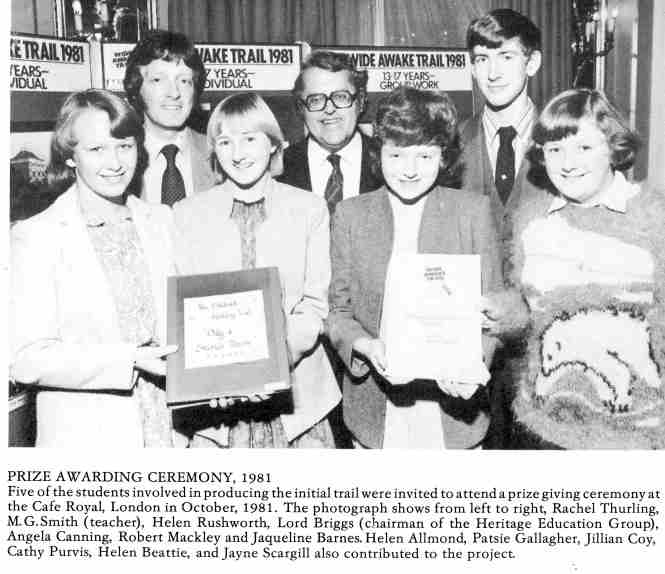
Image taken from the book ‘Oakbank History Trail’ © Maurice G. Smith
Keighley Boys’ Grammar School produced not one, but two, great historians in the early part of the twentieth century. Both were to have an impact on the study and philosophy of history and were to become amongst the most prominent historians of their day, their names were Asa Briggs and Herbert Butterfield (1900-1979). This blog concentrates on Lord Asa Briggs who sadly died last year and in whose honour the Historical Association have kindly donated a collection of books to Keighley Library, where the young Asa Briggs loved to study.

Asa Briggs, historian and public servant, was born in Keighley 7th May 1921. He was the son of William Walter Briggs, a skilled engineer and a good pianist. His mother, Jane, was the daughter of a greengrocer, who, prior to the depression, had been part of a small farming family in Yorkshire.
Asa initially attended Eastwood council school, followed by the school, said to have had the most influence on his development and future studies, the Keighley Boys’ Grammar School, adjacent to the old Mechanics’ Institute in North Street and opposite this library. He used this Carnegie public library, regularly. This is where he first learned to browse. Here too, amongst the newspapers in the reading room, and the large collection of books from the Philip Snowden collection that specialised in social economic and political interests, Briggs says that he studied the politics that he would later introduce to his own version of social history, (Special Relationships, Frontline Books , 2012, p.9).


Briggs enjoyed his school days at Keighley, especially his English and drama lessons with Kenneth Preston, of whom he speaks as the ablest of teachers. He seems to have made the most of his time there, becoming a school prefect and a member of a variety of societies including the Literary and Debating Society, the Stamp Society and the “Thirty- Three” Society. Despite a general love of history, Briggs in fact wanted to become a writer and, during this time at school, wrote poetry and various society reports for The Keighlian, the school magazine. However, another revered mentor at the school, the headmaster Neville Hind, did not favour the further study of English and encouraged students to pursue other subjects and to also try for his old Cambridge College, Sidney Sussex. Briggs was to adhere to this advice, so following in the footsteps of Herbert Butterfield from Oxenhope. By this time Herbert Butterfield was also lecturing at Cambridge. In 1944, Butterfield was elected Professor of Modern History, later Regius Professor and Vice Chancellor of Cambridge University from 1959-1961. He was knighted in 1968. On arrival at Cambridge, Brigg attended his lectures which influenced the young historian, (Special Relationships, Frontline Books, 2012 p.5).
In 1937, with war imminent, Briggs was accepted as a scholar by Sidney Sussex College, Cambridge at the very young age of 16. In Special Relationships, the tutor, James Passant, is quoted as saying, “You’re only a baby, Briggs – but since we are sure there is going to be a war, we would like you to complete your degree before you are called up for military service,”( p.68).
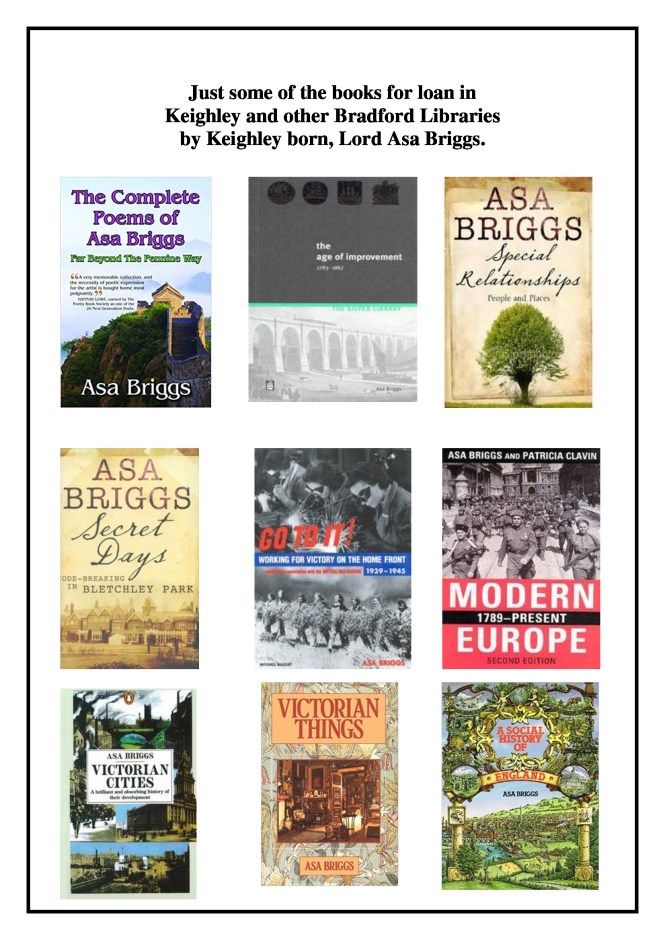
Briggs went on to achieve first class honours in History Tripos Parts 1 and 2. He also graduated from the London School of Economics before his call-up to the Army. He was posted to Bletchley Park as a cryptographer under Frank Adcock. He worked mainly on signals traffic from the Mediterranean using Alan Turing’s proto-computers (Bombes). These allowed them to read enemy signals. He also helped to dupe the Germans into thinking D-Day would not be carried out in Normandy. A full account of his life at Bletchley is given in the acclaimed book Secret Days Code-breaking in Bletchley Park (Frontline Books, 2011), available for loan in Bradford Libraries.
He left Bletchley for Oxford in 1944 where he became Fellow of Worcester College and his academic career began in earnest. His main areas of interest were the social and cultural history of the 19th and 20th centuries and the history of broadcasting in Britain. The following list is taken from the University of Sussex site: http://www.sussex.ac.uk
- 1944-1955 Fellow of Worcester College, Oxford
- 1950-1955 University Reader in Recent Social and Economic History, Oxford
- 1953-1955 Faculty Fellow of Nuffield College, Oxford
- 1953-1954 Member of the Institute for Advanced Studies, Princeton, New Jersey, United States
- 1954-1967 Deputy President, President of the Workers’ Education Association
- 1955-1961 Professor of Modern History, co-Head of the History Dept., Leeds University
- 1961-1967 Professor of History, Dean of the School of Social Studies, Pro-Vice- Chancellor, University of Sussex
- 1967-1976 Vice-Chancellor, University of Sussex
- 1976-1991 Provost of Worcester College, Oxford
- 1978-1994 Chancellor of the Open University
- 1988 A founder, first chair of the Commonwealth of Learning
Asa Briggs was also active in a very large number of societies:
- President of Haworth’s own Brontë Society and also of the following:
- Social History Society
- William Morris Society
- Victorian Society
- Ephemera Society
- British Association for Local History
- Association of Research Associations
He also served on a variety of committees:
- member of the University Grants Committee
- governor of the British Film Institute,
- a trustee of the Glyndebourne Arts Trust, the International Broadcasting Institute, the Heritage Education Group and the Civic Trust
- chairman of the Standing Conference for the Study of Local History, the European Institute of Education, the governors and trustees of the Brighton Pavilion, and the Advisory Board for Redundant Churches.
Briggs also undertook several public appointments: most notably chairing a committee on the future of nursing, which in 1972 recommended improvements in nurses’ pay and conditions and an overhaul of nurses’ training that were later accepted by the Conservative government.
To quote Tam Dalyell in the Independent, Wednesday, 16th March 2016,
“…his output in the written word, and in broadcasts and lectures, was awesome. It is doubtful whether Briggs ever spent a truly idle moment in his life.”
In fact, following his 90th birthday, he completed 3 books including Loose Ends and Extras in 2014.
Asa Briggs always kept in touch with Keighley and regarded himself as a “Lawkholme Laner”, (Keighley News 1930s Special, 16 February 1996). He was brought up in Emily Street, just off Lawkholme Lane.

In 1962, he became the first vice-president of the newly formed Friends of Cliffe Castle. He attended Old Keighlian reunions, and followed the developments of his old school. Keighley Boys’ Grammar School had been renamed Keighley School in 1964, when it became a County school, and it became known as Oakbank Grammar School in 1967. In 1982, Asa Briggs wrote the Foreward of the prize- winning, The Oakbank History Trail, published to commemorate the official opening of the new Oakbank school buildings. He had already attended the prize-giving ceremony in 1981 in London, as Chairman of the Heritage Education Group hosting the ceremony.
In 2015, Keighley Library was contacted regarding Lord Briggs’ time at Keighley Boys’ Grammar school and regarding the first poem that he ever had published, which was in the school magazine, the Keighlian’s December issue 1936, part of our own archive collection. The Complete Poems of Asa Briggs, was subsequently published in 2016 and it was a real privilege for Keighley Library staff to play even a minor role in this last published work of one of Keighley’s greatest sons.
Lord Briggs died at Lewes 15th March 2016, leaving his wife, also an historian, whom he married in 1955, (then Susan Banwell), four children and 14 grandchildren, to whom this last book is dedicated.
Gina Birdsall, November 2017