Christmas Day and the Keighley Stagecoach

By the nineteenth century, stagecoaches in England had been a vital part of its
infrastructure for nearly two hundred years. Though the steam train, at least in the south, was replacing the need for coaches by the 1830’s, they still remained an important mode of transportation and mail in the north.

Through donation, the Keighley Local Studies library has been fortunate to obtain the
records for the Keighley stage coach covering the years for 1841-1843. Opening the ledger a curious researcher will find the lined and long dried inked pages remarkably preserved.  Within its leaves, a pink piece of blotting paper remains where the clerk left it when it was closed nearly two hundred years ago.

Capturesc


The ledger for the stagecoach Invincible reveals that Keighley ran an active stagecoach
business running every day of the week, except Sundays, including Christmas Day.  One can imagine a jolly Dickensian coachman bundling his Keighley passengers into the Christmas coach and on to their holiday destinations. It is left to us today to wonder who they were, but there are clues in the ink:

25 December 1841 ‘Burnley, Wilde Ballet’…1842 ‘Leeds, Firth in’…1843 ’Blackburn, 1, Lady out.’
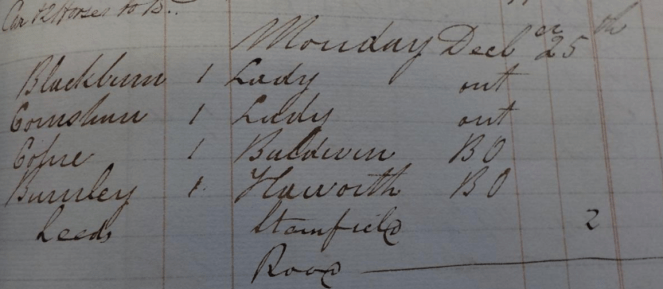
Capturelady

A look at the William White’s History, Gazetteer, and Directory of the West-Riding of
Yorkshire,
Vol. I reveals that in 1837, Keighley was running seven coaches: Union, Invincible, Airedale, Alexander, Tradesman, Wonder and Cars (690). All of these coaches had different departure points. The Union and Invincible, which the ledger is for, departed from the Devonshire Arms Inn.

Devonshire p2
devonshire photo

In order to learn about one’s family history, or lay groundwork for a period drama or novel, one might check records such as birth certificates, marriage licenses, censuses, or diaries, but what about stagecoach records? The study of such a resource would give valuable historical information about who may have lived and traveled through an area, where they traveled to and from or even where they sent their mail. This opportunity is not often possible because very few have survived until the 21st century; however, this rare insight is available at the Keighley Local Studies Library.

A perusal of its leaves reveal names still familiar in Yorkshire, such as Hargreaves, Ibbotson, Firth and Laycock, and those not as locally known, as Lomax, Mulligan, Brookslaw, and Critchley. There are surnames that we associate with the Brontës – Nichols, Earnshaw, Taylor, Greenwood, and Heaton – and names with famous or infamous associations, such as Grimshaw, Turpin, Shuttleworth and Dickenson. And what Lister rode to Bingley on Saturday the 12th of November, 1842?
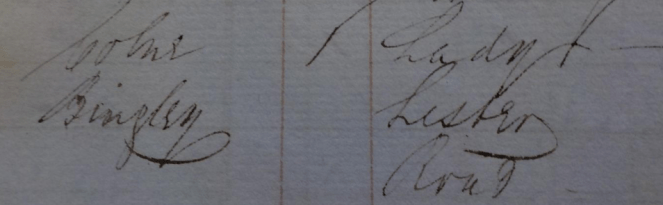
Capture3

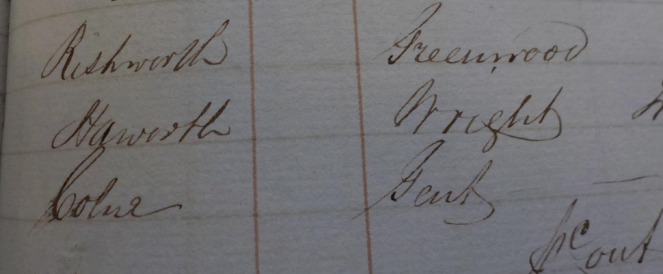
The titles and labels of the passengers given by the ledger keeper are also of interest. The
‘Sheriff for Colne’ rode on 30
th of June 1842. If the passenger was known, or perhaps
prominent, they might be titled, as Mr. Butterfield or Mrs. Hinchcliff were; but, if they were not, they might be labeled simply as ‘Lady’ , ‘Gent,’ ‘boy,’ or even ‘poor woman’ or ‘poor old man’.

The stagecoach places of originations or destinations to and from Keighley are impressive. These include the expected Yorkshire towns and villages, such as Cross Hills, Skipton, Harrogate and Wakefield, as well as Barrowford, Chorley, Colne and Preston in Lancashire.  Haworth is also mentioned (e.g. Monday 1st November 1841), but, alas, we are left to ponder who the passengers may have been. The places listed take in the cities of Leeds, York and Lancaster and extend as far west as Liverpool and east as far away as Scarborough. There is even a mystery destination called ‘Dolly’s’ the location of which is yet to be discovered (10 May, 23 June, 30 June 1842).

Keighley appears to have been quite a transportation hub in its day!

Miriam Adamson, Keighley Local Studies Library volunteer
Capture4

Celebrating Louise Carnegie

Thank you to Irene Lofthouse for her wonderful portrayal of Andrew Carnegie’s most trusted confident, his wife Louise Carnegie, in Keighley Local Studies library on Saturday 12th October, given to a packed audience. This event in our historic Carnegie library marked Libraries week and 100 years since the death of Andrew Carnegie in 1919.

Here are some photographs of the event and a short biography of Mrs Carnegie.


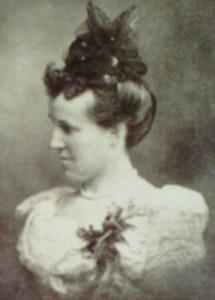
Louise Whitfield was born in Manhattan on March, 7, 1857. Her parents, John and Fannie, descended from families that emigrated from England in the 1600s… Louise’s father was a textile merchant. As he prospered he moved the family from Chelsea to Gramercy Park (where one of Louise’s playmates would be Teddy Roosevelt) and finally to a comfortable brownstone uptown on West 48 Street and Fifth Avenue—two blocks away from the Windsor Hotel. Andrew met John Whitfield through a mutual friend and enjoyed his company. He made frequent visits to the Whitfield home; during one of those visits, he met Louise.

Mrs Carnegie

Louise Carnegie

They shared a love of riding horses and he invited her often to Central Park. During these rides, she let it be known she didn’t want to marry someone who was already successful, but rather help a husband to succeed. He let it be known that he had no intention of holding on to his fortune, but rather wished to give it all away…

…Louise realized that Andrew would not marry while his mother was alive; four years after their meeting, the engagement was called off. But not the friendship. After nearly a year of corresponding, they decided to renew their engagement, but kept it a secret from Andrew’s mother.

Mr Carnegie

Andrew Carnegie

In the fall of 1886, Andrew contracted typhoid fever; inconceivably a week later, his brother Tom became ill with pneumonia. While Andrew’s condition fluctuated, Tom’s rapidly deteriorated and he died on October 19 at the age of 43, leaving behind a wife and nine children. Margaret, already ailing, could not bear the news of the illnesses of her two sons and died three weeks later on November 11 at the age of 77. She was not told of Tom’s death and Andrew was not told of his mother’s death for nearly three weeks until he was fully recovered.’ https://www.carnegiehall.org/Blog/2013

The couple married in 1887 and, unusual for the time, they signed a pre-nuptial agreement, in which Andrew stated that he wanted to give away the bulk of his fortune. They were married for 32 years, had one child named Margaret, and Louise was an influential member of the board of The Carnegie Corporation until her death in Manhattan on June 24, 1946, at the age of 89.

Outstanding community benefits for the time

Significantly, the Carnegie Institute in New York City hosted events and meetings for the American Women’s Suffrage Movement. Similarly the Carnegies’ libraries were accessible to both sexes, all classes and all ethnicities. In fact, the Carnegie Library in Washington was the first public building that was non segregational.

Keighley’s Carnegie Public Library

car

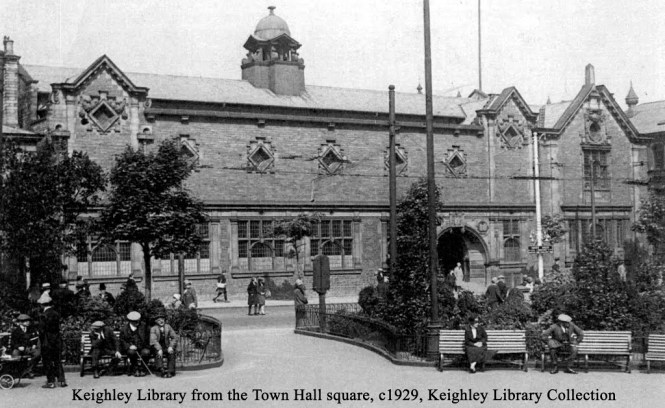
Mrs Louise Carnegie was also ever present as a guiding hand with the arrangements undertaken with Sir Swire Smith for the gift of £10,000 for the building of Keighley Carnegie Public Library. This was the first library in the whole of England ever to be financed by Andrew Carnegie. The money was gifted to the people of Keighley by the Carnegie family because of the wonderful achievements of Keighley’s students, from all backgrounds, studying at Keighley’s Mechanics’ Institute. In the above photograph, Mrs Carnegie is seated with Andrew on her right and Sir Swire Smith, the champion of Keighley Mechanics’ Institute on her left. Mrs Louise Carnegie later attended the ceremony with her husband for the conferring of the Freedom of Keighley to Mr Carnegie and it was she who distributed the prizes to the students on that day, 25th September 1900.

Keighley Library view c1929corespondence 1899

The Carnegie Corporation of New York

Andrew Carnegie established this in 1911,

“to promote the advancement and diffusion of knowledge and understanding,” it is one of the oldest and most influential of American grant-making foundations

“The Corporation has devoted unremitting effort toward the two issues Andrew Carnegie considered of paramount importance: international peace and the advancement of education and knowledge.”  https://www.carnegie.org/about/our-history

The Carnegie UK Trust

Established in 1913 by Scottish-American philanthropist Andrew Carnegie:

“We have sought to deliver this mission in a number of ways over the past 100 years – investing in libraries, public space, further education, social work, children’s rights, rural development and many more…”

https://www.carnegieuktrust.org.uk


Gina Birdsall, Keighley Local Studies Library

Official and administrative records for Keighley

Monday 3rd June – Friday 7th June was collections week at Keighley Local Studies Library to enable work to be carried out on the collections of Local Authority material held in the archives in particular the official and administrative records for Keighley.

Keighley Township initially consisted of a Select Vestry of Parish Officers who managed the Churchwardens, overseers of the poor, surveyors of highways, constables and collectors of Taxes.  By the 1820s this arrangement was inadequate and in 1824, by Act of Parliament, Keighley Improvement Commissioners were appointed for lighting, paving, cleansing, regulating and generally improving the town and from 1816, Keighley Water Works Company supplied water to many parts of it.  A gas works was built in 1825 to supply street lamps, 93 were lit in November 1825. Gas was also sold to mills and individuals.

The Local Board of Health, constituted in 1855, replaced the Water Works Company and the Improvement Commissioners and supplied the town with sewers, pavements, pure water and a gas works.  See the Local Board of Health Plan for 1870 in the library.

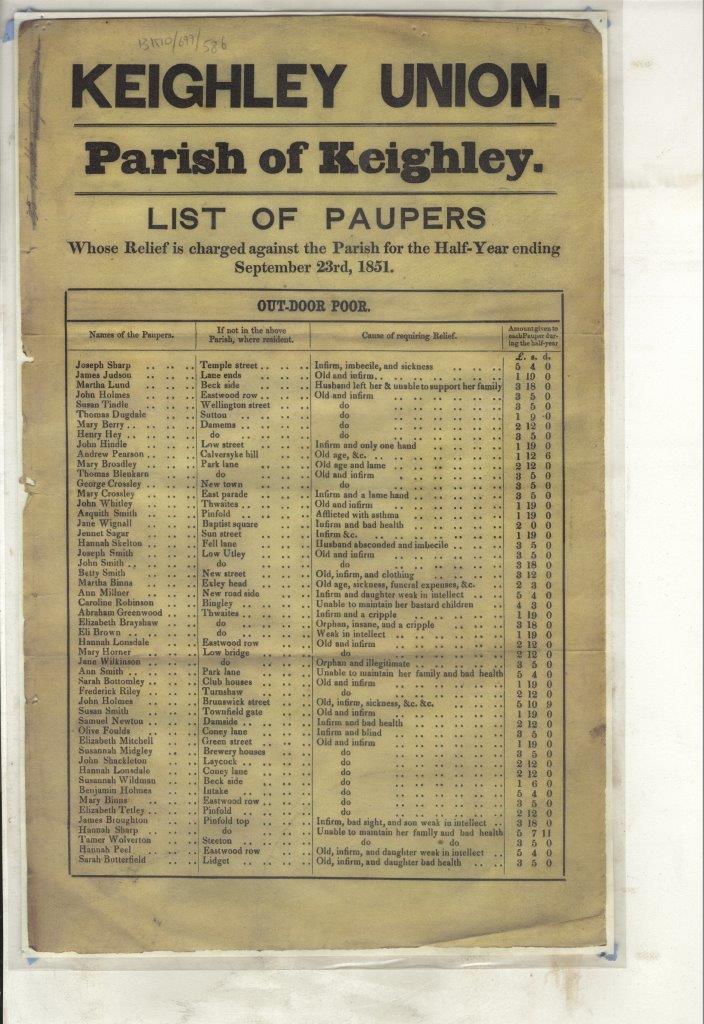
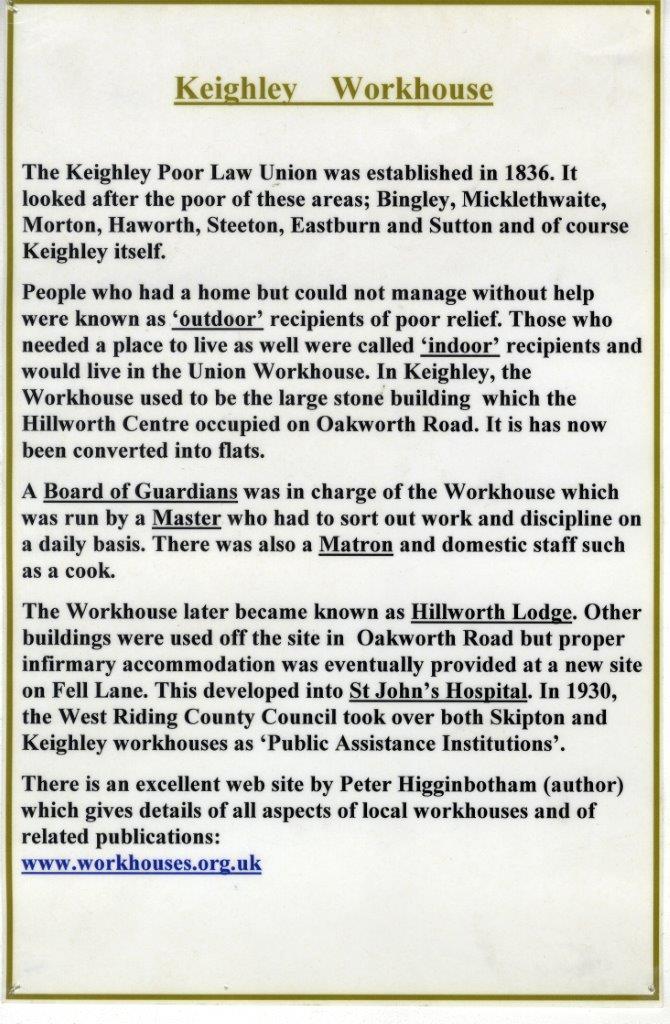
The Poor Law Union for Keighley was established in 1836 to administer to the poor instead of the Parish Overseers.  Keighley Union was governed by a Board of Guardians answerable to the central Poor Law Commission.  Keighley Library holds the records for the Keighley Union and also for the North Bierley Union, covering the Bradford area of administration.  Keighley town became a Borough under a Town Council in 1882.  It came under Bradford MDC in 1974.

Keighley Library holds Township records from the 17th century, Local Board minutes 1855-1882, Borough Council minutes 1882-1974 and many other related records including the minutes of individual committees, c1855-1949.  A full listing of these is available in the library.  The minutes for the Town Council from c1910 are available on open access in bound volumes, as are the accounts.  Individual committee minutes are kept in the archive.  Keighley Library also holds Keighley Rural District Council records and some Urban District Council records for Haworth, Oakworth, Oxenhope.

For further details of these unique and fascinating records, rich sources of historical information see our new leaflet ‘Official and Administrative Records for Keighley’

Official and Administrative Records for Keighley

Taking the stories of workhouse records to a wider audience

Thank you to Sylvia Valentine for contributing the following article about using the workhouse records held in Keighley Local Studies Library Archives.

I am a professional family historian and spend time researching in archives as I help people trace their ancestors and their stories.  This brings me into contact with a wide range of source material, including the various records held in Keighley Local Studies Library.  Amongst the amazing collection of records are a variety of records of Keighley Union and the North Bierley Union, perhaps better known as records of the workhouse.

Minute books of committee meetings might not strike many people as being very exciting, however, over the years I have found a number of fascinating stories about various people who came into contact with the workhouse, either as employees, suppliers, Guardians and of course the inmates. It has been my pleasure in recent years to talk about these stories and the wonderful record collections at various family history events both in England and Canada. When giving my talks, my aim is to encourage other family historians to find for themselves the stories of their own ancestors who might have a “workhouse connection”. The stories I have been able to research make wonderful examples of what can be done with just a few lines from a committee meeting minute book, and hopefully are a source of inspiration to others.

Sylvia Valentine
Recover Your Roots

From Charles Lubelski, author of Pride, Passion and Printing

Pride-Passion-and-Printing-cover-26-10-18

Although I was apprenticed and trained in Leeds as a compositor in the printing trade, like many of my peers, I was always interested in the legendary Bradford printing company Percy Lund Humphries. This was where the great Penrose Annual was printed and published. Each edition had fascinating articles about new technologies, new typefaces, articles about typographers and designers and new devices and machines which promised so much in the ever expanding world of the printing industry. And this remarkable printing company was based in the great city of Bradford.

Therefore, I suppose it is not surprising that when Professor Caroline Archer of Birmingham City University suggested that I write a book about PLH — I had no hesitation in accepting this invitation. It was to be a labour of love. Having spent all my working life in the printing industry I quickly realised that PLH was not the norm – it was the exception. Their philosophy was absolute quality and accuracy in every detail – the company was built on pride and passion – hence the title of my book: Pride, Passion and Printing.

For one hundred years Percy Lund Humphries was one of the world’s great printing establishments. The management and the craftsmen and craftswomen worked as a team for a common purpose – it was always quality first and financial gain second, perhaps an uncommon concept in current times.

I have tried to address social, economic, political, technical and artistic issues from an historic point of view supported where possible by illustrations. Technology and artistic endeavour are ever changing; both significantly affect in one way or another political ideas and economics of society. I leave it for others to explore this observation.

I am delighted that Bradford City Libraries have been displaying a number of the books printed by PLH. Bradfordians of today will get inspiration from this display and perhaps be encouraged to take their city forward with new ideas and new industries.

I personally would like to see a revival of design, typography, and the visual arts. PLH once produced the most beautiful art books – could this great city emulate its past masters?