Book Review: Percy Monkman – An Extraordinary Bradfordian

Percy Monkman – An Extraordinary Bradfordian. By Martin Greenwood. PlashMill Press (www.plashmillpress.com), 2018. 226 pages. Softback. A4 format. ISBN: 978-0-9572612-9-7. £24.49.

Available from Bradford Libraries

PM

A job in banking, a life in the arts.

The above quote from a section heading in this book neatly epitomises the life of Percy Monkman (1892-1986), a local celebrity in Bradford and the West Riding. He was born in Bradford and after spells as an office boy in Swan Arcade and Manningham Mills, and by another in army service (1915-19), Percy worked in Becketts Bank (which later became a branch of the Westminster Bank). He worked in the same bank for forty years, ending up as chief cashier. By night, at weekends, and on holidays, however, he was an entertainer, actor, cartoonist and watercolour painter of the Dales, the Brontë country and Bradford, whose work was acclaimed by the public and held in great respect by colleagues. He had many friendships, including a life-long one with near neighbour J B Priestley.

Percy came from a humble, non-conformist, working-class family in a closely-knit local community in the Toller Lane area of Bradford. Leaving school before he was fourteen, he received only a basic education. War service saw him develop his entertaining skills!  He joined the Bradford Civic Theatre in 1935 and was made a Hon. Life Member in 1974. He was the solo actor in The End, which was awarded one of the Ten Best Cine Films of 1960. His appearances on stage at the Bradford Civic Playhouse are listed here and we learn that from 1935 to 1958 he performed on 214 occasions in plays by such as Gogol, Ibsen, Shakespeare, Emlyn Williams, Christopher Fry, Jonquil Anthony, James Bridie and Priestley.

Percy was highly creative, talented and energetic, a man who achieved high standards in all his artistic activities. He joined the Bradford Arts Club in 1922, was Vice Chair in 1950, Chairman in 1963, and President in 1977. He won numerous prizes for his watercolours, many of which are reproduced here, and received commissions and made sales. He was also a member of the Yorkshire Watercolour Society.

In passing we note Percy’s family life – four brothers and three children; his friendships with lawyer Roger Suddards, artist Ashley Jackson, playwright J B Priestley and others; his dedication to his family with its trials and tribulations, and joys; and his passion for Bradford City FC (he was present at the Valley Road fire disaster). A nice feature is a chapter ‘Ten Perspectives of Percy’ which reproduces articles and letters about Percy from people who knew him, including the Branch Manager at the Westminster Bank (1952), an article in the Dalesman by Ken Feakes (April 1992), and family memories by his daughter, Dorothy (1990s).

This is a large book; not one to be read on the bus or propped up by the sugar bowl in a café. But in this case the extra size is used to good effect, giving the book a relaxed feel with the A4 pages facilitating a good-sized typeface and clear layouts, and, in particular, enabling justice to be done to the many excellent reproductions of Percy’s delightful landscape paintings. In all there are over ninety images. The book is superbly produced. There are several useful appendices including sources of further information and a timeline of Percy’s life with family information, lists of places where he lived, places of education and work, of his artistic achievements, and his appearances on stage at the Bradford Civic Playhouse: a veritable documentary history. The book is well-indexed. I was particularly pleased to see full credits given for the illustrations used and sources consulted, features often skimped. The author is one of Percy’s grandsons. The prose reads well, coverage is comprehensive, and browsing the book an enjoyable experience.

Bob Duckett

Retired Reference Librarian


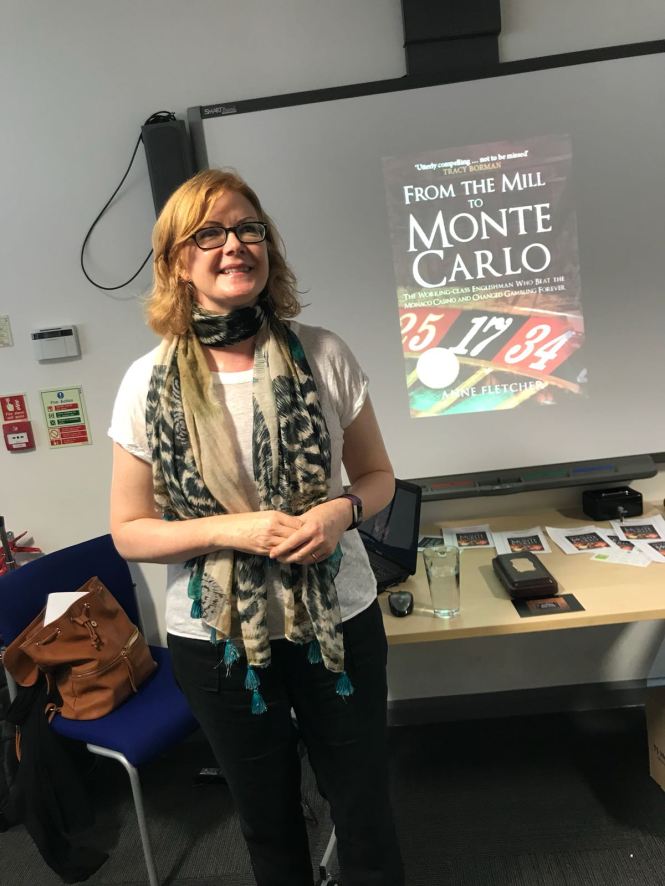
From the Mill to Monte Carlo: The Working-Class Englishman who Beat the Monaco Casino

Many thanks to Anne Fletcher for sharing the wonderful story of her great-great-great uncle Joseph Hobson Jagger in her fascinating talk in Bradford Local Studies library at Bradford Festival on Saturday.

Based on her newly published book, Anne told the story of a man who went from Bradford mill worker to Monte Carlo millionaire. Amongst the men ‘who broke the bank at Monte Carlo’, Joseph Hobson Jagger is unique. He is the only one known to have devised an infallible and completely legal system to defeat the odds at roulette and win a fortune. But he was not what might be expected. He wasn’t a gentleman or an aristocrat, he wasn’t a professional gambler, he was a Yorkshire textile worker who had laboured in the Victorian mills of Bradford since childhood.

Joseph Jagger was an exceptional man who travelled nearly a thousand miles to the exclusive world of the Riviera in a time when most people lived and died within a few miles of where they were born. The trains that took him there were still new and dangerous, he did not speak French and had never left the north of England. His motivation was strong. Joseph, his wife and four children, the youngest of whom was only two, faced a situation so grave that their only escape seemed to be his desperate gamble on the roulette tables of Monte Carlo. Today Jagger’s legacy is felt in casinos worldwide and yet he is virtually unknown.

In  this true-life detective story, Anne uncovers how he was able to win a fortune, what happened to his millions and why Jagger should now be regarded as the real ‘man who broke the bank at Monte Carlo’.

‘From the Mill to Monte Carlo’
By Anne Fletcher
978-1-4456-7139-0

20180714_140915

AFMill-to-Monte-Carlo

Book Review – Heraldic Shields in the Banqueting Hall of Bradford City Hall.

Heraldic Shields in the Banqueting Hall of Bradford City Hall. Researched and written by Janet Senior; window photography by Steve Reeder. City of Bradford Metropolitan District Council, 2016. 28 pages. £5.00. Available from City Hall Reception or from the author (janetsenior@googlemail.com)

Available from Bradford Libraries

Heraldic Shields

This slim booklet is a treasure; a full colour informative and beautifully produced treasure of local history. Heraldic shields may seem an esoteric subject for most of us, and the fact that so few people will ever get to see the ones featured here, high up in the exclusive City Hall Banqueting Hall, is a reason to ignore them. But the beautiful photography of Steve Reeder, and the informative prose of historian Janet Senior, make this an enjoyable browse.

This booklet, apart from a brief introduction, consists of 86 full-colour photographs of hand-painted glass windows in the form of heraldic shields, mostly the work of the stained glass relief artist Henry Gustave Hiller, which were painted at different periods in the early 20th century. Each shield represents the coat of arms of a prominent local personage or family, or in a few cases, a figure of early national importance. In the book, each image is accompanied by a brief note on the person or family concerned. Edmund Peckover, H W Ripley, Sir Henry Mitchell and Alderman W E B Priestley are examples of local persons of note; the Rawsons, the Peckovers and the Ferrands examples of prominent local families; while John of Gaunt, Phillippa of Hainault, and the Duke of Northumberland are examples of national figures. Janet explains that both John of Gaunt and Phillippa (wife of King Edward III) were both, for a while, owners of the Honor of Pontefract, of which Bradford was a part; while Bradford was part of the Percy ‘Fee’ in the 12th and 13th centuries (Percy being the family name of the Dukes of Northumberland). Less exotically, but maybe more usefully, we learn that Charles Harris, along with his uncle, Edmund Peckover, founded the Bradford Old Bank; that Roland Paley was an iron merchant who, with John Stranger, founded the Bowling Iron Works; and that the first Lord Cranbrook was the politician Gathorne Gathorne-Hardy, son of John Hardy, one of the owners of Low Moor Iron Works.

Janet found no trace of why or how these particular people or families were selected and ‘It is not clear if the heraldic shields actually belong to all the families represented.’ It seems, however, that the artist got the wrong shield for the Prince of Wales (that of the Stuart Prince of Wales rather than of the Prince and Princess of Wales who visited Bradford in 1904)!

This is an attractive booklet of great interest. All profits will go to the Lord Mayor’s Fund.

Bob Duckett

Book Review: Punjab to Bradford: Life Stories of Punjabi Immigrants in Bradford

Punjab to Bradford: Life Stories of Punjabi Immigrants in Bradford. By Ramindar Singh and Kashmir Singh Rajput. Privately published (ramindar.singh@ntlworld.com), 2013
204 pp.  ISBN: 978-0-907734-71-10.  £10.00.

Available at Bradford Libraries

Dr Ramindar Singh MBE

This book presents the lives of 44 Punjabi migrants who came to Bradford in the 1950s and made the city their home. With only a few pounds to their name they came here with great hopes and some with good academic qualifications. They were obliged at first, however, to take up unskilled work on the buses, in mills and foundries, finding their qualifications were not recognized in Bradford. They suffered much discrimination too, until opportunities arise where they could use their knowledge and skills more appropriately.  Local colleges, particularly Bradford Technical College, played a significant role in making this transition possible. It was good to find, too, that most of their children became well-qualified and successful in their occupations. As seen with other migrant groups, early arrivals often gave room in their homes to new arrivals, in spite of difficulties it caused. This of course had a substantial effect in promoting community cohesion. The reunion of families when wives came to join their husbands and find work themselves outside the home, must have contributed significantly towards social mobility of their families.

This book gives personal accounts of how the early Punjabi immigrants in the 1950’s coped with their frustrations, humiliations and discrimination.  After an editorial introduction explaining how the book was compiled, there follows an account of the Punjab and reasons of why migration occurred, and its process.  An account is then given of the development of the development of the Punjabi community in Bradford.  The main part of the book contains the stories of individuals who left their homes and families in the Punjab during the 1950s through 1970s to seek their fortunes in vilayat (England).  At the conclusion of these accounts there is a chapter entitled: Reflections of life through Mehfil (informal gatherings). Topics covered here are: Community spirit and mutual support; Understanding local people; Learning new work norms; Duality of conduct; Life in a male dormitory; Entertainment; Women’s position and experience; and Utopian Vilayat vanished.  Finally there is a useful Glossary of Punjabi words and phrases.

In their Conclusion, the compilers note how the Bradford that the 1950 pioneer migrants experienced is no more, and that their children and grandchildren experience a very different world. Reminiscences such as those here are important in keeping the heritage alive. Something, of course, which is true of all cultures, whether migrant (from overseas or other parts of Great Britain ) or even non-migrants. This book is a valuable contribution to Bradford’s social history.

Dr Singh is a former Bradford College lecturer, JP, and deputy chairman of the Commission of Racial Equality. He is author of The Struggle for Racial Justice: From Community Relations to Community Cohesion in the Story of Bradford 1950-2002. K.S.Rajput was a senior education officer with Bradford Council. Bob Duckett

Review reprinted from the Bradford Antiquary, 2016, courtesy of the Bradford Historical and Antiquarian Society.


Book Review – Windyridge: A Classic Yorkshire Novel

Windyridge: A Classic Yorkshire Novel by Willie Riley; with a new introduction by David M. Copeland. Northern Heritage Publications, 2010. 62 + 245 pp. ISBN 978-1-906600-18-1 pbk; 978-1-906600-34-1 hdbk.

Available at Bradford Libraries

windyridge

Windyridge was a sensation when first published in 1912. Written as a story told to two motherless girls he and his wife had befriended, they badgered him to send the script to a publisher. This he did, and struck lucky, very lucky. Featuring a cast of Yorkshire characters as well as locations based on real West Yorkshire moors and villages, Windyridge sold some half a million copies, remaining in print until 1961, with Riley becoming a household name.

This iconic novel has now been reprinted in an elegantly produced edition with a new introduction by Riley scholar, David Copeland, giving an account of the author’s life. Riley’s text has been reproduced in its entirety, including the photographs of the Yorkshire landscape that appeared in the original book.

When the book was published in 1912, Riley had been Managing Director for fourteen years of the Bradford-based firm of Riley Brothers Ltd., an innovative company hiring and selling optical lantern slides and the associated equipment, including an international mail order business.  This activity was but part of the family business activities, all of which had been established by Willie’s father, Joseph, who had gone into business on his own account as a stuff merchant.  Riley junior was also a major figure in northern Methodism, being an active and sought-after local preacher, as well as a popular speaker on a variety of subjects.  He had never intended to become an author, and although not writing his first, Windyridge, until he was 46, by the end of his life in 1961 he had written a total of 39 books, selling a total of over a million copies.

The storyline is simple and straightforward: Grace Holden, a single lady of thirty-four, left London where she worked, and rented a cottage in ‘Windyridge’ (based on Hawksworth) to experience the country life and ways of a small Yorkshire community. Grace gets to know the district, including the nearby communities of Marsland (Baildon), Fawkshill (Guiseley), Romanton (Ilkley), the cities of Airelee (Leeds) and Broadbeck (Bradford), and the famous Uncle Ned’s inn (Dick Hudson’s).  The tone of the novel is homely and positive, with a strong Christian ethos.  Windyridge was followed at almost yearly intervals by books in similar vein.

Copeland’s extensive 62-page introduction is based on his Master’s thesis for Bradford University. It covers the genesis of the story; the importance of location and Riley’s pen-portraits; an extensive account of the reviews and the reception of the novel; the innovative marketing of Windyridge by publisher Herbert Jenkins (whose first book it was); the consequences for the village of Hawksworth; Riley’s early history and his career change on joining the literary world; his family life and his later years.  I would have welcomed a list of Riley’s other books and something about them, perhaps at the expense of the numerous reviews of Windyridge, but we welcome back into the public domain this popular author, and hope for more Riley reprints.

Bob Duckett

Review reprinted from the Bradford Antiquary, 2016, courtesy of the Bradford Historical and Antiquarian Society.