From Charles Lubelski, author of Pride, Passion and Printing

Pride-Passion-and-Printing-cover-26-10-18

Although I was apprenticed and trained in Leeds as a compositor in the printing trade, like many of my peers, I was always interested in the legendary Bradford printing company Percy Lund Humphries. This was where the great Penrose Annual was printed and published. Each edition had fascinating articles about new technologies, new typefaces, articles about typographers and designers and new devices and machines which promised so much in the ever expanding world of the printing industry. And this remarkable printing company was based in the great city of Bradford.

Therefore, I suppose it is not surprising that when Professor Caroline Archer of Birmingham City University suggested that I write a book about PLH — I had no hesitation in accepting this invitation. It was to be a labour of love. Having spent all my working life in the printing industry I quickly realised that PLH was not the norm – it was the exception. Their philosophy was absolute quality and accuracy in every detail – the company was built on pride and passion – hence the title of my book: Pride, Passion and Printing.

For one hundred years Percy Lund Humphries was one of the world’s great printing establishments. The management and the craftsmen and craftswomen worked as a team for a common purpose – it was always quality first and financial gain second, perhaps an uncommon concept in current times.

I have tried to address social, economic, political, technical and artistic issues from an historic point of view supported where possible by illustrations. Technology and artistic endeavour are ever changing; both significantly affect in one way or another political ideas and economics of society. I leave it for others to explore this observation.

I am delighted that Bradford City Libraries have been displaying a number of the books printed by PLH. Bradfordians of today will get inspiration from this display and perhaps be encouraged to take their city forward with new ideas and new industries.

I personally would like to see a revival of design, typography, and the visual arts. PLH once produced the most beautiful art books – could this great city emulate its past masters?

Charlie Bhowmick MBE presents his recently published book ‘From Calcutta to Keighley’ to Keighley Local Studies Library

On Friday December 7th Keighley Local Studies Library was very pleased to formally receive copies of the book ‘From Calcutta to Keighley’ presented by the author, Charlie Bhowmick MBE.

Charlie is a well known character in Keighley. He was born in Calcutta and in 1954 at the age of 17 he followed his older brother to Keighley, where he was given a job at George Hattersley’s engineering business, now Mantra House. He served an apprenticeship with the company and studied mechanical and electrical engineering and later building construction at Keighley Technical College. Charlie went on to study planning and became a town planner with Bradord Council until his retirement in 1994.

Over the years, Charlie has been involved with many local initiatives and organisations including

  • Airedale Hospital Radio
  • The annual Temple Street Edwardian Fair
  • Community Personality of the Year
  • Keighley Community Cricket
  • Governor of Parkwood School
  • Temple Street Methodist Church and overseas movements Community Harmony Award, Bradford Council Marathon running for Keighley Disabled

In 2005 Charlie received the MBE for his work with the Keighley Inter-Faith Group.

Here is an extract from the book:

‘I discovered Keighley Library in 1955, a year after I arrived in Keighley. I met Mr Dewhirst in the Reference Library section on the first floor. He gave me a warm welcome and showed me a desk in the Reference Library where I could undertake my studies. This was very welcome given the cold conditions in my lodging house in Beechcliffe.

I found all the various books I needed for my course at the library and soon became a regular visitor, so much so, I got to know the staff there very well – Ian and also Molly Boulton (Ian Dewhirst’s deputy). I enjoyed the facilities of Keighley Public Library (and its warm temperatures) for about 6 years until I got married and moved into a warm flat on Devonshire Street.’

The book is a great read and reflects Charlie’s irrepressible character with proceeds going to Yorkshire Cancer Research.

BRANWELL BRONTË’S PUBLISHED POEMS

Branwell was the second best poet in the Brontë family and some of his poems are worth studying in their own right.
(Tom Winnifrith in The Poems of Patrick Branwell Brontë)
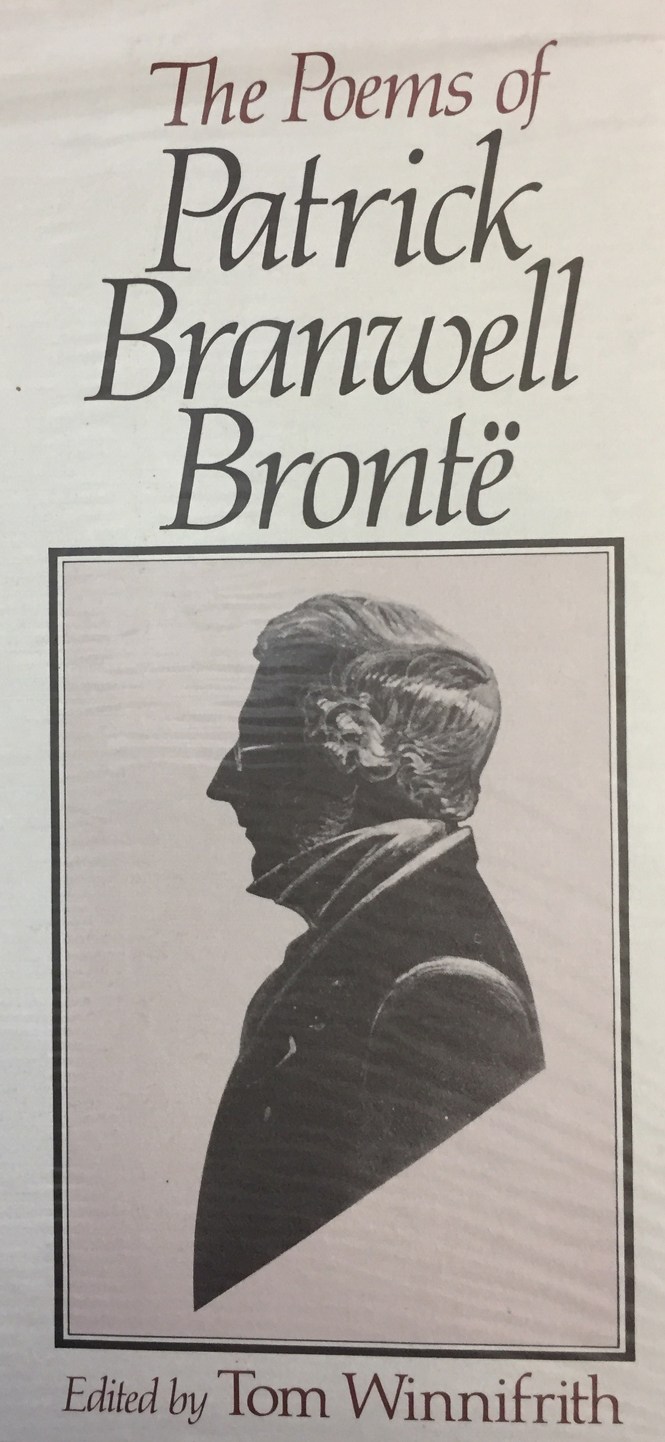
Winnifrith

The year 2017 was the bi-centenary of the birth of local lad, Branwell Brontë, born Thornton 26th June 1817. It was also the year that Routledge published the three-volume complete literary works of Branwell Brontë, which the Library purchased for Keighley’s Brontë Collection.

Like his sisters, Branwell Brontë wanted to be a published writer and thanks to the local newspapers, he succeeded. Indeed, Branwell was a published poet five years before his sisters published their book of poems in 1846 and their first novels a year later. In all, eighteen of Branwell’s poems are known to be published in his lifetime (1817-48), the last just six months before the publication of Jane Eyre in October 1847, and six published a second time in other newspapers. “Given that his sisters’ 1846 volume of poems sold only two copies in its first year, it is safe to say that Branwell’s poems enjoyed significantly wider readership.” (Neufeldt, v.3., p. xx)

All Branwell’s poems were published pseudonymously under the name ‘Northangerland’ except one, which was just signed ‘PBB’. Thus at no time did Branwell’s name appear in print. Why this is so remains a mystery. What is also a mystery is whether his sisters knew of his success. Getting poems published in local newspapers was no easy achievement at that time. There was great competition between newspapers and it is to Branwell’s credit that not only was his work accepted, but also reprinted in rival newspapers.

It has taken a long time for the full extent of Branwell’s poetic success to be realised. In Winnifrith’s edition of Branwell’s poems published in 1983, he wrote that the poem ‘The Afghan War’ was “the only composition of Branwell’s which is known to have been printed during his lifetime.” (p.140). Yet only fourteen years later, Professor Neufeldt, in the US edition of The Works of Patrick Branwell Brontë 1837-1848 (the Routledge edition noted above is a UK reprint) noted twenty-six publications.* More remarkable was the re-discovery, reported in 1999 by Professor Neufeldt, in the Halifax Guardian for October 1847, of an outstanding piece of art criticism on the illustrator Thomas Bewick by … ‘Northangerland’! This, plus Branwell’s success as a published poet, not to mention the mass of his hitherto unpublished writings now made accessible, has caused scholars to modify the hitherto largely negative view many had of Branwell.

With the acquisition of his complete works by the Library, we can now read for ourselves Branwell’s writings, published and unpublished. Listed below are his published poems (together with the page numbers in Volume 3 of Neufeldt’s edition).

‘Heaven and Earth’   Halifax Guardian, 5 June 1841 (p. 335)

‘On the Melbourne Ministry’   Halifax Guardian, 14 August 1841 (p. 340)

Sonnet I: ‘On Landseer’s Painting’   Bradford Herald, 28 April 1842 (p. 365)

Sonnet II: ‘On the callousness produced by cares’   Bradford Herald, 5 May 1842

also Halifax Guardian 7 May 1842 (p. 366)

‘The Affghan War’   Leeds Intelligencer, 7 May 1843 (p. 367)

Sonnet III: ‘On Peaceful Death and Painful Life’   Bradford Herald, 12 May 1842

also Halifax Guardian 14 May 1842 (p. 369)

‘Caroline’s Prayer – On the change from childhood to womanhood’   Bradford Herald, 2 June 1842

also Halifax Guardian 4 June 1842 (p. 370)

Song: ‘Should Life’s first feeling be forgot’   Bradford Herald, 9 June 1842

also Halifax Guardian, 11 June 1842 (p. 371)

‘An Epicurean’s Song’   Bradford Herald, 7 July 1842

also Halifax Guardian, 9 July 1842 (p. 372)

‘On Caroline’   Bradford Herald, 12 July 1842

also Halifax Guardian, 14  July 1842 (p.374)

‘Noah’s Warning over Methuselah’s Grave’   Bradford Herald, 25 August 1842 (p. 375)

‘On Landseer’s Picture: The Shepherd’s Chief Mourner ‘ A Dog Watching alone by his master’s grave’   Yorkshire Gazette, 10 May 1845 (p. 407) Revision of Sonnet 1, above.

‘Black Comb’   Yorkshire Gazette, 10 May 1845 (p. 408)

‘The Emigrant – Two Sonnets’   Yorkshire Gazette, 7 June 1845 (p.406)

‘Real Rest’   Halifax Guardian, 8 November 1845 (p.471)

‘Penmaenmawr’   Halifax Guardian, 20 December 1845 (p. 473)

‘Letter from a Father on Earth to his Child in her grave,   Halifax Guardian, 18 April 1846 (pp. 479-80)

‘Speak Kindly’   Halifax Guardian 19 September 1846 (p. 512) The authorship of this poem is disputed.

‘The End of All’   Halifax Guardian, 5 June 1847 (pp. 504-508)

Also: ‘Thomas Bewick’ [Prose review article] Halifax Guardian, I October 1842 (pp.397-400)

Branwell died in Haworth on 24th September, 1848, aged 31.
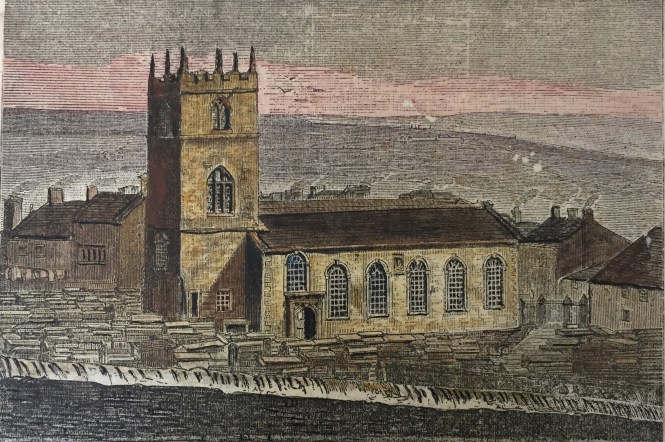
Haworth Church (Before it was rebuilt)

While no great claim can be made for the excellence of Branwell’s poems, they are no worse than many others that were published in the newspapers of the time, and some were considerably better. They range from comments on the political events of the day such as the introduction of the self-adhesive postage stamps and the First Afghan War, to the heartbreak of child deaths – a frequent occurrence in the Haworth of Branwell’s time.

Branwell’s habit of using a pseudonym once caused Library staff a problem when an Australian professor wanted photocopies from the newspapers themselves. She gave us precise references and we managed to find the poems in the Halifax Guardian, Yorkshire Gazette and Leeds Intelligencer, but annoyingly, not in the Bradford Herald, which the library did not have.  A request to the British Library Newspaper Library was returned ‘No Trace’ despite being given the correct dates and page numbers. The reason? We gave the poet as ‘Patrick Branwell Brontë’, whereas the poet’s name in the paper was … ‘Northangerland’!

Bob Duckett

*Neufeldt states that there were 26 publications, though I can find only 24. BD

Selection of Bronte books inKeighley Local Studies Library

Book Review: Bradford in 50 Buildings. By George Sheeran

Bradford in 50 Buildings. By George Sheeran. Amberley Publishing, 2017. 96 pp. ISBN: 978-1-4456-6848-2 (print); 978-1-4456-6849-9 (ebook). £14.99.

George Sheeran book

Available from Bradford Libraries

George Sheeran should be known to all students of Bradford history, and probably is. A steady stream of books, articles and talks, not to mention his work at Bradford University’s Pennine Studies Centre, all testify to his long involvement in this area.1

Bradford in 50 Buildings explores the history of Bradford through a selection of its buildings, not just the better-known iconic public ones, but from all social levels and cultures. Yes, City Hall, the Cathedral, Wool Exchange and the Alhambra Theatre are here, but so are mills, schools, churches, mosques and terrace houses. The focus of the book is more on illustrating the diverse history of Bradford through its buildings than a straightforward architectural narrative. The buildings are all present today: this is Bradford as we see it now. History is all around us. We are looking at it, but what do we see?

The book features just over a hundred coloured photographs of high quality interspersed with prose commentary highlighting the architectural features and giving historical background of the fifty selected buildings. There is a succinct introduction giving context and background to Bradford’s history and a delightfully clear map showing where the buildings are.

Here we have Cotton Weavers’ Cottages in Little Horton Green (testament to the cotton industry), cottages in Dracup Street, Great Horton (characteristic of Bradford’s early nineteenth century industrial development) and mill workers’ terraces in Gathorne Street; on the educational front we have Feversham Street School (built in 1873, with a discussion of the advent of Board Schools), Bradford College (with both the original 1883 building and the striking multi-coloured façade of the new Hockney Building) and Dixon’s Trinity Academy (a 1994 example of post-modernism); industrial buildings include Manningham Mills, Canon Mill and Mitchell Brothers (Bowling Old Lane), while the Midland Hotel, Yorkshire Penny Bank and the red brick Prudential building in Sunbridge Road are other examples of commercial buildings; Churches and mosques are well represented, plus the Hindu Temple in Leeds Road and the Bradford Reform Synagogue in Bowland Street. Council flats (Longlands), large houses (e.g. Bolling Hall), public buildings (e.g. Cartwright Hall, St George’s Hall) and a public house (Shoulder of Mutton, Kirkgate) are some of the other types of building in the author’s selection.

Not all the buildings selected are beauties. High Point, the former Yorkshire Building Society tower in Westgate is ‘the city’s outstanding piece of brutalist architecture … Its walls of corrugated concrete provide a texture … that gives the building more the feel of a piece of urban sculpture’  (plus note on the rise of building societies), the Margaret Macmillan Tower (with a note on Stanley Wardley’s plan to modernise the city and provide a trouble free flow of traffic); and the old  GPO Telephone Exchange (superficially a boring modern cube – but is a much under-rated style of the 1930s ‘stripped classicism’). Yet the author is quick to point out unusual features which will encourage us to take a second look. Thus, ‘ … the Margaret Macmillan Tower … seems just another tower block at first sight, but look again. It rests on a rustic base of slate and rises clad in Portland Stone as a chaste block overlooking the city centre. The stanchions (the vertical members) are also clad in slate producing a fine counterpoint to the Portland stone.’ Indeed, with informed architectural analysis to guide us, together with an equally informed historical background, we see Bradford with new eyes. A wide variety of eras, styles and innovative features are covered. Students of architecture will value these accounts.

Omissions? Of course there are. Magistrates Courts? Transport Interchange? Paper Hall? The Bradford Club? Bradford has far too rich an architectural heritage to be limited to a mere fifty. Maybe the author could be persuaded to do another fifity!

Sheeran wears his learning lightly: we are in the hands of an experienced and knowledgeable teacher. We are not swamped in technical terms yet learn a lot. One grouse I have is that the Contents listing omits the page numbers to the fifty listed buildings, so that I was for ever hunting for page numbers using the entry numbers!         There is no index, though the contents page is detailed.

Two final points. ‘It may seem strange in a book about the architectural riches of a city to show a derelict industrial site, but this one is important for two [historical] reasons.’ (p. 57) The site is that of the Providence and Thompson Mill sites just up from the Alhambra Theatre and the reasons are given, which lead on the second point: ‘This is a sensitive site given its historical provenance. Recent fires in derelict mill buildings and resulting demolitions provoke debate about the future development of the area, and invidious decisions that will need to be taken.’ (p. 58) ‘Let us not make the mistakes of the past.’ pleads the author. Amen to that!

Enjoyable and informative. Essential reading for Bradford city planners and their favoured architects!

(Bob Duckett)

1 Books such as Brass Castles: An Illustrated Guide to the City’s Heritage (1993); The Victorian Houses of Bradford (1990); The Buildings of Bradford: An Illustrated Architectural History (2005); Good Houses Built of Stone: The Houses and People of Leeds/Bradford 1600-1800 (1986); The Mosque in the City: Bradford and its Islamic Architecture (2015).

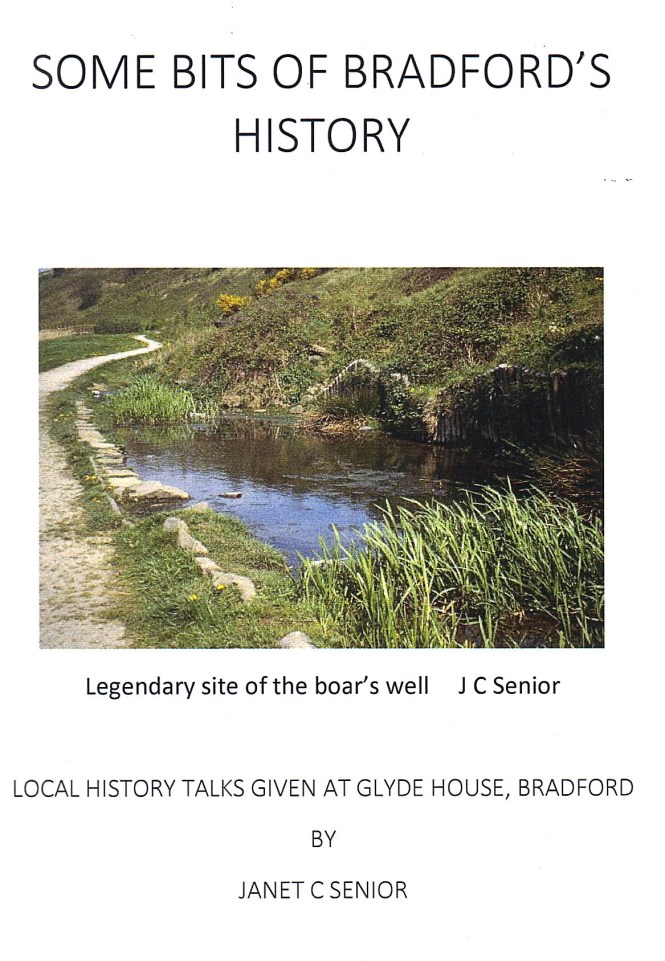
Book Review: Some Bits of Bradford: Local history talks given at Glyde House. By Janet C. Senior

Some Bits of Bradford: Local history talks given at Glyde House. By Janet C. Senior.

Published by Bradford Historical & Antiquarian Society, 2018. 112 pp. ISBN: 978-1-9996419-0-0. £7.99.

Reserve a copy  from Bradford Libraries

We are pleased to welcome this attractive little book based on talks given by local historian Janet Senior. Retired teacher and volunteer archivist Janet has gathered quite a following for her monthly talks on local topics at Glyde House in Bradford, and now a wider public can enjoy a selection. Nine of the talks are featured here augmented by photographs from a variety of sources, new and old, and some drawings by Mary Tetlow.

Starting with the Legend of the Boar of Bradford we progress to the history of the Established Church in Bradford from the 7th to the 17th century, and on to Jonathan Glyde. The legend of the boar is well known, but, as with all these chapters, Janet’s knowledge and enthusiastic research into the archives and her skill at presenting complex subjects borne of her many years as a teacher, will provide much that is new to all. The topics will be sure to interest and enthuse newcomers, young and old. Thus the legend of the boar is set against the earlier, and later, history of Bradford; the history of the established church is made clear and interesting; while Jonathan Glyde (1808-1854) emerges as a profoundly influential figure in the development of Bradford and whose importance has hitherto been poorly recognized.

Charles Samuel Joseph Semon is another of those influential Bradfordians who have found a champion in Janet. Like Jonathan Glyde, he did much to improve the conditions of the populace, and in an aside, we learn that Janet was born in the Semon Nursing Home in Ilkley. Bradford and the Parks Movement is another slice of Bradford history brought to life as public-spirited civic leaders sought to improve the lot of the town’s population. Returning to religion, Janet gives an account of the 1851 Religious Census and what it revealed of worship in Bradford, in particular the decline of church attendance, the strength of non-conformity, and how social life was changing.

Nowhere was this more evident than in the long-standing debate over education, where the National Schools (Anglican based) and British Schools (Non-conformist supported) debated, a debate which local MP, W E Forster, endeavoured to end with his 1870 Education Act. A nice touch in this book is the author’s personal interest in these many subjects. Here, as a teacher, Janet wanted to know why the structure of the school system was so confused and hoped to find out by going back in time by trawling the archives. The Early Years of the Bradford School Board is the result. The chapter on Youth Offenders in Late Victorian Bradford will provide more surprising new knowledge for most of us. Another personal link gives us something very different, bringng us a positive ‘spin’ on the glory days of Bradford when, at its peak, there were no fewer than nineteen Foreign Consulates in Bradford, this internationally famous city of trade.

Each chapter has a brief personal introduction and ends with a glossary and references. Attractively produced, lucid, and full of interest, the BHAS is to be congratulated on this entry into book publishing. And thanks to Janet Senior for sharing her knowledge and enthusiasm. More please Janet!

Bob Duckett

Janet Senior book.jpg