
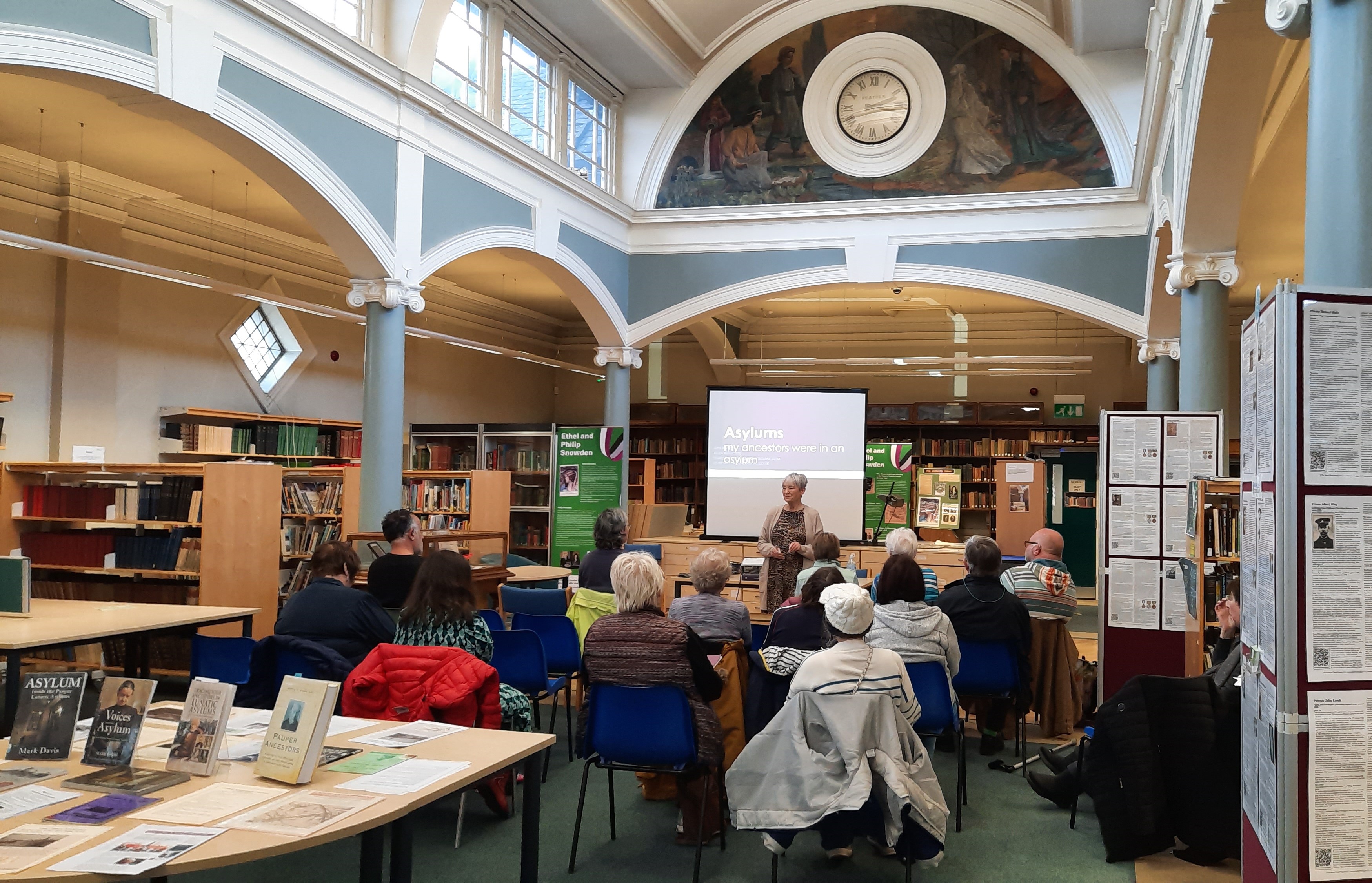
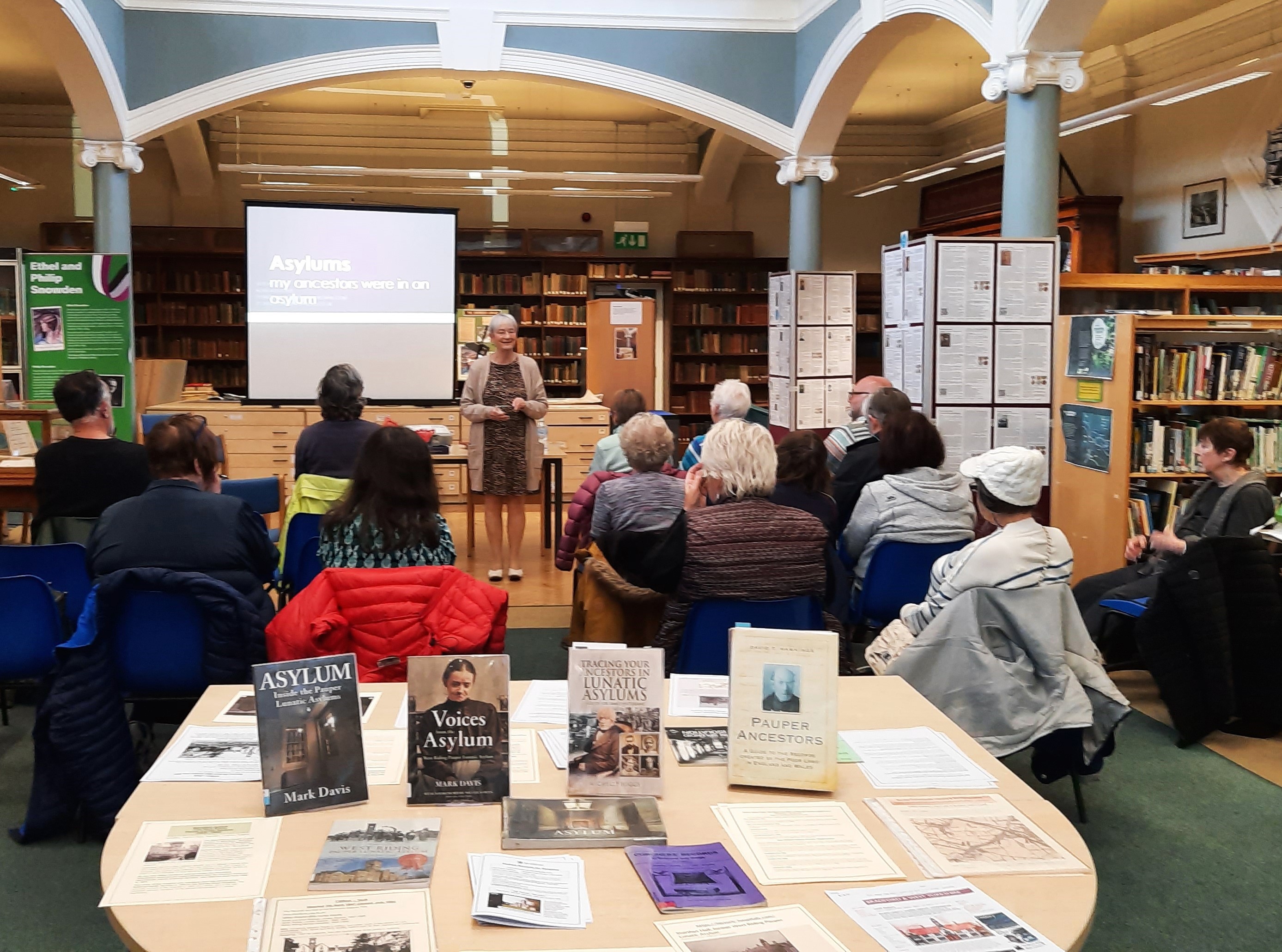
The first of a series of talks on family and local history topics was launched on Wednesday, 23rd October in Keighley Local Studies Library with Jude Rhodes as speaker. Jude is an Associate of the Association of Genealogists and Researchers in Archives (AGRA), specialising in Yorkshire history. She is “passionate about using local history with family history, this provides the exploration of who our ancestors were, why they lived in a particular place and how they were part of their community at a given time”.
The topic this time was Asylums, looking at their history, categories of patients, care provided and life in an asylum, followed by location and access to records. From the start the audience was advised that some of the terminology was difficult to hear and would never be used today but that these terms were mentioned to accurately depict the historical times and attitudes.
Jude began before Henry VIII and noted how monasteries and nunneries had been a support outside London which was the only place that actually had a hospital, Bethlem, later known as Bedlam. There were private “madhouses” but generally and for those of limited means, care for mental health would be entirely dependent on family and friends and this was the case under the old poor law, when the only alternative was the workhouse or prison. The Lunacy Act of 1845 under the new poor law stated that asylums, “Union Asylums”, had to be built but it wasn’t until the 1930s that asylums started to be called mental health institutes.
Historic categories were quite astonishing and could include: “refusal to pray”, “inability to feel pious”, “weeping”, “talking too much” (known as “excitement”) and even “hatred of spouse”. Syphilis was rife at this time, it ravaged the body but in time, the brain too and there were many innocents infected along the way. According to statistics, industrial areas, ports, the military and some mining towns were especially prone to the spread of this infection also known as “Ladies Disease” for women infected. Jude readily acknowledged the dangers of misdiagnosis in the past, with single pregnant women committed, menopausal women and those with post- natal depression, similarly those people with epilepsy or with bipolar and with dementia in old age. The early years after WW1 saw many former soldiers admitted with the effects of shell shock. It was also agreed during the discussion with the audience after the talk that many people in less supportive historical periods may have suffered circumstantial stress that if continuous had led to total breakdown in mental health.
However, Jude also pointed out the advances made at such as Wakefield’s Stanley Royd (1818-1995), formerly known as the West Riding Pauper Lunatic Asylum, that was one of the world’s most famous and active research institutions and led to global scientific changes in the treatment of the mentally ill. Its collection is held at Wakefield District Archives and there is a digital archive at www.wakefieldasylum.co.uk and an online tour at https://museumofthemind.org.uk . Similarly, Clifton in York (1847-1994), under the Medical Superintendent, Dr John Ivison Russell, pioneered in the field of occupational therapy. These larger institutions such as Menston (High Royds) were run as self-contained communities with their own farms, churches, cricket grounds and in Menston’s case, its own railway line connected to the Midland Railway to carry supplies, mainly coal for the boilers. Menston (1888-2003) site was 300 acres and opened with a capacity of 800 beds. There is a digital archive at www.highroydshospital.com and records are held at Wakefield District Archives.
Other local asylums include Scalebor Park, Burley in Wharfedale, a private asylum, and also with records at Wakefield Archives, with an illustrated history on the Burley Archive’s web site at https://burleycommunitylibrary.weekly.com and Storthes Hall, Kirkburton and you can find more about all the hospitals and see images at https://historic-hospitals.com .
Jude finally spoke about her own personal journey through the archives, having had a great grandfather who was an attendant at High Royds and a grandfather who was a also a patient. She now believes that her grandfather was admitted suffering from the effects of shell shock after the First World War that he never recovered from. Nevertheless, he was allowed to practice the organ and became the main organist for all weddings and funerals in Wakefield. He was also taken to the AGM of the Organist Society in London.
We would like to thank Jude for a very informative talk, handled well on a what is still today but especially as you look into its history, a complex and sensitive subject area. Library staff produced handouts and information sheets and if you would like to see them, please call into Keighley Local Studies library on the first floor of Keighley Library and ask for the file at the counter. We also have a small collection of books that cover the history of asylums and how to trace records for loan and for reference.
Our next events are listed below this blog, they are free as part of the 120 Year Celebrations of the free Keighley Carnegie Public Library (1904-2024), all welcome.
Jude Rhodes – History talks
storiesofourgenerations@gmail.com
Wednesday 13th November, 10.30am -12.30am
‘Back-to-back Housing and The Brigg Family, Keighley Mill Owners’
Wednesday 11th December, 2.15pm – 4.00pm
Family History & Christmas Crafts
Saturday 25th January 2025, 10.30am – 12.30pm
One place study with the Mechanics’ Institute as an example.
Saturday, 22nd February 2025, 10.30-12.30pm
‘The Workhouse’
Friday, 7th March 2025, 2.30-4.30pm
‘Nursing History’ (part of the International Women’s Week Celebrations)
Discover more from Bradford and District Local Studies
Subscribe to get the latest posts sent to your email.
